



Why the Carving on a Tibetan Gong Is Not Just Decoration
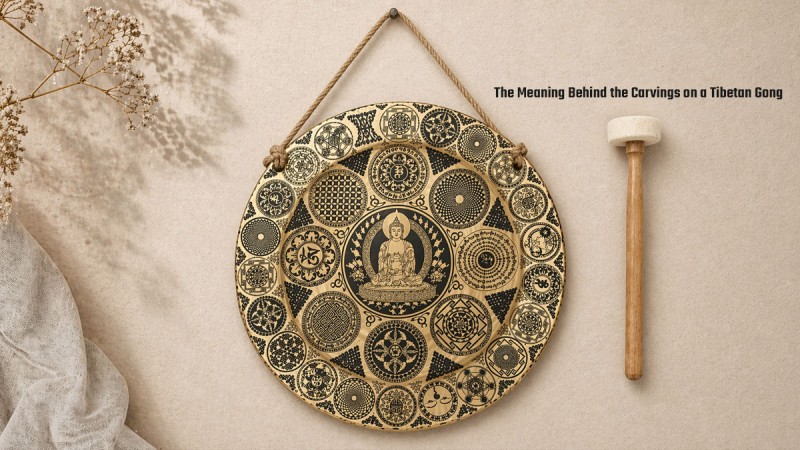
When you look at a handmade Tibetan gong from Nepal, the first thing most people notice is the carving. A seated Buddha. A coiling dragon. A goddess surrounded by lotus petals. Geometric patterns that seem to move the longer you look at them.
These are not decorative choices made by a designer in a factory. Every symbol carved into an authentic Tibetan gong from Kathmandu carries a specific meaning — spiritual, energetic, and protective — that has been understood and honoured in Himalayan tradition for centuries. The artisan who carves a Green Tara into the face of a gong is not making an artistic decision. They are invoking a particular energy into the instrument itself.
This matters practically, not just philosophically. When you choose a Tibetan gong for your home, healing practice, studio, or as a gift, the carving is telling you something specific about what that instrument carries and what kind of energy it amplifies when played. Understanding the symbols helps you choose the gong that is genuinely aligned with your intention — not just the one that looks most beautiful, though many of these are strikingly beautiful too.
Below is a complete guide to every carving found on the handmade Tibetan gongs in the Dharma Tool collection — what each symbol means, where it comes from, and what it brings to a practice or a space.
The Buddha — Compassion, Awakening and Inner Peace
The image of the seated Buddha is the most recognised symbol in all of Himalayan spiritual art. In the context of a Tibetan gong, the Buddha carving represents the possibility of awakening — the understanding that peace and clarity are not things to be acquired from outside but recognised from within.
The seated posture itself communicates stillness and stability. The hands are typically shown in one of several mudras — symbolic gestures that carry their own meaning. The earth-touching mudra (right hand reaching toward the ground) represents the moment of enlightenment. The meditation mudra (hands resting in the lap) represents deep inward stillness. The teaching mudra (hand raised, palm outward) represents the transmission of wisdom.
A Tibetan gong bearing the Buddha carving is traditionally considered appropriate for meditation spaces, healing rooms, temples, and any environment where the intention is clarity, peace, and the cultivation of presence. When struck, the understanding is that the Buddha's energy is carried outward in the vibration — not as a religious claim, but as a concentrated intention set into the instrument at the moment of its making.
✦ Handmade in Nepal · Sacred Carving
Buddha Carved Tibetan Gong
Hand-forged from seven sacred metals and carved with the seated Buddha. For meditation rooms, healing spaces, and those drawn to the energy of awakening and stillness.
View Buddha Carved Gong →Buddha Shakti — The Union of Wisdom and Energy
The Buddha Shakti carving takes the Buddha symbol a step further — combining the seated Buddha with Shakti, the feminine principle of divine energy and creative power. In Himalayan philosophy, wisdom (represented by Buddha) and energy (represented by Shakti) are understood as two aspects of a single reality. Neither is complete without the other. Wisdom without energy is inert. Energy without wisdom is directionless.
A gong bearing this carving is considered particularly powerful for practitioners working at the intersection of meditation and active healing — sound therapists, yoga teachers, energy workers — where both stillness and vitality are called upon in the same session.
✦ Wisdom & Energy · Mantra Carved
Buddha Shakti Himalayan Gong
A master-crafted temple gong combining Buddha and Shakti carvings with sacred mantra. For practitioners who work with both stillness and active healing energy.
View Buddha Shakti Gong →Green Tara — Protection, Compassion and Swift Action
Green Tara is one of the most beloved figures in Tibetan Buddhism — a goddess of compassion and liberation who is said to respond to prayers and suffering with immediate action. Unlike many deities depicted in deep meditation, Tara is shown with one leg slightly extended, ready to rise. She does not wait. She acts.
Green specifically is the colour of active compassion and protection in Tibetan iconography. Green Tara is the most energetically dynamic of the 21 Taras, associated with swift protection from fear, obstacles, and harm. She is also the patron deity of Tibet itself.
A Tibetan gong carved with Green Tara is traditionally used in spaces where protection and healing are the primary intention — hospice work, therapy rooms, spaces used for grief support, or any environment where people arrive carrying fear or pain. The gong does not just produce sound. It is understood to carry Tara's vow of protection into every vibration.
This is also a deeply meaningful gift for someone going through difficulty — illness, loss, transition, or a period of fear. The symbol carries a message that is both ancient and immediate: you are not alone, and something compassionate is moving toward you.
✦ Protection · Compassion · Healing
Green Tara Carved Tibetan Gong
Hand-carved with Green Tara, the goddess of swift compassion and protection. A powerful choice for healing rooms and a meaningful gift for someone in difficulty.
View Green Tara Gong →The Dragon — Strength, Transformation and Elemental Power
In Himalayan and East Asian spiritual traditions, the dragon is not a creature of fear or destruction. It is one of the most auspicious symbols in existence — representing elemental power, transformation, good fortune, and the mastery of natural forces. The Tibetan dragon specifically is associated with wind, clouds, and the movement of energy through space.
A dragon carved into a Tibetan gong brings an energy of strength and vitality to the instrument. Where a Buddha gong calls in stillness and a Tara gong invokes compassion, a dragon gong brings power — not aggressive power, but the natural, elemental kind. The kind that clears a room, shifts stagnant energy, and wakes things up.
Dragon gongs are particularly favoured by sound healers working with groups, by practitioners who feel their space needs energetic clearing, and by those drawn to the idea of transformation — the dragon as an image of something that moves through fire and comes out changed.
✦ Strength · Transformation · Power
Dragon Etched Tibetan Gong
Hand-etched with the Himalayan dragon — symbol of elemental power, transformation, and auspicious energy. For those who want a gong with vitality and presence.
View Dragon Etched Gong →The Flower of Life — Sacred Geometry and Universal Connection
The Flower of Life is one of the oldest and most widely recognised sacred geometry patterns in human history — found carved into stone in temples across Egypt, India, China, and the Middle East, some dating back over 6,000 years. It consists of overlapping circles arranged in a precise geometric pattern that, when extended, generates every other sacred geometry form including the Seed of Life, the Fruit of Life, and the Metatron's Cube.
In its most basic meaning, the Flower of Life represents the interconnectedness of all living things — the idea that every individual form is part of a larger pattern, and that at the level of geometry, everything is made of the same underlying structure.
A Tibetan gong bearing the Flower of Life is considered one of the most universally applicable symbols — it carries no single religious tradition's energy exclusively, making it deeply appropriate for practitioners who work with people of diverse backgrounds and beliefs. It is also one of the most visually striking carvings available, making it a natural choice for a studio centrepiece or a gift of genuine beauty and meaning.
✦ Sacred Geometry · Universal · Timeless
Flower of Life Tibetan Gong
One of the most ancient and universally recognised sacred geometry patterns, hand-carved into a seven-metal Himalayan gong. A studio centrepiece and a deeply meaningful gift.
View Flower of Life Gong →OM — The Sound Beneath All Sound
OM (also written Aum) is the primordial sound of the universe in both Hindu and Buddhist cosmology — the vibration from which, according to these traditions, all other vibrations arise. It is simultaneously the most abstract and the most concrete of all sacred symbols: abstract because it points to something beyond language or form, concrete because it is itself a sound that the practitioner produces with their own body.
The OM symbol carved into a Tibetan gong creates a direct relationship between the instrument's vibration and this foundational concept. When the gong is struck, the understanding is that its resonance is an expression of that same primordial vibration — not metaphorically, but literally, in the sense that all sound is understood to be a manifestation of OM.
There are two versions of the OM carved gong in the Dharma Tool collection — the Tibetan OM, which uses the classical Tibetan script form of the symbol, and the Hindu OM, which uses the Devanagari script form more common in Indian traditions. Both carry the same essential meaning; the choice between them is a matter of personal connection to one tradition or the other.
✦ The Primordial Sound · Tibetan & Hindu
OM Carved Tibetan Gongs
Available in both Tibetan script and Hindu Devanagari forms. The most fundamental of all sacred symbols, carried in the vibration of every strike.
Tibetan OM Gong → Hindu OM Gong →The Endless Knot — Interconnection and Infinite Compassion
The Endless Knot — called Shrivasta in Sanskrit — is one of the Eight Auspicious Symbols of Tibetan Buddhism. It is a closed, interlaced pattern with no beginning and no end, representing the interdependence of all phenomena and the infinite compassion of the Buddha. It also symbolises the union of wisdom and method — the understanding that insight and compassionate action cannot be separated.
In a more accessible reading, the Endless Knot simply represents connection — the idea that nothing exists in isolation, that every person, event, and moment is woven into a larger pattern of cause and effect. For practitioners, this is not just a philosophical idea. It is a lived reality that the practice of meditation and sound healing continually reveals.
The Endless Knot gong is a thoughtful and understated choice — it does not carry the dramatic visual presence of a dragon or a deity, but its meaning is arguably the deepest of all the symbols. It is particularly meaningful as a gift for someone beginning a contemplative practice or navigating a period of feeling isolated or disconnected.
✦ One of the 8 Auspicious Symbols
Endless Knot Tibetan Gong
The Shrivasta — symbol of infinite compassion, interconnection, and the union of wisdom and method. An understated and deeply meaningful choice.
View Endless Knot Gong →The Conch Shell — Awakening, Proclamation and Dharma
The conch shell is another of the Eight Auspicious Symbols — and one of the most ancient instruments of sacred sound in human history, used across Hindu, Buddhist, and indigenous traditions from Nepal to the Pacific Islands. In Tibetan Buddhism, the white conch shell whose spiral opens to the right is considered particularly auspicious, symbolising the proclamation of the Dharma — the awakening call that cuts through the noise of ordinary thinking and reminds beings of their true nature.
The conch carved into a Tibetan gong creates a beautiful layering of sound symbolism — the image of one ancient sound instrument etched into another. It is an especially fitting choice for sound healers and practitioners who understand their work as a form of awakening — not just relaxation, but the invitation to remember something essential.
✦ The Awakening Call · Sacred Sound
Tibetan Conch Carved Gong
The conch shell — symbol of the Dharma and the proclamation of awakening — carved into a handmade seven-metal Himalayan gong. For sound healers and contemplative practitioners.
View Conch Carved Gong →Chakra and Yogi Carvings — The Energy Body and the Practice
The chakra yogi carvings depict the human energy system in its meditative form — a figure seated in meditation with the seven chakra centres indicated along the central axis of the body. This is a direct representation of what the gong's vibration is understood to work upon: the energetic anatomy of the person playing or receiving the sound.
This carving is particularly clear in its intention. It is not symbolic in an abstract sense — it is a literal map of the practice. The gong bearing this image is one made specifically for chakra healing and sound therapy work. Some versions of this gong also incorporate the Eight Lucky Symbols of Tibetan Buddhism alongside the chakra imagery, creating a layered field of auspicious intention.
✦ For Chakra Healing · Sound Therapy
Chakra Yogi Carved Tibetan Gongs
A direct map of the human energy body in meditative form. Made specifically for chakra healing and sound therapy practitioners.
Chakra Yogi Gong → 8 Lucky Symbols Version →The Tree of Life — Growth, Rootedness and Continuity
The Tree of Life is one of the most universal symbols across human cultures — appearing in Norse, Celtic, Hindu, Buddhist, Kabbalistic, and indigenous traditions worldwide. Its meaning is consistent across all of them: the tree whose roots reach deep into the earth and whose branches reach toward the sky represents the axis between the earthly and the divine, the continuity of life across generations, and the nourishment that flows from being genuinely rooted.
In the context of a Tibetan gong, the Tree of Life carving grounds the instrument's energy in something natural and enduring. It is a particularly appropriate choice for practitioners who want their healing space to feel rooted and stable — and for those who work with themes of growth, healing across generations, or the importance of staying connected to one's origins.
✦ Universal Symbol · Grounded Energy
Tree of Life Carved Tibetan Gong
One of the most universal symbols across all human traditions — roots deep, branches wide. For spaces and practices built on stability, growth, and genuine rootedness.
View Tree of Life Gong →Yin Yang — Balance, Duality and the Dance of Opposites
The Yin Yang symbol — the circle divided into dark and light halves, each containing a seed of the other — is one of the most recognisable symbols in the world. Its origin is Taoist, but its meaning has been absorbed into broader Asian philosophical and spiritual traditions including those of Nepal and Tibet.
The Yin Yang represents the understanding that all apparent opposites — light and dark, activity and rest, masculine and feminine, expansion and contraction — are not truly separate but are aspects of a single dynamic whole. One cannot exist without the other. Each carries the seed of the other within it. The circle moves — it is not a static balance but a living, turning relationship between complementary forces.
The Yin Yang Tree Tibetan Gong at Dharma Tool combines this symbol with the Tree of Life, creating a carving that holds both the universal and the dynamic — rootedness and balance together.
✦ Balance · Harmony · Duality
Yin Yang Tree Tibetan Gong
Yin Yang and Tree of Life combined — balance and rootedness held in a single carving. For spaces and practices dedicated to harmony between opposites.
View Yin Yang Tree Gong →Mantra and Mandala Carvings — Sacred Text and Cosmic Pattern
Several gongs in the collection carry mantra carvings — sacred text inscribed around the face of the gong in Tibetan or Sanskrit script. The most common is Om Mani Padme Hum, the six-syllable mantra of Avalokiteshvara, the bodhisattva of compassion. Each syllable is understood to purify a different aspect of existence and to invoke a different quality of awareness.
The Mandala carving adds a further dimension — a sacred geometric diagram representing the cosmos and the mind in their ordered, complete form. Mandalas have been used in Tibetan Buddhist practice for centuries as objects of visualisation and meditation. A gong bearing both mantra and mandala carries an unusually concentrated field of intention.
✦ Sacred Text · Cosmic Geometry
Mantra & Mandala Carved Tibetan Gongs
Om Mani Padme Hum and sacred mandala geometry — the mantra of compassion carried in every vibration. Available in mantra carved and mandala mantra versions.
Mantra Carved Gong → Mantra Mandala Gong →How to Choose a Tibetan Gong by Its Carving
Now that you understand what each symbol carries, here is a simple way to approach the choice:
If you are drawn to stillness, meditation, and inner clarity — the Buddha or OM carved gong is the most aligned choice. If your practice or work centres on compassion, healing, and supporting others through difficulty — Green Tara is the natural answer. If you work with groups, need energetic clearing, or want a gong with presence and vitality — the Dragon or Flower of Life gong brings that quality. If you want something universally accessible that works across traditions and with people of diverse backgrounds — the Flower of Life or Endless Knot. If balance, harmony, and the dance between opposites is your core theme — the Yin Yang Tree. If you are a sound healer or yoga teacher whose work is specifically chakra-based — the Chakra Yogi gong is made for you.
And if none of these quite fits — or if you want a symbol that is entirely personal to you — Dharma Tool offers a custom engraved gong service where you choose the symbol, deity, or design that carries the meaning you want the instrument to hold.
✦ Handmade in Nepal · Healer Selected · DHL Express Delivery
Find Your Tibetan Gong
Every Tibetan gong in our collection is hand-forged from seven sacred metals and hand-carved by skilled artisans in Kathmandu. Browse the full collection or design your own with a custom symbol, size, and engraving.
Browse All Tibetan Gongs → Design a Custom Gong →Frequently Asked Questions
Does the carving on a Tibetan gong affect its sound?
The carving itself does not change the acoustic properties of the gong — the sound is determined by the metal alloy, size, thickness, and hammering technique. What the carving carries is energetic and intentional. In Himalayan tradition, the act of carving a sacred symbol into metal is understood to imbue the object with the quality and energy of that symbol. Whether or not you hold this belief, the carving gives the instrument a specific identity and focus that shapes how it is used and what it means to the person who owns it.
Do I need to follow a specific tradition to use a carved Tibetan gong?
No. The symbols on these gongs come from Tibetan Buddhist and Hindu traditions, but they are used by practitioners of all backgrounds and beliefs worldwide. Many people are drawn to a particular symbol simply because of its meaning or visual beauty, without any affiliation to the tradition it comes from. The gong works through sound and vibration regardless of the carving — the symbol adds a layer of intention and meaning that you can engage with as deeply or as lightly as feels right to you.
Which carved Tibetan gong is best for a meditation room?
For a meditation room, the Buddha carved gong, the OM carved gong, or the Mantra carved gong are the most traditionally aligned choices. All three carry energy specifically associated with stillness, presence, and the cultivation of inner clarity. The Flower of Life is also an excellent choice if you want a symbol that is universally meaningful without being specific to one tradition.
Which carved Tibetan gong makes the best gift?
The Green Tara gong makes a deeply meaningful gift for someone going through difficulty or transition — its meaning (swift compassion, protection, action toward healing) speaks directly to someone who needs support. The Endless Knot is a beautiful gift for someone beginning a contemplative practice. The Flower of Life works for almost anyone. If you want something truly personalised, the custom engraved gong lets you choose a symbol that carries specific personal meaning.
What is the difference between the Tibetan OM and Hindu OM gong?
Both carry the same fundamental meaning — OM as the primordial sound of the universe. The difference is purely in the script: the Tibetan OM gong uses the classical Tibetan script form of the symbol, while the Hindu OM gong uses the Devanagari form more common in Indian traditions. The choice is one of personal connection — which script feels more resonant with your practice or background.
Are all the gongs in the Dharma Tool collection genuinely handmade?
Yes. Every Tibetan gong in our collection is hand-forged from a seven-metal alloy by experienced artisans in Kathmandu, Nepal, using traditional Himalayan metalworking techniques. The carvings are applied by hand, not machine-stamped. Each gong is unique — slight variations in tone, surface, and carving depth are a natural result of authentic handcraft rather than a defect.