




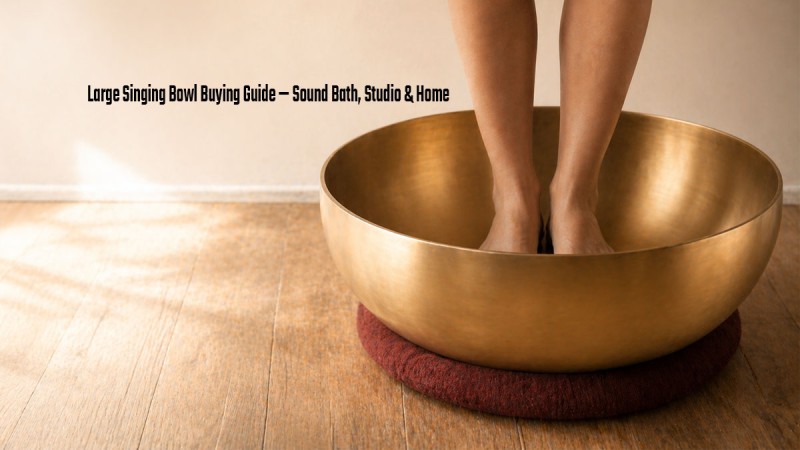
The Moment You Strike a Large Singing Bowl the Room Changes
There is a threshold in singing bowl practice — a point where the experience shifts from pleasant to profound. Most people cross that threshold the first time they hear a genuinely large singing bowl struck in a real space. Not a recording. Not a small bowl through a phone speaker. The actual instrument, in an actual room, producing a wave of sound and vibration that moves through the air, through the floor, through the body itself.
This is what a large singing bowl — 15 inches in diameter and above — does that no smaller instrument can replicate. It does not merely produce sound. It fills space. It moves air. It vibrates surfaces. It produces physical frequencies low enough to be felt in the chest, the abdomen, the legs. Sound healers, yoga teachers, therapists and studio practitioners who have experienced this understand immediately why serious practitioners invest in a large bowl. Those who have not yet experienced it are reading the right guide.
This guide covers everything you need to make a confident, informed decision — what large singing bowls are, how sizes from 15 to 22 inches differ in practice, which size suits which setting, what the carved designs mean, why Nepal-made bowls sound different from anything produced elsewhere, and how to choose the right bowl for your specific use — whether that is a sound bath studio, a yoga space, a therapy practice, or a dedicated home healing room.
What Counts as a Large Singing Bowl — Defining the Category
In the Himalayan singing bowl tradition, bowls are not categorised strictly by size — they are categorised by their function, their acoustic character, and the experience they create. But for practical purposes, a large singing bowl begins at 15 inches in diameter. Below this threshold, bowls produce increasingly rich and personal sound — excellent for individual meditation, chakra work, and one-to-one therapy. Above it, the physics of the instrument changes fundamentally.
A 15-inch or larger bowl has a surface area, wall mass and resonance chamber large enough to produce frequencies in the lowest range of the human hearing spectrum — frequencies that are not only heard but physically felt. The vibration of a 20-inch bowl struck with a heavy felt mallet does not merely travel through air. It travels through the floor, through the walls, through the body of anyone in the room. This is not a metaphor. It is acoustics. The larger the resonating surface, the lower the fundamental frequency — and the more completely that frequency is experienced as a full-body physical event rather than merely an auditory one.
This is why large singing bowls — 15 inches and above — are the instruments of choice for professional sound baths, group meditation sessions, yoga studios, sound healing therapy rooms, and any context where the practitioner needs their instrument to reach and affect multiple people across a significant space simultaneously.
The Four Sizes — What Each One Does in Practice
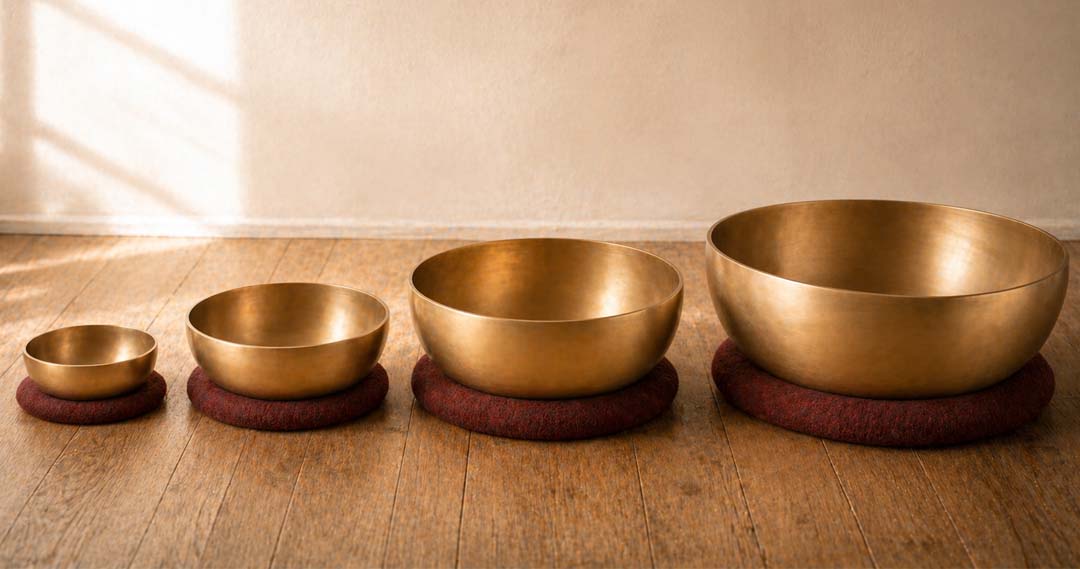
Dharma Tool's large singing bowl collection runs from 16 inches to 22 inches in diameter — each size producing a meaningfully different acoustic and physical experience. Understanding these differences before choosing is the single most important step in selecting the right bowl for your practice.
| Size | Best For | Room Coverage | Physical Vibration | Weight |
|---|---|---|---|---|
| 16 inch | Home healing room, small studio, one-to-one therapy | Up to 25 sqm | Strong — felt clearly by anyone in the room | Approx 6–7 kg |
| 18 inch | Yoga studio, medium group sound bath, therapy centre | 25–50 sqm | Very strong — fills the body from feet to head | Approx 8–10 kg |
| 20 inch | Large studio, group sessions up to 20 people, retreat space | 50–80 sqm | Exceptional — felt as full body physical event | Approx 11–12 kg |
| 22 inch | Large retreat hall, professional sound bath, ceremonial use | 80 sqm+ | Maximum — room-filling vibration, standing inside the bowl possible | 13.5 kg |
16 Inch — The Professional Entry Point
The 16-inch bowl is the starting point of the large singing bowl category and the most practical choice for practitioners who are adding their first genuinely large instrument to an existing collection. It is large enough to fill a dedicated home healing room or small therapy space with substantial sound — producing a fundamental tone low enough to be felt physically by anyone seated or lying within the room — while remaining manageable for solo transport and setup. For yoga teachers who practice in small to medium studios, the 16-inch bowl provides the full-body resonance that elevates a sound bath from pleasant background sound to a transformative physical experience.
18 Inch — The Professional Standard
The 18-inch bowl is the instrument most experienced sound healers choose as their primary large bowl. It covers the acoustic range of a medium yoga studio or therapy centre completely — producing a tone that fills the room without overwhelming it, physical vibration that every participant in a group session feels simultaneously, and a sustain long enough to allow the full resonance to develop before the next strike. At 8 to 10 kilograms, it is the heaviest bowl that most practitioners can comfortably move and set up alone. The 18-inch bowl in the Dharma Tool collection represents the strongest combination of acoustic reach, physical impact and practical usability across the widest range of professional contexts.
20 Inch — Large Group and Retreat Use
The 20-inch bowl enters territory where the instrument becomes the centrepiece of the space rather than one element within it. At this size, the bowl's fundamental frequency is felt from the moment it is struck as a physical wave moving through the room — participants lying in savasana will feel it through the floor before they consciously register the sound. The 20-inch bowl is suited to retreat spaces, large group meditation sessions, and any context where the practitioner wants the sound to completely envelop the participants. It is not a bowl for intimate one-to-one work. It is an instrument of space — designed to fill large rooms with deep, sustained, room-transforming vibration.
22 Inch — The Ceremonial and Professional Peak
The 22-inch bowl is the largest in the Dharma Tool collection — and one of the most significant instruments in the entire Himalayan singing bowl tradition. At 13.5 kilograms and 54 centimetres across, it is large enough for a practitioner to stand inside it and receive the vibration through the soles of the feet — a traditional healing practice that delivers the bowl's acoustic vibration directly into the body from the ground up. The 22-inch bowl produces the deepest fundamental tone of any instrument in the collection — a frequency so low and so sustained that it is experienced less as a sound than as a presence. For professional sound healers running large-format sound baths, retreat facilitators, and practitioners working with ceremonial or temple-scale sound, the 22-inch bowl is the instrument that closes sessions, anchors spaces, and creates the quality of stillness that participants carry with them for days after. Browse the full extra large standing singing bowl collection to see all available designs and sizes.
Dharma Tool's complete large singing bowl collection — hand-forged in Kathmandu, shipped worldwide
Every large singing bowl in the Dharma Tool collection is hand-forged in Nepal from the traditional seven-metal alloy by skilled artisans in Thamel, Kathmandu. Available in 16, 18, 20 and 22-inch diameters with a choice of sacred designs — from plain shining finish to Shiva Nataraja, Buddha Foot, Shree Yantra, Yin Yang, Tree of Life, Flower of Life and more. DHL express worldwide delivery direct from Nepal.
Choosing by Setting — Sound Bath, Studio or Home Practice
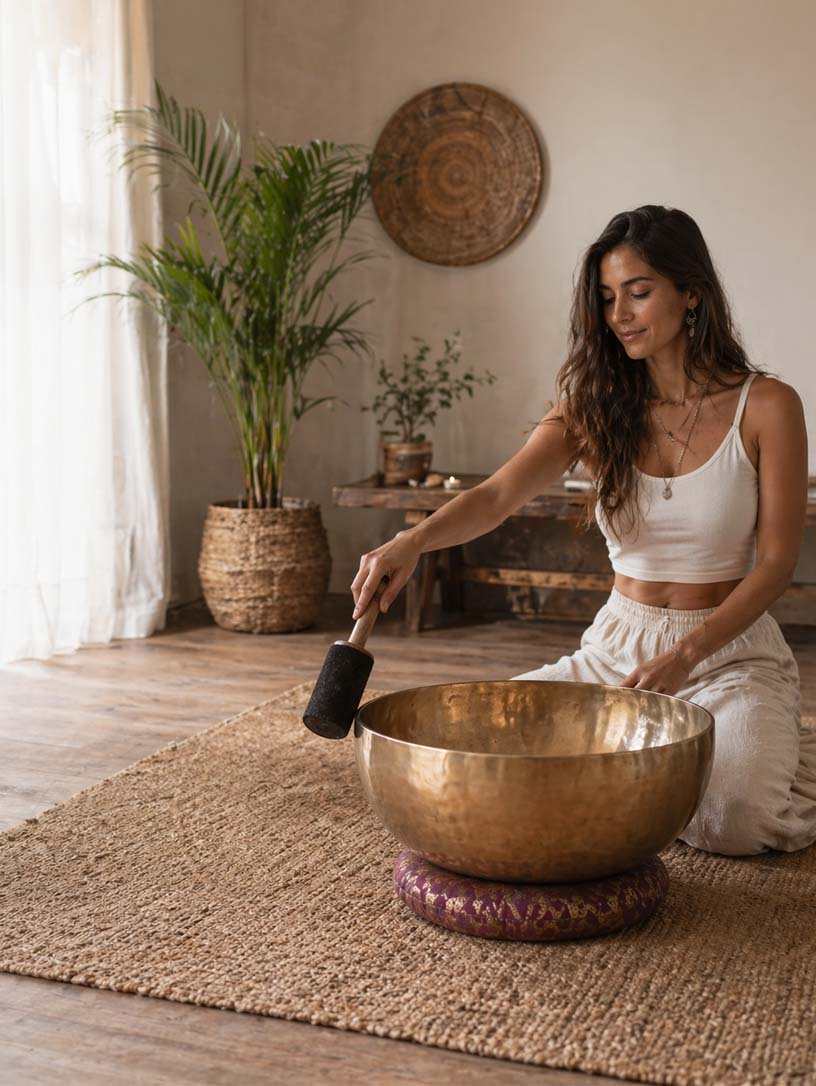
The most practical way to choose a large singing bowl is to start with your specific setting — the physical space where the bowl will be used and the number of people it needs to reach. Each context has different requirements, and matching the bowl to the setting before considering any other factor produces the best result.
For a Professional Sound Bath Studio
A dedicated sound bath studio — where participants lie on mats across a significant floor area while the practitioner creates an immersive sound environment — requires a bowl that produces enough acoustic energy to fill the entire room and enough physical vibration for every participant to feel it simultaneously. For studios up to 50 square metres, the 18-inch bowl is the strongest single choice. For larger studios or retreat halls, the 20 or 22-inch bowl provides the additional acoustic reach and physical intensity that large group sessions require.
For a professional sound bath setup, the large bowl typically serves as the anchor instrument — the deepest, most grounding element of a layered sound environment that may also include smaller bowls, tingshas, gongs and other instruments. The large bowl is usually struck at the opening of the session to set the frequency of the space, at key transition points during the session, and at the close to signal the return to ordinary awareness. Its role is not to play constantly but to define the acoustic territory within which everything else occurs.
For a Yoga Studio
Yoga teachers who use singing bowls in their practice — particularly for savasana and restorative classes — typically need a bowl that fills the studio completely without overwhelming the acoustic environment during active asana practice. The 16 or 18-inch bowl is the natural choice for most yoga studio applications, depending on room size. The 16-inch is ideal for studios of 25 square metres or under — intimate spaces where a smaller group practices. The 18-inch suits the more typical studio of 30 to 50 square metres where ten to twenty students practice simultaneously.
For yoga teachers who want to incorporate the bowl into the full arc of a class rather than only in savasana, the 16-inch is more versatile — its slightly higher fundamental tone sits more comfortably in the acoustic space during the active parts of practice. The 18-inch, with its deeper, more penetrating vibration, is most powerful when the entire class is already still and receptive.
For a Therapy or Healing Practice
Sound healers, Reiki practitioners, massage therapists and holistic health professionals working in one-to-one or small group settings have different requirements from studio practitioners. The therapeutic application of a large bowl in an individual session — placed near the body, used for vibroacoustic work, or used to anchor a client's nervous system at the opening and close of a session — does not require the acoustic reach of a 20 or 22-inch bowl. The 16-inch bowl is the most practical choice for therapy room applications, providing more than sufficient physical vibration for individual body work while remaining manageable in a smaller clinical or healing space. For deeper one-to-one therapeutic work, many practitioners also use a head therapy singing bowl alongside their large standing bowl.
For a Dedicated Home Practice
Serious home practitioners — those who maintain a dedicated meditation or healing room and want a large bowl as the centrepiece of their personal practice space — have the widest range of appropriate choices. A 16-inch bowl is large enough to completely transform the acoustic quality of any home meditation room and to produce meaningful physical vibration that deepens a solo practice. The 18-inch, for those with a larger dedicated space, provides the full professional-grade experience at home. The choice ultimately comes down to the size of the space and the depth of physical vibration the practitioner wants to experience in personal practice.
The Carved Designs — What They Mean and How to Choose
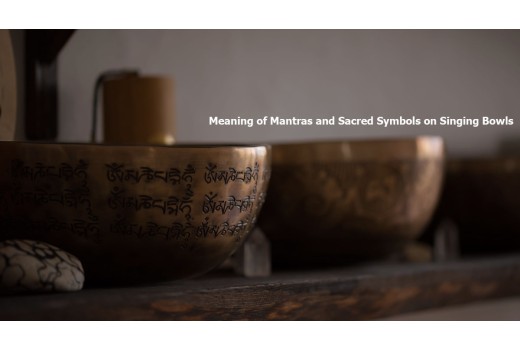
Every large singing bowl in the Dharma Tool collection is available in a range of hand-engraved and carved designs. These are not decorative extras — each design carries specific symbolic meaning rooted in the Himalayan spiritual tradition from which these instruments come. Understanding what each design represents helps practitioners choose a bowl whose symbolic character aligns with their healing intention. You can also explore the broader mantra carved singing bowl collection for smaller carved instruments across all sizes.
Buddha Foot (Buddha Pada)
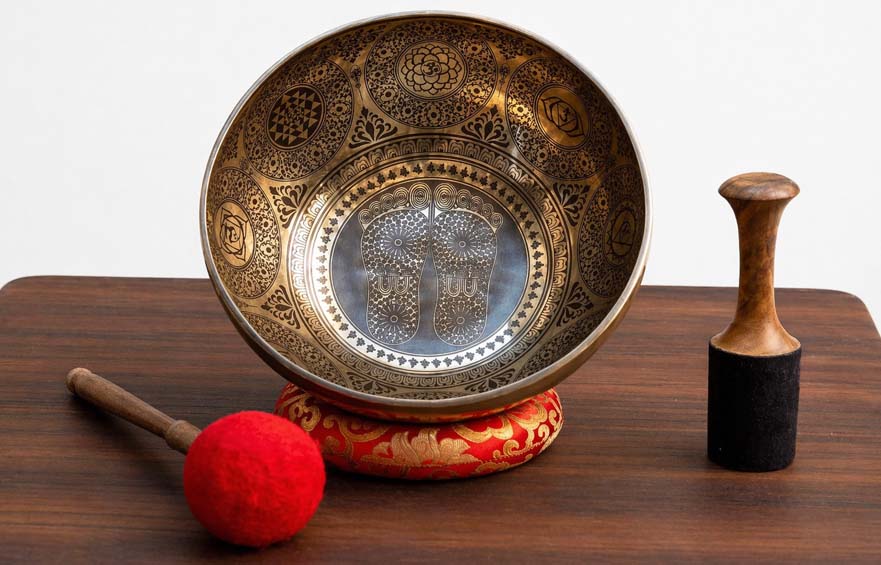
The Buddha Foot — or Buddha Pada — is one of the most sacred symbols in the Himalayan and Buddhist tradition. The footprint of the Buddha represents his physical presence on earth, his accessibility to all beings, and his enduring teachings that outlast the physical body. In the context of a large singing bowl, the Buddha Foot carving inside the base of the bowl is also a practical feature: the bowl is large enough to stand inside, and standing on the carved foot symbol is understood as standing in the energetic presence and protection of the Buddha's teaching. Practitioners who work with grounding, embodiment and the integration of spiritual practice into physical life consistently choose the Buddha Foot bowl. It is the most frequently chosen design among sound healers working with large format bowls.
Shiva Nataraja with Shree Yantra and Om
The Shiva Nataraja bowl carries the image of Lord Shiva as the cosmic dancer — the deity of transformation, creation, dissolution and renewal. Nataraja's dance represents the eternal rhythm of the universe: the continuous arising and passing of all phenomena. The Shree Yantra — the sacred geometric pattern of intersecting triangles that represents the union of masculine and feminine cosmic forces — appears alongside the Om symbol, the primordial sound of creation. This is the most symbolically complex of the large bowl designs and is chosen by practitioners working with transformation, the dissolution of old patterns, and the opening of new phases of life or practice. The combination of these three sacred elements — Nataraja, Shree Yantra, and Om — makes this bowl particularly appropriate for ceremonial and retreat contexts.
Yin Yang with Flower of Life
The Yin Yang design speaks to the balance of complementary forces — masculine and feminine, expansion and contraction, dark and light — and the Flower of Life adds the sacred geometry of creation and universal interconnection. Practitioners who work with polarity integration, relationship healing, and the balancing of energetic opposites choose this design. The Flower of Life base engraving is also associated with cellular healing — the geometric pattern that appears at the foundation of biological structure from the microscopic to the cosmic.
Shree Yantra Carved
The Shree Yantra is one of the most powerful sacred geometric symbols in the Hindu and Tantric tradition — a pattern of nine interlocking triangles that represents the cosmos and the human body simultaneously. It is associated with abundance, alignment with universal order, and the activation of the highest potential within a being or a space. Sound healers who use their large bowl to work with manifestation practices, abundance work, and the clearing of energetic obstacles in a space frequently choose this design.
Tree of Life with Yin Yang Centre
The Tree of Life is a universal symbol appearing across Himalayan, Celtic, Jewish, and many other spiritual traditions — representing the interconnection of all life, the relationship between earthly and heavenly realms, and the strength that comes from deep roots. The Yin Yang centre brings balance to the expansive Tree of Life energy. This design is chosen by practitioners working with nature connection, ancestral healing, and the grounding of spiritual experience into the physical world.
Plain Shining Finish and Extra Large Full Moon
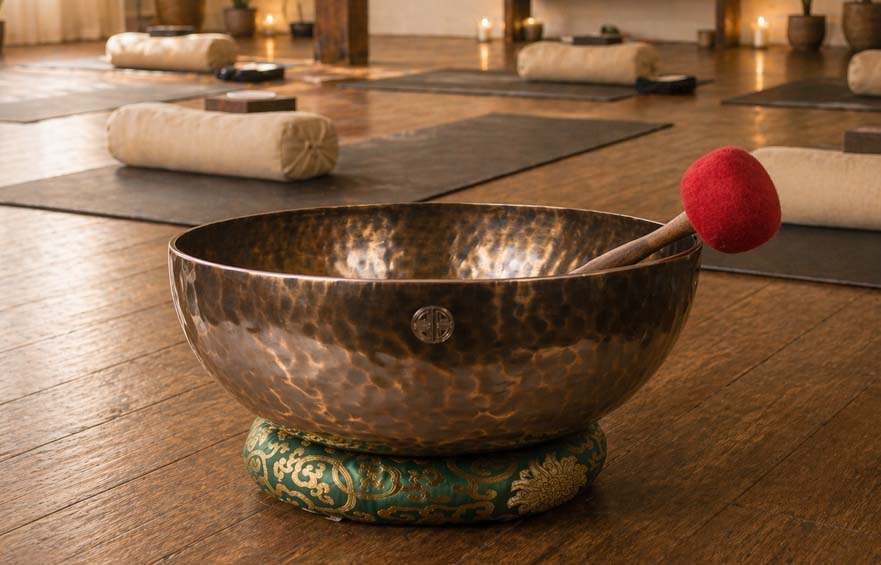
For practitioners who prefer a bowl that speaks through sound alone without symbolic layering, the plain shining finish large bowl and the Extra Large Full Moon Giant Bowl offer the purest acoustic experience within the large bowl category. The Full Moon version — forged during Purnima under the lunar energy of the full moon night — adds the additional dimension of traditional Himalayan ceremonial intention to the instrument without the visual complexity of carved design. Many experienced practitioners prefer this simplicity — the bowl's function expressed through sound and vibration alone, with no visual narrative to interpret.
Buddha Foot Engraved Large Singing Bowl — 7 Chakras and Shree Yantra — handmade in Nepal
The Buddha Foot Engraved Large Singing Bowl by Dharma Tool features the sacred Buddha Pada at the centre, surrounded by 7 Chakra symbols and the Shree Yantra — hand-engraved by skilled artisans in Kathmandu. Available in 16, 18, 20 and 22-inch diameters. The 22-inch version is large enough to stand inside for full-body sound therapy. Worldwide DHL delivery direct from Nepal.
Why Nepal-Made Large Singing Bowls Sound Different
This is the question that matters most for serious practitioners — and the one that most online content fails to answer honestly. There is a significant difference between a large singing bowl made in Nepal by skilled traditional artisans and a large bowl produced elsewhere by machine pressing or low-skill casting. Understanding this difference is essential for making an investment at the scale that a large singing bowl represents.
The Seven-Metal Alloy
Traditional Himalayan singing bowls are forged from an alloy of seven metals — gold, silver, copper, iron, tin, lead and zinc — each metal associated with a celestial body in Vedic cosmology and contributing a specific acoustic property to the finished instrument. The precise ratios of these metals, and the way they interact during the hand-forging process, produce the characteristic harmonic complexity of a quality Himalayan bowl — the layered overtones that evolve during sustain, the physical vibration that carries through air and tissue, and the tonal warmth that distinguishes a genuine instrument from a mass-produced approximation. You can read more about the seven metals in a singing bowl and what each contributes to the sound.
Large bowls require significantly more metal than smaller instruments — and the skill required to forge a uniform, acoustically consistent 20 or 22-inch bowl from this complex alloy is considerably greater than for smaller sizes. This is why large Himalayan singing bowls are rarer and more expensive than their smaller counterparts, and why the quality differential between skilled-artisan and mass-produced instruments is most pronounced at large sizes.
Hand-Hammering at Scale
Every bowl in the Dharma Tool large collection is hand-hammered — shaped through hundreds of individual hammer strikes on heated metal by artisans who have spent years developing the skill to produce consistent, acoustically rich results at large scale. Each hammer strike introduces a slight, unique irregularity into the metal's crystalline structure. These irregularities accumulate across the many strikes required to shape a large bowl, producing an instrument with dozens of simultaneous overtones rather than the simple, thin tone of a machine-pressed bowl.
It is precisely these hand-hammering irregularities that give a genuine Himalayan large bowl its acoustic power. The overtones are not mathematically predictable. They evolve continuously during sustain. The brain's auditory cortex cannot resolve them quickly — it keeps tracking, keeps engaging, keeps being surprised by the sound as it develops. This sustained acoustic engagement is what makes the difference between a pleasant sound and a genuinely transformative vibrational experience. And it is a quality that only genuine hand-hammering by skilled artisans can produce.
Selection and Healer Guidance
At Dharma Tool, every large singing bowl is individually assessed for tonal quality, resonance depth and physical vibration before it is made available. Large bowls — given their scale, their weight and their price — are not mass-catalogued. They are individually selected by a practitioner with direct experience of what quality in this category sounds and feels like. This is the difference between buying an instrument from a warehouse and buying one from a source that actually understands what the instrument needs to do.
Practical Considerations Before You Buy
A large singing bowl is a significant investment — in terms of cost, space, and the commitment to a practice that the instrument represents. The following practical considerations are worth thinking through before making your final decision.
- Space: A 22-inch bowl needs floor space. It should sit on a stable, level surface — ideally a firm cushion or a dedicated stand — with enough clearance on all sides for the mallet to move freely during playing. Measure your space before selecting a size.
- Weight and transport: The 22-inch bowl weighs 13.5 kilograms. The 20-inch weighs approximately 11 kilograms. If you need to transport your bowl between locations — between a studio and a retreat venue, for example — the 16 or 18-inch is more practical. The 20 and 22-inch bowls are better suited to practitioners who have a permanent space for the instrument.
- Mallet selection: Large bowls require large, heavy mallets — typically a felt-wrapped striking mallet of significant weight and a leather-wrapped wooden mallet for rim playing. Using an undersized mallet on a large bowl produces a weak, thin strike that does not activate the instrument's full resonance. The Dharma Tool large collection ships with appropriate mallets included.
- Single strike practice: Large bowls are not designed for continuous playing. The correct technique is a single, deliberate strike — full weight, slow and intentional — followed by complete sustain before the next strike. The interval between strikes on a 22-inch bowl should be at minimum 60 to 90 seconds, allowing the full resonance to develop, peak, and fade before the next activation. Practitioners who approach a large bowl with the same fast, repeated striking technique used for small bowls will not access the instrument's real capability.
- Positioning for sound baths: In a group sound bath setting, the large bowl should be positioned at the centre or front of the space — not at the periphery — so its vibration radiates equally through the room. Participants lying on the floor will receive the most direct physical vibration from the bowl through the shared surface. This is one of the reasons why professional sound bath practitioners specifically request large bowls: the floor conduction of vibration from a large bowl to participants lying flat is one of the most direct and powerful forms of vibroacoustic therapy available.
The Bowl That Defines the Space
Every serious sound healing practice reaches a point where a large bowl becomes not just useful but necessary. It is the instrument that can fill a room completely — not with noise, but with presence. That quality of presence — the sense that the space itself has changed, that the air is different, that something has shifted in the shared experience of everyone in the room — is what a genuinely large, genuinely handmade, genuinely well-chosen Himalayan singing bowl produces.
The artisans in Thamel, Kathmandu who forge these instruments by hand understand this. They are not making decorative objects or pleasant accessories. They are making instruments of a tradition that has used sound to transform the quality of human experience for a very long time. The size of these bowls is not ambition. It is necessity. Some spaces, some sessions, some moments of healing require an instrument large enough to meet them.
Choose the size that matches your space. Choose the design that matches your intention. And then trust the instrument to do what it was made to do.
Frequently Asked Questions
What size is considered a large singing bowl?
A large singing bowl begins at 15 inches in diameter. At this size and above, the bowl's surface area, wall mass and resonance chamber produce frequencies low enough to be felt physically rather than only heard — filling a room with vibration that reaches every person in the space. Dharma Tool's large singing bowl collection runs from 16 to 22 inches, with each size suited to different spaces and applications from home healing rooms to large professional retreat halls.
Which large singing bowl size is best for a sound bath?
For a professional sound bath studio up to 50 square metres, the 18-inch bowl is the strongest single choice — providing full room coverage, powerful physical vibration for all participants simultaneously, and a sustain long enough for genuine deep relaxation to develop. For larger studios or retreat halls of 50 to 80 square metres, the 20-inch bowl is more appropriate. The 22-inch bowl is ideal for large retreat halls, ceremonial spaces and professional sound baths with 20 or more participants.
What does the Buddha Foot carving on a large singing bowl mean?
The Buddha Foot — or Buddha Pada — represents the physical presence and enduring teachings of the Buddha on earth. In the context of a large singing bowl, the foot carving at the interior base of the bowl holds both symbolic and practical significance: the bowl is large enough to stand inside, and standing on the carved foot symbol connects the practitioner to the grounded, embodied wisdom of the Buddhist tradition. The Buddha Foot is the most frequently chosen design among sound healers working with large format bowls for grounding and full-body sound therapy.
Why do Nepal-made large singing bowls sound better than mass-produced ones?
Genuine Nepal-made large singing bowls are hand-forged from a traditional seven-metal alloy by artisans who develop their skill over years of dedicated practice. The hand-hammering process introduces unique irregularities into the metal's structure that produce dozens of simultaneous, evolving overtones — the acoustic complexity that gives the brain's auditory system something rich enough to sustain its engagement and produce genuine therapeutic effects. Mass-produced bowls are machine-pressed to uniform dimensions, producing simpler, thinner tones that lack this complexity. At large sizes, this quality difference is most pronounced — a 20-inch handmade Nepal bowl and a 20-inch machine-pressed bowl are not comparable instruments.
Can I stand inside a large singing bowl?
Yes — the 20 and 22-inch bowls in the Dharma Tool collection are large enough for most adults to stand inside, feet flat on the base of the bowl, while the bowl is played around the rim. This practice delivers the bowl's acoustic vibration directly through the soles of the feet into the entire body — one of the most direct forms of vibroacoustic sound therapy available. The Buddha Foot Engraved version of the 22-inch bowl is specifically designed for this use, with the sacred foot symbol carved at the interior base.
How is a large singing bowl different from a gong for sound healing?
A large singing bowl and a Tibetan gong both produce deep, room-filling sound but through different mechanisms and with different acoustic characters. A large singing bowl produces a fundamental tone with complex, slowly evolving overtones — a sound that rises, sustains and fades in a controlled, meditative arc suited to deep relaxation and sustained attention. A gong produces a broader, more dynamic wash of frequencies with faster attack and a more dramatic presence — better suited to energetic clearing and the opening or closing of ceremonial space. Many professional sound healers use both: the large bowl for grounding and sustained vibration, the gong for space clearing and energetic activation.