





Moon Phase Singing Bowl Rituals: A Guide to All 8 Lunar Phases
Short answer: how do you do a singing bowl ritual for the moon phases?
A moon phase singing bowl ritual is a short sitting practice timed to the moon. At the new moon you set one intention and strike the bowl softly three times. At the full moon you name what you want to let go of, strike three times, then play for 15 to 20 minutes. The six phases between are shorter check-ins of 5 to 20 minutes. Any well-made singing bowl works. If two practices a month is all you can keep up, do the new moon and the full moon.
Long before modern calendars, Himalayan communities kept time by the moon. Festivals, fasts and days of practice are still set by it today. In Nepal the full moon is Purnima and the new moon is Aunsi, and both are days when people slow down, pray and reflect.
The eight-phase practice in this guide is a modern way of working with that old rhythm. The traditional calendar marks the full and new moon above all. The phases in between are a helpful structure for a monthly practice, and I offer them in that spirit. You can use any singing bowl. A full moon singing bowl, hand-hammered on the night of Purnima, is a natural choice for the full moon ritual, and our guide to full moon singing bowl meaning explains why.
The eight moon phases at a glance
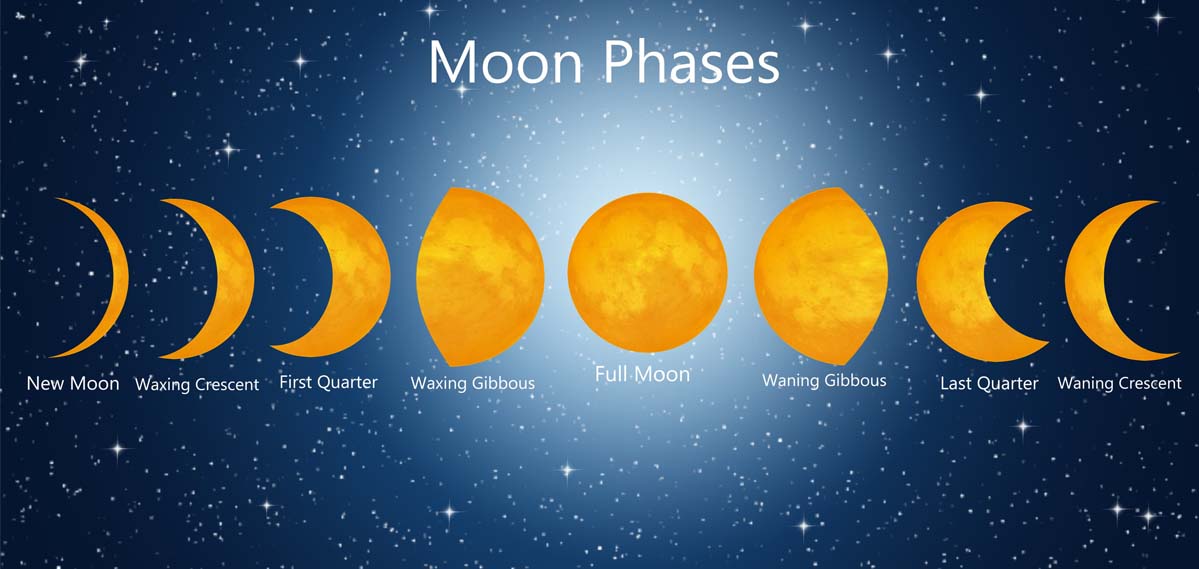
The lunar cycle runs about 29.5 days and is usually divided into eight phases.
| Phase | Theme | With the bowl | Time |
|---|---|---|---|
| 1. New moon | Set an intention | Three soft strikes, long silences | 10–15 min |
| 2. Waxing crescent | Take the first step | Sustained rim-playing | 5–10 min |
| 3. First quarter | Keep going | Firm, steady strikes | 10–15 min |
| 4. Waxing gibbous | Refine, be patient | Slow, even playing | 15–20 min |
| 5. Full moon | Release and give thanks | Three strikes, then sustained play | 20–30 min |
| 6. Waning gibbous | Integrate, be grateful | Gentle playing | 10–15 min |
| 7. Last quarter | Let go of what is left | One firm strike, then play | 10–15 min |
| 8. Waning crescent | Rest | One soft strike, lying down | 5 min |
How to work with each phase
1. New moon: plant the seed
At the new moon the moon cannot be seen. It is the quietest point of the cycle, and the traditional day for turning inward. Use it to set one intention for the weeks ahead.
Ritual: Sit in a dim room with the bowl resting on your open palm. Before you play, write one clear intention: present tense, specific, honest. Then strike the bowl three times very softly, with a long pause between each strike. Let each tone fade completely before the next. The silence matters as much as the sound.
2. Waxing crescent: take the first step
A thin sliver of moon appears in the western sky after sunset. This phase is for one small, concrete action toward what you set at the new moon.
Ritual: Play the bowl around the rim in a sustained tone for 5 to 10 minutes while you hold your intention in mind. Afterwards, write one thing you will do before the next phase.
3. First quarter: push through the resistance
The moon is half lit. This is often the hardest phase, because the first enthusiasm has gone and the result is not yet in sight. What remains is the plain work of continuing.
Ritual: This phase calls for steadiness. Strike the bowl firmly, not hard, and let the sound settle you. Play for 10 to 15 minutes. If doubt comes up, do not fight it. Stay with your breath and the sound.
4. Waxing gibbous: refine and be patient
The moon is more than half full and still growing. This is a time to tend what is already under way, not to start something new.
Ritual: Play slowly and steadily for 15 to 20 minutes. Let your mind review where you are with your intention, honestly and without judgement. What needs adjusting? What is quietly working?
Full moon singing bowls
Hand-hammered in Nepal on full moon nights, in classic and Jhumka forms. Each one is played and chosen for your order before it ships.
5. Full moon: release, celebrate, reset
The full moon is the high point of the cycle, and in Nepal it is the day most given to practice. Many people find feelings run stronger around it. Use the night to let go of what has run its course and to give thanks for what has come.
Ritual: If you like, set the bowl on a windowsill in the moonlight for a while before you begin. Then sit comfortably with the bowl on your palm or its cushion. Write down what you are releasing this cycle: habits, feelings, situations that are finished. You do not need to solve them. Name them.
Strike the bowl three times slowly, with a full breath between each. As each tone travels outward, let what you are releasing go with it. Then play for 15 to 20 minutes. If emotion rises, let it. Finish with three more strikes, holding gratitude and your intention for the cycle ahead. Let the last tone fade completely before you open your eyes.
6. Waning gibbous: integrate and give thanks
The moon is shrinking but still bright. The intensity has passed and the mood turns reflective.
Ritual: Play gently for 10 to 15 minutes in a quiet place. Afterwards, write three things you are grateful for from the cycle so far, and include one that was hard.
7. Last quarter: let go of what is left
The moon is half lit again, now on its way to dark. This phase asks a direct question: what am I still holding on to that keeps me from where I said I wanted to go?
Ritual: Strike the bowl once, firmly, and sit with the sound until it has gone. In the silence, hold the question. Then play for 10 to 15 minutes. Write what comes, and act on it before the new moon.
8. Waning crescent: rest
The last thin sliver before the dark. The cycle is nearly complete, and this phase asks for one thing only, which is rest.
Ritual: The simplest practice of the month. Lie down with the bowl beside you. Strike it once, softly. Let the sound and your breath slow together. Nothing else is needed.
Charging your singing bowl under the moon

Many people like to place their bowl in moonlight once a month, on the night of the full moon or a day either side. It is a ritual of care and attention. It does not change the metal or the sound, but it does mark the bowl as something you look after, and that is worth doing.
Set the bowl on a windowsill as the moon rises and leave it there for half an hour or overnight. If you put it outdoors, bring it in before the dew settles, and wipe it dry. For cleaning and the other traditional ways of clearing a bowl, see how to cleanse and charge a Tibetan singing bowl.
Make it personal: engrave a full moon date
If one full moon matters to you, such as the one nearest a birth, a wedding, or the start of a new chapter, we can engrave that date on a full moon bowl by hand, at no extra cost. Tell us the occasion and the year and we will work out the nearest full moon for you.
Custom full moon singing bowl, date engraved
A hand-hammered full moon bowl engraved with the full moon date you choose. The layout is confirmed with you before anything is cut.
What makes the difference over time
- Keep a simple journal beside the bowl. A few lines after each practice. After three or four cycles you will see patterns you cannot see month by month.
- You do not need all eight phases. The new moon and the full moon are the two anchors. Start there and add the others only if it feels natural.
- Keep the bowl in sight. A bowl on a shelf gets played. A bowl in a cupboard does not.
- Keep it simple. Fifteen quiet minutes will do more than an elaborate ceremony done half-distracted.
If you are new to playing, start with how to play a singing bowl. Our free singing bowl healing course goes further into technique and session structure. And if you are wondering whether a full moon bowl is really different from any other, we answer that honestly in full moon singing bowls: more powerful or just a myth?
Find your singing bowl
Hand-hammered in Nepal, played and chosen for your order by our healer, and shipped worldwide by DHL Express.
Frequently asked questions
What is a full moon singing bowl ritual?
A sitting practice done on the night of the full moon. You name what you want to release, strike the bowl three times, play for 15 to 20 minutes, and close with three strikes of gratitude.
Do I need a full moon singing bowl, or will any singing bowl work?
Any well-made singing bowl works. A full moon singing bowl, hand-hammered on the night of the full moon, is the choice that fits the tradition most closely. The quality of the bowl matters more than the label.
How do I charge my singing bowl under the full moon?
Place it on a windowsill in the moonlight for half an hour or overnight. It is a ritual of care and does not change the sound. If you put it outside, bring it in before the dew and wipe it dry.
Which moon phase is best for a singing bowl ritual?
The full moon is the main night for release and gratitude, and the new moon is the night for setting intentions. If you keep only two practices a month, keep these two.
How long should each moon phase ritual last?
About 20 to 30 minutes at the full moon and 5 to 20 minutes for the other phases. Attention matters more than length.
Can I do these rituals indoors?
Yes. Sit near a window if you can, but it is not required.
What is a full moon date engraved singing bowl?
A full moon singing bowl with a specific full moon date engraved on it by hand, chosen to mark a birth, a wedding, an anniversary or another date that matters.