




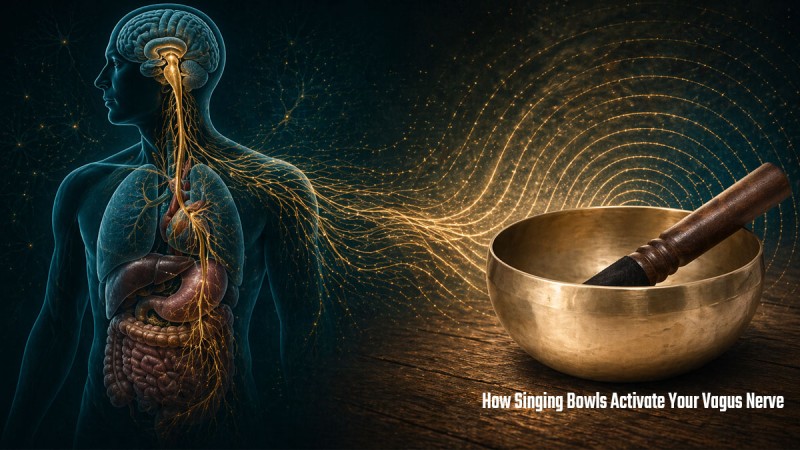
You Already Know This Feeling — You Just Did Not Know What It Was Called
You strike a singing bowl. The sound rises, fills the room, and something happens in your body before you have time to think about it. The shoulders drop. The breath deepens on its own. A quality of stillness arrives that you did not consciously invite. You did not decide to relax. Your body simply began to.
That response has a name. It has a nerve behind it. And understanding that nerve — what it is, what it does, what happens when it is not working well, and why a Tibetan singing bowl activates it so reliably — is one of the most practically useful things a person interested in their own wellbeing can learn right now.
The nerve is the vagus nerve. And this guide is written not for neurologists, but for the person who has felt that bowl-struck stillness in their own body and wants to understand what they felt — and how to use it more deliberately.
What Is the Vagus Nerve — In Plain Language
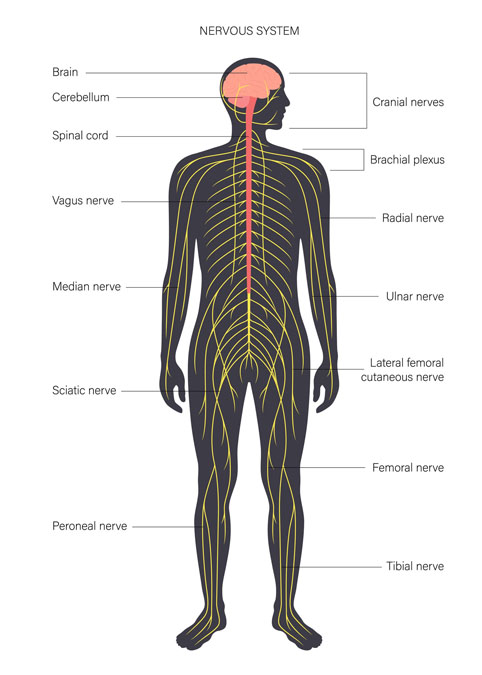
The vagus nerve is the longest nerve in the human body. It runs from the brainstem — the most ancient part of the brain — down through the neck, into the chest where it connects to the heart and lungs, and all the way into the abdomen where it connects to the stomach, intestines and digestive organs. The word vagus comes from the Latin for "wandering" — and the name is earned. This nerve wanders through virtually every major organ system in the body.
But its most important function is not structural. It is communicative. The vagus nerve is the primary two-way communication highway between the brain and the body's organs — and approximately 80% of its fibres carry information upward, from the body to the brain, not the other way around. Your body is constantly sending reports to your brain about its internal state through this nerve. And your brain is constantly sending instructions back.
The vagus nerve is the master regulator of the parasympathetic nervous system — the branch of the autonomic nervous system responsible for rest, digestion, healing, social connection and emotional recovery. It is the biological counterweight to the stress response. When it is functioning well, you recover from stress quickly, sleep deeply, digest easily, connect with others naturally and feel emotionally regulated. When it is not functioning well — when what scientists call vagal tone is low — none of those things happen as they should.
High vagal tone is measurable. It shows up in a metric called heart rate variability (HRV) — the natural variation between each heartbeat. A heart with high vagal tone does not beat like a metronome. It varies slightly with each breath — faster on the inhale, slower on the exhale. This variation is a sign that the vagus nerve is actively regulating the heart in real time. Higher HRV is associated with better cardiovascular health, stronger immunity, lower inflammation, improved emotional regulation and greater resilience to stress.
Low HRV — a heart beating too uniformly, too rigidly — is a sign that vagal tone is suppressed. And suppressed vagal tone is associated with a long list of conditions that affect the quality of modern life in ways that most people never connect to a single underlying cause.
Do You Recognise These Signs — A Self-Assessment
Before explaining the science of how a singing bowl activates the vagus nerve, it is worth pausing here. Low vagal tone is extraordinarily common in modern life — normalised to the point where many people assume their symptoms are simply "how they are" rather than signs of a nervous system that has lost its capacity to fully recover from stress.
Read through the following and notice how many feel familiar:
Signs Your Vagal Tone May Need Support
- You feel anxious or on-edge without a clear reason — as if your body is braced for something that never arrives
- You struggle to fully wind down after a stressful day, even when you are tired
- Your digestion is unpredictable — bloating, reflux, constipation or IBS-type symptoms that worsen when you are stressed
- You feel emotionally reactive — responses come faster and harder than the situation seems to warrant
- You sleep lightly or wake during the night and cannot return to sleep easily
- You feel a persistent low-grade fatigue that rest does not fully resolve
- Social connection feels draining rather than replenishing — you withdraw when overwhelmed
- You carry chronic tension in the neck, shoulders, jaw or chest
- Your breathing tends to be shallow, high in the chest rather than deep in the belly
- You have difficulty feeling truly safe and at ease, even in objectively safe environments
These symptoms feel separate. They are not. They are different expressions of the same underlying condition: a vagus nerve that is not receiving enough activation to keep the parasympathetic system dominant over the chronic stress response. This is why addressing vagal tone can simultaneously improve anxiety, digestion, sleep, emotional regulation and physical tension — because all of these are governed by the same nerve.
What the Himalayan Tradition Already Knew
Long before the vagus nerve was identified by Western anatomy — long before heart rate variability was measured, before polyvagal theory was published, before any of the neuroscience described in this article was formalised — Himalayan healing practitioners were using sound vibration to produce precisely the physiological state that modern science now attributes to vagal activation.
In the Ayurvedic and Tantric healing traditions that inform the practice of singing bowl therapy, the concept closest to vagal tone is prana — the vital life force that moves through the body's energetic channels. When prana flows freely, the body is in a state of health, ease and natural regulation. When it is obstructed — by stress, trauma, emotional holding, energetic blockage — the body falls out of its natural rhythm. What we call low vagal tone, this tradition called prana vayu imbalance — specifically an imbalance in the downward-moving energetic current that governs digestion, elimination, groundedness and the body's capacity to let go.
The use of sustained sound vibration to restore this flow was not accidental. Himalayan healers understood empirically — through thousands of years of direct observation — that certain sounds, certain frequencies, certain qualities of sustained resonance produced specific and reliable shifts in the body's state. The sound of a well-made bowl struck with intention in a quiet space would reliably bring the breath deeper, slow the heart, soften tension held in the body's tissues, and produce a quality of inner stillness that other interventions could not reliably achieve as quickly.
They did not have a name for the vagus nerve. They did not need one. They had the bowl, the tradition, and the lived understanding of what happened when human beings encountered the right kind of sound in the right conditions.
How a Singing Bowl Activates the Vagus Nerve — The Science
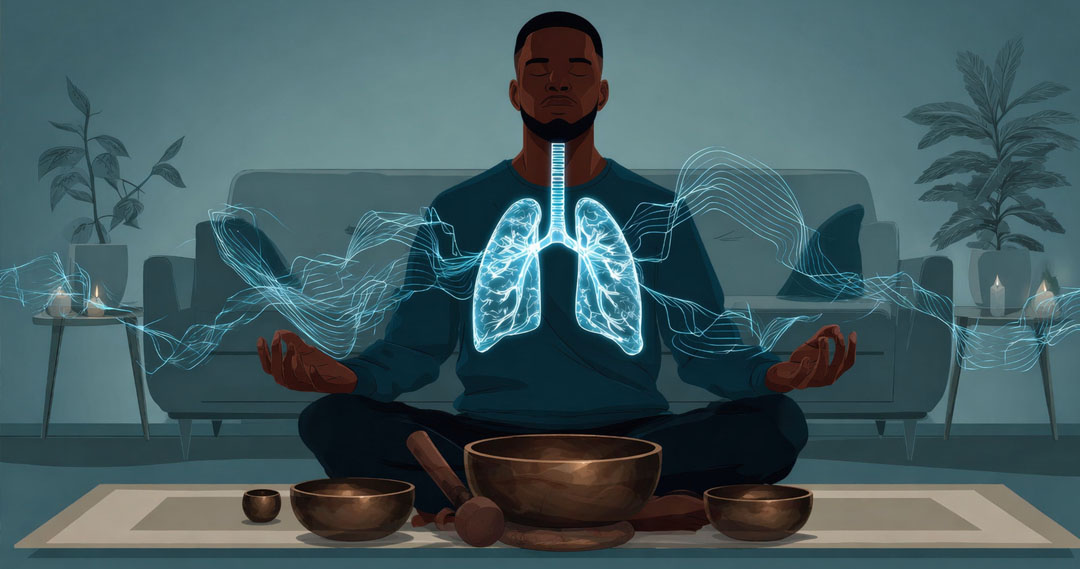
Modern neuroscience has now begun to catch up with what Himalayan practitioners observed across centuries. Here is what the research shows about the specific pathways through which a singing bowl activates the vagus nerve — described not as a technical catalogue but as an integrated explanation of a single, unified physiological response.
Through the Ear — The Most Direct Route
The vagus nerve has a branch — called the auricular branch, or Arnold's nerve — that surfaces at the outer ear canal. It is the only place in the entire body where the vagus nerve is accessible at the skin's surface. When sound waves enter the ear canal, they create pressure changes that stimulate this branch directly — triggering an immediate parasympathetic signal that travels upward to the brainstem.
This pathway is so well established that medical technology has been built around it. Transcutaneous auricular vagus nerve stimulation (taVNS) — an FDA-cleared treatment for depression and epilepsy — delivers gentle electrical pulses to precisely this region of the ear to activate the same branch. A singing bowl, when played near the ear, provides a broad-spectrum acoustic stimulus to this branch that no narrow electrical pulse can replicate in complexity or richness. This pathway is active during any singing bowl session — the listener does not need to be in physical contact with the bowl for it to work.
Through the Middle Ear — The Safety Signal
Inside the middle ear are two tiny muscles — the stapedius and tensor tympani — that are functionally integrated with the vagal system. These muscles evolved primarily to tune the ear for the frequency range of the human voice: approximately 1,000 to 4,000 Hz — the prosodic range of warm, safe, social speech. When these muscles are engaged by sound in this frequency range, the nervous system receives a signal it reads as "safe." Cortisol drops. The stress response softens.
The overtones of a well-made handmade singing bowl — particularly the thick-walled Jhumka bowls and the seven-metal alloy bowls of the Himalayan tradition — naturally span this prosodic frequency range. The bowl literally exercises the muscles that the nervous system uses to assess safety. A 2023 randomised controlled trial published in the European Journal of Investigation in Health, Psychology and Education confirmed that Tibetan singing bowl sessions produced significant reductions in anxiety and measurable improvements in heart rate variability — the direct marker of vagal tone.
Through the Breath — The Respiratory Rhythm
One of the vagus nerve's most important functions is regulating respiratory sinus arrhythmia — the natural increase in heart rate during inhalation and decrease during exhalation. This rhythm is both a sign of vagal tone and a way of increasing it: when breathing slows and deepens, the exhale phase of each breath becomes a moment of direct vagal activation.
A singing bowl's sustained, slowly decaying tone naturally encourages the breath to follow it. Without any instruction, without any effort, the breath tends to deepen and slow in the presence of a resonant bowl tone. Practitioners consistently observe this in clients during sound healing sessions — breathing that was shallow and rapid becomes slow and full within the first two to three strikes of the bowl. Each deepened exhale is activating the vagus nerve. The bowl is not merely setting a pleasant atmosphere. It is directly influencing the breath pattern that drives vagal regulation.
Through the Body — Vibration as Medicine
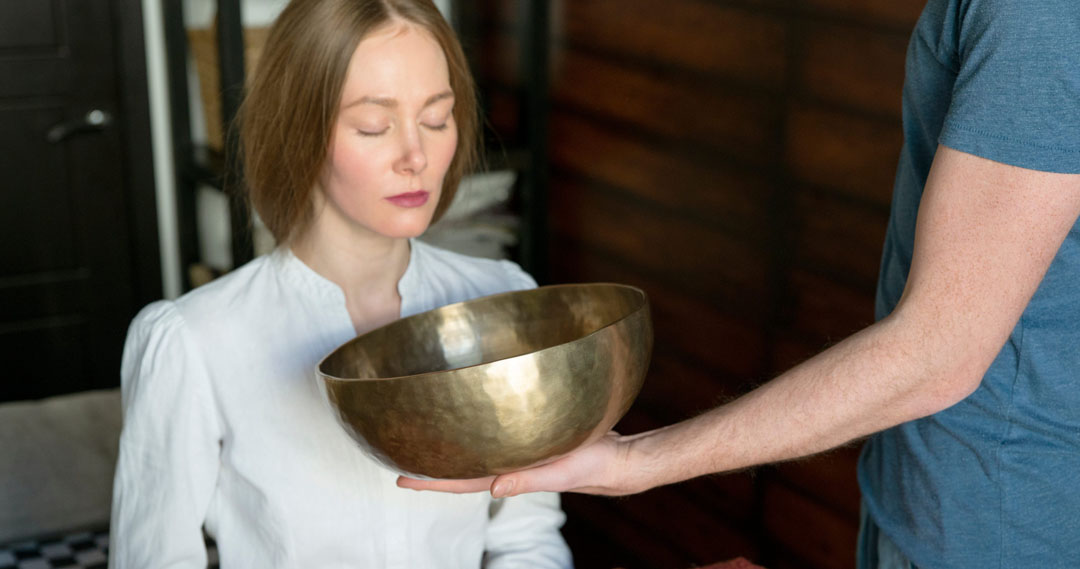
When a singing bowl is placed near or on the body — as in Jhumka bowl body placement, head therapy bowl sessions, or any form of vibroacoustic work — the physical vibration moves through tissue and directly stimulates mechanoreceptors: specialised nerve endings in the skin, fascia and deeper tissues that detect pressure and vibration.
The most important of these are Pacinian corpuscles — highly sensitive receptors that detect vibration in the 30 to 1,000 Hz range, precisely the frequency range of a singing bowl. When these receptors fire, they send rapid neural signals directly to the brainstem, where they modulate vagal output — slowing heart rate, lowering blood pressure, and shifting the autonomic balance from sympathetic (stress) toward parasympathetic (rest and repair). A 2022 study on singing bowl massage published in peer-reviewed research documented significant reductions in EEG beta and gamma wave activity, measurable decreases in heart rate, and increased respiration rate following singing bowl sessions — all consistent with parasympathetic activation through vagal pathways.
This pathway operates completely independently of hearing. Even a deaf person would receive full vibroacoustic vagal benefit from a bowl placed on or near the body. The vibration speaks directly to the nervous system through the skin and tissue — no interpretation required.
Through the Voice — Humming and Toning
The laryngeal muscles — the muscles of the throat involved in voice production — are innervated by the recurrent laryngeal nerve, a branch of the vagus nerve itself. Any sustained vocalization — humming, toning, chanting — directly activates these muscles and produces measurable vagal stimulation. This is why chanting practices appear in virtually every contemplative tradition on earth: the physiological effect of sustained vocal sound on the nervous system is not cultural. It is anatomical.
Many people find that a singing bowl naturally invites humming along — following the fundamental tone with the voice. This is the nervous system's intuitive response to an instrument that produces exactly the kind of safe, sustained, harmonic sound that the vocal system wants to resonate with. When you hum with your bowl, you are activating your vagus nerve simultaneously through two pathways: the auditory-auricular pathway of the bowl's sound entering the ear, and the laryngeal pathway of your own sustained vocalization.
Jhumka Full Moon Singing Bowls — thick-walled, deep resonance, exceptional physical vibration
The Jhumka bowl's thick walls and wide base produce the deep, sustained low-frequency vibration most associated with vibroacoustic vagal activation. Available in 5, 6, 7, 8, 9 and 10-inch diameters — including Full Moon editions forged under Purnima in Kathmandu. Healer-selected, monk-blessed, worldwide DHL delivery.
Why Handmade Himalayan Bowls Work Better Than Recorded Sound
This is a question worth answering honestly, because it matters practically for anyone trying to decide whether to use a recorded singing bowl audio or a physical instrument.
A recording captures the sound of a singing bowl but not its physical vibration. The vibroacoustic pathway — the mechanoreceptor-driven direct vagal activation that occurs when actual vibration moves through tissue — is simply not available through a speaker or headphones. A recording delivers only the auditory component. A physical bowl delivers the auditory component plus the vibroacoustic component simultaneously.
Additionally, a recording compresses and standardises a sound that in reality is continuously evolving. A handmade singing bowl produces slightly different overtones on every strike — because the hand-hammering process introduces microscopic asymmetries into the metal's structure that make each vibration complex, irregular and acoustically unpredictable. This irregularity is not a flaw. It is the mechanism. Your auditory cortex continuously generates predictions about incoming sound. When those predictions fail — as they do with a hand-hammered bowl — your brain generates what neuroscientists call prediction errors that demand processing resources. The analytical mind becomes occupied. The mental noise quiets.
A perfect machine-made bowl produces a tone the brain resolves immediately. A handmade Himalayan bowl produces a tone the brain keeps tracking — and keeps being surprised by — through the entire duration of the sustain. This sustained acoustic engagement is what makes the parasympathetic response deeper and more lasting with a quality physical instrument than with a recording or a uniformly produced bowl.
Your Daily Vagal Toning Practice with a Singing Bowl
The vagus nerve responds to repetition. Vagal tone — like physical fitness — builds gradually through consistent practice rather than dramatic single interventions. The following daily practice is designed to activate the vagus nerve through as many simultaneous pathways as possible in approximately ten minutes. It requires nothing except your bowl, a quiet space, and the willingness to simply be present with the sound.
The 10-Minute Daily Vagal Toning Practice
Step 1 — Arrive (1 minute). Sit comfortably — cross-legged or in a chair with both feet flat on the floor. Place your bowl on its cushion in front of you. Before striking it, take three slow breaths: inhale for four counts, exhale for six. The longer exhale is intentional — it directly activates the vagal brake on the heart rate and begins the shift into parasympathetic mode before the bowl has even been struck.
Step 2 — First strike (2 minutes). Strike the bowl once with your mallet. Do nothing except follow the sound. Do not analyse it. Do not try to relax. Simply let your attention rest in the vibration as it fills the space and slowly fades. Notice what happens in your body without trying to change it. When the sound is gone, allow ten full seconds of silence before striking again. Repeat three times.
Step 3 — Add the breath (3 minutes). Strike the bowl. As the sound rises, inhale slowly. As the sound fades, exhale slowly and completely — making the exhale longer than the inhale. You are synchronising your breath to the bowl's resonance cycle. Each long exhale is directly activating your vagus nerve through the respiratory pathway. Repeat five to six times.
Step 4 — Add humming (2 minutes). Strike the bowl. As it resonates, begin humming softly at whatever pitch feels natural — not necessarily matching the bowl's note exactly. Allow the hum to be quiet, effortless, continuous through the exhale. Feel the vibration of your own voice in your chest and throat. This is your laryngeal vagal pathway activating alongside the auditory one. Repeat three to four times.
Step 5 — Rest in silence (2 minutes). Strike the bowl one final time. Follow the sound to complete silence. Then simply sit. Do not strike again. Rest in the quality of stillness that follows. Notice the difference between the silence before the bowl was struck and the silence after. This quality of post-bowl silence — often described as thick, warm, or spacious — is the signature of vagal activation. The nervous system has settled. Stay in it for at least two minutes before returning to activity.
How Often
Daily practice of even five to ten minutes produces measurable improvements in heart rate variability over three to four weeks of consistency. The key is regularity rather than duration. A ten-minute daily practice builds vagal tone more effectively than an hour-long session once a week. The nervous system responds to pattern, to repetition, to the gradual building of a new baseline state.
Master Healing Head Therapy Bowl — 11, 12 and 13 inches — the most powerful vagal activation through the auricular pathway
The Head Therapy Singing Bowl, placed near or on the crown of the head, delivers direct acoustic stimulation to Arnold's nerve — the auricular branch of the vagus nerve — through the ear canal and cranial structure simultaneously. Available in Golden, Antique and Full Moon finishes with chakra note selection. From $214.99.
Which Bowl Is Best for Vagal Activation
All genuine handmade Himalayan singing bowls activate the vagus nerve to some degree — through the auditory and respiratory pathways at minimum, simply by being struck and heard in a quiet space. But certain bowl types and sizes produce stronger activation through specific pathways:
- For auditory and middle ear activation (any session, no body contact required): Any well-made handmade bowl works well. The richer the overtone structure — which is a function of hand-hammering quality and seven-metal alloy composition — the more completely the middle ear muscles are engaged and the stronger the safety signal sent to the brainstem. Full Moon bowls, hand-hammered under Purnima, consistently produce the richest overtone profiles.
- For vibroacoustic vagal activation (body placement work): Larger, thicker-walled bowls produce stronger physical vibration. The Jhumka bowl range — thick-walled by design — and the 9 to 13-inch singing bowls in the Dharma Tool collection are specifically suited to body-placement practice. The physical vibration of a Jhumka bowl placed near the solar plexus or sacral region is felt immediately and deeply.
- For cranial and auricular vagal activation (head therapy): The Master Healing Head Therapy Bowl — available in 11, 12 and 13-inch sizes — delivers direct acoustic stimulation to the auricular branch of the vagus nerve through the ear canal and cranial structure. For practitioners working with clients at the deepest levels of nervous system regulation, the head therapy bowl produces the most powerful and direct vagal response of any placement in the body.
- For daily home practice (accessible, versatile): A 7 or 8-inch handmade singing bowl from the Dharma Tool collection is the natural starting point for a consistent daily vagal toning practice. Large enough to produce meaningful physical vibration, resonant enough to sustain the respiratory pathway practice described above, and practical enough to keep on a desk or altar as a daily reminder.
What Regular Practice Actually Feels Like Over Time
The immediate effects of a singing bowl session on the vagus nerve are felt within minutes — sometimes within the first single strike. The breath deepens. The shoulders drop. The jaw unclenches. A quality of stillness arrives.
What changes with regular practice over weeks and months is the baseline. The nervous system begins to spend more time in the parasympathetic state not just during practice but throughout the day. The stress response becomes less reactive — triggered less easily, recovered from more quickly. Sleep deepens. Digestion becomes more settled. Emotional responses become more proportionate. The sense of chronic underlying anxiety that many people accept as normal begins, gradually, to lift.
This is what high vagal tone feels like — not as a dramatic transformation, but as a quiet return to a state of regulation that the body always knew how to reach, and is simply being helped to find again. The bowl is not doing something foreign to the body. It is reminding the nervous system of its own capacity for rest. And with enough repetition, that reminder becomes a natural state.
Frequently Asked Questions
What is the vagus nerve and why does it matter for wellbeing?
The vagus nerve is the longest cranial nerve in the body, running from the brainstem through the heart, lungs and digestive organs. It is the primary regulator of the parasympathetic nervous system — the branch responsible for rest, digestion, healing, emotional recovery and social connection. When vagal tone is high, the body recovers from stress quickly and functions with ease. When vagal tone is low — as it commonly is in people under chronic stress — anxiety, poor digestion, disrupted sleep, emotional reactivity and persistent fatigue are common results. Improving vagal tone is one of the most evidence-supported interventions for overall health and resilience.
How does a singing bowl activate the vagus nerve?
A singing bowl activates the vagus nerve through four simultaneous pathways. Through the auricular branch in the ear canal — the same pathway targeted by FDA-cleared vagus nerve stimulation devices. Through the middle ear muscles that send safety signals to the brainstem when engaged by harmonically rich sound. Through the respiratory pathway — the bowl's sustained tone naturally deepens and slows the breath, with each extended exhale directly activating vagal regulation of the heart. And through the vibroacoustic pathway when the bowl is near or on the body — physical vibration stimulating mechanoreceptors that send direct signals to the brainstem through vagal pathways. A fifth pathway activates when the practitioner hums or tones along: the laryngeal muscles, innervated by a branch of the vagus itself, are directly stimulated by sustained vocalization.
What is vagal tone and how do I know if mine is low?
Vagal tone refers to the level of activity in the vagus nerve — its capacity to keep the parasympathetic nervous system dominant over the stress response. High vagal tone is associated with high heart rate variability (HRV), better stress recovery, healthy digestion, good sleep and emotional resilience. Low vagal tone commonly presents as chronic anxiety, difficulty winding down after stress, digestive irregularity, emotional reactivity, light sleep, persistent fatigue, social withdrawal when overwhelmed, and chronic tension in the neck, shoulders, jaw or chest. These symptoms often appear together because they share a single underlying cause — a nervous system that cannot fully shift from stress mode to recovery mode.
Is a recording of a singing bowl as effective as a real bowl for vagal activation?
No — for an important practical reason. A recording delivers only the auditory component of singing bowl therapy. It cannot deliver the physical vibration that activates the vibroacoustic vagal pathway through the body's mechanoreceptors. This pathway — which operates entirely independently of hearing — is responsible for the most direct and immediate nervous system response to a singing bowl, and it requires actual physical vibration moving through air and tissue to work. Additionally, recordings compress and standardise a sound that in reality is continuously evolving and acoustically complex — reducing the brain's sustained engagement with the sound and thus the depth of the parasympathetic response.
How long does it take to improve vagal tone with singing bowl practice?
Research on vagal tone suggests that measurable improvements in heart rate variability — the primary clinical marker of vagal tone — appear within three to four weeks of consistent daily practice. The key factor is regularity rather than duration. A ten-minute daily singing bowl practice builds vagal tone more effectively than an hour-long session once a week. The nervous system responds to repeated pattern — each consistent session reinforces the parasympathetic pathway and gradually raises the body's baseline capacity to return to rest after stress.
Which singing bowl is best for vagus nerve activation?
All genuine handmade Himalayan singing bowls activate the vagus nerve through auditory and respiratory pathways. For stronger vibroacoustic activation — which requires physical vibration through tissue — larger, thicker-walled bowls are more effective. The Jhumka range and 9 to 13-inch bowls in the Dharma Tool collection are well suited for body-placement vagal work. For the most direct auricular vagal activation — stimulating Arnold's nerve through the ear canal — the Master Healing Head Therapy Bowl (11 to 13 inches) is the strongest choice. For daily home practice, a 7 or 8-inch handmade bowl provides an excellent balance of resonance, physical vibration and practicality.