





The Bowl With the Raised Centre That Most People Cannot Explain
Pick up a Lingam singing bowl for the first time and something feels immediately different. Before you even strike it, the eye goes to the raised dome at the centre of the bowl's interior — a smooth, rounded protrusion that seems to belong to a different object. Most people who encounter one for the first time ask the same question: what is that, and why is it there?
The answer reaches back to one of the oldest living spiritual traditions on earth. It connects the physics of sound to the cosmology of Shiva, the geometry of creation to the acoustics of metal, and the rarity of antique craftsmanship to a living tradition still practised today in the workshops of Kathmandu. This guide covers all of it — the meaning, the sound science, the history, the practical uses, and how to choose the right Lingam bowl for your practice.
What Is a Lingam Singing Bowl — The Definition
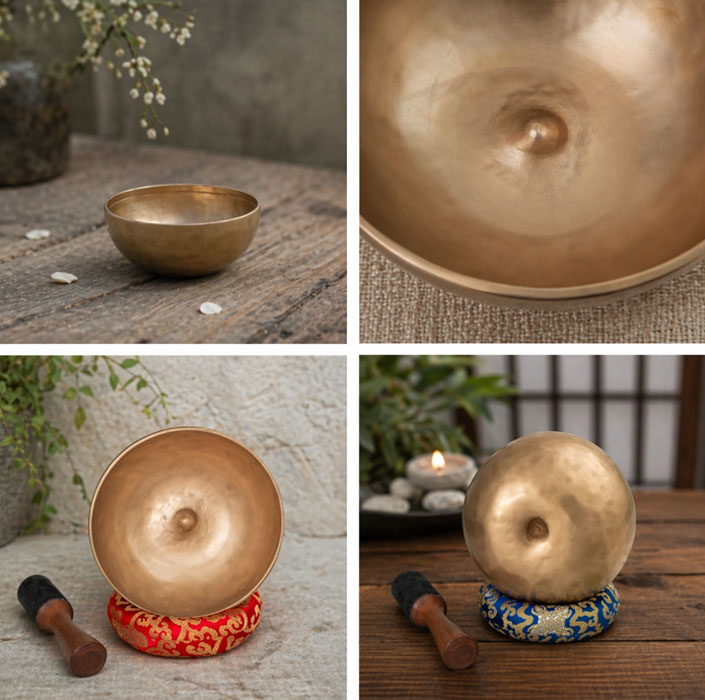
A Lingam singing bowl is a Tibetan singing bowl distinguished by a raised dome — the lingam — cast or shaped at the centre of the bowl's interior base. This protrusion is not decorative. It is a structural, symbolic, and acoustically significant feature that makes the Lingam bowl one of the most unique and sought-after forms in the entire tradition of Himalayan sound instruments.
The bowl's exterior typically appears like any other handmade Tibetan singing bowl — rounded, hand-hammered, made from a seven-metal alloy. It is only when you look inside that the lingam reveals itself: a smooth, upward-rising dome at the centre, ranging from a gentle rise to a more pronounced column depending on the age and tradition of the piece. Beneath the bowl, where most bowls have a flat or slightly curved base, the Lingam bowl often shows the corresponding depression — the navel point, as it is traditionally described.
Lingam bowls are among the rarest singing bowl types. Authentic antique pieces from Nepal and Tibet are genuinely scarce — sought by collectors and healers with equal intensity. Contemporary handmade Lingam bowls, produced in small batches by skilled artisans in Kathmandu, represent a continuation of this tradition for those who cannot access antique pieces.
The Sanskrit Meaning — What Lingam Actually Means

The word lingam (also written linga) comes from Sanskrit and carries a depth of meaning that a single English translation cannot capture. Its most literal translation is "sign" or "mark" — but in the context of Shaivite Hinduism, it refers specifically to the aniconic symbol of Lord Shiva: the cosmic pillar, the generative axis, the formless representation of divine creative power.
In Hindu cosmology, the Shiva Lingam is not a merely physical symbol. It represents the beginning and end of the universe — the cosmic fire that existed before creation and will exist after dissolution. Ancient Vedic texts from as early as the 1st century BCE describe the Lingam as the generator of all power and the axis around which existence revolves. The Puranas describe Shiva as emerging from an infinite pillar of fire — the Lingam — which has no beginning and no end.
Crucially, the Lingam is never understood in isolation. It is always paired with the Yoni — the Sanskrit word for source, sacred space, and feminine creative principle. The Yoni is represented by the depression or base into which the Lingam rises. Together, the Lingam and Yoni form the Shiva-Shakti union: masculine energy and feminine energy, consciousness and creative power, the formless and the formed — two complementary forces that together produce all of existence.
This is why Lingam singing bowls have a corresponding pair: the Yoni bowl, which is characterised by a wider, more open mouth and a slightly different acoustic profile. And it is why the two bowls, when played together, are understood to create a complete energetic field that neither bowl produces alone.
The History — Where Lingam Bowls Come From
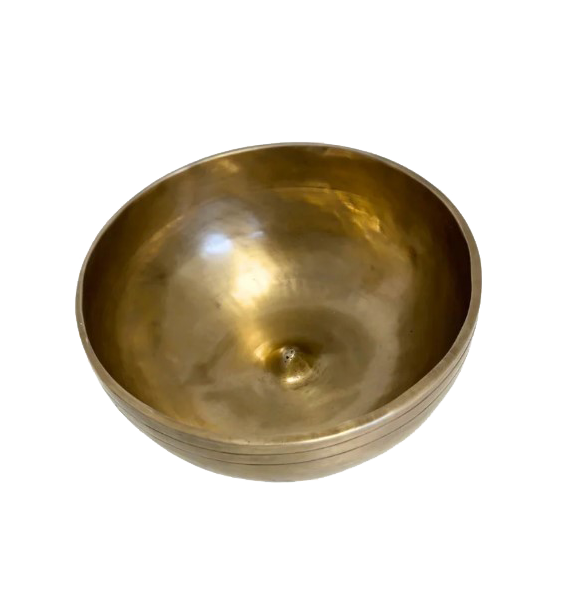
The Lingam singing bowl belongs to a family of sacred Himalayan instruments whose origins trace to the intersection of Tantric Buddhist and Shaivite Hindu practice — two traditions that existed in extraordinary creative dialogue across Nepal, Tibet, and Northern India for well over a thousand years.
The lingam as a sacred form has been venerated in temples and private shrines across the Indian subcontinent for at least two thousand years, possibly longer. The incorporation of this form into a singing bowl — an already sacred sound instrument — represents a convergence of vibrational and symbolic traditions that was uniquely Himalayan in character.
Antique Lingam bowls are extremely rare because they were not made in large quantities. They were created for specific ceremonial contexts — temple use, ritual offerings, monastic practice — and their rarity reflects both the deliberateness of their making and the centuries that have passed since they were cast. The finest antique Lingam bowls, sourced from monasteries, private collections, and Himalayan dealers, carry the acoustic warmth of long use: tones that have matured over generations of vibration into a depth and complexity that newly made bowls can approach but not fully replicate.
Today, skilled artisans in Thamel, Kathmandu continue the tradition in small batches — hand-forging Lingam bowls using the same seven-metal alloy composition and the same hammering techniques that have defined this form for centuries. Dharma Tool sources both antique collected Lingam bowls and contemporary handmade pieces directly from these artisans, maintaining the authenticity of provenance that makes the difference between a genuine instrument and a replica.
The Sound Science — How the Lingam Changes the Acoustic Profile
This is the section most guides skip entirely. The Lingam bowl does not just look different from a standard singing bowl — it sounds different in measurable and meaningful ways. Understanding why requires a basic grasp of how singing bowl acoustics work.
How Standard Singing Bowls Produce Sound
When a standard singing bowl is struck or played around the rim, energy is introduced into the metal. The bowl's walls and base vibrate, producing a fundamental tone and a series of overtones — additional frequencies that sound simultaneously above the fundamental. In a well-made standard bowl, these vibrations travel relatively freely across the smooth, uninterrupted interior surface, creating the rich, layered harmonic field that singing bowls are known for.
What the Lingam Does to the Vibration
The raised dome at the centre of the Lingam bowl's interior fundamentally changes how vibration moves through the metal. Instead of uninterrupted waves travelling across a smooth surface, the vibration encounters the lingam — a mass of additional metal rising from the base. This does three acoustically significant things:
- It creates a natural focal point for resonance. The dome acts as a reflective surface, redirecting vibration back toward the bowl's walls. This redirection produces a characteristic smoothness and steadiness in the Lingam bowl's tone — less overtone scatter, more focused and centred resonance. Practitioners consistently describe the sound as "settled" or "collected" compared to a standard bowl of the same size.
- It extends sustain and reduces complexity. Where a standard bowl's overtones can be richly layered and evolving, the Lingam bowl's tone tends toward a cleaner, longer-sustaining fundamental with a more balanced harmonic profile. The sound does not bloom and scatter — it rises clearly and holds its shape through the decay. This quality makes Lingam bowls particularly effective for practices that require a stable, unwavering sonic anchor.
- It produces a stronger physical vibration through the base. The additional mass of the lingam increases the bowl's weight at the centre, which changes how physical vibration travels downward through the metal and into whatever surface or body the bowl is placed upon. For body-placement work and grounding practices, this means a more focused and direct vibroacoustic experience at the point of contact.
The Ohm Store describes the Lingam bowl sound as "clear, deep and rich" — distinct from the softer, more diffuse character of the Yoni bowl. This description is acoustically accurate. The lingam's structural influence on resonance produces a tone that is more direct, more grounded, and more immediately centring — qualities that make the bowl exceptionally suited for the practical uses described below.
Explore Dharma Tool's Lingam Singing Bowl collection — 7 to 10 inches, new and antique
Dharma Tool offers handmade Lingam singing bowls in 7, 8, 9, and 10-inch diameters — including plain finish, Ashtamangala-engraved, and Lotus Mantra editions — alongside rare Old Collected antique Lingam bowls sourced directly from Nepal. All hand-forged from seven-metal alloy by traditional artisans in Thamel, Kathmandu.
8 Powerful Ways to Use a Lingam Singing Bowl
The Lingam bowl's distinctive acoustic profile — centred, steady, deep, and grounding — makes it particularly suited to a specific set of practices. Each of the eight uses below draws directly on those acoustic and symbolic qualities.
1. Sacral Chakra Balancing
In Himalayan chakra tradition, the Lingam bowl is most directly associated with the Sacral Chakra (Svadhisthana) — the energy centre located approximately four inches below the navel, governing creativity, emotional flow, sensuality, and the generation of life force. The Sacral Chakra note is D, and a Lingam bowl tuned to this note — played in front of the lower abdomen while seated in meditation — is understood to directly address blockages or imbalances in this centre.
The specific connection between the Lingam bowl and the Sacral Chakra is not arbitrary. The sacral chakra is located at the same anatomical height as the reproductive organs — the organs most directly associated with the creative and generative forces that the Lingam symbolises in Shaivite cosmology. This alignment of symbol, anatomy, and sound is characteristic of the depth with which Himalayan healing traditions understood the relationship between form and function.
How to use: Sit cross-legged or in a chair. Place the Lingam bowl on its cushion in front of you, at the level of your lower abdomen. Strike once and follow the sound to silence. Repeat three to five times. Then close your eyes and breathe slowly into the lower belly, allowing the residual vibration to continue working.
2. Grounding and Root Energy Work
The Lingam bowl's deep, centred tone and its symbolic association with the cosmic axis — the pillar that connects earth and sky — make it an exceptionally effective tool for grounding practice. Where smaller, lighter bowls create an expansive, upward quality of sound, the Lingam bowl brings energy downward and inward. Practitioners who feel scattered, unanchored, or mentally hyperactive consistently report that the Lingam bowl's sound settles the energy into the body faster than other bowl types.
How to use: Sit on the floor, preferably cross-legged with the spine upright. Place the bowl on the cushion in front of you at floor level. Strike it gently and place both hands flat on the floor beside your legs. Follow the sound with your full attention. Allow the vibration to remind your body that it is resting on solid ground.
3. Masculine Energy Integration
In Jungian psychology and across many ancient traditions, every human being contains both masculine and feminine energetic qualities regardless of biological sex. The Lingam bowl, as the sonic representation of the Shiva principle — focused, directed, generative, fiery — is used in practice specifically to integrate and strengthen the masculine energetic quality within oneself.
This is not a gender exercise. It is an energetic one. Masculine energy in this context refers to clarity of direction, focused will, the capacity to initiate and complete, and the confidence to act from a settled centre. Many people — regardless of gender — find this quality depleted by chronic stress, self-doubt, or energetic fragmentation. The Lingam bowl's centred, direct sound supports the return of this quality.
How to use: Before a creative project, an important decision, or any situation requiring focused action — strike the Lingam bowl three times. Set your intention before the first strike. Follow each sound to complete silence before the next. Allow the resonance to consolidate your sense of direction before you begin.
4. Paired Practice with the Yoni Bowl — Balancing Opposite Energies
The most powerful way to use a Lingam bowl is with its complementary pair: the Yoni bowl. The Yoni bowl represents the feminine creative principle — receptive, expansive, generative in a different mode — and its acoustic character is correspondingly softer, more diffuse, and more open than the Lingam's focused, grounded tone.
When both bowls are struck together and their sounds are allowed to interact in the room, the overlapping vibrations create a more complex acoustic field than either bowl produces alone. Beat frequencies emerge between the two tones — additional frequencies generated by the interaction of the two instruments — that can span multiple brainwave states simultaneously. This is the sound healing equivalent of what the Lingam and Yoni symbolise: the meeting of two complementary forces that together produce something neither could create separately.
How to use: Place the Lingam bowl to your right and the Yoni bowl to your left. Strike the Lingam first, then the Yoni within one to two seconds. Allow both sounds to develop and interact. Sit in the intersection of the two fields. Breathe slowly. Do not follow either sound individually — simply rest in the combined resonance.
5. Space Clearing and Energy Cleansing
The Lingam bowl's direct, penetrating tone makes it particularly effective for space clearing — the practice of dispelling stagnant or negative energy from a room, an object, or a person's aura. Where softer, more diffuse bowl tones spread gently through a space, the Lingam bowl's focused resonance has a cutting, clarifying quality that practitioners describe as "breaking through" energetic density more effectively.
How to use: Walk slowly through the space you wish to clear, striking the Lingam bowl at each corner of the room and at the centre. Allow each tone to fully dissipate before striking again. Move in a clockwise direction. If clearing an object — a crystal, a mala, a piece of jewellery — place it inside the bowl and strike three times, allowing the vibration to pass directly through the object.
6. Manifestation and Intention Setting
The Lingam's association with Shiva's cosmic creative power — with the force that initiates all existence — makes the Lingam bowl particularly meaningful for practices centred on manifestation and the setting of clear intentions. Striking the bowl while holding a specific intention is understood in this tradition as amplifying and sending that intention outward through sound vibration — making it not merely a mental statement but a physical event in the world.
How to use: Before striking, hold the bowl in both hands and state your intention silently — not as a wish but as a clear affirmation of what you are creating. Then strike once with full attention. Follow the sound as it carries your intention outward and upward. Repeat once more at the close of your practice as a seal.
7. Deep Meditation Anchor
The Lingam bowl's steady, unwavering sustain — longer and more focused than a standard bowl of the same size — makes it an exceptional anchor for deep meditation. Where the mind during meditation tends toward dispersion and wandering, the Lingam bowl's tone provides a stable thread to return to — a sound that does not pull the attention outward but holds it gently at the centre.
How to use: Strike the bowl at the beginning of your meditation session. Do not try to follow the sound analytically. Simply allow your attention to rest in the vibration as it fills the space and slowly fades. When the sound is gone, notice the quality of silence that follows — a silence that feels different from the silence before the bowl was struck. This is the space the Lingam bowl opens. Remain in it.
8. Sound Healing Sessions — Body Placement
For sound healing practitioners working with clients, the Lingam bowl's additional base mass and focused vibroacoustic profile make it a powerful instrument for body-placement work. Placed near the lower abdomen, the sacral region, or the base of the spine — the areas most directly associated with the bowl's energetic function — the Lingam bowl's vibration is felt as more concentrated and purposeful than a standard bowl.
How to use: With the client lying comfortably, place the Lingam bowl on its cushion at the level of the sacral chakra (lower abdomen, approximately four inches below the navel). Strike gently three to five times, allowing each tone to fully sustain and fade. Observe the client's breathing — it will typically slow and deepen within the first one or two strikes. Conclude by striking the bowl once more and lifting it away slowly before moving to other instruments or positions.
Old Collected Lingam Singing Bowls — among the rarest antique Himalayan instruments available
Dharma Tool's antique collection includes rare Old Collected Lingam Singing Bowls sourced directly from Nepal — authentic antique pieces whose tones have matured through decades of use into a depth and complexity that newly made bowls approach but cannot fully replicate. Each piece is individually assessed and selected for resonance quality.
Lingam Bowl vs Standard Singing Bowl — The Key Differences
- Shape: Standard bowls have a smooth, uninterrupted interior. Lingam bowls have a raised dome at the centre of the interior base — a structural feature that defines the entire acoustic and symbolic character of the instrument.
- Sound profile: Standard bowls produce a richer, more layered, more overtone-complex sound that evolves significantly during sustain. Lingam bowls produce a steadier, more centred, more focused tone with a cleaner fundamental and longer, more even sustain.
- Energetic character: Standard bowls are versatile across all chakras and practices. Lingam bowls are specifically associated with the Sacral Chakra, creative energy, masculine principle integration, and grounding.
- Rarity: Standard handmade singing bowls are produced in significant quantities. Authentic Lingam bowls — particularly antique pieces — are genuinely rare and represent a more specialised category of both craftsmanship and collecting.
- Best use: Standard bowls are the strongest choice for a broad sound healing practice, meditation anchor, chakra sets, and sound baths. Lingam bowls are the strongest choice for grounding, sacral work, masculine energy integration, paired practice with a Yoni bowl, and as a focal piece in a dedicated sacred space.
How to Choose Your Lingam Bowl — Size and Condition
By Size
- 7-inch Lingam bowl: The most accessible size for personal practice. Produces a warm, focused tone suited to solo meditation, sacral chakra work, and tabletop use. Ideal for practitioners who want to explore the Lingam bowl's qualities without investing in a larger instrument.
- 8-inch Lingam bowl: A step up in depth and physical vibration — still suitable for personal practice but with a fuller, more present tone. Strong choice for practitioners who already use singing bowls and want to add the Lingam's specific character to their collection.
- 9-inch Lingam bowl: Enters the range where the physical vibration becomes significantly more body-centred — suitable for sound healing work with clients and for practitioners who want a more immersive personal practice experience.
- 10-inch Lingam bowl: The largest available in the Dharma Tool collection — rare, deep-toned, and most suited to experienced practitioners and sound healers. The 10-inch Lingam bowl produces the most powerful vibroacoustic experience in the range and is the instrument of choice for practitioners who work with the Lingam bowl as a primary healing instrument.
Antique vs Contemporary
Antique Lingam bowls carry acoustic qualities that contemporary bowls are still developing — tones that have matured through decades of use into a warmth, depth, and harmonic complexity that is genuinely different from a newly made instrument. For collectors and experienced practitioners who understand what they are listening for, an authentic antique Lingam bowl is among the most significant acquisitions in Himalayan sound healing.
Contemporary handmade Lingam bowls from Dharma Tool's Kathmandu artisans represent the same tradition in living form — made by the same methods, from the same materials, with the same intention. They will develop their full character over years of use. For practitioners beginning their relationship with the Lingam bowl, a contemporary piece is the natural and more accessible starting point.
The Bowl at the Axis of Everything
There is something quietly extraordinary about the Lingam bowl. It is one of the few objects in the world where ancient cosmology, material science, acoustic physics, and practical healing function converge into a single form. The raised dome is not an ornament. It is an axis — the same axis that Shaivite tradition understood as the centre of the universe, the point from which creation emerges and into which it returns.
When you strike a Lingam bowl and the sound rises cleanly from its centre, holds steadily in the air, and fades slowly into silence — you are not just hearing a sound. You are experiencing a principle. The principle that at the centre of everything there is a stillness — a focused, generative quiet — from which everything meaningful is made.
That is worth having in your practice. And worth understanding before you choose.
Frequently Asked Questions
What is a Lingam singing bowl?
A Lingam singing bowl is a Tibetan singing bowl characterised by a raised dome — the lingam — at the centre of the bowl's interior base. This structural feature is both symbolically and acoustically significant. Symbolically, it represents the Shiva Lingam: the aniconic symbol of Lord Shiva and the Shaivite principle of divine creative power. Acoustically, it creates a focused, centred resonance profile distinct from standard singing bowls — steadier in sustain, more grounded in character, and more directly connected to the lower chakras in practice.
What does the lingam symbol mean?
In Sanskrit, lingam means "sign" or "mark" — but in Shaivite Hindu tradition, it specifically refers to the cosmic symbol of Lord Shiva: the infinite pillar of fire representing divine creative power, the beginning and end of the universe, and the generative axis around which all existence revolves. The lingam is always understood in relation to its complementary symbol, the Yoni — representing the feminine creative principle. Together, Lingam and Yoni embody the union of opposing but complementary forces that produces all of existence.
How does a Lingam bowl sound different from a regular singing bowl?
The raised dome at the centre of the Lingam bowl's interior changes how vibration moves through the metal in three key ways. It creates a natural focal point for resonance, producing a steadier and more centred tone. It extends sustain and reduces overtone complexity compared to a standard bowl of the same size. And it increases the physical vibroacoustic intensity at the base of the bowl. The overall result is a sound that practitioners consistently describe as more grounded, more focused, and more directly centring than a standard bowl — clear and deep rather than richly complex.
Which chakra is the Lingam bowl associated with?
The Lingam bowl is most directly associated with the Sacral Chakra (Svadhisthana) — the energy centre located approximately four inches below the navel, governing creativity, emotional flow, sensuality, and life force. This association is both symbolic — the Lingam's creative and generative meaning aligns with the Sacral Chakra's energetic function — and anatomical, as the Sacral Chakra is located at the same height as the organs most directly associated with the generative principle the Lingam represents. The Sacral Chakra corresponds to the D note.
What is the difference between a Lingam bowl and a Yoni bowl?
Lingam and Yoni bowls are complementary pairs from the same Himalayan tradition. The Lingam bowl has a raised dome at the centre of its interior and is associated with the masculine, directed, focused creative principle — the Shiva energy. The Yoni bowl has a wider, more open mouth with a correspondingly more expansive and softer acoustic character, and is associated with the feminine, receptive, generative principle — the Shakti energy. When played together, the two bowls create a complete energetic field representing the union of these complementary forces.
Are antique Lingam bowls worth buying?
For experienced practitioners and collectors who understand what to listen for, an authentic antique Lingam bowl is among the most significant acquisitions in Himalayan sound healing. Antique pieces carry acoustic qualities that contemporary bowls are still developing — tones matured through decades of use into warmth and harmonic depth that a newly made bowl takes years to approach. They are genuinely rare, particularly pieces sourced directly from Nepal with verified provenance. For those beginning their relationship with the Lingam bowl, a contemporary handmade piece from skilled Kathmandu artisans is the more accessible and equally meaningful starting point.