




The 5 Elements of Life and the 5 Element Singing Bowl Set
Short answer: what are the 5 elements?
The 5 elements of life, called Pancha Bhuta in Sanskrit, are Earth (Prithvi), Water (Apas), Fire (Agni), Air (Vayu) and Space (Akasha). In the Vedic and Tantric traditions they describe the five qualities that make up the body and the world: solidity, flow, transformation, movement and openness. Each element has its own chakra and seed sound, and a 5 element singing bowl set has one bowl for each: C for Earth, D for Water, E for Fire, F for Air, and a fifth bowl for Space.
Long before anyone mapped the nervous system, Vedic teachers described the human being as five elements in motion. They were not speaking in metaphor. Earth, Water, Fire, Air and Space were their working description of what a body, a mind and a world are made of, and of what goes wrong when one of the five is weak or overactive.
This guide explains each element, the chakra it belongs to, and the singing bowl note that goes with it. It then shows how to use a 5 Element of Life singing bowl set for a simple cleansing practice. Sound work of this kind supports relaxation and meditation. It does not replace medical care.
The five elements of life (Pancha Bhuta)
Pancha means five and bhuta means element. The idea appears in the Upanishads, in classical Ayurveda and in Tantra, and it is still taught in the Himalayas today. Tibetan Buddhist and Bön teachings work with the same five. The Taittiriya Upanishad describes them unfolding in order: from Space comes Air, from Air comes Fire, from Fire comes Water, and from Water comes Earth.
Each element is a quality of experience, and each is linked to one of the five senses.
Earth (Prithvi)
Earth is solidity, stability and form. It is the densest element and the container for the other four. It is linked to the bones, the flesh and the sense of smell.
In balance: you feel grounded, steady, present in your body and at home where you are.
Out of balance: the tradition describes restlessness, worry without a clear cause, fear about money and security, and a sense of not belonging anywhere.
Water (Apas, also called Jala)
Water is flow, feeling and connection. Where Earth gives the container, Water fills it and keeps it moving. It is linked to the fluids of the body and the sense of taste.
In balance: emotions move without getting stuck, creativity comes easily, and change is not frightening.
Out of balance: emotional numbness or flooding, creative blocks, rigidity, and grief that has nowhere to go.
Fire (Agni, also called Tejas)
Fire is transformation and will. It is what turns food into energy, experience into understanding, and intention into action. It is linked to digestion and the sense of sight.
In balance: a clear sense of direction, the ability to start and finish, and confidence that neither collapses nor dominates.
Out of balance: too little Fire shows as tiredness and low motivation. Too much shows as irritability, perfectionism and burnout.
Air (Vayu)
Air is movement, breath and relationship. It is invisible and everywhere. It is linked to the lungs, the heart and the sense of touch.
In balance: the breath is full, and care moves easily in both directions, given without losing yourself and received without fear.
Out of balance: shallow breathing, loneliness even in company, and tightness held in the chest.
Space (Akasha)
Space is the subtlest element: the openness in which the other four arise. It is linked to the sense of hearing, because in Vedic thought sound is the quality that belongs to Space. Before form, heat or movement, there is vibration.
That one idea is why singing bowls are used for elemental work at all. Sound is Space in action.
In balance: silence feels comfortable, and life feels connected to something larger than the personal self.
Out of balance: a sense of emptiness, constant seeking, and confusion that more information does not resolve.
The five elements and the chakras

The chakras and the elements are not two separate systems. In the classical Tantric map, the first five chakras are the five elements as they sit in the body, from the base of the spine to the throat. The two centres above them, the Third Eye and the Crown, are described as beyond the elements.
| Element | Sense | Classical chakra | Seed sound | Bowl in our 5 Element set |
|---|---|---|---|---|
| Earth (Prithvi) | Smell | Root, Muladhara | LAM | C, Root |
| Water (Apas) | Taste | Sacral, Svadhisthana | VAM | D, Sacral |
| Fire (Agni) | Sight | Solar Plexus, Manipura | RAM | E, Solar Plexus |
| Air (Vayu) | Touch | Heart, Anahata | YAM | F, Heart |
| Space (Akasha) | Hearing | Throat, Vishuddha | HAM | B, Crown (G, Throat on request) |
Root chakra, Muladhara: Earth
Muladhara means "root support". It sits at the base of the spine and is the foundation of the whole system. Its seed sound is LAM.
Sacral chakra, Svadhisthana: Water
Svadhisthana means "one's own dwelling place". It sits just below the navel and is the centre of feeling, creativity and pleasure. Its seed sound is VAM.
Solar Plexus chakra, Manipura: Fire
Manipura means "city of jewels". It sits in the upper abdomen and is the seat of will and digestion. Its seed sound is RAM.
Heart chakra, Anahata: Air
Anahata means "unstruck sound". It sits in the centre of the chest, between the three lower centres and the ones above, and is the centre of breath and compassion. Its seed sound is YAM.
Throat chakra, Vishuddha: Space
Vishuddha means "especially pure". In the classical texts this is the home of Akasha, and its seed sound is HAM. On the usual seven-note scale its bowl note is G.
Why the fifth bowl in our set is a Crown bowl
Our 5 Element of Life set uses a B bowl at the Crown (Sahasrara) for Space, not a G bowl at the Throat. A five-bowl session that begins at the base of the spine then finishes at the top of the head, in the openness and silence that Space stands for. If you follow the classical placement and want G at the Throat as your fifth bowl, use the custom set builder and choose your five notes. Either way, HAM is the seed sound of Space and is the one to use with the fifth bowl.
Why sound works with all five elements
In Vedic understanding, sound is the quality of Space, and Space is the element from which the other four unfold: Space, then Air, Fire, Water and Earth. So when you play a singing bowl you are working with the first element in its own language. That is the traditional reason sound is used to reach all five.
The five notes also feel different in the body. These are descriptions from practice, not measurements:
- C, Earth. The lowest note of the five. Most people feel it low in the body and describe it as settling and steadying.
- D, Water. One step up, with a rounder, more flowing quality. It is felt through the lower abdomen and is often described as releasing.
- E, Fire. Bright and clear, felt around the upper abdomen and diaphragm. Where C settles and D flows, E wakes things up.
- F, Air. Felt in the chest. Practitioners often call it the warmest and most comforting of the five.
- B, Space. The highest note of the five, light and open. It tends to quiet the mind more than it moves the body.
To check the note of any bowl you own, use our live singing bowl tuner. For the full seven-note map, see chakra and note information.
Looking for a 5 element singing bowl set?
Five hand-hammered bowls, one for each element, tuned as a set by selection for your order. Sets also come in 3, 7, 9 and 12 bowls.
The 5 Element of Life singing bowl set: what it is
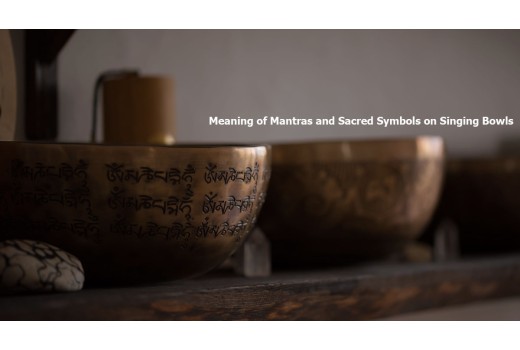
The 5 Element of Life Cleansing Singing Bowl Set is five hand-hammered bowls in the notes C, D, E, F and B, made in Nepal from the traditional seven-metal alloy and decorated with mantras, Buddha feet and the Om. A monk blessing is available. There is also a plainer hand-beaten set of 5, and both sit with the rest of our chakra singing bowl sets.
How the set is tuned
A hand-hammered bowl's note is discovered, not made. A smith cannot hammer toward a target note, and the note is only known once the bowl is finished and decorated. So a set is tuned by selection. When your order arrives, I play the finished bowls and choose five whose notes sit correctly against each other. That is done for each order, from my experience of using these bowls in practice. You can read more about how healer selection works.
Why hand-hammered bowls
A bowl beaten into shape by hand has walls that vary very slightly in thickness. Those small variations give it several overtones at once and a long sustain, where a machine-pressed bowl gives one flat pitch that fades quickly. For elemental work that layered tone is what holds the attention. More on this in hand-hammered singing bowls.
Five bowls or seven
A 7 chakra set covers all seven centres, including the Throat and the Third Eye. A 5 element set covers the five elements and nothing more, which makes it simpler to learn and quicker to play through. Many practitioners start with five and add bowls later. Sets come in 3, 5, 7, 9 and 12 bowls, and in four size ranges: all bowls at 5 inches, 4 to 8 inches, 5 to 10 inches, and 8 to 12 inches. The 5 to 10 inch range is the one I recommend most often.
How to use a 5 element set: a cleansing practice

This practice takes about 20 minutes. It follows the Vedic order, from Earth up to Space, moving from the densest element to the subtlest. Other traditions, including Tibetan practice, order the centres differently, so if you have been taught another order, follow your teacher. If you have never played a bowl, start with how to play a singing bowl.
Preparation
Set the five bowls in front of you in order: C, D, E, F, B. Sit comfortably with a long spine and relaxed shoulders. Take three slow breaths.
Earth: C bowl, Root
Strike the C bowl once. Bring your attention to the base of the spine and the weight of your body on the ground. Breathe into the lower belly. Seed sound: LAM. Words to hold: "I am grounded. I am safe." Follow the sound until it has gone completely.
Water: D bowl, Sacral
Strike the D bowl. Bring your attention just below the navel. Let whatever feeling is present be there without judging it. Seed sound: VAM. Words to hold: "I flow. I feel. I create." Follow the sound into silence.
Fire: E bowl, Solar Plexus
Strike the E bowl. Bring your attention to the upper abdomen and breathe a little more fully. Seed sound: RAM. Words to hold: "I act with clarity and purpose." Follow the sound into silence.
Air: F bowl, Heart
Strike the F bowl. Bring your attention to the centre of the chest and let it soften on each out-breath. Seed sound: YAM. Words to hold: "My heart is open." Follow the sound into silence.
Space: B bowl, Crown
Strike the B bowl. Let your attention rise to the top of the head, or rest at the throat if you follow the classical placement. Do not chase the sound. Let it open and fade. Seed sound: HAM. Words to hold: "I am awareness itself." Stay in the silence for at least a minute.
Integration
Sit quietly for three to five minutes. Put one hand on the ground and one on your heart. This is when the practice settles, so do not skip it.
To go further, our free singing bowl healing course covers session structure and body placement, and how to set up singing bowls for a sound bath shows how to lay out a set for a group.
Which element needs your attention
These pointers come from the Ayurvedic and Tantric descriptions of each element. Use them to decide where to spend more time in your practice.
- Unsettled, anxious or insecure: Earth. Spend longer with the C bowl.
- Emotions stuck, creativity blocked, life feeling rigid: Water. Work with the D bowl.
- Tired and unmotivated, or driven and burnt out: Fire. Work with the E bowl.
- Grief, loneliness or a tight chest: Air. Work with the F bowl.
- Disconnected, or seeking without arriving: Space. Work with the fifth bowl, after the first four.
If you are not sure which note to start with, the chakra quiz will suggest one.
Build your own five-bowl set
Choose your five notes, the size range, the finish and free engraving. The set is tuned by selection and played before it ships from Kathmandu, within 3–4 business days.
Frequently asked questions
What are the 5 elements of life?
Earth (Prithvi), Water (Apas), Fire (Agni), Air (Vayu) and Space (Akasha). In Vedic, Ayurvedic and Tantric teaching they are the five qualities that make up the body and the world. Together they are called the Pancha Bhuta.
Which chakra goes with each of the 5 elements?
In the classical map, Earth is the Root chakra, Water the Sacral, Fire the Solar Plexus, Air the Heart and Space the Throat. The Third Eye and Crown are described as beyond the elements.
What is a 5 element singing bowl set?
A set of five singing bowls with one bowl for each element. Our 5 Element of Life set uses the notes C, D, E, F and B for Earth, Water, Fire, Air and Space.
Why does your set use a Crown bowl for Space when the classical chakra is the Throat?
Our set finishes at the Crown so that a session rising from the base of the spine ends at the top of the head, in the openness that Space stands for. If you prefer the classical placement, choose G for the Throat as your fifth bowl in the custom set builder.
Are the bowls made to those exact notes?
No bowl is made to a note. A hand-hammered bowl's note is discovered once it is finished. A set is tuned by selection: for each order, our healer plays the finished bowls and chooses the ones whose notes belong together.
What is the difference between a 5 element set and a 7 chakra set?
A 7 chakra set has a bowl for all seven centres. A 5 element set has five bowls for the five elements, so it is simpler and quicker to play through. Many people start with five and add bowls later.
In what order should I play the five bowls?
The Vedic order runs from Earth up to Space: C, D, E, F, then the fifth bowl. Other traditions order the centres differently, so follow the tradition you were taught.
How often should I do the 5 element practice?
Once a week is enough for most people. In a difficult period, a few minutes a day with the one or two bowls you need most is a good habit. The full five-bowl sequence takes about 20 minutes.