




Both Bowls Sit in Front of You — Then You Strike Them
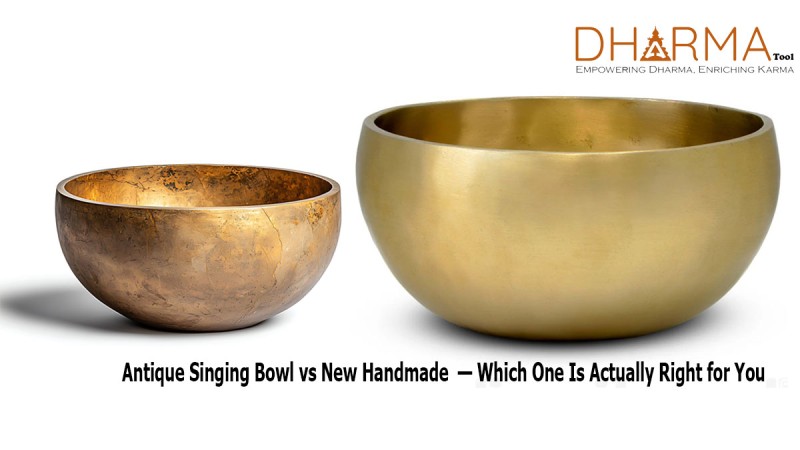
One is newly forged in Thamel, Kathmandu — warm golden finish, perfectly formed cushion, the faint smell of fresh metal and the quiet confidence of something made recently by skilled hands. The other is two hundred years old — darker, heavier, its surface carrying the particular stillness of something that has been through a great deal and arrived at peace with all of it. You strike the new one first. The sound rises immediately, clear and bright and strong. Then you strike the antique. The sound rises differently — slower to open, more layered in its unfolding, settling into a warmth that the new bowl has not yet had time to develop.
Neither bowl is wrong. Neither bowl is simply better. But they are genuinely, audibly, physically different instruments — and understanding that difference precisely is the most useful thing anyone can tell you before you decide which one belongs in your practice.
This guide is written from Thamel, Kathmandu — where Dharma Tool sources both new handmade and old collected antique singing bowls directly from the artisans and collectors who produce and hold them. We work with both categories every day. We know what each one sounds like, who it serves best, and when the choice between them is straightforward and when it is not. Here is that knowledge, honestly shared.
What Each Bowl Actually Is — A Clear Starting Point
Before comparing anything, the definitions matter — because these terms are used loosely across the singing bowl market and the confusion costs buyers both money and the right instrument.
New Handmade Singing Bowl
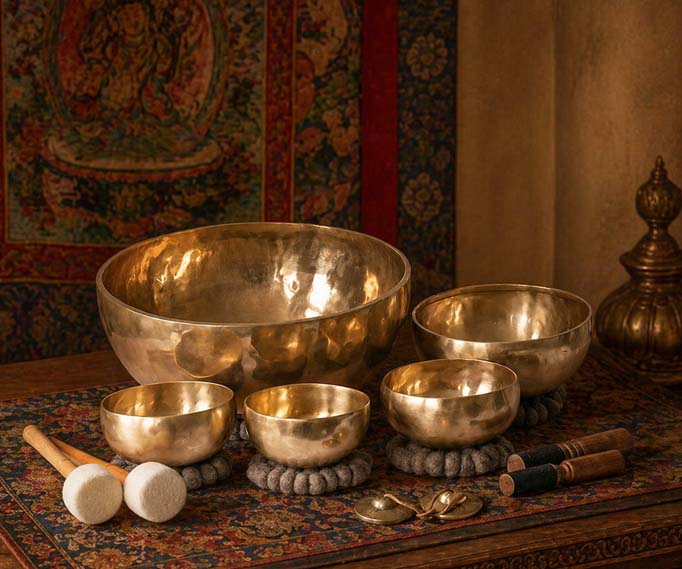
A new handmade singing bowl is one forged recently — within the past few years — by living artisans using the traditional Himalayan method: heating a disc of seven-metal alloy and shaping it through hundreds of individual hammer strikes until it reaches its final form. The word handmade is the critical qualifier. It distinguishes these bowls from machine-pressed, cast or factory-produced bowls — which may look similar but sound fundamentally different because the hand-hammering process, with its accumulated irregularities and asymmetries in the metal, is precisely what creates the complex overtone structure that gives a quality singing bowl its healing character.
Within the new handmade category, Dharma Tool offers several distinct lines — standard handmade bowls, Full Moon bowls forged during Purnima, mantra carved and etched bowls, Jhumka thick-walled bowls for vibroacoustic work, and chakra-tuned sets. All are new. All are handmade. All are sourced directly from artisan workshops in Kathmandu.
Antique Old Collected Singing Bowl
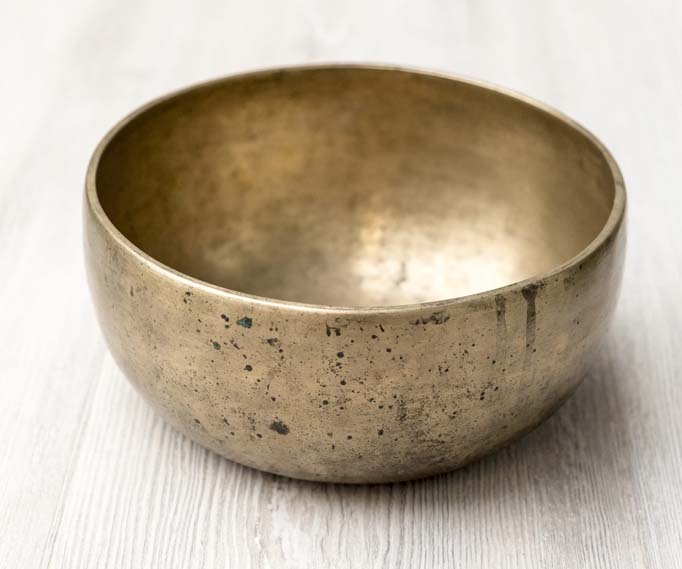
An antique singing bowl is a piece forged between 50 and 350 or more years ago in the Himalayan region — Nepal, Tibet or Northern India — originally made for domestic, monastic or ceremonial use. These bowls were not created as meditation instruments for Western practitioners. They were cooking vessels, alms bowls, offering bowls, storage containers. The fact that they produce extraordinary sound was understood by their makers — but their original purpose was practical and devotional, not therapeutic in the modern sense.
The term Old Collected — used throughout the Dharma Tool antique range — is the most precise and honest description. These are genuine old pieces collected from their original contexts: villages, households, monasteries and private collections across Nepal and Tibet. They are individually assessed for authenticity, tonal quality and provenance before being made available. This distinguishes them from artificially aged pieces and from new bowls misrepresented as antique — a documented problem in the singing bowl market that any responsible source should name directly.
What neither category includes — and what this guide deliberately sets aside — is machine-made, mass-produced or factory-cast bowls. These may be sold as handmade or as antique by less scrupulous sources. They are neither. They are a separate category entirely, producing inferior sound and carrying none of the cultural or acoustic value of genuine handmade or genuinely antique instruments.
The Sound Difference — What You Actually Hear and Feel
This is the section that matters most — and the one where most comparison guides fail by being either too vague ("antique sounds warmer") or too technical ("crystalline grain structure"). The truth is both experiential and scientific, and both dimensions are worth understanding.
What a New Handmade Bowl Sounds Like
Strike a quality new handmade singing bowl and the sound responds immediately. It rises with brightness and confidence — clear, present, direct. The fundamental tone is strong and the overtones are vivid. If you play around the rim, the bowl responds quickly to the mallet's friction and builds a singing tone that is easy to sustain. The physical vibration is powerful and immediate — newer metal, with its internal stresses from recent forging still present, transmits vibration with a directness that experienced practitioners sometimes describe as energising.
The new handmade bowl is an instrument still becoming what it will be. Its overtones are present and real — but they have not yet had decades of use to find their settled relationships with each other. The sound is rich, but it is a richness that is still developing. Play the bowl daily for a year and it will sound noticeably different. Play it for ten years and the change will be significant. The new handmade bowl invites you to grow with it — to develop your practice alongside the instrument's own developing character.
A Full Moon handmade bowl — forged on the night of Purnima — produces a richer overtone profile than a standard new handmade bowl of the same design, because the ceremonial context of its making and the specific conditions of full moon night forging introduce additional harmonic complexity into the metal from the beginning. For practitioners who want the richest possible new handmade sound, the Full Moon range is the natural choice.
What an Antique Bowl Sounds Like
Strike a genuine antique singing bowl and the sound does something different. It does not rush to be heard. It opens — slowly, in layers, revealing harmonic content as it develops that was not obvious in the first moment of the strike. The overtones of a genuine antique bowl have found their natural relationships over decades or centuries of use. They do not compete or scatter. They move together — rising in a coherent layered field and fading with an evenness that experienced practitioners consistently describe as the most meditative quality any instrument can produce.
The physical vibration of an antique bowl is different too — deeper and more diffuse, moving through the air and the body with less of the directness of a new bowl and more of a quality that practitioners describe as pervasive. Where a new handmade bowl strikes the listener with vibration, a quality antique bowl seems to surround them with it.
Acoustically, this difference is real and rooted in materials science. The crystalline structure of a seven-metal alloy settles and stabilises over decades of use and thermal cycling. Internal stresses from forging gradually relax. The patina that develops on the surface changes how vibration behaves at the metal-air interface. The cumulative acoustic result is a tone of extraordinary maturity — a sound that has, quite literally, had a very long time to find itself.
The 7 Real Differences — Specific, Honest, Practical
| Factor | New Handmade Bowl | Antique Old Collected Bowl |
|---|---|---|
| Sound character | Bright, immediate, energising — developing toward its full character with use | Settled, layered, revealing — already at its full acoustic maturity |
| Physical vibration | Direct and strong — powerful transmission through air and body | Deep and diffuse — pervasive rather than striking, surrounds rather than strikes |
| Chakra note selection | Available — choose from all 7 chakra notes at the time of purchase | Not available — antique bowls are what they are; their note is fixed by history |
| Customisation | Full Moon finish, Jhumka thickness, mantra carving, custom engraving, size selection | None — each piece is unique and fixed; selection is from available stock only |
| Provenance certainty | Complete — made by identified artisans in Kathmandu, process known | Requires trust in the source — provenance assessed but not laboratory verified |
| Price | Accessible across a wide range — from entry-level to premium | Significantly higher — reflects rarity, age and irreplaceability, not just quality |
| Investment value | Value is in the practice — not a collectible category | Strong — finite and decreasing supply against growing global demand |
Who Should Choose a New Handmade Singing Bowl
The new handmade bowl is the right choice for the vast majority of practitioners — not because it is a compromise, but because it is precisely the right instrument for where most people are in their practice. Here is who it serves best:
Beginners and Those New to Sound Healing
If you are beginning a singing bowl practice, a quality new handmade bowl gives you everything you need — rich overtones, strong physical vibration, and an instrument responsive enough to learn with. The new handmade collection offers sizes from 4 inches to 13 inches with a range of price points that make genuine quality accessible without the premium of the antique market. Starting with a new bowl also means starting with certainty — you know exactly what you have, how it was made, and what it will do.
Practitioners Who Want Specific Chakra Note Tuning
This is the single most practical reason to choose new handmade over antique. When you select a new handmade bowl from Dharma Tool, you choose your chakra note — from Root (C) to Crown (B). Antique bowls cannot offer this. Their note is whatever the history of the metal has produced, and while that note may be extraordinarily beautiful, it may or may not align with the specific energy centre you are working with. For practitioners doing targeted chakra healing — particularly with the 7 Chakra singing bowl sets — new handmade is not merely convenient. It is the only option that provides the full spectrum of intentional chakra alignment.
Sound Healers Needing Multiple Matching Bowls
Professional sound healers building a collection of matching or harmonically related bowls — for sound baths, chakra sets, layered sessions — need consistency that the antique market cannot reliably provide. You cannot order six matching antique Thadobati bowls tuned to specific notes. You can order six matching new handmade bowls tuned precisely to your specifications. For professional practice at scale, new handmade is the foundation of any serious collection.
Yoga Teachers and Studio Practitioners
Yoga teachers who incorporate singing bowls into their classes — for savasana, pranayama openings, and restorative practice — need instruments that are consistent, portable and predictable. The new handmade range, particularly the 7 to 10-inch sizes, provides exactly this. Paired with a tingsha for session opening and closing, a quality new handmade bowl is the complete yoga class sound toolkit.
Practitioners Who Want to Grow With Their Bowl
There is something meaningful about choosing a new handmade bowl and committing to a practice with it over years. The bowl will change as you change. Its sound will deepen as yours deepens. In ten or twenty years, the bowl you chose today will be an antique in the making — carrying the accumulated vibrations of your own practice in its metal. This is not a consolation prize for not buying antique. It is a different and equally valid relationship with an instrument.
Healer-selected, monk-blessed new handmade singing bowls — with chakra note selection, Full Moon editions and custom engraving
Every new handmade singing bowl at Dharma Tool is hand-beaten by skilled artisans in Thamel, Kathmandu from the traditional seven-metal alloy — individually selected by a professional healer for tonal quality and resonance. Choose your size, your chakra note, your finish — from standard handmade to Full Moon to Jhumka thick-walled. Worldwide DHL express delivery direct from Nepal.
Who Should Choose an Antique Singing Bowl
The antique bowl is the right choice for a specific kind of practitioner — and for those practitioners, it is not merely a better choice but a categorically different one. Here is who belongs in this category:
Experienced Practitioners Who Know What They Are Listening For
This is the most important qualifier. An antique bowl's qualities — the settled overtones, the mature harmonic character, the depth of its acoustic history — are subtleties that require experience to hear and appreciate. A practitioner who has spent months or years working with quality new handmade bowls will immediately recognise what an antique bowl offers that a new bowl cannot yet provide. A beginner will hear a beautiful sound but may not understand why it cost what it costs. The antique bowl rewards experience. It asks that you bring something to the encounter — a practiced ear, an understanding of what you are listening for.
Collectors of Himalayan Heritage
The Old Collected antique singing bowl is a piece of Himalayan cultural heritage — forged by artisans whose specific techniques have in some cases been lost, used in contexts that no longer exist in the same form, carrying in its metal the accumulated history of its many years of service. For collectors who understand this dimension of the instrument — who are drawn not only to the sound but to the object's place in a long human story — an antique bowl is irreplaceable. No new bowl, however well made, carries this dimension.
Sound Healers Seeking Maximum Therapeutic Depth
Professional sound healers who have built their practice over years and want to add the deepest possible therapeutic instrument to their collection consistently gravitate toward antique bowls — particularly the Old Collected Jambati for sound bath work and the Old Collected Thadobati for one-to-one sessions. The settled, diffuse quality of a genuine antique's vibration reaches the client's nervous system with a quality that even the finest new handmade bowl has not yet developed. For practitioners working at the deepest levels of therapeutic sound healing, a quality antique bowl is the instrument that takes their work to a different level entirely.
Practitioners Drawn to Lineage and History
Some practitioners are called specifically to work with the lineage of the instrument — the sense that the bowl has been held, played and offered by many hands before theirs, and carries something of those encounters in its metal. This is not fantasy. A bowl used for daily practice in a monastery for a century has been vibrated millions of times in a context of specific intentional use. That history is physically present in the instrument. For practitioners who resonate with this dimension of working with antique objects, the choice is not primarily acoustic. It is relational.
Investors Who Understand the Supply Reality
The antique singing bowl market has a straightforward supply dynamic: the supply is finite and decreasing, demand from Western practitioners and collectors is growing, and the largest export volumes ever seen — in the early 2000s — will never be repeated because the source material that enabled them has been largely depleted. Quality Manipuri bowls are now genuinely scarce. Jambati and Thadobati prices are rising. The window to acquire quality pieces at current prices will not remain open indefinitely. For those who understand this and approach the antique market with the knowledge to buy well, genuine antique singing bowls represent a meaningful long-term investment — in both the financial and the personal sense of that word.
Genuine Old Collected antique singing bowls — Thadobati, Jambati, Manipuri, Lingam, Mani, Remuna, Naga Pedestal and more
Every antique bowl in the Dharma Tool collection is a genuine Old Collected piece sourced directly from Nepal — individually assessed for tonal quality, resonance depth and authenticity. Based in Thamel, Kathmandu, Dharma Tool has direct access to antique sources that no Western reseller can reach. Each piece is unique. Stock is finite. DHL express worldwide delivery.
The Journey Both Bowls Are On — The Insight That Changes Everything
Here is the perspective that no other comparison guide offers — because most guides are written by people who sell one category or the other, not both from the same source in the same city where both are made and collected.
Every antique bowl was once new. Every genuine antique Jambati that produces its extraordinary settled tone today was struck for the first time by an artisan in a Kathmandu or Tibetan workshop somewhere between one and three centuries ago. In that moment, it sounded like a new handmade bowl — bright, strong, developing. Its overtones were present but unsettled. Its vibration was direct rather than diffuse. The qualities that make it extraordinary today were not yet present. They developed through generations of use, through thousands of strikes in contexts of devotion and daily life, through cycles of warmth and cold, through the accumulated physical history of a very long existence.
A quality new handmade singing bowl from Thamel, Kathmandu — made today, in 2025, by an artisan continuing the same tradition — is at the beginning of that same journey. The question is not which bowl is better. The question is where you want to meet a bowl on its journey.
Do you want to begin alongside it — to grow your practice as the bowl grows its character, to witness the development of its sound over the years of your life? Or do you want to inherit a journey already completed — to work with an instrument that has already arrived at its full acoustic self, carrying everything it has been through in the quality of its sound?
Both are profound choices. Both are right for different practitioners at different moments. The wisest approach — for those with the means and the experience — is ultimately to have both. Let the new handmade bowl be the instrument of daily practice, of development, of the ongoing relationship between a practitioner and a sound. Let the antique bowl be the instrument of depth — brought out for the sessions that require everything the tradition has to offer.
The Decision Framework — A Simple, Honest Guide
Choose a New Handmade Singing Bowl if:
- You are new to singing bowl practice and want to begin with quality
- You want to choose a specific chakra note — from Root C to Crown B
- You want a Full Moon bowl, Jhumka thick-walled bowl, or custom engraved piece
- You are building a chakra set or matched professional collection
- You are a yoga teacher or studio practitioner who needs consistency
- You want to grow with your bowl over years of daily practice
- You want complete certainty about what you are buying and how it was made
- Budget is a consideration — quality without antique premium
Choose an Antique Old Collected Singing Bowl if:
- You are an experienced practitioner who already knows what quality sounds like
- You collect Himalayan instruments and understand their cultural significance
- You want the deepest possible settled, mature harmonic character in your practice
- You are drawn to working with the lineage and history of the instrument
- You are a professional sound healer adding a depth instrument to an existing collection
- You understand the investment dimension of a finite, decreasing supply
- You want a piece that cannot be replicated — because nothing made today can be what it already is
Consider both if:
- You have an established practice and want to add the depth of antique alongside the versatility of new handmade
- You run a professional healing practice where different sessions call for different instruments
- You want the chakra precision of a new bowl set and the historic depth of an antique centrepiece
- You understand that new handmade and antique are not competing — they are complementary
Why Buying Both from Nepal Directly Matters
The sourcing question is not separate from the quality question — it is the same question. Both new handmade and antique singing bowls exist on a quality spectrum that is entirely determined by how close to the source the buyer is when they make their selection.
A Western reseller buying from a Nepal wholesale catalogue gets whatever the wholesaler selected. A buyer purchasing directly from Dharma Tool in Thamel, Kathmandu gets bowls individually assessed by a practitioner with daily hands-on experience of the full range of quality available in the Kathmandu market. For new handmade bowls, this means healer-selected pieces from artisan workshops where the quality of each individual bowl's tone, sustain and vibration is verified before listing. For antique bowls, this means pieces sourced from collectors and estates across Nepal, assessed individually for authenticity — patina, weight, sound profile, hammer marks — before being made available.
No Western reseller, however reputable, can replicate this proximity. The quality differential between a healer-selected bowl from source and a wholesale catalogue bowl from a reseller is real, consistent and audible. For both new handmade and antique, the closest point to the source produces the best instrument. That point, for Himalayan singing bowls, is Nepal — specifically Thamel, Kathmandu, where the tradition of bowl making and bowl collecting is still alive in the hands of people who understand it from the inside.
Frequently Asked Questions
What is the main difference between a new handmade and an antique singing bowl?
The primary difference is acoustic maturity. A new handmade singing bowl is forged recently by living artisans using the traditional seven-metal alloy and hand-hammering method — it produces a bright, immediate, energising sound with rich overtones that are still developing toward their full character with use. An antique old collected singing bowl is a piece forged between 50 and 350 or more years ago — its overtones have settled into natural relationships over decades of use, producing a sound that experienced practitioners describe as more layered, more diffuse in its vibration, and more harmonically mature. Neither is universally better — they are different instruments at different stages of the same acoustic journey.
Do antique singing bowls actually sound better than new handmade ones?
Not universally better — but genuinely different in specific ways that experienced practitioners consistently recognise. Antique bowls produce a more settled, harmonically complex tone whose overtones move together rather than competing. New handmade bowls produce a more immediate, energising sound with strong direct vibration that some practitioners find more effective for active healing work. The most honest answer is that a quality antique bowl sounds like a new handmade bowl that has had one to three centuries to develop — which is a meaningful difference, but one that requires a practiced ear to fully appreciate and that does not make the antique universally superior for all practice contexts.
Can I choose a specific chakra note in an antique singing bowl?
No — and this is one of the most practically significant differences between the two categories. New handmade singing bowls from Dharma Tool allow you to select your chakra note at the time of purchase, from Root C to Crown B. Antique old collected bowls are what history has made them — their note is fixed and cannot be specified at the time of buying. This makes new handmade bowls the only option for practitioners doing specific chakra-targeted work or building a tuned chakra set. If precise note selection is important to your practice, new handmade is the appropriate choice regardless of any preference for antique character.
How do I know if an antique singing bowl is genuinely old?
The most reliable indicators are: genuine patina showing specific wear patterns — brighter on the rim and outer wall where hands have contacted the metal, darker in recessed areas — rather than uniform artificial darkening; weight heavier than expected for the size; hammer marks irregular in patterns consistent with actual hand movement; and most reliably, the sound — a genuine antique bowl reveals new harmonic content as it fades rather than simply diminishing in volume. Buying from a Nepal-based source with direct provenance access — like Dharma Tool in Thamel, Kathmandu — significantly reduces the authentication risk compared to purchasing from a Western reseller working from a wholesale catalogue.
Are antique singing bowls worth the higher price?
For the right practitioner — yes, clearly and specifically. The higher price of a genuine antique bowl reflects rarity, irreplaceability and the acoustic maturity that cannot be purchased in a new instrument regardless of price. It does not reflect the quality of craftspersonship alone — a quality new handmade bowl made by Kathmandu's finest artisans is genuinely excellent. The premium of the antique reflects what cannot be made new: the settled harmonic character of aged metal, the cultural and historical significance of a piece with genuine provenance, and the investment reality of a finite, decreasing supply. For beginners, the premium is not yet appropriate. For experienced practitioners, collectors and serious sound healers, it is often the most meaningful investment they make in their practice.
Which is better for sound healing — new handmade or antique?
Both are highly effective — through different mechanisms and at different depths. New handmade bowls, particularly Full Moon and Jhumka thick-walled types, produce powerful direct vibration that activates the vagus nerve through multiple pathways simultaneously and is exceptionally effective for active therapeutic work, body placement and nervous system regulation. Antique bowls produce a more diffuse, deeply settled vibration whose quality of harmonic maturity reaches the nervous system differently — creating a quality of stillness in the sound itself that many practitioners describe as the most meditative acoustic experience available. For professional sound healers, the ideal is eventually to have both — using new handmade bowls for the structure of a session and a quality antique bowl for its deepest moments.