




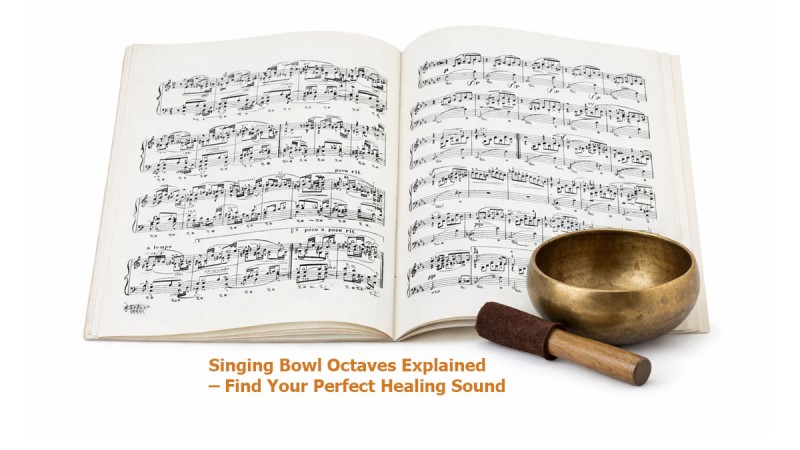
Singing Bowl Octaves Explained
When people ask about the octave of a singing bowl, they are really asking about the pitch range in which that bowl speaks most clearly. Whether you are exploring a single Tibetan singing bowl or a full singing bowl set, understanding octave helps you make a more informed choice.

However, singing bowls are not simple instruments. A handmade Himalayan singing bowl produces a layered sound, not just one fixed frequency. That is why octave must be understood correctly.
What an Octave Actually Means
In acoustics, an octave is a doubling of frequency. For example, 220 Hz becomes 440 Hz in the next octave. This is a scientific relationship used across all musical systems.
Octaves help describe whether a sound is deep, balanced, or bright — something you will notice immediately when listening to a Tibetan singing bowl.
The Standard Octave System (Oct 0 – Oct 8)
- Octave 0 – near the lowest limit of human hearing
- Octave 1 – extremely deep bass
- Octave 2 – heavy, grounded tones
- Octave 3 – fuller low-mid sound
- Octave 4 – natural listening range
- Octave 5 – bright and clear tones
- Octave 6+ – very high frequencies
Most Himalayan singing bowls operate within Octave 2 to Octave 5, which is ideal for meditation and sound-based practices.
Why Singing Bowls Are Not Single-Frequency Instruments
Unlike modern instruments, a handmade Tibetan singing bowl does not produce a single pure tone. Instead, it produces:
- A fundamental tone (main pitch)
- Multiple harmonics (higher frequencies)
This is why even within a singing bowl set of 7, each bowl feels unique. The interaction of tones creates a richer experience than a single note.
Explore Tibetan & Himalayan Singing Bowls
Browse our collection of handmade Tibetan singing bowls and complete singing bowl sets, carefully selected for sound quality and resonance.
Shop Singing BowlsWhat Octave Means in Real Practice
When choosing a singing bowl, octave is best understood as the general sound range:
- Lower range – deeper, grounding tones
- Mid range – balanced, stable sound
- Higher range – clearer, more focused tones
In a chakra singing bowl set, different bowls often span multiple octaves to create a full sound experience.
Why the 4th Octave Is Often Preferred
You may come across the idea that the 4th octave is the “best” for singing bowls. In reality, there is no single perfect octave for everyone. However, there is a reason why many high-quality Tibetan and Himalayan singing bowls are often found around the 4th octave range.
The 4th octave sits close to the natural range of human hearing, where sound feels clear, balanced, and easy to process. This is the same general range where much of the human voice operates, which is why it feels familiar and comfortable.
In practical use, bowls that resonate around this range tend to offer:
- Clarity – the sound is easy to hear without strain
- Balance – not too deep and not too sharp
- Versatility – suitable for meditation, relaxation, and general sound work
This is why many singing bowl sets, including chakra singing bowl sets and singing bowl sets of 7, are designed so that several bowls fall within or near this range. It creates a stable and harmonious listening experience.
That said, the 4th octave is not “better” than other octaves. Lower ranges provide deeper vibration, while higher ranges offer more brightness and clarity. Each range serves a different purpose.
The key is not to chase a specific octave, but to choose a bowl or singing bowl set that feels natural and resonant to you.
Octave vs Note – Important Difference
A note (C, D, E, etc.) tells you the position in a scale, while the octave tells you how high or low that note is.
This is especially important when working with a singing bowl set of 7, where each bowl is associated with a different note but may still vary in octave and harmonic content.
Why You Should Not Choose a Bowl by Octave Alone
Octave is only one part of the experience. A Himalayan singing bowl should be chosen based on:
- Sound clarity
- Sustain
- Resonance
- Overtone richness
This is why many practitioners prefer bowls that are tested and selected for sound rather than just labeled by frequency.
Get a Custom or Healer-Selected Singing Bowl
Looking for a specific sound? Request a personalized or chakra singing bowl set selected based on tone and resonance.
Request Custom BowlThe Most Common Mistake About Singing Bowl Octaves
Many guides simplify octave too much, often linking it only to size or chakra. In reality, a singing bowl is influenced by multiple factors including metal composition, thickness, and craftsmanship.
This is why two Himalayan singing bowls of similar size can produce very different sounds.
How to Understand Octave by Listening
- Listen to the first strike
- Notice if the sound feels deep, balanced, or bright
- Observe how the sound evolves
- Try the rim tone separately
This approach works better than relying only on technical labels.
Final Understanding
Singing bowl octaves are a useful guide, but they do not define the full experience. Every Tibetan singing bowl produces a unique combination of tones.
Whether you choose a single bowl or a full singing bowl set, the best choice comes from how the sound feels, not just how it is labeled.
Frequently Asked Questions About Singing Bowl Octaves
What does octave mean in a singing bowl?
An octave refers to the pitch range of the bowl’s main sound. In acoustics, an octave means a doubling of frequency. For singing bowls, it helps describe whether the sound is deeper, more balanced, or brighter.
Are singing bowls tuned to one exact octave?
Not usually. Handmade singing bowls do not behave like perfectly machine-tuned instruments. A bowl produces a main tone along with harmonics, so the sound is layered rather than limited to one exact frequency.
Is octave the same as note in a Tibetan singing bowl?
No. A note tells you the pitch name such as C, D, or E, while the octave tells you how high or low that note is. For example, C3 and C4 are both C, but they are in different octaves.
Do larger singing bowls always have a lower octave?
Not always. Size can influence pitch, but it is not the only factor. The alloy, wall thickness, shape, and hand-forging method also affect how a Himalayan singing bowl sounds.
Why do two singing bowls with a similar note sound different?
Because singing bowls produce overtones in addition to the main tone. Two bowls may seem close in pitch, but their resonance, sustain, and harmonic richness can be very different.
What octave range do most Tibetan singing bowls fall into?
Most Tibetan singing bowls are generally heard within the lower to middle musical range, often around Octave 2 to Octave 5, depending on the bowl and how it is played.
Is octave important when buying a singing bowl set?
Yes, but it should not be the only thing you look at. In a singing bowl set or singing bowl set of 7, the full experience depends on tone quality, resonance, sustain, and how the bowls work together.
What is better for beginners: a single bowl or a chakra singing bowl set?
A single bowl is often easier for beginners because it lets you focus on one sound and one playing style. A chakra singing bowl set can offer more variety, but it may take more time to understand each bowl fully.
How can I understand a bowl’s octave without technical tools?
The easiest way is to listen carefully. A deeper sound usually feels more grounded, a middle-range sound feels balanced, and a brighter sound feels lighter and clearer. Listening is often more useful than relying on numbers alone.
Why is octave information useful for a Himalayan singing bowl buyer?
It helps you understand the general sound register of the bowl, but it should be used together with real listening, sound quality, and personal preference. The best bowl is the one that resonates with you clearly and naturally.