




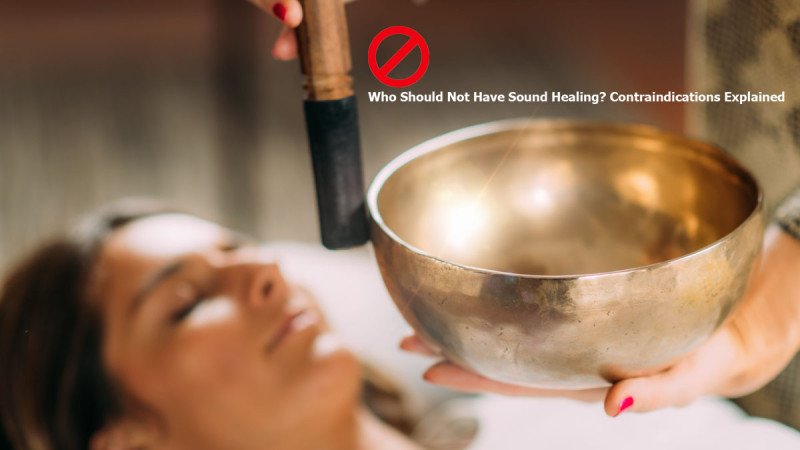
The list nobody in this industry publishes
Sound healing is generally very safe. For most people the worst that happens is that nothing happens.
But there are situations where a bowl should be played differently, placed elsewhere, or not at all — and they are almost never written down. Search for singing bowl benefits and you will find thousands of pages. Search for who should not have sound healing and you will find very little.
This is that list, taken from the practitioner training in Course Three of our free course. It is written for anyone giving sessions to other people, and it is worth reading if you are receiving one too.
Is sound healing safe?
For most people, yes. It involves no substances, no manipulation of the body, and no claims that require you to stop doing anything else.
The risks that do exist come from four things: vibration placed directly on the body, volume close to the head, deep relaxation in someone who should not be deeply relaxed, and a practitioner saying something they should not.
Almost everything below is one of those four.
Who should not receive sound healing?
| Situation | What changes |
|---|---|
| Pregnancy | No bowls on the abdomen or lower back. Keep it quiet and short. Many practitioners avoid placement entirely in the first three months. |
| Pacemaker or implanted device | No bowl placed on or near the device. |
| Epilepsy or seizure disorder | Avoid sustained rhythmic pulsing. Ask them to check with their doctor first. If unsure, decline. |
| Recent surgery, fracture or wound | Nothing on or near the site, and nothing at all until healed. |
| Tinnitus or sound sensitivity | Quiet bowls, played gently, checked partway through. |
| History of psychosis or dissociation | Not the right setting. Decline kindly and suggest their own clinician. |
| Under 18 | A parent or guardian present, and their consent as well as the young person's. |
| Fever or acute illness | Reschedule. They should be resting. |
| Alcohol or drugs | Do not proceed. Consent is not meaningful and neither is the session. |
| Recent bereavement or trauma | Go gently, offer eyes open, no touch, shorten it. Sound brings things up faster than people expect. |
Is sound healing safe during pregnancy?
Sound in the room is not the concern. Vibration on the body is.
A bowl played beside someone, or held above them, is no different from listening to music. A heavy bowl resting on the abdomen or lower back is a different proposition, and it is the one to avoid.
Most practitioners keep pregnancy sessions shorter and quieter, work with the client seated or side-lying rather than flat, and place nothing at all. Plenty avoid the first trimester altogether, not because there is evidence of harm but because nobody wants to be the person who was in the room.
Can you have sound healing with a pacemaker?
Yes, with one restriction: no bowl on or near the device.
Ambient sound is not the issue. Direct mechanical vibration against the chest is what to avoid, so the whole upper chest is out of bounds for placement. Everything else — bowls played beside the body, at the feet, around the head — is unaffected.
The same applies to any implanted device, and if the person is unsure what they have or where it sits, that is a question for their cardiologist rather than for you.
Is sound healing safe if you have epilepsy?
Ask them to check with their doctor first.
The concern is not the bowls themselves but sustained rhythmic pulsing — the same category of caution that applies to strobe lighting. Anything resembling brainwave entrainment, with a repeating beat held for long periods, should be avoided entirely.
A slow session with long silences between strikes is a very different thing from a pulsing one. But this is not a judgement for a sound practitioner to make alone, and if you cannot get a clear answer, decline politely.
What about after surgery or injury?
Nothing placed on or near the site, and nothing at all until it has healed. Scar tissue, healing bone and recent stitches do not want vibration.
Sound from a distance is fine and often welcome — people recovering from surgery are frequently bored, uncomfortable and sleeping badly, which is exactly what a quiet session helps with.
The same caution covers metal implants and joint replacements: work around the site, not on it.
What if someone is sensitive to sound?
Ask before you begin, every time. Tinnitus, hyperacusis and general sound sensitivity are common and rarely volunteered.
Some people with tinnitus find bowls soothing. Others find them unbearable. You cannot tell in advance, so play quietly, check partway through, and stop if the answer is anything other than a clear yes.
This is one reason a smaller bowl is often the better instrument near the head. Hand-hammered bowls in the higher notes give you something you can play very softly and still have carry.
What about mental health?
Deep relaxation is not neutral for everyone.
For most people, lying still with eyes closed for half an hour is restful. For someone with a history of psychosis or dissociation it can be destabilising, and a sound session is not the right setting for that.
Decline kindly, without making it a moment, and suggest they speak to their own clinician about whether it would suit them.
Anxiety and low mood are different. Those people can absolutely have a session, and it may well help them sleep — but ask, kindly, whether they have support, and encourage it if they do not. Sound work sits alongside professional care, never instead of it.
When should you stop a session immediately?
Four things, none of which are sound healing matters:
- Chest pain
- Difficulty breathing
- Sudden severe headache
- Thoughts of harming themselves
Stop, stay with them, and help them reach medical or professional support. Recognising these quickly is one of the most useful things a practitioner ever does.
What do you say when someone asks you to treat their illness?
It will happen. Someone will ask whether you can help with their back pain, their thyroid, their fertility, their cancer. Have an answer ready, because improvising under that kind of hope is how decent people end up making claims they never meant to make.
I can't treat that, and I wouldn't want to say otherwise. What this does do is help people relax deeply, and a lot of people sleep better afterwards. You're very welcome to have a session for that reason, alongside whatever your doctor is doing.
Honest, kind, and it sends nobody away. It also earns more trust than a bolder claim would — people are used to being oversold and they notice when someone declines to do it.
Never suggest anyone reduce, delay or stop medical treatment. Not as advice, not as a hint, not as a story about someone else who did.
What if the person cannot lie down at all?
This is where most sound healing quietly gives up, and where the Nepali tradition has an answer that others do not.
Warm water therapy was developed for older people who cannot manage floor work. The session is given seated in a firm chair, runs about twenty minutes rather than forty, and uses a bowl part-filled with warm water — which lowers the tone, softens it, and makes the sound visible as ripples on the surface.
Two safety points that matter more than they sound. Warm, never hot — test it on your own wrist every time, because older people often have reduced sensitivity to heat and thinner skin. And help them up slowly afterwards: people are less steady after deep relaxation than before it, and that is the likeliest moment for a fall.
A heavier bowl with a broad flat base works best for this, which is why the large standing bowls are what the method assumes.
If you are the one receiving a session
A good practitioner will ask you most of the above before you lie down. If nobody asks you anything, that tells you something.
You are also entitled to say no to being touched, to keep your eyes open, and to stop at any point without giving a reason. Any practitioner worth seeing will say so before they begin.
Where this comes from
All of the above is drawn from Lesson 3.2 of our free sound healing course — thirty-six lessons transcribed from the handwritten training notebook of Nepali healer Sunita Poudel.
The course covers both the Vedic and Tibetan healing systems, sound massage, warm water therapy, five-element cleansing and an eighteen-day treatment programme. It is free to read in full, with no account and no email.
Learn to give a session properly. Thirty-six lessons, four courses, nothing locked.
And if you are choosing a bowl to work with, our guide to choosing a singing bowl covers the practical side, or you can browse the full range.