




What Mantra Is Written on a Tibetan Prayer Wheel?
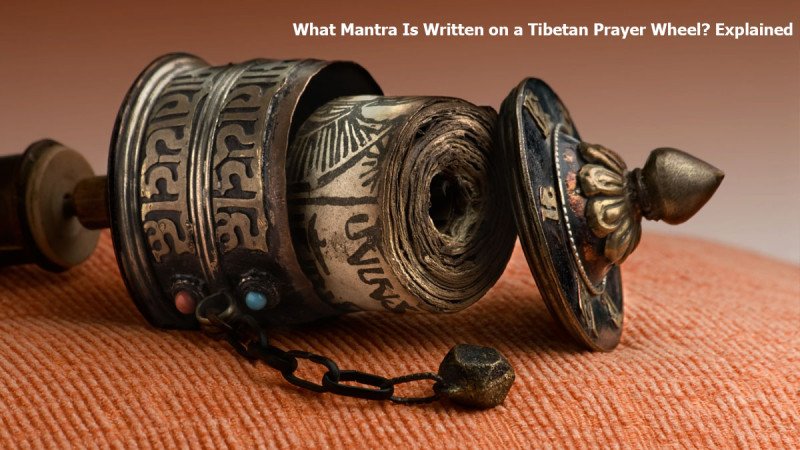
The mantra written on a Tibetan prayer wheel is Om Mani Padme Hum, the six-syllable mantra of Avalokiteshvara, the Bodhisattva of Compassion. It appears twice: engraved on the outside of the copper or brass cylinder, usually in the ornamental Ranjana script, and printed thousands or millions of times on a tightly wound paper scroll hidden inside. The outer engraving is what you see. The inner scroll is what the wheel actually turns.
Most people who hold a prayer wheel for the first time see the beautiful lettering on the outside and assume that is the prayer. It is not — or rather, it is only half of it. The engraving on the surface is a declaration of what the object is. The real substance of a prayer wheel is sealed inside, wound around a central wooden or metal axis, and it is never meant to be read by human eyes at all.
This guide explains both: the six syllables and what each one means, the two scripts you will see, what the "two-line" and "ten-line" descriptions on a Tibetan prayer wheel actually refer to, and what is genuinely printed on the scroll inside a properly made wheel.
What Does Om Mani Padme Hum Mean?
Om Mani Padme Hum is the most widely recited mantra in Tibetan Buddhism. It belongs to Avalokiteshvara — Chenrezig in Tibetan — the Bodhisattva who embodies the compassion of all the Buddhas.
A common translation is "the jewel in the lotus," and that is not wrong, but it is thin. Mani means jewel, and stands for method: compassion, loving intention, the wish to benefit others. Padme means lotus, and stands for wisdom — the understanding of how things actually are. Hum means indivisibility. The mantra is not describing a jewel sitting inside a flower. It is saying that compassion and wisdom, held together and inseparable, are what transform an ordinary mind into an awakened one.
Om opens it. The syllable is made of three sounds — A, U, M — representing the impure body, speech, and mind of an ordinary being, and at the same time the pure body, speech, and mind of a Buddha. The mantra begins by placing both in the same syllable, because the path from one to the other is the whole point.
The Six Syllables and What Each Purifies
In traditional teaching, each of the six syllables corresponds to one of the six perfections and works against one of the six root afflictions. This is the framework given when the mantra is formally transmitted.
| Syllable | Perfection cultivated | Affliction purified |
|---|---|---|
| OM (ༀ) | Generosity | Pride |
| MA (མ) | Ethics | Jealousy |
| NI (ཎི) | Patience | Desire and attachment |
| PAD (པ) | Diligence | Ignorance |
| ME (དྨེ) | Concentration | Greed and possessiveness |
| HUM (ཧཱུྃ) | Wisdom | Anger and aversion |
Six syllables, six perfections, six afflictions. When the wheel turns, all six move together. This is why the mantra is considered complete in itself — nothing needs to be added to it, and nothing may be taken away.
Which Script Is the Mantra Written In?
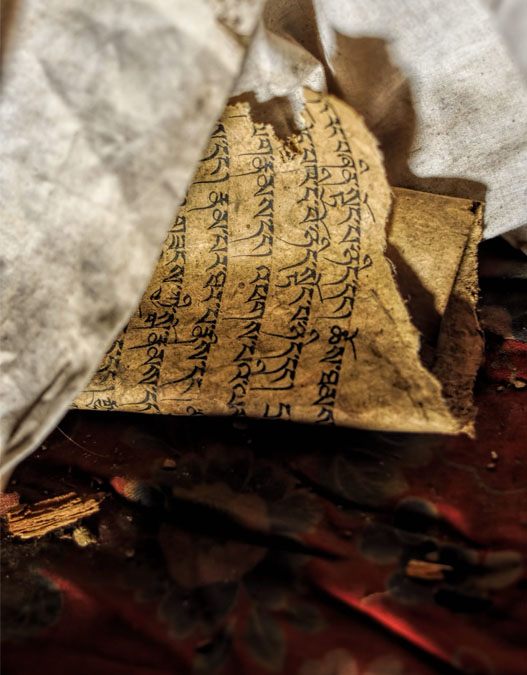
Two scripts appear on prayer wheels, and both are correct.
Ranjana (Lantsa) Script
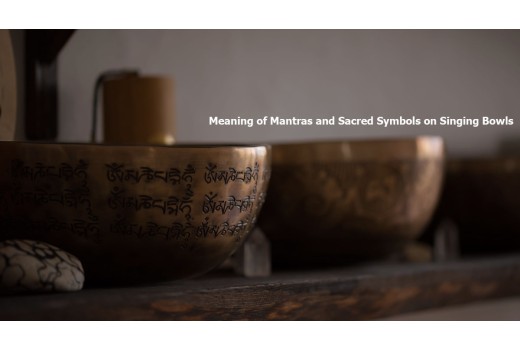
Most of the flowing, ornamental lettering you see raised on the outside of a prayer wheel is Ranjana — called Lantsa in Tibetan. It is an old Indian script, developed in the Kathmandu Valley around the eleventh century, and Newar artisans in Nepal have used it for sacred inscriptions ever since.
Ranjana is used because mantras came to Tibet from India in Sanskrit. Writing them in the Indian script preserves the connection to their source. It is also, plainly, the more beautiful script for embossing — the long horizontal head-line and the curling verticals suit metalwork in a way that everyday writing does not. When you look at a mantra-engraved prayer wheel and see rows of elegant looping characters, you are looking at Ranjana.
Tibetan Uchen Script
The other script is Uchen — the formal Tibetan block script used for scriptures. It appears on prayer wheels too, particularly on wheels made for Tibetan communities rather than for export, and it is very often the script used on the paper scroll inside.
Neither script is more valid. A wheel engraved in Ranjana and filled with a scroll printed in Uchen is entirely traditional, and extremely common.
What Does "2-Line" or "10-Line Mantra" Mean on a Prayer Wheel?
This is the question we are asked most often, and it has a simple answer that almost no one explains.
The number of lines refers to how many horizontal rows of Om Mani Padme Hum are engraved around the outside of the cylinder. A two-line prayer wheel carries the mantra in two bands stacked around the body. A ten-line wheel carries ten.
The mantra itself does not change. It is the same six syllables in every case. What changes is how many times they are physically written on the surface — and in the traditional understanding, a mantra written more times is a mantra more fully present in the object.
| Configuration | What it means | Typically found on |
|---|---|---|
| 2-line mantra | Two rows of Om Mani Padme Hum around the cylinder | Smaller wheels, 5-8 inch, with room for larger lettering |
| 3-line mantra | Three stacked rows | Mid-size table-top and wall wheels |
| 4-line mantra | Four stacked rows, finer lettering | Taller cylinders where the body allows more bands |
| 10-line mantra | Ten rows, densely worked | Larger table-top wheels made for daily devotional use |
A two-line wheel gives each syllable more space and is easier to read at a glance. A ten-line wheel covers the entire surface in mantra with almost no bare metal remaining. Between them sit the three-line and four-line wheels, which are the most common.
Choose by what draws you. Neither carries more blessing than the other in any mechanical sense — the merit of a prayer wheel rests overwhelmingly on what is sealed inside it, not on the outer engraving.
Every wheel filled with a genuine mantra scroll before it leaves Nepal
A prayer wheel without its scroll is an ornament. Every wheel in our Tibetan prayer wheel collection is made by Newar artisans in the Kathmandu Valley and filled with a properly printed mantra roll. Choose a hand-held wheel for walking practice, or a table-top or wall-hanging wheel for a shrine or entrance.
What Else Is Engraved Around a Prayer Wheel?
/14-inch-tabletop-tibetan-prayer-wheel-austamangal-symbol-1100x744w.jpg.webp "Eight Auspicious Symbols (Ashtamangala) embossed around a Tibetan prayer wheel")
The mantra is rarely alone. Several other elements appear alongside it, each with its own meaning.
The Eight Auspicious Symbols — Ashtamangala, or Austamangal as it is often written in Nepal — are the eight gifts offered to the Buddha at his enlightenment: the parasol, the golden fish, the treasure vase, the lotus, the conch, the endless knot, the victory banner, and the dharma wheel. A wheel carrying all eight alongside the mantra is understood to be protected and auspicious from every direction.
The endless knot often appears at the base, symbolising the interdependence of all phenomena — that nothing arises alone and nothing ends cleanly. It suits the base of a wheel particularly well, since it is the point where the turning meets the ground.
The dorje, or vajra, represents indestructible clarity — wisdom that cuts through delusion and cannot itself be broken. It appears on bases and finials, and carries the same meaning it does in the bell and dorje set used in ritual practice.
Dragons appear on some wheels as guardians and as a symbol of the power of the awakened mind. The Potala gate frames the cylinder on certain designs, invoking the palace of Avalokiteshvara himself — appropriate, given whose mantra the wheel carries.
None of these replace the mantra. They surround it, in the same way a temple surrounds its shrine.
What Do the Turquoise and Coral Stones on a Prayer Wheel Mean?
Turquoise and coral are the two most important stones in Tibetan and Himalayan life, and they are not set into a prayer wheel for decoration alone. Together they represent a complete pairing — sky and sea, heaven and life-force, the blue above and the red within.
You will see them on jewellery, on ritual implements, on the headdresses of Tibetan women, and on the bodies of prayer wheels, usually set in brass or silver bezels between bands of mantra. Lapis lazuli often joins them as a third stone.
| Stone | Tibetan name | Traditional meaning |
|---|---|---|
| Turquoise | གཡུ — gyu | The sky and water. The most treasured stone in Tibet, associated with long life, healing and protection. Traditionally believed to absorb misfortune on the wearer's behalf — a stone that darkens or cracks is said to have taken something that would otherwise have fallen on its owner. |
| Red coral | བྱུ་རུ — churu | Life-force and vitality, the colour of blood and of the fire element. Carried into Tibet along the old trade routes from distant seas, which made it precious and rare. Worn and set for protection, particularly for women and children, and to guard against illness. |
| Lapis lazuli | མུ་མེན — mumen | Healing and truth. The Medicine Buddha is described in the sutras as having a body the colour of lapis, which ties the stone directly to healing practice. Its deep blue is also read as the depth of wisdom. |
Why the Pairing Matters
Turquoise and coral set together is the classic Himalayan combination, and the logic is elemental. Turquoise is sky, water, coolness, the vast and the eternal. Coral is blood, fire, warmth, the living and the immediate. One is what surrounds us; the other is what moves inside us.
Setting both into an object that turns a compassion mantra places the practice between them — heaven above, life below, the wheel turning in the space where a human being stands. This is not a modern interpretation added for retail. It is why these two stones have been paired in Himalayan craft for centuries.
On Stone Quality
Genuine turquoise varies in colour from pale sky blue to deep green, and often carries dark veining from the host rock — this matrix is a mark of natural stone, not a flaw. Natural coral ranges from pale pink through deep ox-blood red. Perfectly uniform, glassy stones of intense colour are frequently reconstituted or dyed.
Most stone-set prayer wheels use natural Himalayan turquoise and coral of ordinary commercial grade rather than gem quality, and that is entirely traditional. These were always working sacred objects, not jewellery. The stone is there for what it means, not for what it is worth.
Our stone-set pieces include the turquoise, coral and lapis three-in-one wheel, the twelve-inch stone-inlaid mantra wheel, and the Eight Lucky Symbols wheel with stone inlay, where the stones sit between the embossed symbols rather than among the mantra bands.
What Is Actually Written on the Scroll Inside a Prayer Wheel?
Here is the part almost nobody sees.
/10-inch-tabletop-tibetan-prayer-wheel-eight-lucky-symbols_5-1100x744w.jpg.webp "The mantra roll inside a Tibetan prayer wheel — Om Mani Padme Hum printed thousands of times on a wound paper scroll")
Inside the cylinder, wound tightly around a central axis, is a long strip of paper printed with Om Mani Padme Hum repeated over and over — thousands of times in a small hand-held wheel, hundreds of thousands or millions in a large one. This scroll is the actual substance of the prayer wheel. Everything outside it is housing.
The Life Tree at the Centre
The axis the scroll is wound around is called the srog shing — the life tree, or life-force wood. It is made of wood or metal, and it is not merely structural. The srog shing is itself inscribed or consecrated with the seed syllables of enlightened body, speech, mind, quality, and activity. It functions as the central channel of the wheel, in the same way the central channel runs through the subtle body in tantric practice.
A prayer wheel without a srog shing is a hollow tube with paper in it. With one, it becomes a body.
How the Mantras Are Written
Several conventions govern how the scroll is prepared, and they are not decorative.
The mantra must be complete every single time — nothing omitted, nothing added. A scroll with one syllable dropped from one repetition is considered flawed.
The syllables are written without the tseg, the small dot that normally separates syllables in Tibetan script. Removing it is understood to make the written form more potent, and it also allows more repetitions to fit in the same space. Both reasons matter, and traditional printers observe the convention strictly.
Where longer texts are included, they follow a fixed order: preliminary prayers first, then the main mantra, then verses of auspiciousness, and finally the dedication of merit. The scroll is not a random mass of syllables. It is a complete liturgy, laid out correctly, sealed inside metal.
The Direction of Winding
The scroll is wound so that the syllables face outward and read correctly as the wheel turns clockwise. This is why direction matters when spinning — a wheel turned anticlockwise runs the mantras backwards against their own orientation. Our article on why prayer wheels are turned clockwise covers this in more detail.
In many wheels the paper roll is also wrapped in a printed mantric cloth before being enclosed, so the mantra covers the scroll as well as filling it.
Why the Number of Mantras Inside Matters
According to the lineage texts, one revolution of a prayer wheel carries the merit of reciting the mantra as many times as it is written inside. A wheel containing one hundred thousand repetitions delivers one hundred thousand recitations with a single turn of the wrist.
This is why the scroll, not the engraving, determines a wheel's real substance. Two wheels can look identical on the outside and differ enormously in what they hold.
It is also, regrettably, where mass production fails. Many cheap prayer wheels sold online contain no scroll at all — an empty cylinder, or a scrap of blank paper as filler. The object turns. Nothing turns with it. When buying a prayer wheel, this is the one question worth asking that almost nobody asks: what is inside it?
Every wheel in the Dharma Tool prayer wheel collection is filled with a genuine printed mantra roll before it leaves the workshop in Kathmandu, including the smallest pieces — even the prayer wheel key rings carry a proper scroll.
Ask what is inside before you ask what is engraved outside
An empty cylinder spins just as smoothly as a full one — which is precisely the problem. Our wheels are filled and finished by artisan families in the Kathmandu Valley, from vajra-based table wheels to dragon-worked three-in-one wheels that mount on a wall or stand on a shrine.
How to Turn a Prayer Wheel Correctly
- Hold it in the right hand and turn clockwise. The direction follows the sun, and follows the orientation of the mantras wound inside.
- Turn gently and rhythmically. Not fast, not frantic. The wheel should move with the same steadiness as breathing. Spinning hard is not more meritorious and puts strain on the axis.
- Recite the mantra as you turn, if you are able. Om Mani Padme Hum, spoken or silent. Body, speech, and mind then move together — the hand turning, the voice reciting, the mind attending. This is the complete form of the practice.
- Begin with intention. Bring to mind the wish that the practice benefit all beings, not only yourself. In the tradition this motivation is not an optional refinement; it is what gives the turning its direction.
- Dedicate the merit at the end. A brief moment offering whatever benefit has arisen for the welfare of others closes the practice properly.
It is taught that even turning the wheel while distracted carries benefit, and that even an insect crossing the shadow of a turning prayer wheel receives something from it. But attention makes the practice far more than mechanical, and it costs nothing to give.
Choosing a Prayer Wheel
Hand-held wheels are for movement — walking, circumambulating a stupa, sitting in a place where the hands are free. They are weighted so that a small motion of the wrist keeps them turning almost on their own. Ours run from eight to fifteen inches, with wooden, cane, or bamboo handles, and belong in the hand-held prayer wheel section.
Table-top and wall-hanging wheels are for a fixed place — a shrine, an entrance, a room where people pass. Wall-mounted wheels at a doorway follow the old arrangement found at monasteries, where every person entering gives the wheel a turn on their way through. These are in the table-top and wall-hanging section, including three-in-one and multi-wheel sets.
Size matters less than placement. A small wheel that sits where you pass it twenty times a day will be turned far more often than a large one on a high shelf. The best prayer wheel is the one your hand actually reaches for.
Prayer wheels also sit naturally alongside other practice tools — mala prayer beads for counting recitations, and Tibetan incense for the shrine itself.
Frequently Asked Questions
What mantra is written on a Tibetan prayer wheel?
Om Mani Padme Hum, the six-syllable mantra of Avalokiteshvara, the Bodhisattva of Compassion. It is engraved on the outside of the cylinder, usually in ornamental Ranjana script, and printed thousands or millions of times on the paper scroll wound inside. Some wheels dedicated to other deities carry different mantras, but Om Mani Padme Hum is by far the most common.
What is written on the scroll inside a prayer wheel?
A long strip of paper printed with Om Mani Padme Hum repeated continuously — thousands of times in a hand-held wheel, up to millions in a large one. The scroll is wound around a central axis called the srog shing or life tree, which is itself consecrated with seed syllables. Each repetition must be complete, and the syllables are printed without the separating tseg dot, both to increase potency and to fit more repetitions in the space.
What does 2-line or 3-line mantra mean on a prayer wheel?
It refers to how many horizontal rows of Om Mani Padme Hum are engraved around the outside of the cylinder. A two-line wheel carries the mantra in two stacked bands, a three-line wheel in three, and so on up to ten. The mantra itself is identical in every case — only the number of times it is written on the surface differs.
What script is the mantra written in?
Usually Ranjana script, called Lantsa in Tibetan — an ornamental Indian script developed in the Kathmandu Valley and used by Newar artisans for sacred inscriptions for around a thousand years. Tibetan Uchen script also appears, particularly on the inner scroll and on wheels made for Tibetan communities. Both are traditional and correct.
Do all prayer wheels have a scroll inside?
They should, but many mass-produced wheels do not. Cheap wheels are frequently sold as empty cylinders or filled with blank paper, which makes them ornaments rather than functional prayer wheels. Since the merit of a turn is traditionally counted by the number of mantras written inside, an empty wheel carries none. Always ask what is inside before buying.
What do the turquoise and coral stones on a prayer wheel mean?
Turquoise represents the sky and water, and is associated with long life, healing and protection — it is the most treasured stone in Tibet, traditionally believed to absorb misfortune on the owner's behalf. Red coral represents life-force and vitality, the colour of blood and the fire element, and is set for protection against illness. Together they form the classic Himalayan pairing of heaven and life. Lapis lazuli, linked to the Medicine Buddha, is often added as a third stone for healing.
Which way should a prayer wheel be turned?
Clockwise, held in the right hand. The scroll inside is wound so the mantras face outward and read correctly in that direction, so turning clockwise moves them as intended. Turn gently and rhythmically rather than fast, and recite the mantra as you turn if you are able.