




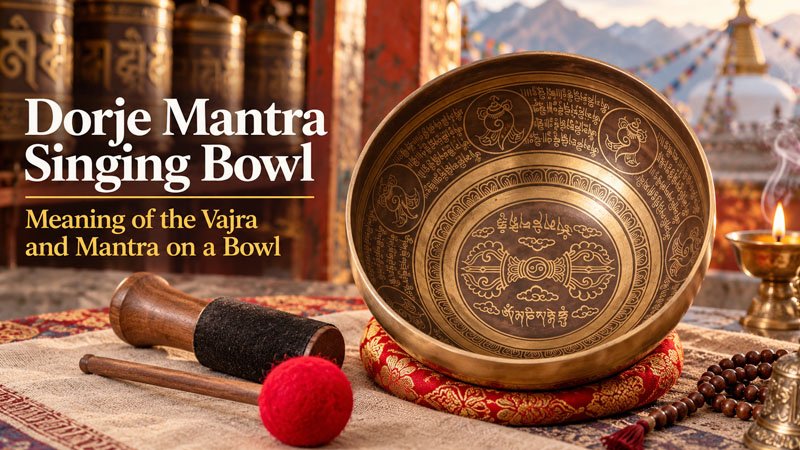
Dorje and Double Dorje on a Singing Bowl - Meaning of the Vajra
The dorje on a singing bowl is the vajra, the diamond-thunderbolt of Tibetan Buddhism: a symbol of the awakened mind, which nothing can break. A single dorje is held with a bell in ritual, for compassion and wisdom joined; a double dorje is two dorjes crossed, for absolute stability. Both are carved on bowls, at the centre or as the steady ground underneath.
Key takeaways
- Dorje: the vajra, unbreakable like a diamond, irresistible like a thunderbolt.
- With a bell: the dorje is compassion, the bell wisdom, never apart.
- Double dorje: two dorjes crossed, stability in every direction.
- On a bowl: at the centre inside, or carved on the base.
What is a dorje?
Dorje is the Tibetan word for the Sanskrit vajra. It has the qualities of a diamond, which cannot be broken, and of a thunderbolt, which nothing can stop, and it gives its name to Vajrayana, the "diamond way" of Tibetan Buddhism.
On a bowl you may meet it in two forms: the single dorje, a ritual tool with two matching ends, and the double dorje, two dorjes crossed into a four-headed emblem.
What do the parts of a dorje mean?
| Part | What it shows |
|---|---|
| The central sphere | Emptiness, the open source of all things |
| Two lotuses | Samsara and nirvana, the world and its release |
| Makara | Sea creatures whose mouths release the prongs: opposites united |
| Five prongs | Often linked with the five wisdoms of the five Buddhas |
| The meeting point | The prongs join at the tip: many as one |
The most common dorje has five prongs at each end: four curving outer prongs around a straight central one. The single vajra is the emblem of Akshobhya, the blue Buddha of the east, explained in the Five Buddhas on singing bowls.
Why is the dorje paired with a bell?
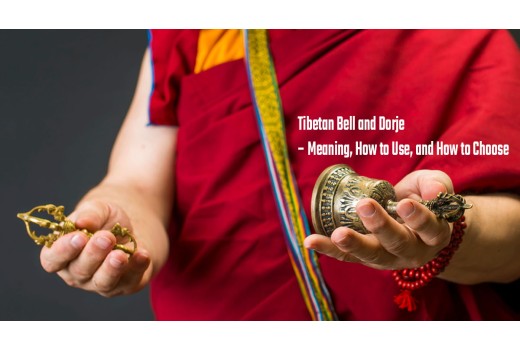
In ritual the dorje is held in the right hand and the bell in the left. The dorje stands for compassion and skilful means, the bell for wisdom; held together, they show that the two are never apart. Our Tibetan bell and dorje guide explains how the pair is used, and the sets are in Tibetan bell and dorje.
What does the double dorje mean?
The double dorje, in Sanskrit the vishvavajra or "universal vajra", is two dorjes crossed at right angles. It stands for absolute stability: in the Tibetan picture of the universe a vast crossed vajra lies beneath the whole world, and in a mandala it is the foundation the palace stands on.
| Part | What it shows |
|---|---|
| Four heads | The four directions: east white, south yellow, west red, north green |
| The centre | Dark blue: the still, unshakeable ground |
| Five colours together | The five elements and the five Buddha families |
| The whole emblem | Amoghasiddhi's all-accomplishing wisdom |
The symbol is so central to Tibetan culture that it has its own character in Unicode: ࿇.
Dorje or double dorje: what is the difference?
| Dorje | Double dorje | |
|---|---|---|
| Form | One vajra, two matching ends | Two vajras crossed, four heads |
| Use | A ritual tool, held with the bell | An emblem, not held |
| Meaning | The unbreakable awakened mind; compassion and skilful means | Stability, the ground under everything |
| Buddha | Akshobhya, east | Amoghasiddhi, north |
| On our bowls | At the centre, or under a Buddha | At the centre, or on the base |
Where do the dorje and double dorje appear on a bowl?
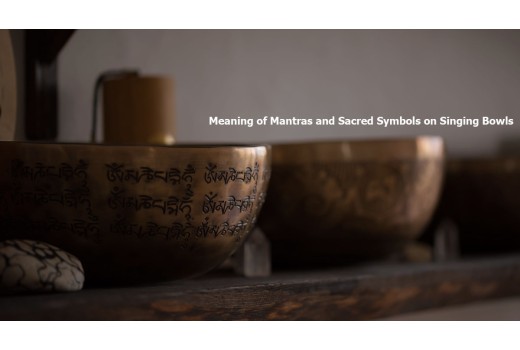
On many of our bowls the double dorje is the main symbol at the centre inside, with mantra around the outside and another symbol beneath: a double fish, a conch or a lotus mandala. On others a single or double dorje is the ground underneath, carved on the base beneath a Buddha, a Tibetan Om, an endless knot or the Flower of Life.
Looking for a dorje bowl?
Our Double Dorje bowl has the double dorje at the centre, Om Mani Padme Hum around the outside and the double fish on the base, hand-hammered, in 8 to 12 inches.
Which dorje bowl should you choose?
| If you want | Look at |
|---|---|
| A single dorje at the centre | Dorje Tibetan singing bowl: Tibetan mantra ring and Tibetan Om, 7 to 12 inches |
| A single dorje under a Buddha | Akshobhya Buddha bowl: dorje on the back, 7 to 12 inches |
| A double dorje with the double fish | Double Dorje double fish bowl: Om Mani Padme Hum around, 8 to 12 inches |
| A double dorje with a conch below | Double Dorje conch bowl, 7 to 12 inches |
| A double dorje with a lotus mandala below | Double Dorje lotus mandala bowl, 11 to 13 inches |
| A double dorje in a Potala gate design | Double Dorje Potala gate bowl, 7 to 12 inches |
| Tibetan Om inside, double dorje below | Tibetan Om double dorje bowl, 7 to 12 inches |
| A small bowl, double dorje below | Lucky Leaf bowl: Flower of Life, double dorje below, 6 and 7 inches |
Every symbol bowl is in carved and etched singing bowls.
How do you use a dorje bowl?
- Set it down firmly: on its cushion, as steady as the symbol it carries.
- Ground yourself first: feel your seat and your feet before you strike.
- Strike once and let the sound spread out in every direction.
- Rest in the centre: as the sound fades, stay still, like the sphere at the heart of the dorje.
Practice like this supports relaxation and focus, and does not treat any condition.
Can you have a dorje on your own bowl or gong?
Yes. Ask for a single or double dorje inside, around the outside or on the base of a custom singing bowl; engraving is free. For a gong, use our custom gong page.
Frequently asked questions
What does dorje mean?
Dorje is the Tibetan word for vajra, the diamond-thunderbolt of Vajrayana Buddhism: unbreakable like a diamond and irresistible like a thunderbolt. It stands for the awakened mind, which nothing can destroy.
What do the parts of a dorje mean?
The sphere at the centre stands for emptiness, the open source of all things. The two lotuses stand for samsara and nirvana, and the prongs rise from the mouths of makara, sea creatures, and meet at a point.
Why is the dorje held with a bell?
The dorje stands for compassion and skilful means, the bell for wisdom. Held together, in the right and left hands, they show that the two are never apart.
What does the double dorje mean?
The double dorje, or crossed vajra, stands for absolute stability: the unshakeable ground on which everything rests. Its four heads point to the four directions around a still centre.
What is the difference between a dorje and a double dorje?
A single dorje is a ritual tool, held with the bell. The double dorje is two dorjes crossed, an emblem of stability rather than a tool held in the hand.
Why is a dorje on the bottom of a singing bowl?
In Tibetan art the vajra, and above all the crossed vajra, is the steady foundation that holds everything up, so it is often carved underneath as the ground of the bowl.
Which Buddhas go with the dorje and double dorje?
The single vajra is the emblem of Akshobhya, the blue Buddha of the east. The double vajra belongs to Amoghasiddhi, the green Buddha of the north.
Can I have a dorje or double dorje on my own bowl or gong?
Yes. Ask for either one inside, outside or on the base on our custom singing bowl page, or on our custom gong page for a gong. Engraving on a bowl is free.
Want a dorje on your bowl?
Choose the size and finish, and tell us which dorje you want and where: inside, outside or underneath. Engraving is free, and Sunita chooses your bowl after your order arrives.