




The Five Buddhas on Singing Bowls - Akshobhya, Amitabha and the Others
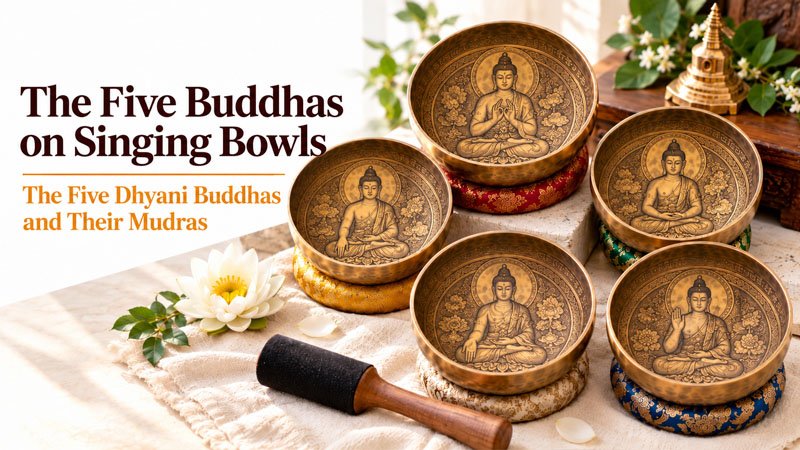
The five Buddhas on a singing bowl are the Five Dhyani Buddhas: Vairocana, Akshobhya, Ratnasambhava, Amitabha and Amoghasiddhi. Each sits in one direction of the mandala and has his own colour, hand gesture and seed syllable, and each stands for one of five wisdoms. On an etched bowl the colours do not show, so read the hands to tell them apart.
Key takeaways
- Five Buddhas: also called the five wisdom Buddhas or Five Tathagatas.
- Read the hands: each Buddha has his own gesture.
- Five seed syllables: Om, Hum, Tram, Hrih and Ah.
- On our bowls: Akshobhya most often, then Amitabha, Amoghasiddhi and all five together.
Who are the Five Buddhas?
In Tibetan and Nepali Buddhism, the Five Buddhas are the five faces of awakening. Each leads a Buddha family, sits in one direction of the mandala and turns one of the five poisons of the mind, such as anger or pride, into wisdom.
In Kathmandu you can see them at Swayambhunath, where the great stupa's dome is surrounded by five meditating Buddhas. They appear on thangkas, stupas and the small stone chaityas of the valley's courtyards too.
How do you tell the five Buddhas apart?
| Buddha | Colour and place | Hand gesture | Element | Throne |
|---|---|---|---|---|
| Vairocana | White, centre | Teaching, both hands at the heart | Space | Lions |
| Akshobhya | Blue, east | Right hand touching the earth | Water | Elephants |
| Ratnasambhava | Yellow, south | Right hand open in giving | Earth | Horses |
| Amitabha | Red, west | Both hands in the lap, in meditation | Fire | Peacocks |
| Amoghasiddhi | Green, north | Right hand raised, palm out, in fearlessness | Air | Garudas |
If your bowl shows a Buddha touching the earth with his right hand, it is most likely Akshobhya, the one we etch most often. The same gesture is used for the historical Buddha, so the mantra around him helps confirm it.
What does each Buddha stand for?
| Buddha | Family and emblem | Wisdom | Turns this poison |
|---|---|---|---|
| Vairocana | Buddha family, wheel | Seeing the true nature of all things | Ignorance |
| Akshobhya | Vajra family, vajra | Mirror-like wisdom | Anger |
| Ratnasambhava | Jewel family, jewel | Wisdom of sameness | Pride |
| Amitabha | Lotus family, lotus | Discerning wisdom | Desire |
| Amoghasiddhi | Action family, double vajra | All-accomplishing wisdom | Jealousy |
Traditions differ a little; some swap the poisons of Vairocana and Akshobhya. The full list is set out in the Five Tathagatas entry on Wikipedia.
What are the Five Buddhas' mantras?
| Buddha | Seed syllable | Mantra |
|---|---|---|
| Vairocana | Om ཨོཾ | Om Vairocana Hum |
| Akshobhya | Hum ཧཱུྃ | Om Akshobhya Hum |
| Ratnasambhava | Tram ཏྲཱཾ | Om Ratnasambhava Tram |
| Amitabha | Hrih ཧྲཱིཿ | Om Amitabha Hrih, said in Tibetan as Om Ami Dewa Hrih |
| Amoghasiddhi | Ah ཨཱཿ | Om Amoghasiddhi Ah Hum |
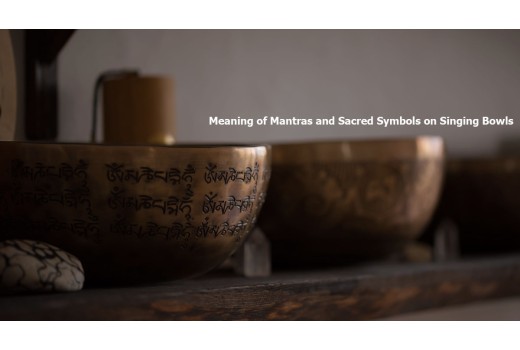
Each mantra is simply the Buddha's name between Om and his seed syllable. On our bowls the ring around the Buddha is often Om Mani Padme Hum, explained in Om Mani Padme Hum singing bowl.
Who is Akshobhya?
Akshobhya means "the Immovable One". As a monk he vowed never to feel anger or malice towards any being, and he kept that vow until he became a Buddha; his pure land in the east is called Abhirati, "the Joyous".
He is blue, touches the earth with his right hand and often holds a vajra in his lap. An Akshobhya mandala bowl places him at the centre with a ring of mantra around him, like the centre of a mandala.
We etch Akshobhya on four bowls: with a band of Tibetan mantra and his vajra on the back, with a carved Tibetan Om, inside a mantra mandala of Om Mani Padme Hum, and with Om Mani Padme Hum in the ornate Nepa script.
Looking for an Akshobhya bowl?
Our Akshobhya bowl is hand-hammered, then etched by thangka artists: the Buddha inside, Tibetan mantra around the outside and a vajra on the back, in 7 to 12 inches.
Who are Amitabha and Amoghasiddhi?
Amitabha, "Boundless Light", is the red Buddha of the west, seated in meditation. His pure land, Sukhavati, is the hope of Pure Land Buddhists across Asia, and Tibetans recite Om Ami Dewa Hrih to him.
Amoghasiddhi, "Unfailing Accomplishment", is the green Buddha of the north, his right hand raised to say do not fear. He leads the Action family, the family of Green Tara.
We do not etch Vairocana or Ratnasambhava alone; you will meet them with the other three on our Five Buddha bowl and bell.
Which Five Buddha bowl should you choose?
| If you want | Look at |
|---|---|
| Akshobhya with his vajra | Akshobhya Buddha bowl, 7 to 12 inches |
| Akshobhya with a Tibetan Om | Akshobhya carved bowl, 8 to 12 inches |
| An Akshobhya mandala | Akshobhya mantra mandala bowl, 8 to 12 inches |
| Nepa script | Akshobhya Nepa mantra bowl, 8 to 12 inches |
| Amitabha | Amitabha Buddha bowl, 7 to 12 inches |
| Amoghasiddhi with sacred symbols | Amoghasiddhi bowl, 8 to 12 inches |
| All five together | Pure bronze Five Buddha embossed bowl, 6 inches |
| All five on a bell | Five Buddha bell and dorje set |
Every figure bowl is in carved and etched singing bowls.
How do you use a Five Buddha bowl?
- Five strikes: strike five times, one for each Buddha, letting each sound fade.
- Five syllables: on each strike, chant one seed syllable: Om, Hum, Tram, Hrih, Ah.
- One poison at a time: with each Buddha, let go of one of the five, from ignorance to jealousy.
- Five elements: each Buddha is linked with an element, the same five behind our 5 element singing bowl set.
Practice like this supports relaxation and focus, and does not treat any condition.
Can you have the Five Buddhas on your own bowl?
Yes. On our custom singing bowl page we can engrave any one of the five, or all five, with their mantras around them. Every figure you may meet on a bowl is explained in deities on singing bowls, and other symbols in singing bowl symbols and mantras.
Frequently asked questions
Who are the five Buddhas on my singing bowl?
The Five Dhyani Buddhas: Vairocana, Akshobhya, Ratnasambhava, Amitabha and Amoghasiddhi. Each sits in one direction of the mandala and stands for one of five wisdoms.
How do I tell the five Buddhas apart?
By their hands. Vairocana teaches with both hands at his heart, Akshobhya touches the earth, Ratnasambhava gives, Amitabha meditates and Amoghasiddhi raises his hand in fearlessness.
What does Akshobhya mean?
The Immovable One. He vowed never to feel anger towards any being, and he turns anger into mirror-like wisdom.
What is the Akshobhya mantra?
Om Akshobhya Hum. His seed syllable is Hum, written ཧཱུྃ in Tibetan script.
What is the Amitabha mantra?
Om Amitabha Hrih, which Tibetans say as Om Ami Dewa Hrih. His seed syllable is Hrih, ཧྲཱིཿ.
What are the five Buddha families?
The Buddha, Vajra, Jewel, Lotus and Action families, led by Vairocana, Akshobhya, Ratnasambhava, Amitabha and Amoghasiddhi.
Can I have one of the five Buddhas on my own bowl?
Yes. We can engrave any of the five, or all five, on a custom singing bowl with their mantras, and engraving is free.
Want a Buddha at the centre of your bowl?
Choose the size and finish, and ask for the Buddha and mantra you want. Engraving is free, and Sunita chooses your bowl after your order arrives.