



Deities on Singing Bowls - Buddhist and Hindu Figures and Their Mantras
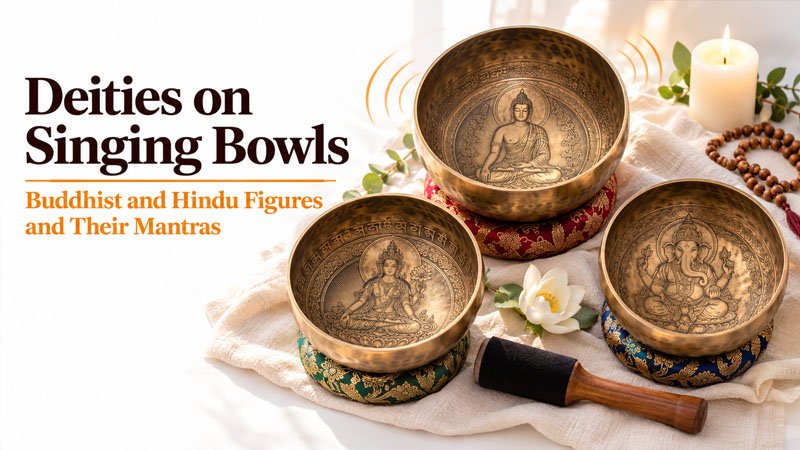
The figure carved at the centre of a singing bowl is usually a Buddhist or Hindu deity, and the ring of script around it is most often that figure's mantra. Buddhist mantras are written in Tibetan script and Hindu mantras in Devanagari. Find your figure below, with its mantra as it appears on the bowl and what every word means.
Key takeaways
- Centre and ring: the figure sits at the centre; its mantra circles it.
- Two scripts: Tibetan for Buddhist figures, Devanagari for Hindu ones.
- Most common: Buddha, Green Tara, Avalokiteshvara, Guru Rinpoche, Ganesha and Shiva.
- The sound: comes from the bowl, not the figure.
How is a figure bowl laid out?
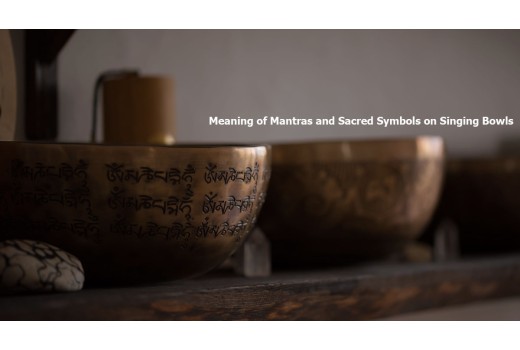
Look inside and you will usually find the figure in a round panel at the centre of the floor, with a ring of mantra around it. On some bowls the mantra runs along the rim or the outside wall instead, and a symbol such as a mandala or a double dorje sits on the base.
The figure and the mantra are etched or carved into the metal after the bowl is hammered. The note comes from the bowl itself, and Sunita chooses each one from her experience in practice.
Is the script on your bowl Tibetan or Devanagari?
Buddhist mantras are mostly Sanskrit words written in Tibetan script, with a small dot, the tsheg, after each syllable. Hindu mantras are written in Devanagari, the script of Sanskrit and Nepali, where a flat line runs along the top of each word.
A few Nepali bowls use a third, ornate script called Ranjana, also known as Nepa or Lantsa, usually for Om Mani Padme Hum. The Tibetan spellings in this guide follow Lotsawa House, a library of Tibetan Buddhist texts in translation.
Who is on your bowl? A quick finder
| Figure | How to spot it | Mantra around it |
|---|---|---|
| Shakyamuni Buddha | Monk's robe, hand touching the earth, alms bowl | Om Muni Muni Maha Muniye Soha |
| Avalokiteshvara | White, four arms, hands joined at the heart | Om Mani Padme Hum |
| Green Tara | Green, right leg stepping down, blue lotus | Om Tare Tuttare Ture Soha |
| White Tara | White, full lotus, eyes on palms and forehead | Om Tare Tuttare Ture Mama Ayur… |
| Manjushri | Flaming sword raised, book on a lotus | Om A Ra Pa Tsa Na Dhih |
| Guru Rinpoche | Lotus hat, vajra, trident staff | Om Ah Hum Vajra Guru Padma Siddhi Hum |
| Medicine Buddha | Deep blue, bowl in lap, plant in hand | Om Bekandze Bekandze… |
| Vajrasattva | White, vajra at heart, bell at hip | Om Vajrasattva Hum |
| Vajradhara | Dark blue, arms crossed with vajra and bell | Om Ah Hum |
| Samantabhadra Yab-Yum | Blue figure embracing a white consort | Om Mani Padme Hum on our bowls |
| The Five Buddhas | Five Buddhas in white, blue, yellow, red and green | Om, Hum, Tram, Hrih, Ah |
| Ganesha | Elephant head, round belly, four arms | Om Gam Ganapataye Namah |
| Shiva | Third eye, crescent moon, trident, snake | Om Namah Shivaya |
| Saraswati | White, playing the veena, swan | Om Aim Saraswatyai Namah |
| Chakra Yogi | Meditating figure with seven chakras | Lam Vam Ram Yam Ham Om |
Part 1: Which Buddhist figures appear on singing bowls?
Most figures on Tibetan singing bowls come from Tibetan Buddhism: the Buddha himself, the great bodhisattvas, the teachers and the primordial Buddhas. Their mantras are carved in Tibetan script.
Who is Shakyamuni Buddha on a singing bowl?
Shakyamuni is the historical Buddha, Siddhartha Gautama, born in Lumbini in today's Nepal. His name means "the sage of the Shakya clan".
How to spot him: a monk's robe, curled hair with a rounded top-knot, and a calm seated pose. His right hand reaches down to touch the earth, the moment of his awakening, and his left holds an alms bowl.
| Word | In the script | Meaning |
|---|---|---|
| Om | ཨོཾ | The sacred opening sound |
| Muni Muni | མུ་ནི་མུ་ནི | Sage, sage |
| Maha Muni | མ་ཧཱ་མུ་ནི | Great sage |
| Shakyamuniye | ཤཱཀྱ་མུ་ནེ་ཡེ | To the sage of the Shakyas |
| Soha | སྭཱ་ཧཱ | So be it |
It is often shortened to Om Muni Muni Maha Muniye Soha. Many Buddha bowls carry Om Mani Padme Hum around him instead, as on our Buddha engraved singing bowl, 8 to 12 inches.
Who is Avalokiteshvara, or Chenrezig?
Avalokiteshvara is the bodhisattva of compassion, called Chenrezig in Tibet. The Dalai Lamas are regarded as his emanations.
How to spot him: white and crowned, with four arms. Two hands are joined at the heart holding a jewel; the other two raise a crystal mala and a white lotus.
| Word | In the script | Meaning |
|---|---|---|
| Om | ཨོཾ | The sacred opening sound |
| Mani | མ་ཎི | Jewel |
| Padme | པདྨེ | In the lotus |
| Hum | ཧཱུྃ | The seed syllable that seals the mantra |
Each syllable is explained in Om Mani Padme Hum singing bowl. Our Avalokiteshvara engraved bowl has him at the centre, his compassion mantra on the rim and a plain outside, in 8 to 12 inches.
Who is Green Tara on a singing bowl?
Green Tara, Jetsün Dölma in Tibetan, "the venerable mother of liberation", is the female Buddha of compassion in action: help that comes quickly. One story tells that she arose from a tear of Avalokiteshvara.
How to spot her: green and crowned, her right leg stepping down, ready to rise and help. Her right hand rests open in the gesture of giving, and her left holds a blue lotus at her shoulder.
| Word | In the script | Meaning |
|---|---|---|
| Om | ཨོཾ | The sacred opening sound |
| Tare | ཏཱ་རེ | O Tara, the one who frees |
| Tuttare | ཏུཏྟཱ་རེ | The one who frees from fear |
| Ture | ཏུ་རེ | The swift one |
| Soha | སྭཱ་ཧཱ | So be it |
Say it as Om Tah-ray Too-tah-ray Too-ray So-ha. Our Green Tara singing bowl has Tara etched at the centre and this mantra engraved around her, in 8 to 12 inches; other Green Tara bowls pair her with a conch, a double dorje or a mantra mandala.
Who is White Tara?
White Tara, Dolkar in Tibetan, is the form of Tara linked with long life and serenity. Her mantra begins like Green Tara's, then asks for long life, merit and wisdom to grow.
How to spot her: white, seated in full lotus, with seven eyes: one on her forehead and one on each palm and sole. Her right hand gives, and her left holds a lotus.
| Word | In the script | Meaning |
|---|---|---|
| Om Tare Tuttare Ture | ཨོཾ་ཏཱ་རེ་ཏུཏྟཱ་རེ་ཏུ་རེ | As in Green Tara's mantra |
| Mama | མ་མ | For me, or for the one you pray for |
| Ayur | ཨཱ་ཡུར | Long life |
| Punye | པུཎྱེ | Merit |
| Jnana | ཛྙཱ་ན | Wisdom |
| Pushtim Kuru | པུཥྚིཾ་ཀུ་རུ | Make them increase |
| Soha | སྭཱ་ཧཱ | So be it |
We do not keep a White Tara bowl in stock, but we can engrave her at the centre of a custom bowl with her mantra around her. Our White Tara statue shows her seven eyes clearly.
Who is Manjushri?
Manjushri, Jampelyang in Tibetan, is the bodhisattva of wisdom. Students and writers often call on him before study.
How to spot him: a flaming sword raised in his right hand, cutting through confusion, and a book of the Perfection of Wisdom resting on a lotus at his left shoulder.
| Word | In the script | Meaning |
|---|---|---|
| Om | ཨོཾ | The sacred opening sound |
| A Ra Pa Tsa Na | ཨ་ར་པ་ཙ་ན | The first five letters of the Arapacana alphabet, used to teach the Perfection of Wisdom |
| Dhih | དྷཱིཿ | Manjushri's seed syllable of wisdom |
Our premium Manjushri bowl has him at the centre, a Tibetan mantra carved around him and the golden fish on the base, in 11 to 13 inches.
Who is Guru Rinpoche, the Guru Lama?
Guru Rinpoche, "Precious Teacher", is Padmasambhava, the Lotus-Born, who helped bring Buddhism to Tibet in the eighth century. He is honoured above all in the Nyingma tradition.
How to spot him: a lotus hat with a feather on top, a vajra in his right hand, a skull cup in his left, and a trident staff, the khatvanga, resting against his left shoulder.
| Word | In the script | Meaning |
|---|---|---|
| Om Ah Hum | ཨོཾ་ཨཱཿཧཱུྃ | Enlightened body, speech and mind |
| Vajra | བཛྲ | Indestructible, like a diamond |
| Guru | གུ་རུ | The teacher |
| Padma | པདྨ | The lotus, for the Lotus-Born |
| Siddhi | སིདྡྷི | Accomplishment |
| Hum | ཧཱུྃ | The seed syllable of enlightened mind |
Tibetans say it as Om Ah Hung Benza Guru Pema Siddhi Hung. Our Guru Lama engraved bowl has him at the centre and this mantra in a single line along the rim, in 8 to 12 inches.
Who is the Medicine Buddha?
The Medicine Buddha, Sangye Menla in Tibetan, is the Buddha of healing, called on for wellbeing of body and mind. A bowl with his image is a reminder of care, and does not treat any condition.
How to spot him: deep blue, like lapis lazuli. His right hand rests on his knee holding the myrobalan plant, and his left holds a bowl of nectar in his lap.
| Word | In the script | Meaning |
|---|---|---|
| Om | ཨོཾ | The sacred opening sound |
| Bekandze Bekandze | བྷེ་ཥ་ཛྱཻ་བྷེ་ཥ་ཛྱཻ | Healer, healer |
| Maha Bekandze | མ་ཧཱ་བྷེ་ཥ་ཛྱཻ | Great healer |
| Radza Samudgate | རཱ་ཛ་ས་མུདྒ་ཏེ | King of healers, the one who has risen |
| Soha | སྭཱ་ཧཱ | So be it |
Many begin it with Tayata, "it is like this". We keep the Medicine Buddha as a statue rather than a bowl, but we can engrave him at the centre of a custom bowl with his mantra around him.
Who is Vajrasattva?
Vajrasattva, Dorje Sempa in Tibetan, is the Buddha of purification. His long hundred-syllable mantra is recited to clear away past mistakes; the short form fits neatly around a figure.
How to spot him: white, crowned and seated, holding a vajra at his heart in his right hand and a bell at his hip in his left.
| Word | In the script | Meaning |
|---|---|---|
| Om | ཨོཾ | The sacred opening sound |
| Vajrasattva | བཛྲ་སཏྭ | The diamond being, whose nature cannot be broken |
| Hum | ཧཱུྃ | The seed syllable of enlightened mind |
Tibetans say it as Om Benza Satto Hung. For a Vajrasattva bowl, we can engrave him at the centre of a custom bowl.
Who is Vajradhara?
Vajradhara, Dorje Chang, means "the vajra holder". The Kagyu, Sakya and Gelug traditions see him as the primordial Buddha; in the Nyingma tradition he is the active form of Samantabhadra.
How to spot him: dark blue, crowned and richly adorned, with his arms crossed at the heart holding a vajra and a bell, for compassion and wisdom joined.
Vajradhara has no short mantra in everyday use the way Tara does; he is honoured with lineage prayers. Around him, Om Ah Hum is a natural choice:
| Syllable | In the script | Meaning |
|---|---|---|
| Om | ཨོཾ | Enlightened body |
| Ah | ཨཱཿ | Enlightened speech |
| Hum | ཧཱུྃ | Enlightened mind |
What does Samantabhadra Yab-Yum mean?
Samantabhadra, Kuntuzangpo, "the All-Good", is the primordial Buddha of the Nyingma tradition: the pure, timeless awareness that is the nature of mind. He is shown with his consort Samantabhadri.
How to spot them: a sky-blue Buddha in meditation embracing a white consort, both without clothes or ornaments, for the bare nature of mind. Yab-yum is Tibetan for "father-mother": blue stands for limitless space, white for wisdom, never apart.
Like Vajradhara, he has no short everyday mantra. Our Samantabhadra Yab-Yum singing bowl carries Om Mani Padme Hum around the pair, in 8 to 12 inches; others carry a band of Tibetan mantra.
Who are the Five Buddhas?
The Five Buddhas, also called the Five Dhyani Buddhas or Five Tathagatas, each stand for one of five wisdoms and sit in one direction of the mandala. Each has a seed syllable, a one-sound mantra.
| Buddha | Colour and place | Hand gesture | Seed syllable | Wisdom |
|---|---|---|---|---|
| Vairocana | White, centre | Teaching | Om ཨོཾ | Of the true nature of all things |
| Akshobhya | Blue, east | Touching the earth | Hum ཧཱུྃ | Mirror-like |
| Ratnasambhava | Yellow, south | Giving | Tram ཏྲཱཾ | Of sameness |
| Amitabha | Red, west | Meditation | Hrih ཧྲཱིཿ | Discerning |
| Amoghasiddhi | Green, north | Fearlessness | Ah ཨཱཿ | All-accomplishing |
Akshobhya sits alone at the centre of several of our bowls, and Amitabha and Amoghasiddhi each have their own. All five appear together on our pure bronze Five Buddha embossed bowl, 6 inches.
Find your figure in metal
Buddha, Tara, Avalokiteshvara, Guru Rinpoche, Manjushri, the Five Buddhas and more, etched by hand at the centre of hand-hammered bowls.
Part 2: Which Hindu and yogic figures appear on singing bowls?
In Nepal, Hindu and Buddhist traditions live side by side, and so do their figures on singing bowls. Hindu mantras are written in Devanagari, the script of Sanskrit and Nepali.
Who is Ganesha on a singing bowl?
Ganesha, the elephant-headed son of Shiva and Parvati, is the remover of obstacles and the patron of learning and the arts. He is worshipped first, at the start of any ceremony or new venture, and Tibetan Buddhism honours him too.
How to spot him: an elephant head with one broken tusk, a round belly and usually four arms, holding an axe, a noose, his broken tusk and a sweet. A mouse often sits at his feet.
| Word | In the script | Meaning |
|---|---|---|
| Om | ॐ | The sacred sound |
| Gam | गं | Ganesha's seed syllable |
| Ganapataye | गणपतये | To Ganapati, lord of the hosts |
| Namah | नमः | I bow |
Many Ganesha bowls carry Shree Ganeshaya Namah, श्री गणेशाय नमः, "salutations to revered Ganesha", as on our Ganesha shatkona singing bowl, 8 to 12 inches. Another of our Ganesha bowls carries Om Mani Padme Hum, a Nepali mix of both traditions.
Every symbol Ganesha holds, and how to use his bowl, is explained in Ganesha singing bowl meaning.
Who is Shiva on a singing bowl?
Shiva is one of the three great gods of Hinduism: the destroyer and renewer, and the great yogi who meditates on Mount Kailash. In Kathmandu he is honoured at Pashupatinath, Nepal's most sacred Shiva temple.
How to spot him: a third eye, a crescent moon in his piled-up hair, a snake around his neck, and a trident, the trishula, with a small drum tied to it. He may also dance in a ring of fire as Nataraja, lord of the dance.
| Word | In the script | Meaning |
|---|---|---|
| Om | ॐ | The sacred sound |
| Namah | नमः | I bow |
| Shivaya | शिवाय | To Shiva, the auspicious one |
Its five syllables, Na-Ma-Shi-Va-Ya, are linked with earth, water, fire, air and space. Our Lord Shiva etched bowl has Shiva at the centre and Om Namah Shivaya around the outside, in 8 to 12 inches.
Shiva also appears without a human form, as the lingam, a rounded pillar. On our lingam bowls it rises as a dome inside the bowl.
His symbols, the five syllables of his mantra and every Shiva bowl are explained in Shiva singing bowl meaning.
Who is Saraswati on a singing bowl?
Saraswati is the goddess of knowledge, speech, music and the arts. In Nepal students honour her on Shree Panchami, at the start of spring, and Tibetan Buddhists know her as Yangchenma.
How to spot her: dressed in white and seated on a white lotus, playing the veena, a long-necked lute. A book, a mala and a white swan are often with her.
| Word | In the script | Meaning |
|---|---|---|
| Om | ॐ | The sacred sound |
| Aim | ऐं | Her seed syllable of knowledge and speech |
| Saraswatyai | सरस्वत्यै | To Saraswati |
| Namah | नमः | I bow |
Our Saraswoti singing bowl, the Nepali spelling of her name, has her at the centre with the seven chakra symbols on the inner wall, in 10 to 12 inches.
Who is the Chakra Yogi?
The Chakra Yogi is not a god but a meditating yogi, aligned with the seven chakras from the base of the spine to the crown. The image comes from the yoga traditions of India and Nepal, and is a simple reminder to sit, breathe and settle.
How to spot him: seated cross-legged with a straight back, often with the seven chakra symbols around him. The Jungle Yogi, with long flowing hair, meditates in the forest; the Home Yogi stands for peaceful living at home.
| Seed sound | In the script | Chakra |
|---|---|---|
| Lam | लं | Root chakra |
| Vam | वं | Sacral chakra |
| Ram | रं | Solar plexus chakra |
| Yam | यं | Heart chakra |
| Ham | हं | Throat chakra |
| Om | ॐ | Third eye chakra |
The crown chakra is usually kept in silence. Our Chakra Yogi mantra mandala bowl has the yogi at the centre and Om Mani Padme Hum around him, in 8 to 12 inches.
How do you use a figure bowl in practice?
- Sit with the bowl in front of you, the figure facing you.
- Strike once and listen for a breath.
- Chant the figure's mantra softly on each out-breath while the sound fades.
- Count 21 or 108 recitations on a mala if you like.
- Finish in silence, then one last strike.
Practice like this supports relaxation and focus, and does not treat any condition.
How do you look after a bowl with a sacred figure?
- Keep it raised: on a cushion, a shelf or an altar, not on the floor.
- Do not step over it, or set things on top of it.
- Handle it with clean hands, and wipe it with a soft dry cloth.
Can you have your own god at the centre of your bowl?
Yes. On our custom singing bowl page you can ask for any god or figure at the centre: Buddha, Green or White Tara, Guru Rinpoche, Ganesha, Shiva, Saraswati or any other figure in this guide, with its mantra in a ring around it.
- Choose the bowl: its size and finish.
- Name your figure: the god or teacher you want at the centre.
- Choose the mantra: the figure's own mantra or Om Mani Padme Hum, in Tibetan script or English letters.
- Add a personal touch if you like: a name, a date or a symbol on the outside or the base.
Engraving is free, and Sunita chooses your bowl after your order arrives. If you would rather have a figure bowl ready to go, see our carved and etched singing bowls.
Frequently asked questions
Who is the figure in the centre of my singing bowl?
Most often Shakyamuni Buddha, Green Tara, Avalokiteshvara, Guru Rinpoche or Manjushri on Buddhist bowls, and Ganesha, Shiva or Saraswati on Hindu ones. Look at the colour, the hands and what the figure holds, then read the script around it.
What mantra is written around the figure?
Usually the figure's own mantra, such as Om Tare Tuttare Ture Soha around Green Tara. Om Mani Padme Hum, the mantra of compassion, also appears around many Buddhist figures.
Is the writing on my bowl Tibetan or Sanskrit?
Most Buddhist mantras are Sanskrit words written in Tibetan script. Hindu mantras are written in Devanagari. Small dots between syllables mean Tibetan; a flat line along the top of each word means Devanagari.
What is the Green Tara mantra?
Om Tare Tuttare Ture Soha, written ཨོཾ་ཏཱ་རེ་ཏུཏྟཱ་རེ་ཏུ་རེ་སྭཱ་ཧཱ in Tibetan script. It calls on Tara, the one who frees, swiftly.
What is the difference between Green Tara and White Tara?
Green Tara is linked with swift help and protection, and sits with her right leg stepping down. White Tara is linked with long life, sits in full lotus and has seven eyes, on her forehead, palms and soles.
Why is a Hindu god on a Tibetan singing bowl?
Singing bowls are made in Nepal, where Hindu and Buddhist traditions live side by side. Ganesha is honoured in both, and a single bowl may carry a Hindu figure with a Buddhist mantra.
Does the figure change the sound of the bowl?
No. The figure is etched or carved into the surface, and the note comes from the bowl itself: its shape, weight and metal.
Can I have my own god engraved at the centre of my bowl?
Yes. We can engrave any god or figure at the centre of a custom bowl, with its mantra around it. Ask on our custom singing bowl page; engraving is free.
Want your god at the centre of your bowl?
We can engrave any god or figure at the centre, with its mantra around it. Choose the size and finish, name your figure and mantra; engraving is free, and Sunita chooses your bowl after your order arrives.