



Shiva Singing Bowl - Om Namah Shivaya and What It Means on a Bowl
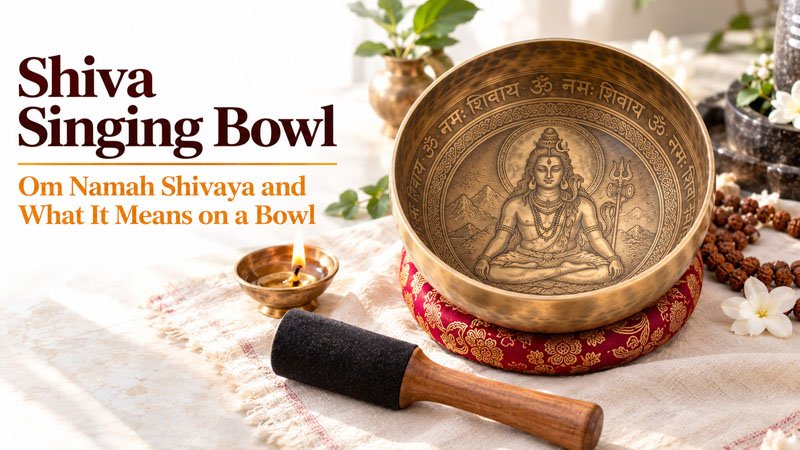
A Shiva singing bowl has Shiva, the great yogi of the Himalayas, etched at the centre, often with Om Namah Shivaya around the outside in Devanagari: "Om, I bow to Shiva". Shiva stands for stillness and renewal, so the bowl suits meditation. The sound comes from the bowl itself.
Key takeaways
- Who he is: Shiva, the destroyer and renewer, and the first yogi.
- His mantra: Om Namah Shivaya, ॐ नमः शिवाय, built on five syllables.
- On a bowl: Shiva inside, his mantra outside, sometimes the Shree Yantra below.
- Without a face: the lingam, the raised dome of a Lingam bowl.
Who is Shiva?
Shiva is one of the three great gods of Hinduism: Brahma creates, Vishnu preserves, and Shiva destroys and renews, clearing away what is old so something new can begin. He is also Adiyogi, the first yogi, patron of yoga and meditation, who sits in stillness on Mount Kailash.
In Kathmandu he is honoured at Pashupatinath, on the banks of the Bagmati river, as Pashupati, the lord of all beings. On Maha Shivaratri, his great night, hundreds of thousands of pilgrims gather there.
Shiva is also the father of Ganesha, whose bowl is explained in Ganesha singing bowl meaning.
How do you recognise Shiva on a bowl?
| Look for | What it tells |
|---|---|
| Third eye | The eye that burned Desire to ashes |
| Crescent moon | Worn in his hair; one of his names is Chandrashekhara |
| Ganga in his hair | The river caught in his locks so she would reach the earth gently |
| Blue throat | He held the world's poison in his throat; one of his names is Nilakantha |
| Snake | Vasuki, the serpent king, worn as an ornament |
| Trident and drum | The trishula's three forces, and the damaru's rhythm of creation |
| Ash and tiger skin | The yogi who has let go of the world |
On an etched bowl the colours do not show, so look for the crescent moon, the piled-up hair and the trident. Om Namah Shivaya around the bowl confirms it.
What does Om Namah Shivaya mean?
| Word | Devanagari | Meaning |
|---|---|---|
| Om | ॐ | The sacred sound |
| Namah | नमः | I bow, salutations |
| Shivaya | शिवाय | To Shiva, the auspicious one |
Say it as Om Na-mah Shi-vaa-ya. Its five syllables after Om are called the Panchakshara, and the words come from the Shri Rudram, a hymn of the Yajurveda.
Om, the sound at its start, has its own guide in Om singing bowl meaning.
Which forms of Shiva appear on bowls?
- Shiva the yogi: seated in meditation with his trident; the figure on most Shiva bowls.
- Nataraja: Shiva as lord of the dance, in a ring of fire, dancing on the dwarf of ignorance. Our extra large Shiva bowl carries this form.
- The lingam: Shiva without a human form, the rounded stone found at the heart of his temples. A Lingam bowl has it as a raised dome inside.
The Lingam bowl and its sound are explained in what is a lingam singing bowl.
Where do Shiva and his mantra appear on a bowl?
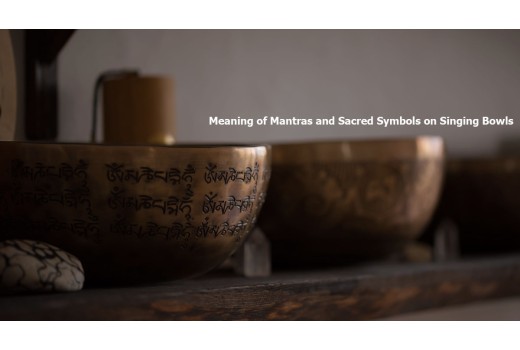
On our Lord Shiva bowl, Shiva is etched at the centre inside, Om Namah Shivaya runs around the outside wall, and the Shree Yantra, a sacred diagram of interlocking triangles, is engraved on the base.
Looking for a Shiva bowl?
Our Lord Shiva etched bowl has Shiva at the centre, Om Namah Shivaya around the outside and the Shree Yantra on the base, in 8 to 12 inches.
Which Shiva bowl should you choose?
| If you want | Look at |
|---|---|
| Shiva with Om Namah Shivaya | Lord Shiva etched bowl: mantra outside, Shree Yantra on the base, 8 to 12 inches |
| Shiva alone, plain outside | Lord Shiva etched handmade bowl, 8 to 12 inches |
| Shiva as Nataraja, extra large | Shiva engraved extra large bowl, 16 to 22 inches |
| The lingam with Shree Yantras | Lingam Shree Yantra mantra bowl, 7 to 10 inches |
| The lingam with Tibetan mantra | Lingam Tibetan mantra bowl, 7 to 10 inches |
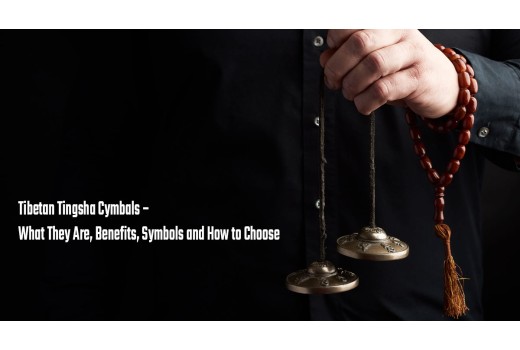
| His mantra in your hands | Om Namah Shivaya tingsha, 2.5 inches |
Bowls large enough to stand in are in large standing singing bowls, and every figure bowl is in carved and etched singing bowls.
How do you use a Shiva bowl?
- Sit still, back straight, the bowl in front of you.
- Strike once and follow the sound until it fades.
- Chant Om Namah Shivaya softly on each out-breath, or 108 times on a mala.
- Choose your day: Monday is traditionally Shiva's day, and Maha Shivaratri his great night.
- Close with tingsha: one clear ring of our Tibetan tingsha to end the session.
Practice like this supports relaxation and focus, and does not treat any condition.
Can you have Shiva on your own bowl?
Yes. On our custom singing bowl page we can engrave Shiva at the centre, with Om Namah Shivaya around him, and add a name or a date on the outside or the base. Every figure you may meet on a bowl is explained in deities on singing bowls.
Frequently asked questions
What does a Shiva singing bowl mean?
It carries Shiva, the great yogi of the Himalayas who stands for stillness and renewal, usually with Om Namah Shivaya around the bowl. It is a bowl for meditation; the sound itself comes from the bowl.
What does Om Namah Shivaya mean?
Om, I bow to Shiva. Namah means I bow, and Shivaya means to Shiva, the auspicious one.
How do you write Om Namah Shivaya in Devanagari?
ॐ नमः शिवाय. On a bowl it usually runs around the outside wall.
What are the five syllables of Om Namah Shivaya?
Na, Ma, Shi, Va and Ya, called the Panchakshara. In the Shaiva tradition they are linked with earth, water, fire, air and space.
How do you recognise Shiva on a bowl?
Look for the crescent moon in his piled-up hair, the third eye, the snake at his neck and the trident with a small drum beside him.
What is a lingam singing bowl?
A bowl with a raised dome at the centre of the floor, the lingam, Shiva's symbol without a human form.
Can I have Shiva engraved on my own bowl?
Yes. We can engrave Shiva at the centre of a custom singing bowl with Om Namah Shivaya around him, and engraving is free.
Want Shiva at the centre of your bowl?
Choose the size and finish, and ask for Shiva with Om Namah Shivaya around him. Engraving is free, and Sunita chooses your bowl after your order arrives.