




Om Singing Bowls: Hindu Om, Tibetan Om, and What They Mean
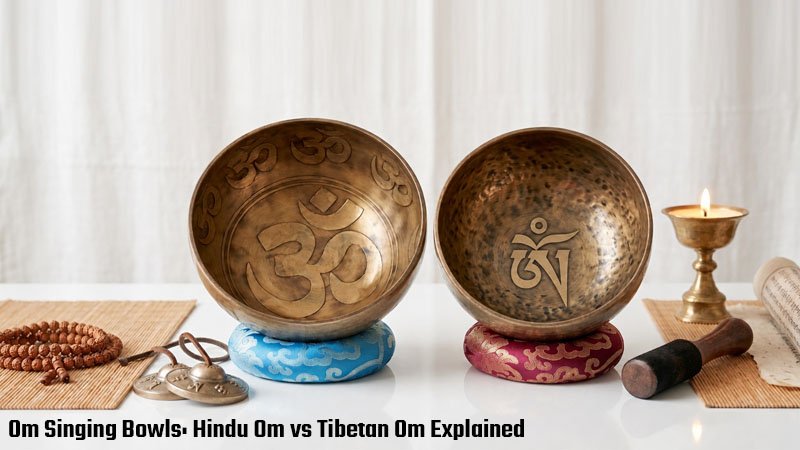
Short answer: an Om singing bowl is a Himalayan singing bowl carrying the Om symbol, carved by hand into the metal. There are two different Oms and they are not interchangeable:
- Hindu Om (ॐ) — written in Devanagari script, the form most people recognise. Associated with Hindu tradition, yoga and mantra practice.
- Tibetan Om (ༀ) — written in Tibetan script, visually quite different. Associated with Tibetan Buddhism, and the opening syllable of Om Mani Padme Hum.
Om is regarded in both traditions as the primordial sound from which everything else arises, which makes it the natural symbol for an instrument whose entire purpose is sound. The carving does not change the tone if the bowl is hammered and tuned first, then engraved.
What is an Om singing bowl?
An Om singing bowl is a hand-hammered Himalayan bowl with the Om symbol cut into its surface by hand. It is the most requested engraved design we make, and has been for as long as we have been selling.
The symbol can appear in several ways, and which one you choose changes the character of the object more than most people expect. It may be a single bold Om at the centre of the outer wall, a smaller Om repeated as part of a mantra band, an Om cut into the base, or a design where Om is worked into a fuller composition alongside other symbols.
What matters first, though, is which Om.
Hindu Om and Tibetan Om: what is the difference?
They are the same syllable written in two different scripts, belonging to two different traditions. Sellers frequently treat them as decorative variants of one another. They are not, and anyone with a practice in either tradition will notice immediately.
The Hindu Om is written in Devanagari, the script used for Sanskrit and Hindi. It is a single flowing form with a crescent and a dot above it, and it is the version that appears on yoga studio walls, jewellery and tattoos across the world. If your practice is rooted in yoga, in Sanskrit mantra, or in Hindu tradition, this is the Om you mean.
The Tibetan Om is written in Tibetan script and looks quite different — an angular base letter with its own vowel sign, crescent, dot and flame above. It is the first of the six syllables in Om Mani Padme Hum, and it belongs to Tibetan Buddhist practice. If your bowl is for Buddhist practice, or you want it to match the mantra work on a prayer wheel or a mala, this is the one.
Both are the same sacred syllable. Neither is more authentic than the other. But a bowl carrying a Devanagari Om in a Tibetan Buddhist shrine room reads slightly oddly, in the same way an English inscription would on a Latin memorial — nobody will be offended, but someone will notice.
Our terminology guide covers the wider vocabulary, and singing bowl symbols explained covers the twelve designs we cut most often.
What does Om actually mean?
Om is understood in both Hindu and Buddhist tradition as the primordial sound — the vibration from which everything else arises. It is not a word with a translation. It is a sound that is held to precede words.
In the Mandukya Upanishad it is analysed as three sounds, A–U–M, mapped to waking, dreaming and deep sleep, with the silence that follows representing the state beyond all three. That fourth part matters: the silence after the sound is not an absence but the point of the whole thing.
Which is exactly why the symbol belongs on this object rather than any other. A singing bowl produces a tone that rises, fills a space, and then fades slowly into a silence you are still listening to. The bowl performs what the syllable describes. That correspondence is not marketing — it is the reason Om has been cut into these bowls for as long as anyone has been cutting anything into them.
What is Om Mani Padme Hum?
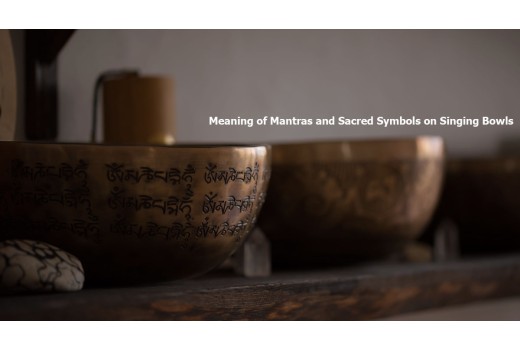
Om Mani Padme Hum is the six-syllable mantra of Avalokiteshvara, the bodhisattva of compassion, and the most widely recited mantra in Tibetan Buddhism. On a bowl it is usually cut as a continuous band around the outer wall, often with a Tibetan Om at the centre.
The six syllables are commonly given as: Om, the primordial sound; Mani, the jewel; Padme, the lotus; Hum, indivisibility or the awakened mind. The usual gloss is "the jewel in the lotus", though practitioners will tell you that the meaning is in the recitation rather than the translation.
It is the same mantra that fills a prayer wheel — written on the outside and rolled inside by the thousand — which is why a mantra-banded bowl and a prayer wheel sit naturally together on the same shrine.
Where does the Om appear on the bowl?
Four placements, and they suit different purposes.
- Single central Om on the outer wall. The boldest option and the most common. Legible from across a room, which matters if the bowl sits on an altar or at the front of a class.
- Mantra band running around the bowl, usually Om Mani Padme Hum, sometimes with a larger Om at the front. Quieter visually, richer close up, and the traditional choice for a bowl used in daily practice.
- Full carved surface where Om is worked into a complete composition with lotus, mandala or auspicious symbols. The most labour-intensive and the most striking.
- Om on the base, seen only when the bowl is lifted. Chosen by people who want the symbol present without it being the object's main feature.
Does carving an Om change how the bowl sounds?
Not if the work is done in the right order. The bowl is hand-hammered and tuned first, and carved afterwards, so the tone is established before a single line is cut.
What the carving does change is the surface. A heavily worked bowl feels different under the mallet, and most players find the extra texture gives useful grip when rim-playing rather than hindering it. If you are new to rim technique, a lightly carved bowl is marginally more forgiving than a deeply cut one — though our guide to why a bowl takes time to sing covers the far more common causes of difficulty, none of which are the engraving.
The thing that genuinely determines the sound is the metal and the hammering. Why every singing bowl sounds different explains what happens at the anvil, and if you want the evidence on what the alloy actually is, we reviewed every metallurgical study that exists.
How is the Om carved?
By hand, with a chisel and hammer, by artists trained in thanka painting. They work freehand from the traditional forms rather than tracing a template, which is why no two Om bowls carry identical lines.
That is worth checking wherever you buy. Much of what is sold as carved is acid-etched — masked, chemically bitten and finished, which is fast and cheap and produces a flat, uniform line. Hand-cut work has depth that varies as the chisel travels, and under raking light you can see where the tool started and stopped. Neither is fraudulent, but they are different objects at different prices, and the words are used interchangeably by sellers who would rather you did not ask.
Which Om bowl should you choose?
Start with the script, because it is the one thing that cannot be changed afterwards.
- Yoga, Sanskrit mantra, Hindu practice → Hindu Om in Devanagari.
- Tibetan Buddhist practice, or matching a prayer wheel or mala → Tibetan Om, usually with the mantra band.
- No specific tradition → either. Most people choose the Devanagari Om simply because it is the form they recognise, and that is a perfectly good reason.
- A gift → a central Om with the recipient's name or a date engraved alongside it. Engraving is free on our bowls, in English or Tibetan script, and a custom bowl lets you set the layout properly.
Then size and note, which are separate questions covered in how to choose a singing bowl and chakra and note information. You can measure any bowl's frequency yourself with our live singing bowl tuner.
See the Om bowls
Hindu and Tibetan Om, mantra bands, and full carved designs — hand-cut in Kathmandu, with free personal engraving, and tuned and played by a sound healer before shipping.
Can you have an Om bowl made to order?
Yes. If the combination you want does not exist in stock, the smiths will hammer one and the artists will carve it. This is the route most people end up taking once they know what they are looking for, because an Om bowl has more variables than almost anything else we make.
What you specify on a custom singing bowl:
- Which Om — Devanagari or Tibetan. The decision that matters most, and the one stock rarely lets you make.
- How it is placed — a single bold Om, a mantra band, Om worked into a larger composition, or Om on the base.
- Diameter — from a palm bowl to a floor-standing piece, rather than whatever size the design happens to exist in.
- Musical note — mapped to the chakras from C at the Root to B at the Crown.
- Finish — natural, antique, or a golden interior, which throws the carved lines into relief.
- Your own engraving alongside the Om, free of charge: a name, a date, a dedication, a mantra of your own, in English or Tibetan script.
Three situations where commissioning is genuinely the better answer rather than an upsell. When you want a Tibetan Om at a particular size — the script is stocked in fewer sizes than the Devanagari, so the combination you want often does not exist. When the bowl is a gift with a name and a date, and you want the engraving laid out to sit properly with the symbol rather than squeezed in beside it. And when you are matching a bowl to instruments you already own, in note and in visual style.
Building a full set rather than one bowl? The custom set builder lets you specify the notes across several bowls with the same Om or mantra cut on each — which is what practitioners generally want, and what an assembled set almost never gives you.
We confirm the engraving layout with you before anything is cut, and the finished bowl is tuned and played by a sound healer before it ships, the same as everything else.
Design your own Om bowl
Choose the script, the placement, the size, the note and the finish, and add your own engraving at no extra cost. Tell us what you have in mind and we will come back with what is possible and how long it will take.
How do you care for a carved bowl?
Much as any other, with one difference: carved lines hold dust and polish residue. Use a soft dry brush rather than cloth, which snags. Do not use metal polish on a carved bowl — it builds up in the cut lines and turns them grey. Our guide to cleansing and charging a singing bowl covers what is safe, and how long a singing bowl lasts covers ageing.
Frequently asked questions
What is an Om singing bowl?
A Himalayan singing bowl with the Om symbol carved into the metal by hand. It is the most requested engraved design, and appears as a single central symbol, as part of a mantra band, within a full carved composition, or on the base.
What is the difference between Hindu Om and Tibetan Om?
The same syllable in two scripts. Hindu Om (ॐ) is Devanagari, associated with yoga, Sanskrit mantra and Hindu tradition. Tibetan Om (ༀ) is Tibetan script, belongs to Tibetan Buddhism, and is the first syllable of Om Mani Padme Hum. Neither is more authentic; they suit different practices.
What does Om mean?
Om is understood as the primordial sound from which everything arises. It is not a word with a translation. The Mandukya Upanishad analyses it as A–U–M, mapped to waking, dreaming and deep sleep, with the silence afterwards representing the state beyond all three.
Why is Om carved on singing bowls specifically?
Because the bowl does what the syllable describes. A tone rises, fills the space, and fades into a silence you are still listening to. The correspondence between the instrument and the sound it symbolises is unusually direct.
What does Om Mani Padme Hum mean?
It is the six-syllable mantra of Avalokiteshvara, bodhisattva of compassion, and the most recited mantra in Tibetan Buddhism. Commonly glossed as "the jewel in the lotus", though practitioners hold that the meaning lies in the recitation rather than the translation.
Does engraving affect the sound of a singing bowl?
No, provided the bowl is hammered and tuned first and carved afterwards. The surface texture changes, and most players find the extra grip helps when rim-playing.
How can you tell hand-carved from acid-etched?
Hand-cut lines vary in depth as the chisel travels, and under raking light you can see where the tool started and stopped. Acid-etched lines are flat and uniform. Both are sold as "carved".
Can I have an Om bowl made to order?
Yes. You specify which Om, where it sits, the diameter, the note, the finish and your own engraving, and the bowl is hammered and carved to that specification. It is often the only way to get a Tibetan Om at a particular size, since the script is stocked in fewer sizes than the Devanagari. See custom singing bowls.
Can I have my own name engraved alongside the Om?
Yes, and on our bowls it is free, in English or Tibetan script. The layout is confirmed with you before anything is cut.