




Why Does Every Singing Bowl Sound Different?
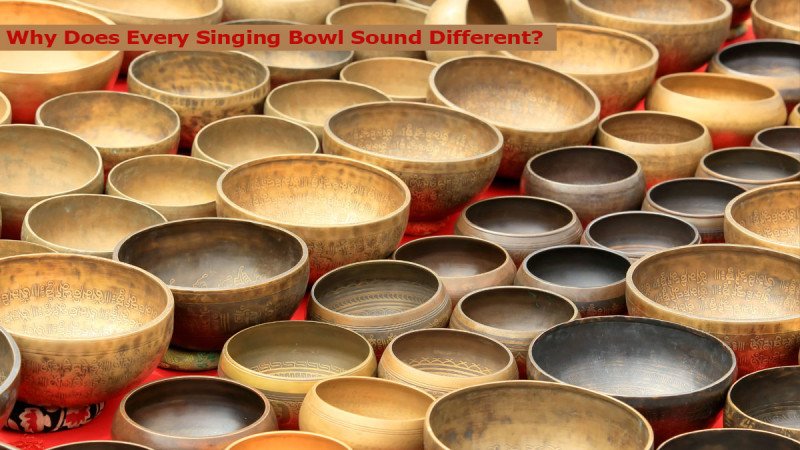
Because a hand-forged singing bowl is not manufactured to a specification — it emerges from one. Thousands of hammer strikes leave wall thickness varying across the surface, the rim profile forms as it forms, and heat cycles set different internal tensions in every piece. The result is that each bowl produces its own fundamental, its own overtone spacing and its own pulse. Two bowls of identical size and finish will not sound the same.
This surprises people, and it should. Almost nothing else you buy behaves this way. Two guitars of the same model sound close enough. Two speakers of the same model are meant to be indistinguishable.
Singing bowls are not like that, and the reason is not sloppiness. It is the direct consequence of how they are made — and the same thing that makes them impossible to duplicate is what makes them worth owning.
A Bowl Is Not Made to a Note — the Note Is Discovered
Start here, because everything follows from it.
A hand-forged bowl begins as a disc of bronze. It is heated, hammered, reheated, hammered again — thousands of strikes over hours, sometimes by four smiths working in unison on the larger pieces. The form rises out of repeated impact.
At no point in that process is anyone aiming at a frequency. The smith is working the metal into shape, guided by craft and experience. What note the finished bowl produces is not decided in advance. It is identified afterwards, once the bowl is finished and someone strikes it.
This is worth sitting with, because it inverts how most people assume manufacturing works. The pitch is an outcome, not a target. And outcomes vary.
What Actually Varies From Bowl to Bowl
Six factors, all of them consequences of hand-forging, and each one shifts the sound.
| What varies | Why it varies | What it changes |
|---|---|---|
| Wall thickness across the surface | No human arm strikes identically ten thousand times | Each region of the wall vibrates slightly differently — the root of nearly everything else |
| Overall wall thickness | How far the metal was worked | Thicker walls lower the fundamental and slow the response |
| Curvature and rim profile | The shape emerges from forging rather than a template | How the bowl flexes, and how readily it rims |
| Internal tension | Heat and cooling cycles differ between pieces | How the metal holds and releases vibration |
| Alloy composition | Subtle differences between batches and workshops | Tonal character and overtone colour |
| Symmetry | Hand-hammering is never perfectly even | Produces mode splitting — the pulse, covered below |
Any one of these on its own would make two bowls differ. All six together make identical bowls effectively impossible. Even two pieces that look indistinguishable will measure differently on a frequency analyser.
Mode Splitting: Why No Two Pulses Match
This is the most interesting of the six, and the one people hear without knowing what they are hearing.
In a perfectly symmetrical bowl, each vibrational mode would produce a single frequency. In a hand-hammered bowl, the slight asymmetry means each mode produces two frequencies, very close together.
Spectrum analysis of one bowl measured its fundamental sounding at 334.1 Hz and 335.5 Hz simultaneously. Its first overtone at 932.8 Hz and 942.9 Hz. Its second at 1742.3 Hz and 1747.7 Hz. Every partial split into a pair.
Those pairs interfere with each other. What you hear as a result is a slow pulse under the tone — a rise and fall, a shimmer, what some people describe as the bowl breathing.
The gap between the pair sets the speed of the pulse. A wider gap gives a faster beat, a narrower one a slower breath. And because the gap comes from that individual bowl's particular asymmetry, no two bowls pulse the same way.
This is the acoustic fingerprint. Two bowls can share a fundamental to the decimal and still be immediately distinguishable, because what sits underneath the note is different. Our article on the male and female tones of a singing bowl covers mode splitting further, including how to find the striking points that favour one frequency over the other.
Overtones That Are Almost, But Not Quite, Harmonic
There is a second layer of variation on top of the fundamental.
A study analysing seven bowls found their overtones sitting at near-integer ratios to the fundamental — clustering around three times and six times — but never exactly. Close to consonance, offset from it.
That offset is the whole character of the instrument. Exact ratios would sound like a tuned note: clean and somewhat sterile. Wildly non-integer ratios would sound clangy. Bowls sit in the narrow band between, close enough that the ear hears harmony, far enough that something in the sound keeps moving.
And crucially, how far off differs from bowl to bowl. One instrument's overtones sit slightly sharp of the ratio, another's slightly flat. That determines whether a bowl reads as bright, warm, complex or plain — and it is not something anyone chose.
Which is why every bowl is played and assessed before it is listed
If bowls were interchangeable, a spec sheet would do. They are not, so someone has to listen. Explore handmade singing bowls, antique collected bowls where the variation is most pronounced, or check your own bowl with our live frequency analyser.
The Same Bowl Also Sounds Different Depending on How You Play It
Variation does not stop at the instrument. One bowl produces measurably different results depending on what you do to it.
Where you strike. Because mode splitting means two frequencies per partial, and each corresponds to a different orientation of the vibration pattern, striking at twelve o'clock and at three o'clock makes different frequencies dominant. The character shifts. Experienced players mark the spots they prefer.
What you strike with. A felt mallet emphasises warmth and the lower partials. Wood brings the higher overtones forward and adds friction noise.
How hard. Playing force shifts the measured fundamental slightly, and hard striking excites the upper modes disproportionately.
Strike versus rim. A strike excites many modes at once. Rimming selectively drives the fundamental and sustains it, which is an entirely different sound from the same object.
What is in the bowl. Adding water lowers the pitch, because the liquid loads the vibrating rim. The more water, the lower the tone.
Which is why tuning apps give different readings for the same bowl on different days. It is not the app. It is that a singing bowl does not have one frequency — it has a range of behaviours, and you are sampling one of them.
Machine-Made Bowls Can Be Identical — and That Is the Problem
Here is the trade-off, stated plainly.
A machine-pressed bowl has near-perfectly uniform walls, because a press applies identical force everywhere. Two pressed bowls from the same die genuinely can be near-indistinguishable.
And they sound thin. Uniform walls produce one clean frequency per mode instead of a pair, which means no interference, no beating, no pulse. The tone arrives, sits flat, and stops. There is nothing underneath it.
The variation that makes hand-forged bowls impossible to duplicate is the same variation that gives them depth. You cannot have consistency and character from the same process, because character is the inconsistency.
This is also why hand-casted bowls sit between the two. Casting gives more uniform walls than hammering, so cast bowls are more consistent, easier to play and cleaner in tone — with less of the layered shimmer. That is a legitimate trade for some people and the wrong one for others.
What This Means When You Are Buying
Four practical consequences.
A photograph tells you almost nothing. Two bowls that look identical can sound completely different. Appearance is the least informative thing about a singing bowl, and it is the only thing most listings show you.
"Tuned to exactly 432 Hz" should raise an eyebrow. Hand-forged bowls are not made to a frequency, and the measured pitch shifts with strike position and force. A precise number attached to a traditional bowl is describing one measurement under one condition, not a property of the instrument.
Someone has to actually listen. If bowls were interchangeable, quality control could be a checklist. Since they are not, the only meaningful assessment is a person playing each one. That is why our selection process takes three to four days per order rather than being a warehouse pick.
Your bowl is genuinely yours. Not in a sentimental sense — in a measurable one. The particular pulse rate of your bowl, the exact spacing of its overtones, the spots on its rim that favour one frequency over another: that combination exists once.
If you want to know your own bowl's numbers, our live singing bowl tuner will show you the fundamental and, on a good hand-forged piece, the split.
How Do You Choose When Every Bowl Is Different?
The variation is real, which makes choosing harder. Some structure helps.
- Decide the size first. Size determines the fundamental range, and that is the one thing predictable from specification. Large bowls sit low and are felt physically; small bowls sit high and are heard. This narrows the field before sound enters the picture.
- Decide what the bowl is for. Daily meditation, group sessions, body work and teaching all favour different characteristics. A bowl that is perfect for one is mediocre for another.
- Judge sustain over first impression. Most people decide in the first two seconds. Sustain and the quality of the fade tell you far more.
- Listen for whether overtones blend or fight. In a good bowl they layer and support each other. In a poor one they beat against each other in a way most people register as vaguely unpleasant without being able to name it.
- Accept that you cannot compare on paper. Two bowls with the same stated note and diameter are not the same product. Either play them, or buy where someone has played them for you.
When You Need Predictability
Sometimes variation is precisely what you do not want — matching a set, replacing a bowl in a sequence, or needing a specific note for practice.
Commissioning is the direct route. Through the custom singing bowl service you specify size, wall thickness, musical note, metal composition and engraving, hand-forged by artisans in Kathmandu. The bowl is still individual — that cannot be engineered away — but the characteristics that matter to you are set deliberately rather than left to chance.
Specify the note and size rather than hoping one turns up
Matching a set, replacing a bowl in a sequence, or working to a specific note are all reasons to commission rather than browse. Through Dharma Tool's custom singing bowl service you set the size, note, thickness, engraving and intention, and it is hand-forged in Kathmandu. Optional monk blessing on every commission.
The Variation Is the Point
It would be possible to make singing bowls consistent. Press them, machine them to tolerance, tune them to concert pitch. Some manufacturers do exactly that, and the results are reliable and dull.
The bowls people keep for decades are the ones that came out of a process nobody fully controlled — where a particular sequence of hammer strikes, a particular cooling, a particular set of small imperfections produced something that could not be produced again.
That is an unusual thing to be able to say about an object you can buy. Most manufacturing spends enormous effort eliminating variation. This craft never tried, and the sound is the reason.
Frequently Asked Questions
Why does every singing bowl sound different?
Because hand-forged bowls are not made to a specification — the sound emerges from the process. Thousands of hammer strikes leave wall thickness varying across the surface, the rim profile forms as it forms, and heat cycles set different internal tensions in each piece. Every bowl ends up with its own fundamental, its own overtone spacing and its own pulse.
Can two singing bowls of the same size sound the same?
No, not exactly. Even two bowls that look indistinguishable will measure differently on a frequency analyser. Wall thickness variation, curvature, internal tension, alloy differences and asymmetry all differ between pieces, and each of those shifts the sound. Two bowls can be close, but identical is effectively impossible with hand-forging.
What is the pulse or wobble I hear in my singing bowl?
Mode splitting. Hand-hammering leaves the metal slightly asymmetric, so each vibrational mode produces two frequencies very close together rather than one — a measured example had a fundamental sounding at both 334.1 and 335.5 Hz. Those pairs interfere, and the interference is the pulse. The size of the gap sets its speed, and because the gap is unique to each bowl, no two pulse the same way.
Why does my tuning app give different readings for the same bowl?
Because a singing bowl does not have one frequency. Strike position, mallet material, playing force, and whether you strike or rim all shift the measured pitch. Adding water lowers it further. The app is sampling one behaviour out of several the bowl is capable of, which is why readings vary between sessions.
Are machine-made bowls more consistent?
Yes, and that is their problem. A press applies identical force everywhere, so pressed bowls have near-uniform walls and genuinely can be near-indistinguishable. But uniform walls produce one clean frequency per mode instead of a pair, which means no interference and no pulse. The tone arrives, sits flat and stops. The variation that makes hand-forged bowls impossible to duplicate is what gives them depth.
How do I choose a bowl if they all sound different?
Start with size, which determines the fundamental range and is the one thing predictable from specification. Then decide what the bowl is for, since daily meditation, group work and body work favour different characteristics. Judge sustain rather than first impression, and listen for whether the overtones blend or fight. Two bowls with the same stated note and diameter are not the same product — either play them, or buy where someone has played them for you.