




Has Anyone Actually Tested What's in a Singing Bowl? Every Study, Reviewed
Short answer: yes, but far less than the confident claims on both sides suggest. There are two metallurgical analyses that the entire argument rests on. One was commissioned by a bowl seller. The other, as far as we can establish, nobody has ever produced a copy of — including the researcher who cited it.
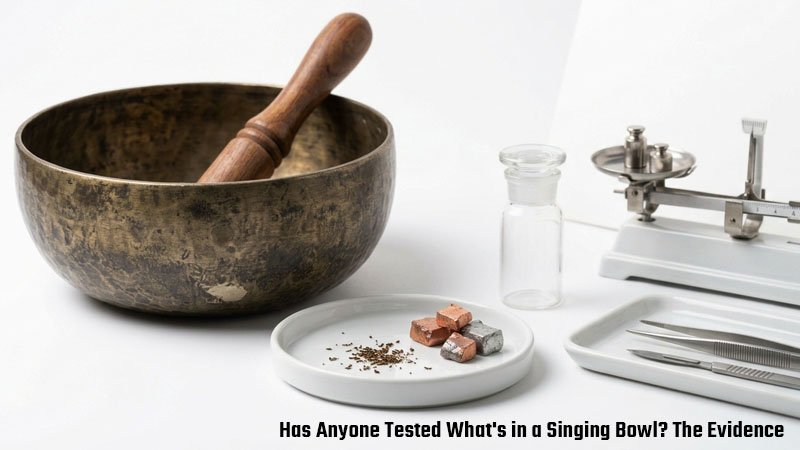
What the testing does support: antique Himalayan bowls are bell-metal bronze, roughly 77 to 80 percent copper and 20 to 23 percent tin. What it does not cover at all: bowls being made today. Every published analysis examined antiques.
This page collects every study we could find, what each actually examined, and where the gaps are. We work in a Kathmandu workshop and we sell these bowls, so we have an interest — which is why everything below is linked to its source for you to check.
Why does this question need answering at all?
If you search for what a Tibetan singing bowl is made of, you will find two confident and opposite answers. One says seven sacred metals, each tied to a planet. The other says that is a marketing myth and bowls are simply bronze.
We have repeated the first version ourselves, on this site, because it is what the trade says. Before changing that we wanted to read the actual evidence rather than the summaries of it. What we found was thinner than either camp lets on, and the gaps in it are more interesting than the argument.
The terms, defined
Four words do most of the work in this argument and they are not interchangeable.
- Bronze — an alloy of copper and tin. Ordinary bronze runs around 10 percent tin.
- Bell-metal bronze — a high-tin bronze, roughly 20 to 23 percent tin and 77 to 80 percent copper. Used for the world's best bells, gongs and cymbals, and what published testing consistently finds in antique singing bowls.
- Brass — copper and zinc, not tin. Cheaper, easier to machine-press, and sonically quite different: brighter, shorter, far fewer overtones. Most inexpensive bowls sold as Tibetan are brass.
- XRF — X-ray fluorescence spectrometry. The standard non-destructive method for determining what elements a metal object contains. It reads the surface rather than the body of the metal, which matters on old bronze where tin can be depleted at the surface.
What studies exist? The evidence at a glance
| Study | Year | What was examined | Reported finding | Independent? |
|---|---|---|---|---|
| Oxford, Dept of Materials Dr Peter Northrup |
2010 | 100+ antique bowls, 16th–19th century | High-tin bronze, 77–78% copper, 22–23% tin. No seven metals. | Commissioned by a bowl seller |
| Concordia University, Quebec | 1995 or 1996 | Disputed — antique or recent bowls, depending who cites it | Disputed — cited as finding seven or eight metals, and as finding no gold or mercury | Document not publicly available |
| Bells of Bliss | ongoing | Hundreds of bowls, seller's own testing | Bell-metal bronze or brass only | Seller's own testing |
| Terwagne & Bush, Nonlinearity |
2011 | 4 antique bowls — acoustics, not composition | Density 8,366–9,372 kg/m³ | Yes, peer-reviewed |
That is the whole body of evidence. Four entries, of which only one is peer-reviewed and that one was not measuring composition.
What did the Oxford study actually find?
This is the source behind almost every "singing bowls are just bronze" article on the internet, usually without attribution.
The 2010 Oxford analysis found that antique Himalayan singing bowls are bell-metal bronze — roughly 77 to 78 percent copper and 22 to 23 percent tin — with no deliberate additions of gold, silver or mercury.
Archaeological metallurgists in the Department of Materials at the University of Oxford, led by Dr Peter Northrup, examined a group of antique bronze bowls dated from the 16th to the 19th century, with one possibly older. The reported result was a high-tin bronze of roughly 77 to 78 percent copper and 22 to 23 percent tin — the alloy known as bell-metal bronze, used for the best bells, gongs and cymbals worldwide. Across more than a hundred bowls, very little variation in the alloy was found.
What it actually establishes. That antique Himalayan bowls in that collection were bell-metal bronze, consistently, and contained no deliberate additions of gold, silver or mercury. On that narrow question the finding looks solid, and the high tin content is a genuinely useful explanation for why these bowls sustain the way they do.
Two things worth knowing that rarely get mentioned.
- The bowls came from a seller, and the analysis was commissioned by that seller. The bowls were supplied by Himalayan Bowls, and the work confirmed that company's own prior metallurgical assessment. Oxford metallurgists have no stake in the answer, and we are not suggesting the analysis is wrong. But it is not independent academic research, and it is routinely described as though it were.
- Every bowl was an antique. The study says nothing whatsoever about what a workshop in Kathmandu melts today. Those are separate questions and they are constantly treated as one.
Sources: the analysis is described by Himalayan Bowls, who commissioned it, and discussed at length in a 2011 exchange between Dr Jeffrey Thompson and others published by Bodhisattva Trading Company.
What is the Concordia study, and does it exist?
The Concordia report is cited constantly, quoted by both sides for opposite conclusions, and appears to be unavailable to anyone. This is the single most important thing on this page.
A metallurgical analysis from Concordia University in Quebec, dated variously as 1995 or 1996, is cited constantly. It is cited by both sides of the argument, for opposite conclusions.
- Karma and Luck reports Concordia as finding an eight-metal alloy — copper and tin, plus gold, iron, lead, mercury, silver and zinc.
- Dr Jeffrey Thompson, in that same 2011 discussion, describes it as an earlier analysis that may be where the seven-metals idea originated, and which included gold and mercury.
- Solacely and Ravensounds cite a 1996 Concordia study as finding essentially copper and tin, with no gold and no mercury at all.
- Instruments du Monde states the report is dated May 1995 and examined relatively recent bowls rather than antiques — and that it did find multiple metals.
The same document is being used to prove two incompatible things. And in that 2011 exchange, Thompson — the person introducing it to the debate — says he will try to get hold of a copy. He did not have one.
We have looked. We cannot find a publicly available copy of this report, a catalogue reference, an author, or any published record of it beyond people quoting each other. It may well exist. But at present, one half of the most repeated argument in this industry rests on a document that, as far as we can establish, nobody involved in the argument has read.
If you have a copy, we would genuinely like to see it. Please send it to us and we will publish it here, whatever it says.
What have sellers found testing their own stock?
Bells of Bliss states it has tested hundreds of bowls and never found the seven metals — only bell-metal bronze or, in cheaper instruments, brass. They also make the fair point that non-destructive testing is straightforward and the real obstacle is that somebody has to pay for it.
We take that seriously, and we would note the obvious thing: we are a seller too. So is Himalayan Bowls. So is everyone else publishing on this. Nobody arguing about singing bowl metal is disinterested, ourselves included, which is precisely why the underlying documents matter more than the conclusions drawn from them.
Is there any peer-reviewed research?
There is peer-reviewed science on singing bowls, but none of it measures what the metal is made of. The published work is about acoustics, not composition. Terwagne and Bush published work in the journal Nonlinearity in 2011 on the acoustics and fluid dynamics of Tibetan bowls — the study behind the widely shared footage of droplets leaping from the surface of a water-filled bowl.
Their paper does include physical measurements of four antique bowls, and one figure is worth noting here: the densities range from 8,366 to 9,372 kg/m³. That is a wider spread than a single uniform alloy would produce, though with only four bowls it proves nothing on its own. It is simply the one composition-adjacent number in the peer-reviewed literature.
Sources: the paper on arXiv, and ScienceDaily's summary.
So what does the evidence actually show?
Setting the noise aside, here is where things honestly stand.
Reasonably well established: antique Himalayan bowls are bell-metal bronze at roughly 77 to 80 percent copper and 20 to 23 percent tin. Iron appears occasionally in trace quantities, at levels consistent with impurity in the raw material rather than deliberate alloying. No credible analysis has found gold, silver or mercury in quantities suggesting intentional inclusion.
Not established at all: what bowls made in the last thirty years contain. Every analysis anyone cites examined antiques — with the possible exception of the Concordia report, which may have examined recent bowls, and which nobody can produce.
This matters more than it sounds. A Kathmandu workshop in 2026 is not an 18th-century village forge. It buys metal on a modern market, often including scrap and recycled material. And it works in a market that specifically asks for seven-metal bowls. It is entirely possible that modern bowls contain metals antique bowls did not, precisely because the story became a selling point. Nobody has tested this properly. It is a genuine open question, and the two camps shouting at each other have both been answering a different one.
Which part of the seven-metals claim is wrong?
- "Singing bowls are made from seven metals as a deliberate recipe." For antiques, the testing does not support this. For modern bowls, it is untested.
- "The seven metals are an ancient Himalayan tradition." The seven planetary metals — gold, silver, mercury, copper, iron, tin and lead — are the seven metals of classical and medieval alchemy, a European framework. Several researchers place the appearance of the seven-metal singing bowl claim at around the 1970s, as the Western market grew. Antique Singing Bowls makes the point that the claim is repeated by practically every bowl seller, in Kathmandu and elsewhere.
- "The planetary and metal symbolism is meaningful." This is not a metallurgical question and a spectrometer cannot address it. Symbolic frameworks do not require a chemical basis to matter to the people using them, and we are not going to tell anyone their practice is invalid because of a test result.
Most arguments about this collapse all three into one and then talk past each other.
What actually determines how a bowl sounds?
Here is the part the seven-metals debate obscures entirely. The important variable is not how many metals are in the alloy. It is the ratio of two of them.
Ordinary bronze runs around 10 percent tin. Bell metal runs to 20 percent and beyond, and that extra tin is what produces the long sustain and layered overtones of a good bowl. Push it higher and the metal turns brittle enough to crack under the hammer. Pull it back and the tone dies quickly.
Tin is also expensive, and it is the metal most easily lost in melting — it melts at 232°C while copper melts at 1083°C, so tin can evaporate before the copper has fully liquefied. Making a high-tin bronze over a traditional fire takes real skill, and a workshop cutting costs cuts tin.
That single decision does more to determine whether a bowl sings than any question of gold or silver, and it is invisible in a photograph. It is also why a brass bowl — copper and zinc rather than copper and tin — sounds so different: brighter, shorter, with far fewer overtones. Most inexpensive bowls sold as Tibetan are brass. Our comparison of bronze versus brass singing bowls covers the difference, and how Tibetan singing bowls are made covers what happens after the melt.
What has nobody tested, and what are we doing about it?
Every study above was conducted by Western researchers examining antique bowls in laboratories. Not one of them asked the people who make these instruments what they put in the crucible.
We work with smiths in Kathmandu every week. So we are doing the two things nobody has done:
- Having our own bowls analysed — new hand-hammered, hand-cast, antique, a second smith's work, and a cheap machine-pressed bowl from a tourist shop for contrast. Non-destructive XRF, multiple readings per bowl, full report published here whatever it says.
- Asking the smiths directly what goes in, where the metal comes from, whether their fathers used the same mix, and what they actually do when a customer asks for a seven-metal bowl. Published in their words, with their names.
We have committed to publishing the result before knowing what it is. If it comes back as plain bell bronze, that is what this page will say.
We will publish the results here
The analysis and the workshop interviews will be added to this page when complete. If you want to be told when, or you have information that belongs on it, get in touch.
Reference list: every source on this page
Everything cited above, in one place. We have linked to sources we disagree with as well as ones we agree with, including direct competitors, because a reference page that only cites its own side is not a reference page.
- Himalayan Bowls — on the Oxford analysis and bell metal bronze
- Bodhisattva Trading Company — Dr Jeffrey Thompson on singing bowl physics and metallurgy, 2011, where the Concordia report enters the debate
- Bells of Bliss — the seven metals myth
- Antique Singing Bowls — on seven-metal claims and bell metal
- Instruments du Monde — the seven metals and their meanings
- Karma and Luck — citing Concordia for an eight-metal alloy
- Solacely — history of singing bowls and the real timeline
- Ravensounds — what singing bowls are made of
- Terwagne & Bush — the Tibetan singing bowl: acoustics and fluid dynamics (arXiv)
- ScienceDaily — researchers map the physics of Tibetan singing bowls
Related reading on this site
- What are the seven metals in a singing bowl — the tradition and the symbolism, which this page does not dispute
- How to spot a fake antique singing bowl — five checks, including why the sound is the one thing a finish cannot imitate
- Why does every singing bowl sound different? — what hand-hammering does that alloy alone cannot explain
- Why are antique singing bowls so expensive?
- How long does a singing bowl last? — what happens to bronze over centuries
- Who invented the singing bowl? — the origin question, with the same shortage of hard evidence
- Do singing bowls actually work? Science vs myth
- 12 factors that determine a singing bowl's frequency
- Types of singing bowls and the terminology guide
And the bowls themselves: hand-hammered, antique and collected, and hand-casted, each tuned and played by a sound healer before shipping — how that works.
Frequently asked questions
Has anyone actually tested what singing bowls are made of?
Yes, but less than the confident claims suggest. The main analysis is a 2010 examination of over 100 antique bowls by archaeological metallurgists at Oxford, which found bell-metal bronze at 77–78% copper and 22–23% tin. It was commissioned by a bowl seller and examined only antiques. A second frequently cited report from Concordia University is quoted by both sides for opposite conclusions, and we cannot find a publicly available copy of it.
Are Tibetan singing bowls made from seven metals?
For antique bowls, published testing does not support it — analyses consistently find copper and tin with only trace impurities, and no gold or mercury. For bowls made today, the honest answer is that nobody has tested this properly.
What are singing bowls actually made of?
Bell-metal bronze: roughly 77 to 80 percent copper and 20 to 23 percent tin. The high tin content produces the long sustain and complex overtones. Cheaper bowls are usually brass, which is copper and zinc, and sounds noticeably brighter and shorter.
Where did the seven metals story come from?
The seven planetary metals are a classical and medieval European alchemical framework. Researchers place the appearance of the seven-metal singing bowl claim at around the 1970s, as the Western market for these instruments grew. One suggestion is that it originated with the disputed Concordia report.
Is there peer-reviewed research on singing bowls?
Yes, but on acoustics rather than composition. Terwagne and Bush published on the acoustics and fluid dynamics of Tibetan bowls in Nonlinearity in 2011. There is no independent peer-reviewed metallurgical analysis of singing bowl alloy that we have been able to find.
Does the number of metals affect the sound?
Far less than the ratio of copper to tin. Bell metal runs to 20 percent tin and beyond, which is what produces sustain and overtones, and tin is expensive and easily lost in melting. A workshop cutting costs cuts tin, and that affects the sound more than any precious metal would.