




What Determines the Frequency of a Singing Bowl?
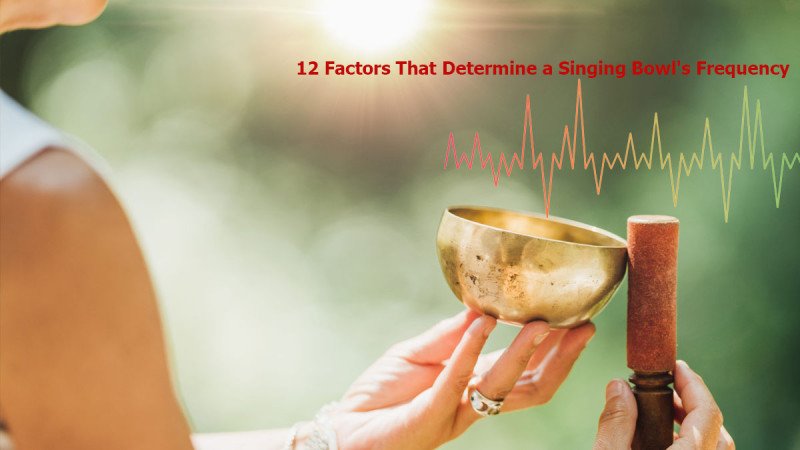
Twelve factors, and they split into two halves. Seven are fixed at the forge — diameter, wall thickness, curvature, rim profile, alloy, internal tension and hammering. Five are decided every time you play: where you strike, whether you strike or rim, which mallet you use, how hard, and what the bowl contains or rests on. Diameter dominates the first group. Together they mean a bowl does not have one frequency — it has a range of behaviours.
People ask what note a bowl is as though the answer were a single number stamped somewhere on it. It is not, and the reason is more interesting than the question.
Half of a bowl's pitch was settled by hammer strikes decades or centuries ago. The other half is settled by what your hand does in the next few seconds. Understanding which is which tells you what you can choose when buying, and what you can change once you own it.
Part One: Seven Factors Fixed at the Forge
These were decided when the bowl was made and cannot be altered afterwards.
1. Diameter — the Dominant Factor
Nothing else comes close. For a bowl-shaped shell, frequency is roughly proportional to wall thickness divided by diameter squared. That squared term is why size overwhelms everything else.
Double the diameter and the pitch drops by roughly two octaves. This is why a 30cm bowl sits somewhere around 80 to 160 Hz while a 10cm bowl sits above 700 Hz, and why no amount of technique will make a small bowl deep.
If you want a low note, you are shopping by size. Everything else is refinement. Our large standing bowls sit at the bottom of the range for exactly this reason.
2. Wall Thickness
Thicker walls lower the fundamental. But note the relationship: thickness appears in the numerator, not squared, so doubling wall thickness drops the pitch by roughly one octave — half the effect of doubling diameter.
Thickness does other things too. More mass means more energy needed before the tone establishes, which is why heavy bowls take longer to sing, and more physical weight in the tone once they do.
3. Wall Height and Curvature
How tall the walls are and how they curve changes how the shell flexes. A deep bowl with high walls vibrates differently from a shallow one of the same diameter, because the vibrating surface has a different shape to move through.
This is part of why bowl types sound distinct even at matched sizes — a Thadobati with straight high walls and a shallow round-bottomed Manipuri are not the same instrument.
4. Rim Profile
The rim is where most of the movement happens, so its shape matters disproportionately.
An Ultabati, whose wall curves inward under the rim, behaves differently from a straight-walled bowl of similar diameter. The inward curve changes the mass distribution at the most active part of the shell. Rim width and whether the edge is rounded or squared also shift the response.
5. Alloy Composition
Traditional bowls are bronze — copper with tin, typically somewhere around eighty to twenty. Tin content particularly affects the result: higher tin gives a harder, more brittle alloy that rings brighter and sustains differently.
Brass, the copper-and-zinc alloy in most machine-pressed bowls, is softer and damps faster. This is a genuine acoustic difference rather than a marketing one. Our article on the seven metals in a singing bowl covers the composition question in more detail.
6. Internal Tension
Forging is heat and cooling repeated many times. Each cycle leaves stress patterns in the metal, and those affect how it holds and releases vibration.
Two bowls with identical dimensions and alloy can differ measurably because one was worked through more heat cycles than the other. This factor is invisible, unmeasurable from outside, and real.
7. Hammering Pattern and Asymmetry
Thousands of strikes, none identical. This produces two effects.
Work-hardening changes the metal's stiffness where it has been struck most, which shifts pitch. And the slight asymmetry left behind causes mode splitting — each vibrational mode produces two frequencies rather than one. A single bowl has been measured with a fundamental sounding at both 334.1 Hz and 335.5 Hz simultaneously.
Those pairs interfere, and the interference is the pulse or shimmer people prize. Our article on the male and female tones of a singing bowl covers mode splitting in full.
Seven of these you choose when you buy, not after
Diameter and wall thickness decide most of a bowl's pitch, and neither can be changed later. Explore large standing bowls for the low end, handmade bowls across the range, or check what your own bowl is actually producing with our live frequency analyser.
Part Two: Five Factors Decided When You Play
This is the half most people do not know exists, and it is why the same bowl gives different readings on different days.
8. Where You Strike on the Rim
Because mode splitting produces two frequencies per partial, and each corresponds to a different orientation of the vibration pattern, striking at different points makes different frequencies dominant.
Strike at twelve o'clock, then at three o'clock, and listen. On a good hand-forged bowl the difference is audible. Experienced players mark the spots they prefer.
9. Strike Versus Rim
A strike is a single impulse that excites many vibrational modes at once — the fundamental plus a stack of overtones, all decaying at different rates.
Rimming works through stick-slip friction, feeding energy in continuously, which selectively drives the fundamental mode and sustains it. As the tone builds, the higher partial becomes dominant. Same bowl, entirely different measured result.
10. Mallet Material
Felt produces a soft attack that favours warmth and the lower partials. Wood is harder and brings the higher overtones forward, adding friction noise. Leather sits between them.
Swap the mallet and a tuning app will often read differently, because you have changed which partials dominate rather than changing the bowl.
11. Playing Force
How hard you strike shifts the measured fundamental slightly, and hard striking excites the upper modes disproportionately. A gently struck bowl and a hard-struck bowl produce measurably different spectra.
This is one reason gentle playing is recommended beyond simply sounding better — it gives you the bowl's own voice rather than a distorted version of it. Our guide on how to play a singing bowl covers technique.
12. What the Bowl Contains and Rests On
Water lowers the pitch by loading the vibrating rim with mass. More water, lower tone — the effect is substantial and entirely predictable.
What the bowl sits on matters too. A firm ring cushion supports the base and leaves the walls free. A soft cushion absorbs energy. Fingers on the wall damp specific modes and can silence a bowl entirely.
All Twelve at a Glance
| Factor | Effect on pitch | How much it matters |
|---|---|---|
| 1. Diameter | Larger is much lower — inverse square | Dominant. Nothing else is close |
| 2. Wall thickness | Thicker is lower | High — roughly half the influence of diameter |
| 3. Wall height and curvature | Changes how the shell flexes | Moderate. Explains differences between bowl types |
| 4. Rim profile | Alters mass at the most active point | Moderate. Ultabati versus straight-walled |
| 5. Alloy composition | Tin content affects brightness and sustain | Moderate. Bronze versus brass is significant |
| 6. Internal tension | Changes how metal holds vibration | Real but invisible and unpredictable |
| 7. Hammering asymmetry | Causes mode splitting and the pulse | Defines character more than pitch |
| 8. Strike position | Makes one split frequency dominant | Audible on any good hand-forged bowl |
| 9. Strike versus rim | Excites many modes, or drives one | Large. Effectively two instruments |
| 10. Mallet material | Felt favours low partials, wood high | Noticeable, and often mistaken for the bowl |
| 11. Playing force | Hard strikes over-excite upper modes | Small but measurable |
| 12. Contents and support | Water lowers pitch, soft surfaces damp | Large with water, moderate otherwise |
Why Your Tuning App Keeps Changing Its Mind
A common frustration: you measure your bowl, get one reading, measure again next week and get another. People assume the app is unreliable.
It is usually not. Five of the twelve factors change every time you play, and any of them will shift the reading. You struck a different spot. You used a different mallet, or the same mallet harder. You rimmed rather than struck. The bowl was on a different surface.
What the app gives you is one sample of one behaviour, not a property of the object. A bowl does not have a frequency. It has a range of behaviours, and you are choosing one each time you touch it.
If you want a reading you can rely on, standardise the conditions: same mallet, same strike position, same gentle force, bowl on a firm cushion, nothing inside. Then the number means something, because you are comparing like with like. Our live singing bowl tuner will show you the fundamental and, on a good hand-forged bowl, the split.
Why the Note Is Discovered Rather Than Chosen
Seven factors, all interacting, several of them invisible. That combination has a practical consequence worth stating plainly.
Nobody can predict a hand-forged bowl's frequency from its dimensions.
Two bowls of the same diameter and apparent thickness can come out several semitones apart, because their internal tension, alloy variation and hammering differed in ways nobody was tracking. The smith is not aiming at a note. The note is identified afterwards, once the bowl is finished and somebody strikes it.
This is why traditional bowls were never made to notes, and why the chakra-note correspondence is a modern framework applied to instruments that predate it. Our chakra note information page sets out how the mapping works if you want to use it.
What to Do If You Need a Specific Note
Two reliable routes, and browsing is neither of them.
Hand-casted bowls. Casting sets dimensions and wall thickness by the mould, which makes pitch predictable before the metal is poured. If you need an exact note — matching a set, replacing a bowl in a sequence — hand-casted bowls are how you get it reliably.
Commissioning. Through the custom singing bowl service you specify size, wall thickness, musical note, metal composition and engraving, hand-forged by artisans in Kathmandu. The factors that determine frequency are set deliberately rather than left to emerge.
If the note matters, set the factors that decide it
Diameter, wall thickness and alloy determine frequency, and all three are fixed at the forge. Through Dharma Tool's custom singing bowl service you choose them directly, hand-forged in Kathmandu. For predictable pitch without commissioning, hand-casted bowls are the reliable route.
What This Means in Practice
Four practical conclusions from the twelve.
Buy by size first. Diameter dominates, and it is the one factor you can judge reliably from a listing. Everything else is refinement on top of a decision size has already made.
Treat stated notes as approximate. A hand-forged bowl advertised as C is producing something near C under one set of conditions. That is not dishonest, it is the nature of the instrument. If the exact number matters, buy cast or commission.
Learn your own bowl's behaviours. Find the strike points, try both mallets, compare striking with rimming. You have more control over what your bowl produces than you probably realise.
Standardise before you measure. Any frequency reading is only meaningful if you can repeat the conditions that produced it.
Frequently Asked Questions
What determines the frequency of a singing bowl?
Twelve factors in two groups. Seven are fixed at the forge: diameter, wall thickness, wall height and curvature, rim profile, alloy composition, internal tension, and hammering pattern. Five are decided when you play: strike position, whether you strike or rim, mallet material, playing force, and what the bowl contains or rests on. Diameter dominates the first group by a wide margin.
Does the size of a singing bowl affect its pitch?
More than anything else. For a bowl-shaped shell, frequency is roughly proportional to wall thickness divided by diameter squared — and that squared term is why size overwhelms every other factor. Doubling the diameter drops the pitch by roughly two octaves, while doubling the wall thickness only drops it by about one. A large bowl is low because it is large.
Why does my singing bowl sound different depending on where I strike it?
Mode splitting. Hand-hammering leaves the metal slightly asymmetric, so each vibrational mode produces two frequencies rather than one — a measured example had a fundamental at both 334.1 and 335.5 Hz. Each corresponds to a different orientation of the vibration pattern, so striking at twelve o'clock and at three o'clock makes different frequencies dominant.
Why does my tuning app give different readings for the same bowl?
Because five of the twelve factors change every time you play. Strike position, mallet material, playing force, whether you strike or rim, and what the bowl rests on all shift the measured pitch. The app is sampling one behaviour rather than reading a property of the object. Standardise the conditions and the number becomes meaningful.
Can a singing bowl be made to a specific note?
Not reliably by hand-forging. Seven interacting factors, several of them invisible, mean nobody can predict pitch from dimensions — two bowls of the same size can emerge several semitones apart. The note is identified after forging rather than targeted. For a specific note, hand-casted bowls have predictable pitch because the mould sets dimensions, and commissioning lets you specify the factors directly.
Does adding water change a singing bowl's frequency?
Yes, substantially. Water loads the vibrating rim with additional mass, which lowers the pitch — and the more water, the lower the tone. The effect is predictable and reversible, which is why water is sometimes used deliberately to shift a bowl's note downward within a session.