




Why Are Antique Singing Bowls So Expensive?
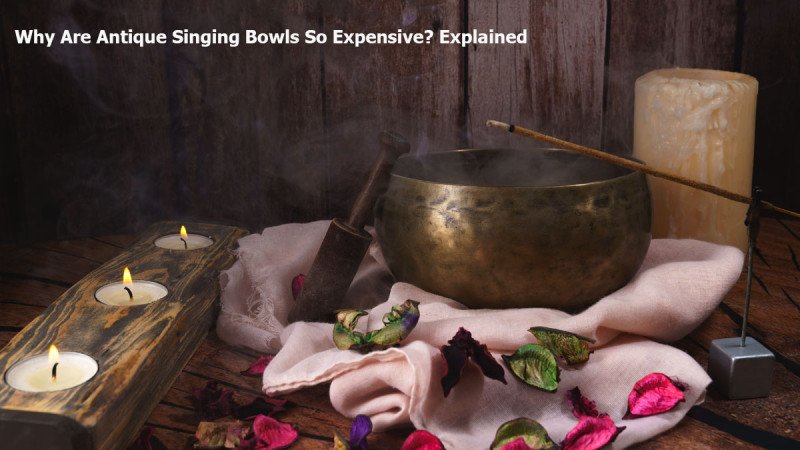
Antique singing bowls are expensive because the supply is finite and shrinking. No more are being made, they are sourced one at a time from remote Himalayan villages, and the rarer forms surface only occasionally. Price is then driven by type, condition and sound quality — a common Thadobati costs a fraction of a rare Lingam. The widespread faking of antiques has pushed verified genuine pieces higher still.
It is a fair question, and it deserves a better answer than "because it's old."
A new handmade bowl and an antique of similar size can differ in price by a factor of five or ten. Both are bronze. Both were hand-forged. One of them has three hundred years of use on it, and that alone does not obviously justify the gap.
The real answer is a stack of separate factors, some of them economic, some acoustic, and one of them a market problem. Here is the whole picture — including where an antique is not worth the money.
Nobody Is Making Any More
This is the foundation, and everything else sits on top of it.
Antique singing bowls were forged between roughly the 15th and early 20th centuries. Production of bowls in the old manner, for the old purposes, ended. Every genuine antique in existence has already been made, and the number can only go down as bowls are damaged, lost or absorbed into permanent collections.
Meanwhile demand has risen steadily as sound practice has spread worldwide. A fixed and slowly shrinking supply meeting a growing market produces exactly one outcome, and it has been producing it for thirty years.
New bowls do not have this constraint. A workshop in Kathmandu can forge another one next week. That single difference accounts for most of the price gap before you consider anything about the instrument itself.
How an Antique Bowl Actually Reaches You
The supply chain is unusual and it is worth understanding, because it explains a great deal about cost.
Virtually every antique singing bowl entering the market today is sourced from remote Himalayan villages by collectors working on behalf of a small number of specialist dealers in Kathmandu. Someone physically travels, finds households with old bowls, negotiates, and carries them back.
There is no warehouse. There is no wholesale catalogue. There is no reordering. Each bowl is found individually, and the collector may return from a trip with three that are worth having.
Those bowls are then sorted, assessed and played, because a great many old bowls are simply not good instruments. The ones that pass reach dealers. The rest do not.
Compare that with a new bowl, which is produced to order by a known workshop and shipped in quantity, and the cost difference stops looking arbitrary.
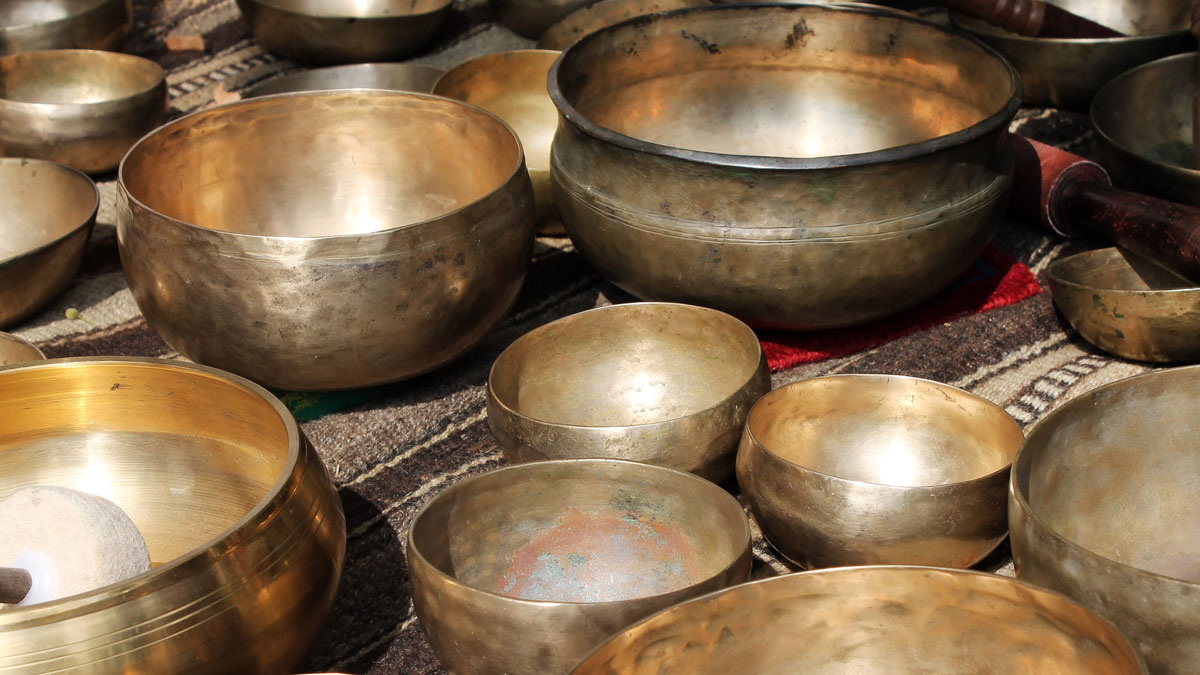
Why One Antique Costs Ten Times Another
"Antique singing bowl" covers forms that differ enormously in rarity and price. This is the single biggest variable and almost nobody explains it to buyers.
| Type | Character | Rarity and price |
|---|---|---|
| Thadobati | Flat bottom, high straight walls. 10-20cm. Among the oldest forms, some 16th century. Notes across the 2nd to 4th octave | Numerous, so the most affordable entry point. Quality varies enormously and good examples are getting harder to find |
| Manipuri | Shallow, round-bottomed, small to medium | Common. Wide range of sizes and prices, often a first antique |
| Jambati | The largest and heaviest form. 20-38cm, full curved walls, inward-facing lip. Long sustain, deep voice. Notes from the 1st octave up | Substantial. Often well preserved because many were used for grain storage. Popular with collectors and sound therapists |
| Ultabati | Jambati geometry but the wall curves inward under the rim. 22-35cm. Prominent hammer marks, often dark outside and bright within. Very low tones, some produce fountains | Uncommon, and hard to find with genuinely good sound. Specialist dealers commonly list these from several hundred to a few thousand dollars |
| Lingam | Carries a raised protrusion in the base. Ceremonial rather than utilitarian | Seldom reaches the market at all. Prices have risen sharply. The most faked form for exactly that reason |
| Mani | Small, thick-walled, high-pitched | Rare, ceremonial, prized by collectors |
| Naga / Pedestal | Chalice-like, raised on a stem | Uncommon. Responsive, though a loose pedestal can compromise the tone |
Thadobati, Manipuri and Jambati account for most antique bowls in Western collections. The Lingam and Mani are the pieces that make collectors travel. Our article on what a Lingam singing bowl is covers that form in detail.
Found one at a time, played before listing, never reordered
Every piece in our antique and collected bowls is sourced individually and assessed by ear before it reaches the shop. If an antique is not the right fit, our handmade bowls and large standing bowls deliver the same craft at a fraction of the cost.
What Age Actually Does to the Sound
Part of the price is acoustic, and this part is real — though smaller than the marketing suggests.
Older bowls tend to be thinner-walled. The old forging methods involved enormous amounts of hammering, and many antique bowls were worked thinner than most modern production. Thinner walls respond faster and sing more readily, which is why a good antique often feels alive under the mallet in a way a heavy new bowl does not.
Hand-hammering asymmetry produces mode splitting. In a hand-forged bowl each partial sounds at two slightly different frequencies rather than one, and the interference between them is the pulse or shimmer people prize. Older forging methods left more of this asymmetry, so antique bowls often have a more pronounced and more interesting pulse. Our article on the male and female tones of a singing bowl covers mode splitting in detail.
Bronze becomes more brittle over centuries, which changes how it vibrates. Many practitioners describe antique bowls as warmer and more complex in their overtone blending. That is a widely reported impression rather than a measured effect, and it is worth labelling as such.
The rim wears smooth. Centuries of playing round the rim edge, which changes the contact surface and often makes the bowl easier to rim.
The Honest Caveat
None of this means old automatically means better. Plenty of antique bowls are mediocre instruments — thin sound, short sustain, wobbling fundamental. They are old and that is all they are.
Age correlates with quality in the antique market mainly because poorly made bowls did not survive three centuries, and because everything was hand-forged then as a matter of course. A well-made contemporary bowl comfortably outperforms a mediocre antique. Our comparison of new handmade and antique bowls goes further into this.
Craftsmanship determines quality. Age is a proxy for it, and proxies are not the thing itself.
The Fakes Problem — and Why It Pushes Genuine Prices Up
As authentic antiques have grown scarcer and more valuable, faking them has become an industry.
Specialist dealers describe a plague of fake Thadobati and fake Lingam bowls on the market. The methods are straightforward: a new bowl artificially aged with chemical patina and applied wear, or — in the case of Lingams — a genuinely old bowl with the lingam protrusion added later to multiply its value.
A real old Lingam shows consistent metal throughout, because the protrusion was formed with the bowl. An added one does not, though spotting the difference takes experience.
This has a counterintuitive effect on price. Because so many fakes circulate, buyers pay a premium for pieces that come with credible assessment behind them. Verification has become part of what an antique costs, and a bowl sold cheaply as an antique should raise your suspicions rather than your interest.
What to Check
- Consistent metal. Patina, wear and colour should be coherent across the whole bowl. Sharp transitions suggest work has been done.
- Wear where wear belongs. A genuinely old bowl is worn where hands and mallets touched it — the rim, the outer wall. Uniform "aging" across every surface is a chemical bath, not three centuries.
- Undisturbed patina. A brightly polished "antique" has either been cleaned for export, which reduces its value considerably, or was never old.
- The sound. The most reliable test and the hardest to fake. A good old bowl has a long sustain and a distinct pulse. Faking a patina is easy; faking three centuries of acoustic character is not.
- Who is selling it. Antiques are not a category to buy from a marketplace listing with a stock photograph.
What You Are Actually Paying For
Set out plainly, the premium breaks into five parts.
Scarcity. The largest component. A finite and shrinking supply against rising demand.
Sourcing. Each bowl found individually in a remote village and carried back, rather than ordered from a workshop.
Selection. Most old bowls are not good instruments. Someone has to play a great many to find the ones worth selling, and the cost of the rejects is carried by the ones that sell.
Type rarity. Whether the form is common or one that surfaces a few times a year.
Verification. The premium for a piece someone knowledgeable has assessed, in a market with a serious counterfeit problem.
What you are not paying for is a guarantee of better sound. That has to be judged bowl by bowl, and any dealer implying otherwise is selling the category rather than the instrument.
Is an Antique Bowl Worth It?
Depends entirely on what you want, and the honest answer is that for many people it is not.
Worth It If
You are drawn to the object as much as the sound. You want an instrument with a history you can see in the metal. You are collecting, and value provenance and rarity. You have played enough bowls to hear the difference a good antique makes. Or you specifically want a form — Lingam, Ultabati, Mani — that is not made new in the same way.
Not Worth It If
You want the best possible sound for the money. A good new handmade bowl will beat a mid-range antique on sound alone, at a fraction of the price.
You need a specific note. Antique pitch is whatever it happens to be. A custom-forged bowl can be made to the note, size and wall thickness you specify — and a custom piece, while not cheap, still costs considerably less than an antique equivalent.
You are buying your first bowl. Learn what you like on something affordable before spending seriously.
You are buying as an investment. The market is small, illiquid and dependent on authentication. It is not a reliable place to store money.
Made to your specification — antique character without antique scarcity
If what you want is a specific note, a particular wall thickness or a large deep-voiced bowl, commissioning is the direct route. Through Dharma Tool's custom singing bowl service you specify size, note, thickness, engraving and intention, hand-forged by artisans in Kathmandu — and it costs considerably less than an antique of comparable size.
Why the Price Is Not Going Back Down
Worth saying, because people sometimes wait for a better moment.
The supply of genuine antiques was fixed centuries ago and has only contracted since. The villages that held them have largely been visited. The specialist dealers who assess them are a small group, and the collectors who source them are older than they were.
Nothing in that picture suggests prices ease. The bowls that command serious money now were unremarkable thirty years ago, when nobody in the West had noticed rare forms existed. That window closed.
Which is not an argument for buying in a hurry. It is an argument for buying carefully, once, from someone who has played the bowl — rather than buying quickly and discovering later that patina was the only old thing about it.
Frequently Asked Questions
Why are antique singing bowls so expensive?
Because the supply is finite and shrinking while demand grows. No genuine antiques are being made, and those entering the market are sourced individually from remote Himalayan villages rather than ordered from workshops. Price is then driven by the rarity of the form, condition, and sound quality. The widespread faking of antiques has pushed verified genuine pieces higher still.
Which antique singing bowl type is most expensive?
Lingam bowls, which carry a raised protrusion in the base, seldom reach the market and have risen sharply in price. Mani bowls are similarly rare. At the other end, Thadobati and Manipuri are relatively numerous and much more affordable, which makes them common first antiques. Jambati and Ultabati sit in between, with Ultabati harder to find in good acoustic condition.
Do antique singing bowls sound better than new ones?
Often, but not automatically. Older bowls tend to be thinner-walled and show more pronounced mode splitting, which produces the pulse many people prize. But plenty of antiques are mediocre instruments with thin sound and short sustain. Age correlates with quality mainly because poor bowls did not survive three centuries. A well-made new bowl comfortably outperforms a mediocre antique.
How can I tell if an antique singing bowl is genuine?
Check that patina, wear and colour are consistent across the whole bowl, with no sharp transitions. Look for wear where hands and mallets actually touched — the rim and outer wall — rather than uniform aging everywhere, which indicates a chemical bath. A brightly polished antique has either been cleaned, reducing its value, or was never old. The most reliable test is sound: faking a patina is easy, faking centuries of acoustic character is not.
Are antique singing bowls a good investment?
Not reliably. Genuine antiques have appreciated as supply declined, but the market is small, illiquid and heavily dependent on authentication and provenance. Selling well means finding the right buyer, which takes time. A good antique is a purchase that holds value rather than an investment vehicle, and the reason to buy one should be that you want to play it.
Is there a cheaper alternative to an antique bowl?
Yes, and for most buyers it is the better choice. A good new handmade bowl delivers excellent sound at a fraction of the price. If you want a specific note, size or wall thickness, a custom-forged bowl gives you exactly that and still costs considerably less than an antique of comparable size — while an antique's pitch is simply whatever it happens to be.