




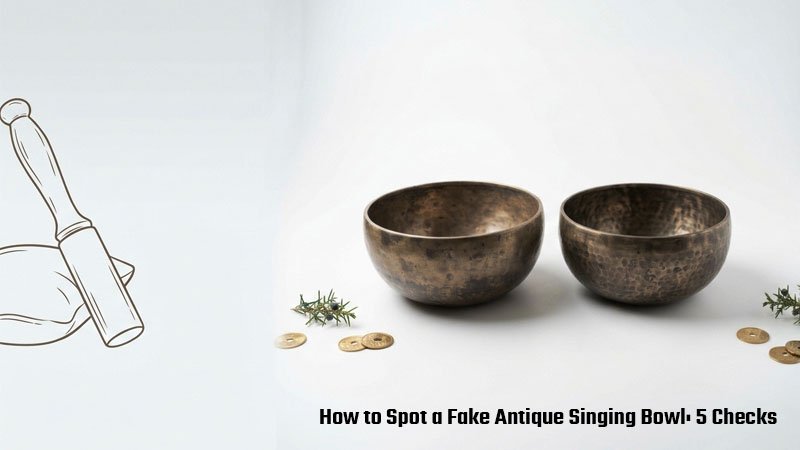
How to Spot a Fake Antique Singing Bowl: 5 Checks
Short answer: you cannot date a Himalayan singing bowl, but you can tell whether it has been used. Five checks separate genuine age from an applied finish:
- Wear pattern — genuine wear concentrates on the rim, the outer belly and the base, not evenly across the bowl.
- Interior — decades of household use leave it smoothed unevenly and irregularly stained.
- Hammer marks — worn bowls have rounded but legible facets; tumbled fakes show one-directional scoring.
- Patina — real oxidation runs continuously into dents and scratches; applied patina sits over them.
- Sound — an old bowl has a slower attack, a longer non-linear decay and overtones that unfold in sequence. No finish can imitate this.
Checks 1 to 4 can be done from good photographs. Check 5 needs a recording of the specific bowl, and it is the one that settles it.
You cannot date a Himalayan bowl, but you can tell whether it has been used. That is the whole of it. A new bowl can be given a convincing patina in an afternoon, and in a photograph the result is indistinguishable from a bowl that spent sixty years in a Nepali kitchen. What cannot be faked is the pattern that decades of handling leave behind, and what that handling does to the sound.
Five checks separate genuine age from applied age. Four you can do from good photographs. The fifth needs a recording, and it is the one that settles it.
| Check | Genuine old bowl | Aged reproduction |
|---|---|---|
| 1. Wear pattern | Concentrated on rim, outer belly and base; untouched between | Even across the whole surface |
| 2. Interior | Smoothed unevenly, irregular staining from use | Clean, evenly coloured, photogenic |
| 3. Hammer marks | Rounded and polished flat at the high points, still legible, random directions | Scored in one direction, smeared rather than worn |
| 4. Patina | Deep and variable, runs continuously into dents and scratches | Flat and uniform, sits over damage; dents look brighter |
| 5. Sound | Slow attack, long non-linear decay, overtones unfold in sequence | Fast attack, straight decay, partials arrive together |
How are fake antique singing bowls made?
Antique Himalayan bowls command several times the price of new ones, the supply is finite, and nothing about the object carries a date. That combination guarantees a market in aged reproductions, and there is a small industry in Kathmandu and across the border doing exactly that.
The methods are not exotic. A newly hammered bowl is treated with acid or a sulphide solution to darken the surface, then tumbled with grit or steel to soften the edges and add scratching. Some are buried in damp earth for a few weeks to accelerate oxidation. Others are simply heated and rubbed with oil and ash. The better workshops finish by scuffing the rim and the base by hand, because they know that is where a buyer looks first.
None of this is illegal, and an aged-finish bowl sold honestly as an aged-finish bowl is a perfectly reasonable object. The problem is only ever the label.
Check 1: Where does the wear sit?
On a genuine antique singing bowl, wear concentrates on the rim, the outer belly and the base — not evenly across the surface. This is the most reliable visual test and the one most fakes fail.
A bowl that has been used for fifty years has been picked up, set down, carried, filled and washed tens of thousands of times. The wear that leaves behind is uneven and specific. It concentrates on the outer rim, where fingers grip. On the outer belly, roughly a third of the way down, where a hand cradles it. On the base, from being set on stone, wood and earth. Between those zones the surface is comparatively untouched, and on the underside of the curve you will often find the original darker patina almost intact.
Antique, collected, aged finish: what the terms mean
These words are used loosely and sometimes interchangeably. Here is what each one actually denotes in the Himalayan bowl trade.
- Antique singing bowl — a hand-hammered Himalayan bowl made decades ago and used before being sold on. There is no agreed age threshold; most bowls sold as antique are between fifty and a hundred years old.
- Collected singing bowl — the trade's term for the same thing. It simply means the bowl was bought second hand from a household, temple or dealer rather than made to order.
- Old singing bowl — used interchangeably with both of the above, with no fixed meaning.
- Aged finish or antique finish — a new bowl treated to look old. This is an honest description when used honestly, and the source of nearly every dispute when it is not.
- Patina — the surface colour produced by oxidation over time. On a genuine bowl it works into the alloy; a chemical patina sits on top of it.
Note what is missing from all of these: any claim about a specific year. Our terminology guide covers the wider vocabulary, including the bowl forms.
Applied ageing is applied evenly, because it is done by dipping, tumbling or wiping. The result is a bowl that looks equally old everywhere. If the wear has no geography — if you cannot look at it and say "that is where it was held" — be sceptical.
Ask for photographs of the base and the underside of the curve specifically. Sellers photograph the pretty side.
Check 2: What does the interior look like?
The interior of a genuine old bowl is smoothed unevenly and stained irregularly by use. Most of these bowls were not ritual objects for most of their lives. They were household vessels — for grain, curd, water, offerings. That use leaves an interior that is smoothed unevenly and stained irregularly, often with a lighter ring where the contents sat and darker patches toward the base.
Faked bowls are usually finished attractively inside, because the seller is thinking about the listing photograph rather than about what sixty years of curd does to bronze. A pristine, evenly coloured interior in a bowl described as a century old is a contradiction.
The exception worth knowing: genuinely old bowls that were only ever used ritually, in a monastery, can have cleaner interiors. But those are rarer than the market pretends, and the outside will still show the handling.
Check 3: Are the hammer marks worn or smeared?
Every genuine Himalayan bowl was raised from a heated disc by hand, and the hammering leaves a texture of overlapping facets across the whole surface. Our post on why every singing bowl sounds different explains what that process does to the metal, and the guide to singing bowl types covers how the forms differ.
Decades of handling wear those facets down gradually. The marks stay legible but blurred — you can still see individual hammer strikes under the wear, particularly if you tilt the bowl to the light, but their edges are rounded and the highest points are polished flat.
Mechanical tumbling, used to simulate age quickly, does something different. It abrades in one direction and leaves the facets looking smeared or scoured rather than worn — a directional scratch pattern laid over the hammering, instead of hammering that has softened into itself. Once you have seen both, the difference is obvious. In photographs, look for scratching that runs consistently one way.
Also watch for the opposite failure: a bowl with a dark antique finish and crisp, sharp hammer marks underneath. That is a new bowl in old clothes, and it is the most common fake of all.
Check 4: Is the patina in the metal or on it?
Himalayan bowls are forged from a seven-metal alloy, predominantly copper and tin — our explanation of the seven metals covers what each contributes. Over decades, oxidation works into that alloy and produces a colour that is deep, warm, and slightly variable across the surface, with browns and golds shifting as you turn the bowl.
Chemical patina sits on top. It tends to be flatter, more even, and often slightly wrong in hue — too grey, too uniformly chocolate-brown, or with a faint greenish cast from a sulphide treatment. Because it is a surface layer, it also wears through in use, so an aged-finish bowl that has been handled for a year often shows bright metal at the rim in a way a genuine antique does not.
One practical test if the bowl is in front of you: genuine patina is continuous into the scratches and dents, because the damage happened before or during the oxidation. Applied patina often sits over damage, leaving the scratch itself looking newer and brighter than the surface around it. Look into the deepest dent you can find.
Check 5: How does it sound when you strike it?
This is the check that settles the other four, and it is why we record every bowl in our antique and collected collection rather than relying on photographs.
Bell metal is crystalline, and sustained vibration over decades gradually relieves internal stress and settles the grain structure — the same principle behind why a long-played brass instrument responds differently from a new one. In a bowl, three things follow from that:
- A slower attack. Strike a new bowl and the tone arrives immediately. An old bowl takes a moment to open, as though the sound is gathering before it leaves.
- A longer, less linear decay. New bowls fade fairly evenly. Old ones fade in stages, with the tone appearing to swell slightly before it settles.
- Overtones that unfold in sequence. In a new bowl the upper partials arrive together with the fundamental. In an old one they emerge over several seconds, which is what players mean when they say a bowl "opens".
A new bowl with an antique finish sounds new. No surface treatment changes the interior structure of the metal, and no amount of tumbling produces a slow attack. If a seller will not send you a recording of the specific bowl, that is your answer — this is also why we do not publish stock sound clips, because a recording of a different bowl tells you nothing at all.
Hear the bowl before you buy it
Every antique bowl we hold is a single piece, so we record the one you are considering — struck and rim-played — and send it to you before you decide. Usually the same day, and no obligation.
Can an antique singing bowl be dated?
You will see antique bowls listed as "circa 17th Century" or "circa 1500 A.D." with complete confidence. It is worth understanding what that confidence rests on, which is very little.
Himalayan bowls carry no maker's marks, no dates and no documentation. They were domestic objects made by village smiths, not signed works. Bronze cannot be carbon dated, because radiocarbon dating requires organic material. Metallurgical analysis can tell you the alloy composition, which narrows the region and sometimes the era very loosely, but it is expensive and almost nobody does it for a bowl worth a few hundred dollars.
So every specific date you see attached to a singing bowl is an estimate, based on form, wear, alloy colour and the judgement of whoever is selling it. Some of those judgements are well informed. None of them are evidence.
This matters for spotting fakes because a precise date is itself a warning sign. A seller who tells you a bowl is "roughly fifty to eighty years old, judging by the wear" is telling you what they actually know. A seller who tells you it is from 1720 is telling you a story.
What are the warning signs in a listing?
- A specific century, stated as fact. See above.
- Multiple identical "antiques". Genuine old bowls are single pieces. If a seller has six that look alike, they are not old, or they are not six.
- A monastery provenance with no detail. "From a Tibetan monastery" is unverifiable and universal. Ask which monastery, and how it came to be sold.
- Photographs only of the front and the inside. Ask for the base, the underside of the curve and the rim edge.
- Flawless condition. An unmarked hundred-year-old household vessel should raise an eyebrow, not lower the price.
- No recording offered. The single clearest signal. A seller confident in the piece has nothing to lose by letting you hear it.
- Uniform stock photography. If the listing image could be any bowl, it probably is.
What should you ask the seller before buying?
Six questions. An honest seller will answer all six without hesitation.
- How old do you believe this is, and what are you basing that on?
- Where was it collected — household, temple, dealer?
- Can you photograph the base and the underside of the curve?
- What is the condition of the rim? Any dents, flat spots or repairs?
- Can you send me a recording of this specific bowl, struck and rim-played?
- Is the finish original, or has it been treated or cleaned?
That last question is the fairest one you can ask, and the answer tells you a great deal. Plenty of legitimate dealers sell lightly cleaned or restored bowls and will say so.
How do you check a bowl you already own?
Run the same checks in reverse. Look at where the wear sits. Look inside. Tilt it to the light and study the hammer marks. Find the deepest dent and see whether the patina runs into it. Then strike it and listen for the attack — that slight hesitation before the tone arrives is the hardest thing to fake and the easiest to recognise once you know it.
And if it turns out to be a new bowl with an aged finish, that is not a disaster. It is a hand-made bowl, forged by the same methods, and it should be judged as one. Plenty of new hand-hammered bowls outperform mediocre antiques — age improves a well-made bowl, it does not rescue a poor one. Our comparison of new handmade versus antique bowls goes into which actually suits which practice, and how long a singing bowl lasts covers what happens to metal over time.
What you should not do is polish it. The patina is the record of the bowl's working life, and removing it destroys both the character and the value. Our guide to cleansing and charging a singing bowl covers what is safe.
How does Dharma Tool assess antique bowls?
Every collected bowl that reaches our Kathmandu workshop is played by Sunita Poudel, our founder and a professional sound healer, before it is listed. She judges from years of using these instruments in practice rather than from a photograph: whether the tone is genuinely aged, whether the bowl is structurally sound, whether it still plays cleanly, and what it actually suits. Bowls that do not pass are not listed. You can read more about how that assessment works.
We also do not assign centuries. We will tell you the form, the condition, the depth of the wear and what the surface and tone suggest about its working life — and we will record it for you before you buy. If precise provenance matters to you more than sound does, a specialist collector's dealer will serve you better than we will, and we would rather say so.
Looking for a particular piece?
A full-size Jambati, a Lingam, a small Thadobati cup to start with. Tell us the form and size you are after and we will let you know when one comes through the workshop.
Frequently asked questions
Can a singing bowl be carbon dated?
No. Radiocarbon dating requires organic material, and these bowls are bronze. Any specific date attached to a Himalayan bowl is an estimate based on form, wear and alloy colour.
How old does a singing bowl have to be to count as antique?
There is no agreed threshold in this trade. Most bowls sold as antique are between fifty and a hundred years old. "Collected" and "old" are used interchangeably with "antique", and none of the three has a fixed definition.
Do antique singing bowls sound better than new ones?
Often, but not automatically. Decades of vibration settle the metal's grain structure, producing a slower attack and longer decay. That improves a well-made bowl. It does not rescue a poorly made one, and a good new hand-hammered bowl will outperform a mediocre antique.
Is an aged-finish bowl worthless?
Not at all. It is a hand-made bowl and should be judged as one. The problem is only ever a bowl sold as something it is not.
What is the single most reliable test?
The sound. Surface treatments cannot change the internal structure of the metal, so a new bowl with an antique finish still has a fast attack and a linear decay. Ask for a recording of the specific bowl.