




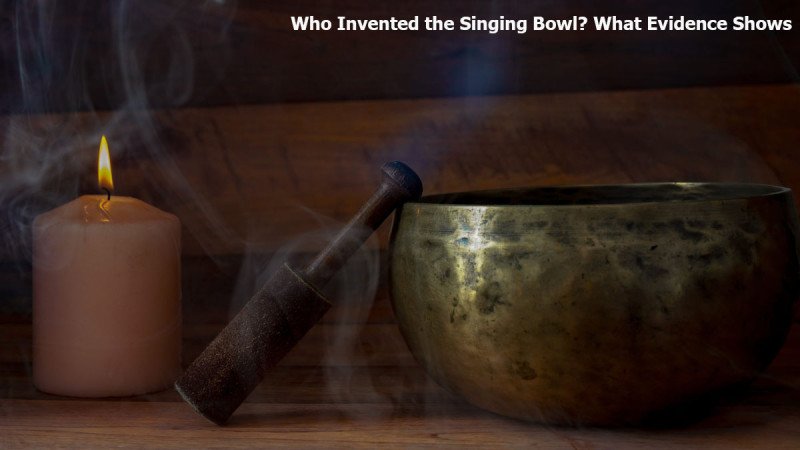
Who Invented the Singing Bowl?
Nobody. There is no named inventor, no origin event and no founding text. The best hard evidence comes from a 2010 metallurgical study at Oxford, which found early Himalayan bowls chemically related to Persian and Khorasan bowls of the 9th to 12th century — meaning the craft descends from an older metalworking lineage that travelled east rather than being invented in the Himalayas. The bowls emerged from a tradition, not from a person.
It is a reasonable question and it gets a lot of confident wrong answers. Depending on which site you land on, singing bowls were invented by Tibetan monks two and a half thousand years ago, or by Mesopotamians five thousand years ago, or by the Buddha himself.
None of those claims has evidence behind it. What does have evidence is more interesting, and it points somewhere most people do not expect.
What the Metal Actually Tells Us
In 2010, archaeological metallurgists at Oxford University's Department of Materials analysed a group of antique Himalayan singing bowls. This is the only serious laboratory work anyone has done on the question, and it produced a clear result. The findings are documented by the Singing Bowl Museum, whose collection was the subject of the analysis.
The early bowls turned out to be metallurgically related to Persian and Khorasan bowls from the 9th to 12th centuries. Not similar in appearance — related in alloy composition. They also share engraving styles and a distinctive method of folding the metal during forging, a technique now considered a lost art.
The Himalayan examples appear slightly younger than their Persian counterparts, which places the beginning of the Himalayan tradition somewhere around the 12th century, possibly earlier. The bowl types most collectors know — Thadobati, Jambati and the rest — came later, with many forms appearing from the 16th century onward.
So the honest picture is a craft lineage rather than an invention. Metalworking knowledge moving east along trade routes from Persia and Central Asia into the Himalayan belt, where Newar artisans in the Kathmandu Valley developed it into the forms we recognise.
Nobody sat down and invented the singing bowl. Smiths made vessels, the technique travelled, and the tradition became local.
What They Are Called in Nepal
There is a detail here that tells you a great deal in three words.
In Nepali, these objects are called dabaka, bati or bata. All three simply mean bowl.
Not singing bowl. Not sound vessel. Not healing instrument. Bowl.
If an object had been created for ritual sound and used that way for millennia, you would expect the local language to reflect it. It does not. The name describes a vessel, because for most of their history that is what these were — objects that also happened to be beautifully made and, as it turned out, capable of extraordinary sound.
Why "Tibetan Singing Bowl" Is Not Quite Right
Two words in that phrase are doing work they have not earned.
"Tibetan" is largely a sales decision. The overwhelming majority of these bowls were made — and are still made — in Nepal, particularly in the Kathmandu Valley by Newar metalworking families. Dealers found that "Tibetan" carried more mystique and commanded better prices than "Nepali," and the label stuck. Our own singing bowl information page has said for some time that the name is a modern one.
"Singing" is a Western description of a technique, applied retroactively. Which brings us to the part most sellers avoid.
Nepali craft, by Nepali artisans — which is the accurate story and a better one
Every bowl we sell is hand-forged by artisan families in the Kathmandu Valley, in a tradition traceable back centuries. Explore handmade singing bowls, or antique collected pieces that carry the older forging methods in the metal itself.
When Did Bowls Start Singing?
This is the genuinely contested question, and we would rather set it out than pretend it does not exist.
Samuel M. Grimes, Assistant Professor of Religious Studies at Fairfield University, argued in the Buddhist magazine Tricycle in March 2020 that there is no hard evidence the bowls are ancient as sound instruments, and even less that they are Tibetan. He traces the first written appearance of the term "singing bowls" in the West to a 1972 record — Tibetan Bells, by Henry Wolff and Nancy Hennings.
The historical silence is part of his case. Perceval Landon travelled in Tibet in 1903 and 1904 and wrote about its music without mentioning singing bowls at all. Neither do the missionaries and travellers who otherwise catalogued Tibetan ritual sound in detail. Reference works on standing bells note that while people sometimes trace the bowls to a pre-Buddhist Bon tradition, the making and use of bowls specifically for singing is believed to be modern.
More pointedly: monks who grew up in Tibet have said they never saw bowls being spun and rubbed. Struck, occasionally. Rimmed into sustained tone, in the way every Western practitioner now does it, apparently not.
The point has been made from within the Tibetan community too. Tenzin Dheden of the Canada Tibet Committee wrote an op-ed for the Toronto Star in February 2020 under a title that leaves little ambiguity: "'Tibetan singing bowls' are not Tibetan. Sincerely, a Tibetan person."
If this is right, the object is old and the technique is young. The bowls were vessels — for offerings, for storage, sometimes for ritual — and the sustained singing tone that defines them today was developed, or at least popularised, in the West within living memory.
What This Does and Does Not Mean
It does not mean the bowls are fake. They are genuinely old, genuinely hand-forged, genuinely made in a tradition centuries deep. A 16th-century Thadobati is exactly what it appears to be.
It does not mean the practice is worthless. The acoustics are real, the physiological effects have measurable mechanisms behind them, and a practice does not need to be ancient to be worth doing.
What it does mean is that the story deserves telling accurately. An object with a real and traceable history does not need a fabricated one layered on top, and layering one on invites exactly the scepticism it was meant to prevent.
How Singing Bowls Reached the West
Whatever their earlier use, the route these bowls took into Western hands is well documented and reasonably recent.
The 1950s and the Tibetan exodus. Following the Chinese occupation of Tibet and the exodus of 1959, refugees crossed into Nepal and India carrying what they could. Household metalware went with them, and much of it was sold to survive. A great many bowls entered the market this way, which is also how so many acquired a Tibetan association regardless of where they were forged.
The 1960s and the overland travellers. Western travellers reaching Nepal and India encountered the bowls in Kathmandu shops, were struck by the sound, and carried them home. This is the point at which the bowls stopped being objects and started being instruments.
1972 and the recording. Tibetan Bells by Wolff and Hennings put the sound in front of an audience that had never heard it, and gave the object its English name. Karma Moffett, who worked at The Tibet Shop in San Francisco, was among the early collectors and recording artists who followed.
The 1980s onward. Demand grew, workshops in Kathmandu expanded to meet it, and an export industry formed around a craft that had previously served local needs. That industry is what supplies the world today, ours included.
What Is Actually True
Sorting the common claims by what stands up.
| Claim | Status |
|---|---|
| Early bowls are metallurgically related to 9th-12th century Persian and Khorasan bowls | Supported — Oxford Department of Materials, 2010 |
| The Himalayan tradition begins around the 12th century | Reasonable inference from the same analysis |
| Most bowls are made in Nepal by Newar artisans | True, and still true today |
| The oldest surviving bowls found in Nepal are around 500-600 years old | Consistent with dealer and collector records |
| Related standing bell traditions exist in China, Japan, Korea and Vietnam | True — a wider family of instruments |
| Bowls were used as sound instruments for thousands of years | No evidence. Actively disputed by scholars |
| They originated in Mesopotamia 5,000 years ago | Widely repeated, no sourcing behind it |
| The Buddha used one | No evidence. Confusion with the monastic alms bowl |
| Crystal singing bowls are an ancient Himalayan tradition | False. A Western invention of the 1980s, from quartz manufacturing |
Why This Is a Better Story
There is a version of singing bowl history that is tidier: ancient monks, sacred formulas, unbroken transmission. It is easier to sell and it is not true.
The real version has more in it. Metalworking knowledge moving east out of Persia along trade routes over centuries. Newar families in the Kathmandu Valley taking that knowledge and developing it into forms nobody else made. Bowls sitting in Himalayan households for four hundred years doing ordinary work, beautifully made because that was simply how things were made. A political catastrophe scattering them across the world. A generation of travellers hearing something in them that their owners had never particularly emphasised. A recording in 1972 that gave them a name.
That is a real history, and everything in it is verifiable. It involves trade, craft, migration, accident and attention — which is how most genuinely old things actually arrive, rather than through invention by a single hand.
The bowls we sell are hand-forged in Kathmandu by families working in a tradition that runs back centuries and connects, through the metal itself, to workshops in Persia a thousand years ago. We would rather say that accurately than say something grander that falls apart when checked.
The craft did not end in the 16th century — it is still being practised
Commissioning a bowl puts you directly in contact with the living tradition. Through Dharma Tool's custom singing bowl service you specify size, note, wall thickness and engraving, and the bowl is hand-forged by artisan families in the Kathmandu Valley using methods passed down through generations.
Sources and Further Reading
Everything in this article is traceable. These are the sources behind it, and we would encourage anyone interested to read them directly rather than take our summary on trust.
- Samuel M. Grimes, "Tibetan Singing Bowls: Where Did They Really Come From?" — Tricycle: The Buddhist Review, 4 March 2020. The clearest scholarly statement of the case against ancient Tibetan origins.
- Tenzin Dheden, "'Tibetan singing bowls' are not Tibetan. Sincerely, a Tibetan person" — Toronto Star, 18 February 2020. The same argument made from within the Tibetan community.
- The Singing Bowl Museum — documentation of the 2010 Oxford metallurgical analysis and the Persian and Khorasan connection.
- "Thermal and structural analysis of high-tin bronze corresponding to the composition of the singing bowl" — Journal of Thermal Analysis and Calorimetry, 2019. Metallurgical work on singing bowl alloy composition.
- Lin, Yang & Wang, "Effects of Tibetan Singing Bowl Intervention on Psychological and Physiological Health in Adults: A Systematic Review" — Healthcare, 2025. The systematic review of clinical evidence referenced across our articles.
Where our account differs from the sources, we have said so. Where the evidence is thin, we have said that too.
Frequently Asked Questions
Who invented the singing bowl?
Nobody. There is no named inventor, no origin event and no founding text. Metallurgical analysis at Oxford in 2010 found early Himalayan bowls chemically related to Persian and Khorasan bowls of the 9th to 12th century, indicating the craft descends from an older metalworking lineage that travelled east rather than being invented in the Himalayas. The tradition emerged rather than being created.
How old are singing bowls?
The Himalayan tradition appears to begin around the 12th century, based on metallurgical relationships with earlier Persian and Khorasan bowls. Most of the bowl types collectors recognise date from the 16th century onward, and the oldest surviving examples found in Nepal are roughly 500 to 600 years old. Claims of two thousand or five thousand years have no evidence behind them.
Are singing bowls Tibetan or Nepali?
Overwhelmingly Nepali. The majority were made — and are still made — in Nepal, particularly by Newar metalworking families in the Kathmandu Valley. The "Tibetan" label was largely a commercial decision by dealers who found it carried more mystique and commanded higher prices. Many bowls did reach the market through Tibetan refugees after 1959, which reinforced the association.
Did ancient monks use singing bowls for healing?
There is no evidence for it, and scholars actively dispute it. Religious studies scholar Samuel Grimes has argued there is no hard evidence the bowls are ancient as sound instruments, and monks raised in Tibet have said they never saw bowls being spun and rubbed. The bowls are genuinely old as objects. The sustained singing technique that defines them today appears to be far more recent.
When did singing bowls come to the West?
Mainly from the 1960s onward. Tibetan refugees carried household metalware into Nepal and India after the 1959 exodus and sold much of it to survive. Western travellers encountered the bowls in Kathmandu shops and brought them home. The 1972 record Tibetan Bells by Henry Wolff and Nancy Hennings gave the object its English name and introduced the sound to a wide audience.
Does it matter that the history is less ancient than claimed?
Not to the instrument. A 16th-century hand-forged bronze bowl is exactly what it appears to be, the acoustics are real, and a practice does not need to be ancient to be worth doing. What the accurate history does is remove the need for embellishment — an object with a traceable lineage back to Persian workshops a thousand years ago is remarkable enough without additions that fall apart when checked.