




Why Does a Singing Bowl Take Time to Sing?
A singing bowl takes time to sing because the mallet must feed enough energy into the metal to overcome its natural damping before a continuous tone can build. Thicker-walled bowls need more revolutions than thin ones. The most common causes of a bowl not singing are moving the mallet too fast, inconsistent pressure, fingers touching the bowl wall, a mallet that does not match the bowl, and stopping after two or three seconds — before the tone has had time to establish.
Almost everyone has the same first experience with a singing bowl. You bring the mallet to the rim, start moving it round, and get a scratchy rattle. Nothing that resembles the sound you heard in the shop. A few seconds later you stop, slightly embarrassed, and wonder whether the bowl is faulty.
The bowl is almost certainly fine. What is happening is a mismatch between what the metal needs and what your hand is currently giving it — and in nine cases out of ten, the fix is a small adjustment rather than a different bowl.
This guide explains what is physically happening when a Tibetan singing bowl starts to sing, why some bowls take considerably longer than others, and how to diagnose exactly which part of your technique is holding it back.
How Does a Singing Bowl Actually Start Singing?

Rimming works through stick-slip friction. As the mallet travels around the rim, it does not glide smoothly — it grips the metal briefly, releases, grips again, hundreds of times per second. Each of those micro-catches delivers a tiny pulse of energy into the bowl wall.
The metal is simultaneously losing energy through damping — internal friction in the alloy, contact with your hand or cushion, and the air itself. The tone only builds when the energy going in exceeds the energy being lost.
This is why singing is not instant. The first revolutions are spent overcoming that deficit. Once input exceeds damping, the vibration begins amplifying itself and the rattle resolves into a clear, growing tone. The rattle at the start is not a mistake — it is the sound of energy accumulating before it reaches the threshold.
Understanding this reframes the whole problem. The question is never "why won't it sing" but "where is the energy leaking, or why is not enough going in."
Why Do Some Singing Bowls Take Longer Than Others?
Bowl construction accounts for a large part of the difference, and it is worth knowing before assuming the fault is yours.
Wall Thickness Is the Biggest Factor

A thick-walled bowl has more mass to set in motion and more internal damping to overcome. It needs more revolutions before the tone establishes. A thin-walled bowl responds almost immediately by comparison.
This is not a quality difference. Thick bowls typically produce a deeper, heavier, more grounded tone with longer sustain once they are singing — they simply ask for more patience at the start. Many antique collected bowls are relatively thin-walled and sing readily, while heavier contemporary bowls need more work.
Small and Thick Is the Hardest Combination
A small bowl with thick walls is the most difficult thing to rim. The rim circumference is short, so each revolution delivers less total energy, while the thick wall demands more. Some very thick small bowls and cups cannot be reliably rimmed at all, and are designed to be struck rather than sung.
If a small heavy bowl refuses to sing after genuine effort, that may simply be what it is. Strike it instead — the tone is often excellent.
Large Bowls Build Slowly but Powerfully
Large standing singing bowls take longer to reach full volume because there is far more metal to mobilise. The tone builds gradually over many revolutions and then keeps growing. Rushing a large bowl is the most common mistake with them — the correct approach is slow, patient, and unhurried.
Some bowls sing in one revolution. Others take ten. Both can be excellent.
Every bowl at Dharma Tool is played and listened to before it is listed, so you know how it behaves before it arrives. Explore handmade singing bowls, antique collected bowls that tend to sing easily, or large standing bowls for deep, slow-building resonance. If you want a specific wall thickness and response, a custom singing bowl can be forged to it.
Why Won't My Singing Bowl Sing? Seven Common Causes
Once bowl construction is accounted for, the remaining causes are all technique — and all fixable.
1. Moving the Mallet Too Fast
Speed is the single most common error. Fast movement does not build the tone faster — it prevents the stick-slip cycle from establishing at all, producing a squeal or a scratchy skid instead.
The correct pace is far slower than most people expect: roughly one full revolution every three to four seconds. That feels almost absurdly slow at first. It is correct.
2. Pressure That Is Too Light, Too Heavy, or Inconsistent
Too light and the mallet slides without gripping, so no energy transfers. Too heavy and the mallet drags, chatters, and kills the vibration it just created. What matters most is that the pressure stays even — a bowl building nicely will collapse the moment pressure fluctuates.
Aim for firm, continuous contact. Lack of steady pressure, rather than the wrong amount of pressure, is what defeats most beginners.
3. Your Fingers Are Touching the Bowl
This is the most overlooked cause and the easiest to fix. Any finger or thumb curled onto the upper wall or rim damps the vibration directly and chokes the tone before it starts.
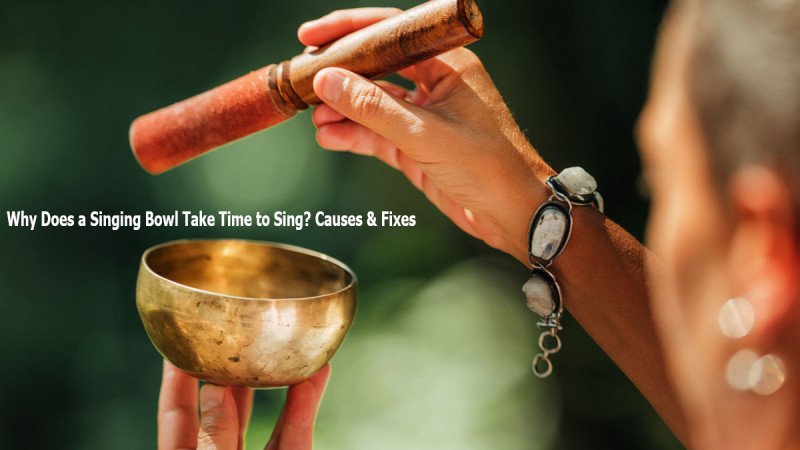
Hold the bowl on a flat, open palm with fingers spread wide and flat, like holding a saucer. As little skin as possible should touch the metal. Remove rings and bracelets — metal jewellery against a vibrating bowl produces a buzz that ruins the tone.
A quick diagnostic: if the bowl sings on a cushion but not in your hand, your hand is the problem.
4. The Wrong Mallet for the Bowl
Mallet diameter needs to roughly match bowl size and thickness. Too thin a mallet on a large bowl cannot deliver enough energy per revolution. Too heavy a mallet on a small bowl overloads it and produces noise instead of tone.
Surface matters too. A bare wooden mallet grips aggressively and brings the higher overtone up quickly, with more friction noise. A suede or leather-wrapped mallet produces a smoother, quieter build. If a wooden mallet is only screeching, try the leather side.
A worn mallet also stops working. Wood that has polished smooth with use, or leather that has glazed, loses grip and needs replacing.
5. Lifting the Mallet Mid-Circle
Any break in contact — even a fraction of a second — dumps the accumulated energy and restarts the process. The mallet must stay glued to the rim through the entire revolution.
Most lifting happens because people rim with the wrist rather than the arm. Wrist movement cannot maintain even contact through a full circle. Move from the shoulder and elbow, keeping the wrist relaxed but stable, as though stirring something thick.
6. Stopping Before It Starts
The rattle at the beginning is normal and expected. It is the sound of energy building toward the threshold. Most beginners stop within two or three seconds — right before the tone would have arrived.
Give it at least eight to ten complete revolutions at consistent speed and pressure before concluding anything is wrong. On a thick or large bowl, more.
7. The Bowl Is Damped by What It Sits On
A bowl resting on an over-soft cushion sinks in and loses vibration to the fabric. A cushion that is too small lets the bowl wobble. A hard surface can transmit vibration away entirely.
The bowl should sit on a firm ring cushion that supports only the base, leaving the walls completely free to vibrate. If the bowl rocks or the cushion swallows the bottom third, that is your problem.

Singing Bowl Troubleshooting: Symptom, Cause and Fix
| What you hear | Likely cause | Fix |
|---|---|---|
| High squeal or screech | Moving too fast | Slow to one revolution every 3-4 seconds |
| Rattling or chattering | Too much pressure, or too fast | Lighten the touch and slow down together |
| Tone dies the moment you start circling | Pressed without moving | Begin moving the instant the mallet touches the rim |
| Sings on a cushion but not in your hand | Fingers damping the wall | Flatten the palm, spread fingers, remove rings |
| Nothing at all, just silent sliding | Pressure too light, or a glazed mallet | Increase pressure slightly, or replace the mallet |
| Buzzing or rattling under the tone | Jewellery, or bowl touching another object | Remove rings, isolate the bowl on its cushion |
| Tone builds then collapses repeatedly | Uneven pressure, or lifting the mallet | Move from the shoulder, keep constant contact |
| Very slow build on a heavy bowl | Thick wall — normal behaviour | Continue past ten revolutions, be patient |
How to Make a Singing Bowl Sing: Step by Step
- Remove rings and bracelets. Metal jewellery against a vibrating bowl produces a buzz and damps the tone.
- Set the bowl properly. On a firm ring cushion that supports only the base, or on a flat open palm with fingers spread wide. Nothing should touch the walls.
- Hold the mallet like a pen, near the middle, pointing straight down. A near-vertical mallet gives clean contact. Angled mallets skid.
- Strike the outer wall once, gently, about two thirds of the way up. This seeds the vibration and makes the rimming build far easier.
- Bring the mallet to the rim and start moving immediately. Do not press and pause — contact without movement silences the strike you just made.
- Circle slowly, one revolution every three to four seconds, with firm even pressure. Move from the shoulder and elbow, not the wrist.
- Keep going for at least eight to ten revolutions. The initial rattle smooths into tone. Do not stop early.
- Once the tone is established, ease off slightly to hold it steady. Increase speed or pressure gently to build volume, decrease to soften. Never accelerate sharply.
Our full guide on how to play a singing bowl covers striking, rimming, and water techniques in more detail.
Which Singing Bowls Are Easiest to Play?
The easiest singing bowls to play are medium-sized bowls with moderate wall thickness, typically 15-20cm across. There is enough rim circumference to deliver energy efficiently and not so much mass that the build takes forever.
If you are buying a first bowl and want quick success, avoid the two extremes: very small thick bowls, which are the hardest to rim, and very large heavy bowls, which need patience and technique you may not have yet. Our guide on choosing a large singing bowl covers when the bigger sizes genuinely earn their place.
Thinner-walled bowls respond faster. Many antique collected bowls fall into this category — older hand-forged bowls were frequently worked thinner, which is part of why they are prized for responsiveness as well as tone.
When to Have a Bowl Made to Your Requirements
Wall thickness, size, and rim profile all determine how easily a bowl sings, and none of those are things you can select from a standard listing. For a teacher who needs a bowl that sings instantly in front of a class, a beginner who wants forgiving response, or a practitioner who needs a specific note in a specific weight, being able to specify those characteristics changes the outcome.
Dharma Tool's custom singing bowl service lets you specify size, wall thickness, musical note, metal composition, and engraving, with the bowl hand-forged by artisans in Kathmandu. If you have struggled with a bowl that is technically fine but simply does not suit your hands, a bowl made to your requirements solves the problem at the source.
A bowl that sings the way you need it to, made for your hands
Wall thickness and rim profile decide how easily a bowl sings — and neither is something you can pick from a shelf. Through Dharma Tool's custom singing bowl service, you specify the size, note, thickness, engraving, and intention, and the bowl is hand-forged in Kathmandu. Optional monk blessing available on every commission.
When the Bowl Genuinely Is the Problem
Occasionally the instrument really is at fault, and it is worth knowing the signs. A bowl with a crack will buzz persistently regardless of technique — run a finger slowly around the rim and inside wall to check. A machine-pressed brass bowl often has walls too uniform and too thin to produce proper stick-slip friction, which is one practical difference between mass-produced pieces and hand-forged ones.
Some genuine bowls are simply built to be struck rather than rimmed. Very thick cups and certain heavy small bowls fall into this category, and no amount of technique will change that. If a bowl strikes beautifully but refuses to rim after honest effort, that is likely what you have — and it is not a defect.
Everything else is technique, and technique is learnable. Most people who think their bowl is broken are moving too fast and stopping too soon.
Frequently Asked Questions
Why does my singing bowl take so long to start singing?
The mallet must deliver enough energy to overcome the metal's natural damping before a continuous tone can build. Thicker-walled and larger bowls need more revolutions to reach that threshold. The initial rattle is the sound of energy accumulating. Give the bowl at least eight to ten complete revolutions at a slow, steady pace before assuming something is wrong.
Why does my singing bowl squeal instead of singing?
A squeal or screech almost always means the mallet is moving too fast. Fast movement prevents the stick-slip friction cycle from establishing properly. Slow to roughly one full revolution every three to four seconds — considerably slower than most people expect — and keep the pressure firm and even.
Why does my bowl sing on a cushion but not in my hand?
Your fingers are damping the vibration. Any finger or thumb curled onto the upper wall chokes the tone before it can build. Hold the bowl on a completely flat, open palm with fingers spread wide, so as little skin as possible touches the metal. Remove rings and bracelets, which also cause buzzing.
How fast should I move the mallet around the rim?
About one complete revolution every three to four seconds. This feels very slow at first and is correct. Move from the shoulder and elbow rather than the wrist, keeping the mallet in constant contact with the rim throughout the entire circle. Any break in contact dumps the accumulated energy.
Can every singing bowl be rimmed?
No. Some very thick small bowls and cups have walls too heavy relative to their rim circumference to sustain rimming, and are designed to be struck instead. If a bowl strikes beautifully but will not rim after genuine sustained effort with correct technique, that is likely its nature rather than a defect.
Which singing bowl is easiest for a beginner to play?
A medium-sized bowl of roughly 15-20cm with moderate wall thickness is the most forgiving. There is enough rim circumference to transfer energy efficiently without excessive mass to overcome. Avoid very small thick bowls, which are the hardest to rim, and very large heavy bowls, which require patience and developed technique. A custom-forged bowl allows wall thickness and size to be specified directly.