



Every Mark on Your Bowl Has a Story — Here's How to Read It
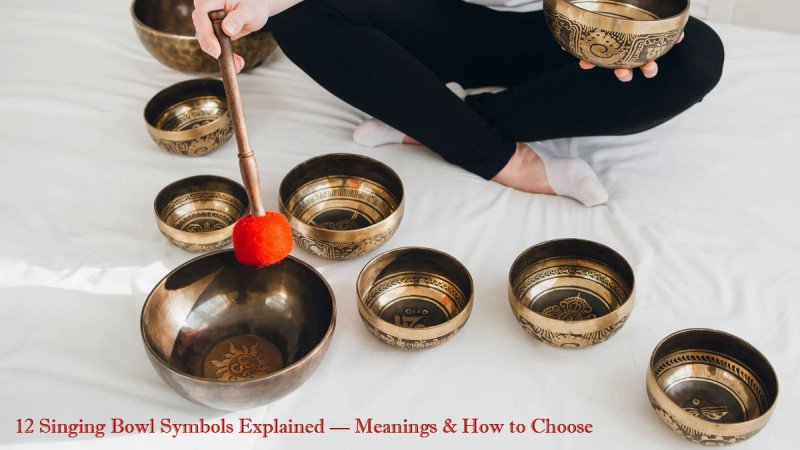
Pick up a carved or etched Tibetan singing bowl and look closely. The lines running around the rim, the figure at the centre, the geometric pattern on the base — none of it is random. Every mark was placed deliberately, by an artisan who understood exactly what it meant.
These symbols come from centuries of Himalayan Buddhist and Hindu tradition. They appear in temple carvings, thangka paintings, ritual objects, and sacred architecture across Nepal, Tibet, and the broader Himalayan region. When an artisan etches them onto a handmade Tibetan singing bowl, they're not decorating an instrument — they're extending a visual and spiritual language that predates the bowl itself by thousands of years.
This guide walks through 12 of the most significant symbols you'll find on singing bowls from Nepal. For each one: what it is, what it means in Himalayan tradition, what kind of practice it suits, and where to find it at Dharma Tool. By the end, you'll know exactly which symbol belongs with you.
1. Om (ༀ) — The Sound Before All Sounds
Om is the single most sacred syllable in both Hindu and Buddhist tradition. It represents the primordial vibration — the sound from which all existence is said to have emerged. In Sanskrit it is written ॐ, and in Tibetan script ༀ. It opens virtually every mantra, prayer, and sacred text in the Himalayan world.
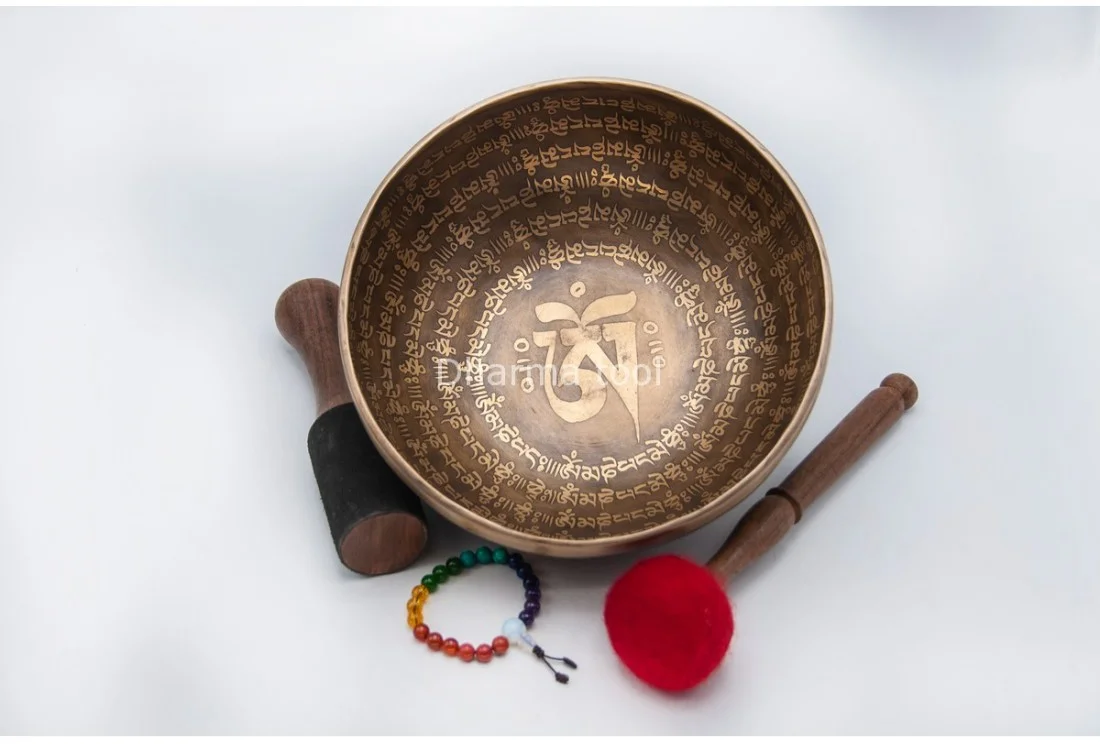
When Om is etched onto a singing bowl, the symbolism deepens. The bowl itself produces sound — and that sound, in the Himalayan view, is the Om of the instrument's own nature. Striking an Om-engraved bowl is understood as an alignment of two vibrations: the one you create, and the one the symbol represents.
Best for: Daily meditation, altar practice, beginners entering the world of sacred sound, anyone drawn to the simplicity of a single universal symbol.
Explore the Om Engraved Extra Large Tibetan Singing Bowl — hand-forged in Nepal with Om symbols and Tibetan mantras etched across the body for deep, sustained resonance.
2. Om Mani Padme Hum — The Most Loved Mantra in the Himalayas
If Om is the seed, Om Mani Padme Hum is the full bloom. This six-syllable mantra — often translated as "the jewel in the lotus" — is the foundational chant of Tibetan Buddhism, associated with Avalokiteshvara, the Bodhisattva of Compassion. Each syllable is believed to purify a different aspect of body, speech, and mind.
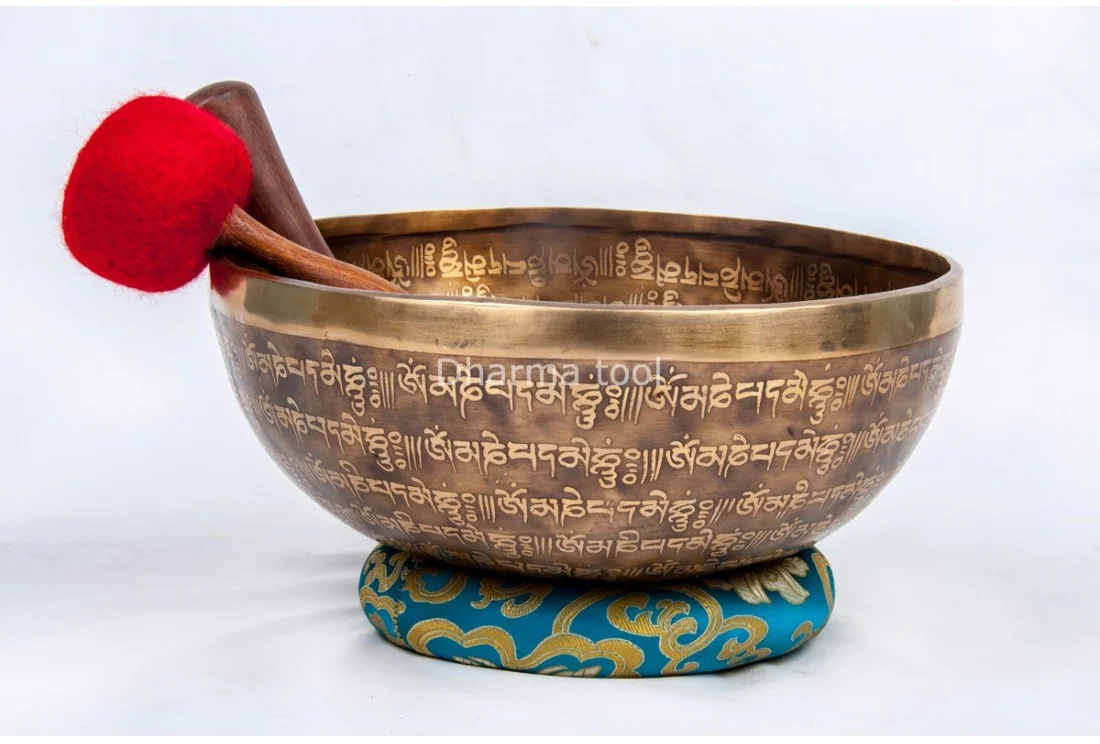
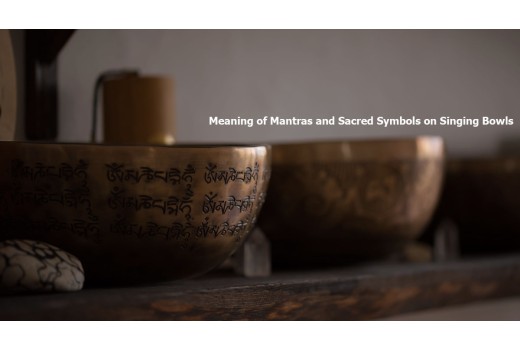
You'll find this mantra etched in a ring around the rim of many mantra carved singing bowls, running in Tibetan script from one side to the other. Playing the bowl while chanting or silently reciting the mantra is a traditional practice — the vibration of the metal and the vibration of the words becoming one. It's the most popular engraving on Himalayan bowls for a reason: few teachings are this complete in so few syllables.
Best for: Compassion practices, sound healing sessions, meditation focused on emotional release, anyone with a connection to Buddhist tradition or the Tibetan mantra lineage.
3. Buddha Eyes (Wisdom Eyes) — Seeing in All Directions
Look at any stupa in Nepal and you'll see them staring back at you — the wide, all-seeing eyes of the Buddha, painted on all four sides of the tower. These are the Wisdom Eyes, or Buddha Eyes: a symbol so deeply woven into Nepali culture that they have become a national emblem.
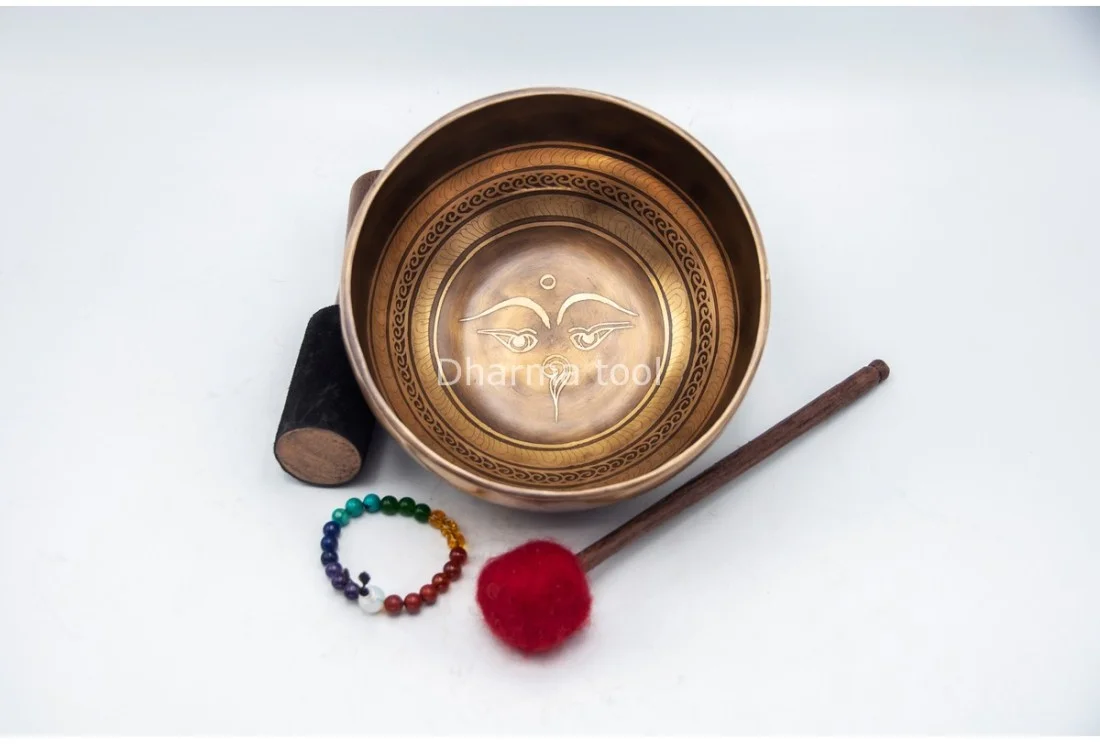
The eyes represent the omniscience of the awakened mind. The dot between them is the third eye — a symbol of spiritual awareness beyond ordinary perception. The curling mark below, resembling a nose, is actually the Sanskrit numeral one, representing unity: the idea that all paths lead back to a single source.
On a singing bowl, Buddha Eyes etched at the centre create a powerful focal point during meditation — something for awareness to rest on while the sound fades into silence.
Best for: Mindfulness practice, those working with awareness and attention, meditation on clarity and the nature of mind, anyone who has visited Nepal and carries a connection to this deeply Nepali symbol.
4. The Lotus Flower — Rising Without Being Stained
The lotus grows from mud. Its roots sit in dark, still water, but the flower blooms above the surface, clean and luminous. In both Hindu and Buddhist tradition, this is the central teaching of the lotus: purity that emerges from difficulty, beauty that rises from struggle, spiritual awakening that comes through — not around — the ordinary world.
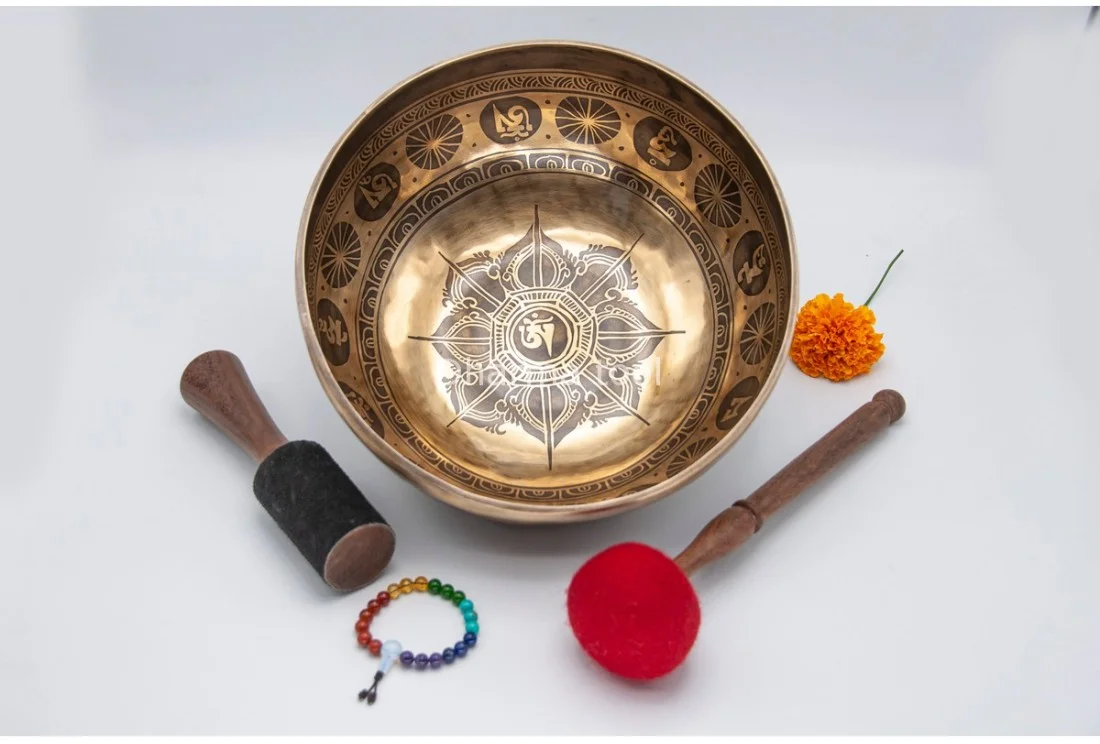
The lotus is one of the most universally understood sacred symbols across Asia. It appears in images of the Buddha, in chakra iconography, in temple architecture, and consistently on Tibetan singing bowls. A lotus etched at the centre of a bowl frames the interior with this teaching — every sound that rises from it carries the same message.
Best for: Healing practices, those in transition or recovery, meditation focused on transformation and renewal, yoga sessions with themes of growth and letting go, gifting to someone going through a significant life change.
5. Double Dorje (Vishvavajra) — Indestructible in All Directions
The Dorje — also called Vajra — is one of the most important ritual objects in Tibetan Buddhism. It represents indestructible clarity: a wisdom that nothing can break, and that cuts through everything else. If you're familiar with the Tibetan Bell and Dorje set, you already know the Dorje as a physical object. The Double Dorje, or Vishvavajra, is two Dorjes placed at right angles to form a cross — pointing in all four cardinal directions simultaneously.
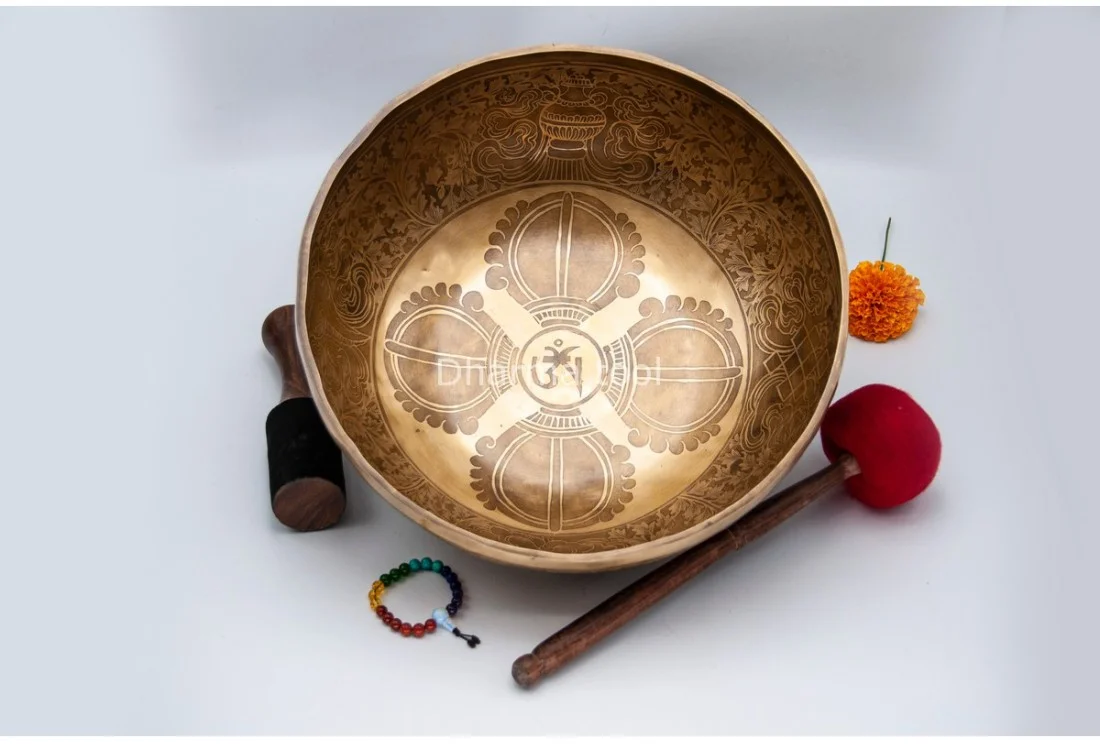
This symbol represents complete, all-directional spiritual power. A wisdom not limited by perspective, position, or time. You'll find it engraved on the backs and bases of many etched singing bowls, often paired with Om Mani Padme Hum along the rim — the two symbols working together like two pillars of a complete practice.
Best for: Sound healing practitioners, those working with protection and clarity, advanced practitioners familiar with Vajrayana Buddhist symbolism, anyone drawn to the balance of four directions.
6. Eight Auspicious Symbols (Ashtamangala) — Offerings at the Moment of Enlightenment
In Buddhist legend, when the Buddha attained enlightenment, the gods brought him eight sacred gifts. These eight offerings became the Ashtamangala — the Eight Auspicious Symbols — and they have been central to Himalayan sacred art ever since. The eight are: the Parasol, the Golden Fish, the Treasure Vase, the Lotus, the Right-Coiling Conch, the Endless Knot, the Victory Banner, and the Dharma Wheel.
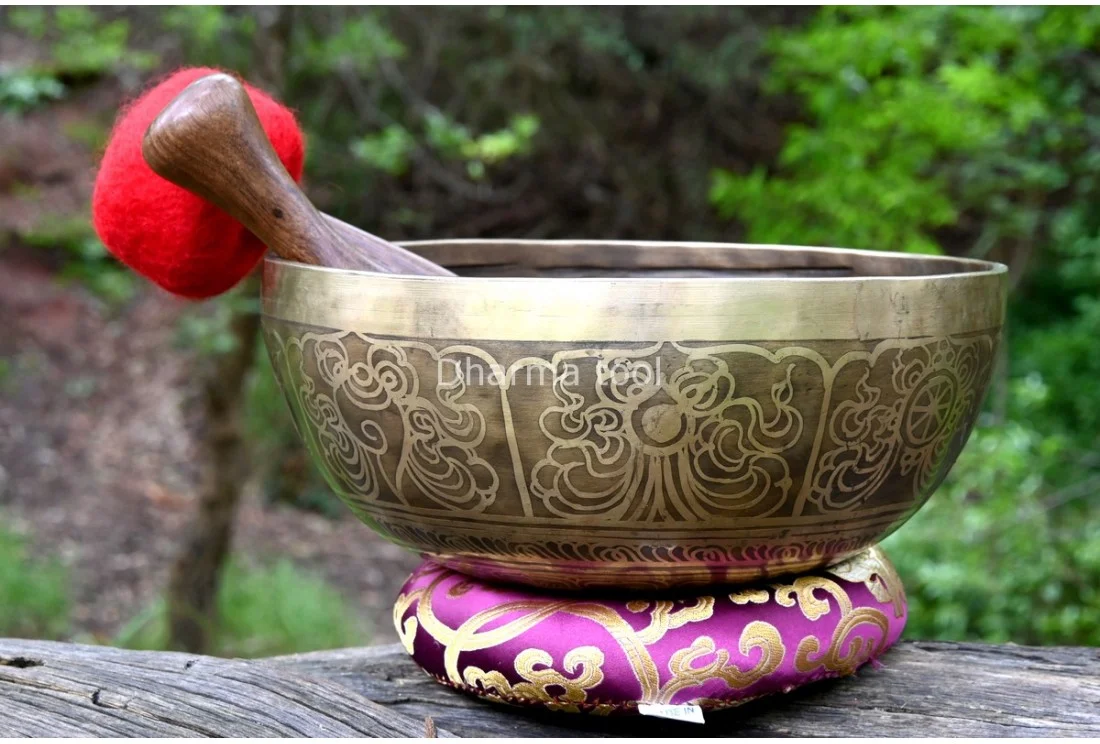
Together they represent protection, prosperity, spiritual victory, and liberation. Bowls engraved with all eight symbols carry a particularly complete spiritual presence — the feeling of something held and guarded from every direction at once. They're among the most detailed and time-consuming bowls to engrave, which is why skilled Newari thangka artists are often specifically commissioned for this work.
Best for: Altar pieces, ceremonial use, gifting to established practitioners, those seeking a bowl with comprehensive Himalayan spiritual meaning rather than a single focused symbol.
Browse Ashtamangala etched singing bowls at Dharma Tool — each featuring all eight symbols carved by artisans with generations of experience in this specific iconographic tradition.
Every symbol. Every tradition. All hand-etched by Nepali artisans in Kathmandu.
From Om and Om Mani Padme Hum to Chakra Yogi, Shree Yantra, and Flower of Life — Dharma Tool's carved and etched singing bowl collection brings every major Himalayan symbol together in one place. Each bowl is hand-forged and individually engraved — no two are identical.
7. Flower of Life — Sacred Geometry of the Universe
The Flower of Life is a geometric pattern of perfectly interlocking circles arranged in a hexagonal form. It appears carved into ancient temples across Egypt, India, China, and the Middle East — often thousands of years old. In Himalayan spiritual art, it represents the interconnectedness of all living things, the geometry underlying creation, and the pattern that holds the universe together.
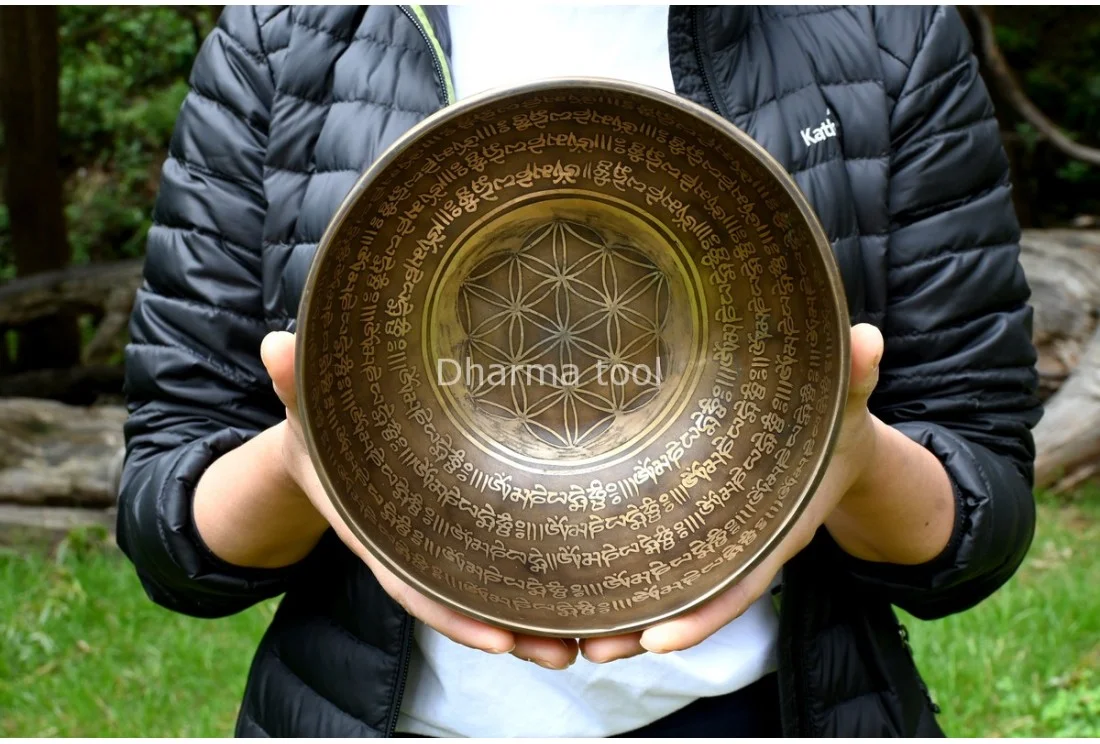
It looks complex but carries a simple message: everything is connected, and that connection has a pattern. On a singing bowl, the Flower of Life at the base creates a visual anchor for meditation on unity — the idea that the sound moving out from the bowl touches everything in the room, just as the circles of the pattern touch each other without interruption. Many practitioners find it especially suitable for sound bath work, where the intention is to fill a shared space with healing vibration.
Best for: Sound baths, practitioners working with sacred geometry, yoga teachers, those who approach spirituality through a universal rather than tradition-specific lens.
The Flower of Life Carved Large Singing Bowl features deep relief carving across the body with a Tibetan mantra surround — one of the most visually striking pieces in the collection, and equally powerful in sound.
8. Shree Yantra (Sri Yantra) — The Geometry of the Divine Feminine
The Shree Yantra is one of the most complex and revered sacred geometric forms in Hindu tradition. It consists of nine interlocking triangles — four pointing upward (representing Shiva, the masculine principle) and five pointing downward (representing Shakti, the divine feminine). Their intersection creates 43 smaller triangles arranged around a central point called the bindu — the seed of creation.
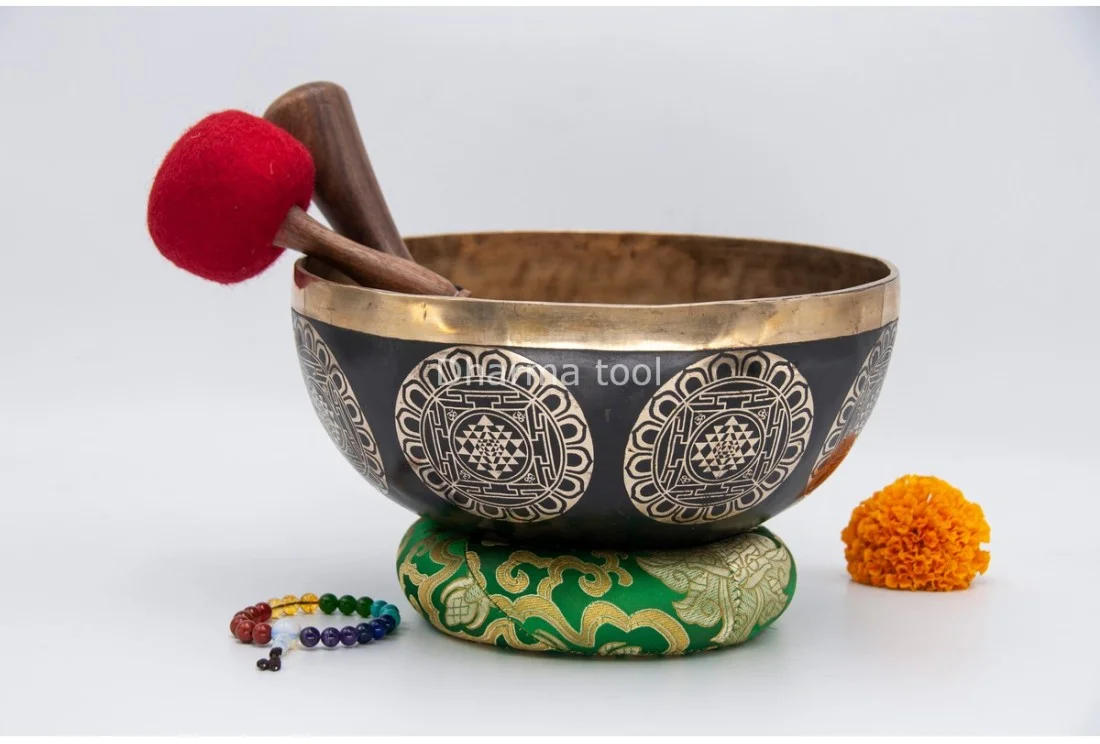
Meditating on the Shree Yantra is considered a complete spiritual practice in itself. It's associated with prosperity, manifestation, cosmic order, and the union of opposites. On a singing bowl, it often appears on the base — the point of contact between the instrument and the earth, symbolically grounding the bowl's sound in universal creative energy.
Best for: Manifestation practices, those working with divine feminine energy, yogis, energy healers, practitioners of Hindu tantric traditions, and anyone drawn to the mathematics of the sacred.
Explore the Shree Yantra Carved Singing Bowl — extra large, hand-forged in Nepal, with deep relief carving that makes the geometric detail visible from across a room.
9. Tree of Life — Rooted on Earth, Reaching Toward the Sacred
The Tree of Life appears in spiritual traditions across nearly every culture on earth. In the Himalayan context, it represents the connection between the earthly and the divine: roots deep in the ground, branches reaching toward the sky, trunk standing in the space between. It carries the energy of growth, stability, and generational continuity — the idea that something deeply rooted can grow and give life endlessly.
On a large standing singing bowl, the Tree of Life carving feels especially appropriate. The bowl sits on the earth, fills the room with sound, and connects the person playing it to something much older than themselves. For practitioners who work with grounding, the Tree of Life combines the message and the medium into one.
/large-tree-of-life-singing-bowl-nepal_5-1100x744w.jpg.webp "Large Tree of Life carved singing bowl handmade in Nepal")
Best for: Grounding practices, those going through transitions or seeking stability, yoga studios and healing spaces, gifting to someone beginning a new chapter of life, anyone drawn to symbols that speak across cultural traditions.
The Tree of Life Carved Large Singing Bowl features a Yin Yang at the centre surrounded by the tree design — combining two powerful symbols of balance and growth in one instrument.
10. The 7 Chakra Symbols — Your Energy Body Mapped in Metal
The seven chakras are the energy centres of the subtle body in Hindu and Buddhist tradition — seven points along the spine from root to crown, each associated with a specific quality of consciousness, an element, a colour, and a sound frequency. When all seven are balanced and open, the result is health, clarity, and spiritual ease.
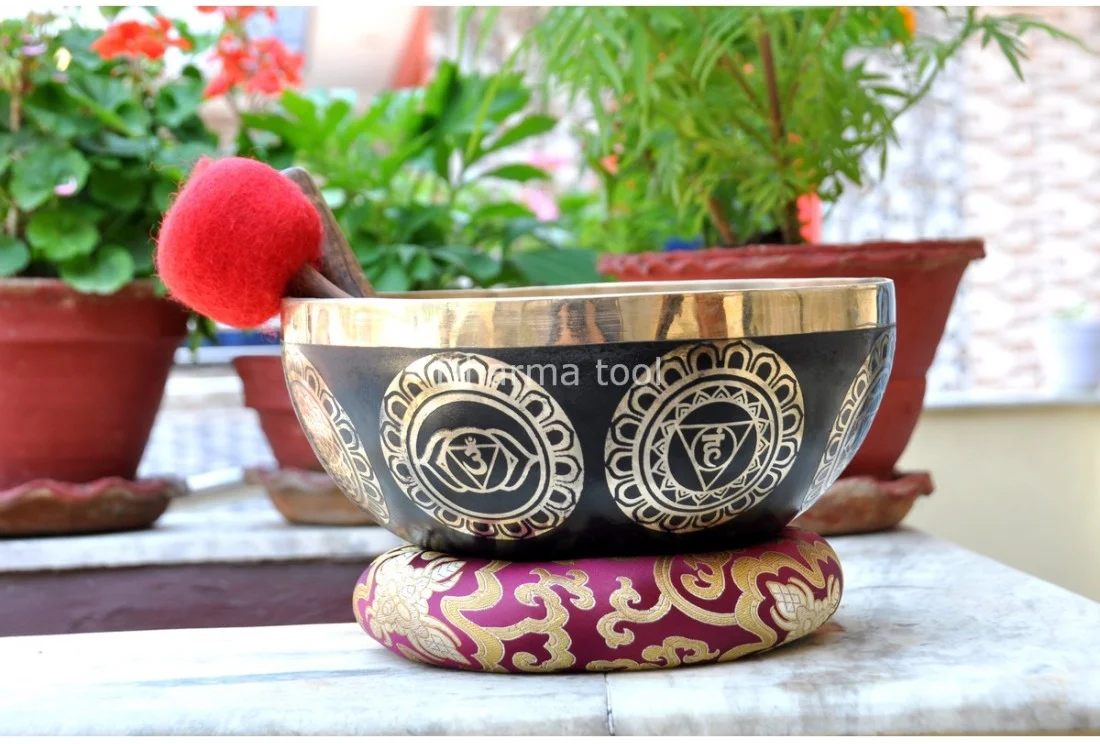
Singing bowls etched with all seven chakra symbols carry this complete map of the energy body. Some bowls feature one chakra symbol at the centre, selected for the musical note corresponding to that energy centre. Others circle all seven symbols around the rim — a reminder of the whole system during every session. For practitioners building a chakra-focused sound healing practice, a single bowl carrying all seven symbols is a powerful tool for intention-setting.
Best for: Chakra healing sessions, yoga teachers working with energetic themes, sound healers, anyone building a practice around the chakra system.
Browse the full Chakra Singing Bowl Sets — professionally tuned sets of seven bowls, each aligned to one chakra note. For a single etched bowl with all seven symbols, explore the carved and etched collection.
11. Chakra Yogi — The Practitioner at the Centre of the Practice
The Chakra Yogi is one of the most distinctive and meaningful symbols you'll find on modern Himalayan singing bowls. It depicts a meditating yogi figure seated in lotus position, with the seven chakra energy centres shown along the spine — from root to crown — in their traditional positions. The image is a complete visual map of the human energy system, embodied in a single figure in stillness.
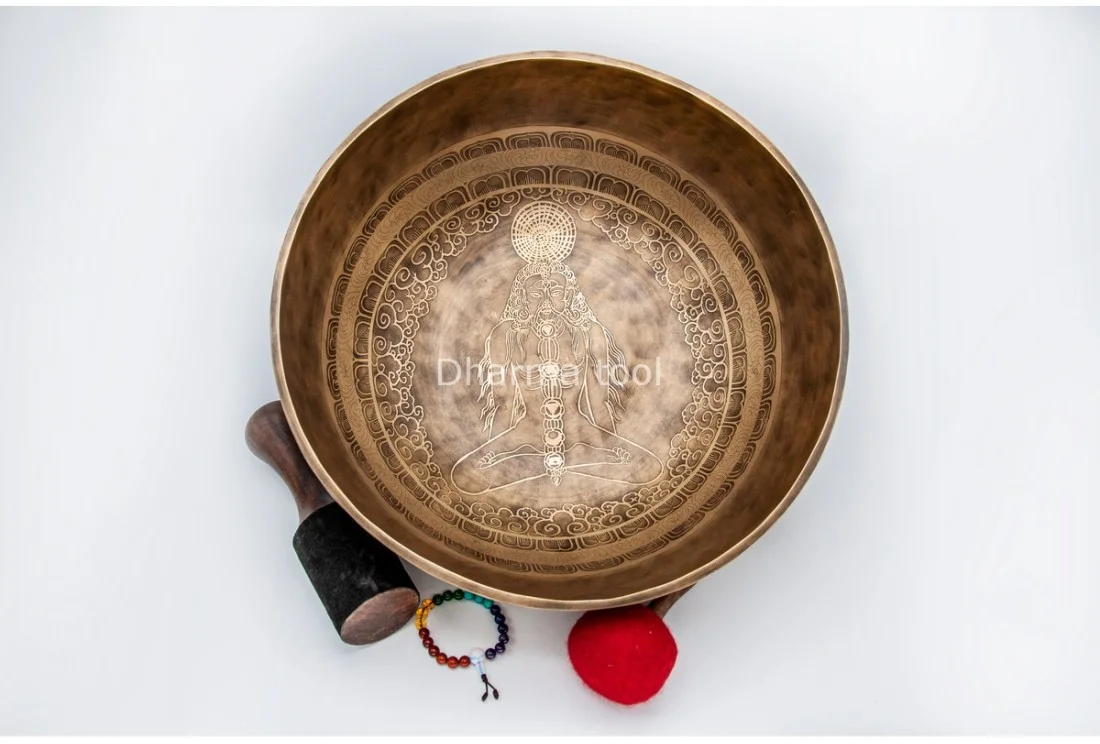
What makes this symbol particularly powerful is its perspective. Most sacred symbols represent cosmic forces, divine figures, or abstract geometries. The Chakra Yogi places the practitioner at the centre — a reminder that the real work of awakening happens inside the human body, through practice, breath, and sustained attention. It's at once a teaching and an encouragement. The yogi on your bowl is doing exactly what you're about to do.
This symbol resonates especially strongly with yoga teachers and studio owners, sound healing practitioners, and anyone whose practice is rooted in the chakra system. When Sunita selects Chakra Yogi bowls for Dharma Tool's carved collection, she looks for pieces where the figure sits cleanly at the centre — fine enough to show all seven energy points clearly, with enough space around it for the mantra ring and secondary symbols to breathe.
Best for: Yoga teachers and studios, sound healers, chakra practitioners, meditation retreats, anyone who wants their bowl to reflect the human journey of inner practice rather than an external deity or symbol.
Dharma Tool carries multiple Chakra Yogi bowls — including versions with Flower of Life back designs, Om Mani Padme Hum mantra rings, Double Dorje details, and Ashtamangala surrounds. Each is individually hand-etched. Browse the full carved and etched collection to find the version that matches your practice.
12. Yin Yang — Balance as a Practice, Not a Destination
The Yin Yang symbol is Chinese in origin but carries a message that resonates deeply across all Himalayan spiritual traditions: opposing forces are not in conflict but in constant, dynamic relationship. Light needs dark. Rest needs movement. Silence needs sound. The small circle of each colour within the other is the key insight — nothing is purely one thing, and wholeness requires both.
/Large-Himalayan-singingbowls_2-1100x744w.jpg.webp "Large Yin Yang engraved Himalayan singing bowl handmade in Nepal")
On a singing bowl, the Yin Yang symbol is particularly apt. The bowl is both an object of stillness and a source of sound. It sits silent until touched, then vibrates and returns to silence. That cycle — movement and rest, sound and quiet — is the Yin Yang principle made audible. Every time you play the bowl, you're enacting the teaching engraved on it.
Best for: Those working with balance and integration, practitioners of any tradition seeking a universally understood symbol, yoga teachers, sound healing practitioners, and anyone drawn to the principle of harmony between opposites.
The Yin Yang Engraved Large Tibetan Singing Bowl pairs the central symbol with Tibetan mantras around the inner walls and a Flower of Life on the base — three symbols layered into one instrument, all pointing toward the same teaching of unity and balance.
Etched vs Carved vs Embossed — What's the Difference?
You'll see these three terms used across the carved and etched collection. They describe different techniques, and the difference matters for feel, depth, price, and the visual impact of the finished bowl.
Etching removes a thin layer of metal from the surface using acid or abrasive tools. The result is clean, precise, and relatively shallow — you can see the design clearly but feel only a slight texture with your fingertip. Etched bowls often carry fine-detail work like mantra script, Buddha Eyes, or Chakra Yogi figures with intricate linework. They're generally more affordable than carved bowls.
Carving goes deeper. The artisan physically removes metal layer by layer to create raised or recessed patterns you can feel clearly with your fingers. Carved bowls have a more tactile, handmade quality and a stronger visual presence. The Flower of Life, Shree Yantra, and Tree of Life bowls at Dharma Tool use this deeper technique — you can run your finger across the pattern and feel every line.
Embossing creates raised patterns from the inside — the design pushes outward from the bowl's surface rather than being cut into it. Embossed bowls have a sculptural quality, with the symbol appearing to emerge from the metal itself. The Ashtamangala embossed bowls are a good example of this approach and are particularly striking in person.
None of these techniques significantly changes the sound. The carving process removes a small amount of metal, which may create very subtle tonal differences, but the fundamental resonance is determined by shape, size, and metal composition — not surface markings. Choose the technique that speaks to how you want to relate to the bowl visually and physically.
How to Choose the Right Symbol for Your Practice
With 12 symbols to consider, the choice can feel overwhelming. Here's how Sunita approaches it — a framework grounded in years of healing practice rather than product recommendations.
Choose by intention. If your practice centres on chakra healing or yoga, the Chakra Yogi or 7 Chakra symbols will feel most aligned. If you work with sound in a more universal, cross-tradition context, the Flower of Life or Yin Yang carries meaning that translates across backgrounds. If you have a deep connection to Buddhist practice, the Om Mani Padme Hum, Ashtamangala, or Double Dorje will resonate most naturally.
Choose by what draws your eye. This isn't a superficial consideration. Sunita consistently finds that practitioners who choose a bowl because a symbol calls to them — even before fully understanding its meaning — develop a stronger and more consistent practice with it. The aesthetic pull is often information about what your practice needs.
Choose by how it will be used. A bowl for personal daily meditation can be smaller and simpler in its carving. A bowl for a sound healing studio benefits from visual presence — something that creates a feeling in the room even when not being played. Large carved bowls with symbols like the Tree of Life, Shree Yantra, or Flower of Life do exactly that.
For gifting, the most universally meaningful symbols are the Lotus (transformation and growth), the Om (universal sound belonging to no single tradition), and the Chakra Yogi (which reflects the human journey of practice). All three speak clearly without requiring deep prior knowledge of Himalayan tradition. Any of them can also be commissioned in a custom size with a personal engraving or message.
Not sure which symbol fits your practice? The collection makes it clear.
Every bowl in the Dharma Tool collection has been personally selected by certified sound healer Sunita Poudel. Browse the full carved and etched singing bowl collection, explore chakra sets, or commission a custom bowl with the exact symbol, size, and note your practice calls for.
Can You Request a Custom Symbol Engraving?
Yes — and this is one of the things that makes Dharma Tool genuinely different from any marketplace. Through the custom singing bowl commission service, you can request a bowl engraved with a specific symbol, mantra, name, date, or sacred geometry not available in the standard collection.
This is especially meaningful for healing practitioners who want their bowl to carry a specific intention — a client's name, a healing mantra from their own lineage, or a symbol from a particular tradition. It's also an option for yoga studios and retreat centres looking for instruments that reflect their specific teaching. The bowl is hand-forged and engraved by Dharma Tool's artisan partners in Kathmandu, with the custom design worked in before the bowl is completed and tuned.
Every custom piece can also include the optional monk blessing — a traditional Himalayan practice of consecrating a new instrument with intention before it enters use. For a bowl you're commissioning with a specific purpose in mind, this combination of custom engraving and blessing creates something genuinely one of a kind.
Frequently Asked Questions
Do the symbols on a singing bowl change its sound?
Not significantly. Etching and carving remove a very small amount of metal from the surface, which may create the subtlest of tonal variations — but nothing a practitioner would notice in normal use. A bowl's sound is determined primarily by its size, shape, metal composition, and wall thickness. The symbols add spiritual and visual meaning without altering the fundamental acoustic character. If sound is your primary criterion, explore Dharma Tool's chakra note information or commission a custom bowl with a specific musical note.
Which symbol is best for a complete beginner?
The Om symbol or the Lotus are both excellent starting points. Om is universally recognised and carries meaning across Hindu, Buddhist, and broader spiritual contexts — no prior knowledge required. The Lotus is equally welcoming: its message of growth and transformation resonates whether you approach it spiritually or simply aesthetically. Both appear across multiple sizes and price points in the carved and etched collection.
What exactly is the Chakra Yogi symbol?
The Chakra Yogi depicts a meditating figure in lotus position with the seven chakra energy centres shown along the spine from root to crown. It's a visual map of the human energy system in meditation — making it particularly meaningful for yoga teachers, chakra practitioners, and sound healers whose work centres on the subtle body. Dharma Tool carries several Chakra Yogi bowl versions, from smaller etched pieces to large standing bowls with Ashtamangala, Flower of Life, and Double Dorje details.
What is the difference between an etched and a carved singing bowl?
Etching is a shallower surface technique — precise and clean, ideal for fine detail like mantra script or delicate figures. Carving goes deeper into the metal, creating a texture you can clearly feel with your fingers and a stronger visual relief. Carved bowls tend to cost more due to the additional skill and time involved. Both are available across the Dharma Tool carved and etched collection, and both hold their engraving permanently with no special maintenance required.
Can I get a bowl with a symbol not listed here?
Yes. Through Dharma Tool's custom singing bowl service, you can commission a bowl with virtually any symbol, mantra, name, or sacred image. The bowl is individually hand-forged and engraved in Nepal. Popular custom requests include specific deity images, personal mantras, names and dates for memorial pieces, and lineage symbols for yoga or healing studios.
Which engraved symbol makes the best gift?
The Lotus, Om, and Chakra Yogi are the most universally meaningful gifts. The Lotus speaks to growth and transformation — appropriate for almost any life transition. Om is the simplest and most universally recognised sacred symbol, carrying meaning across traditions without requiring background knowledge. The Chakra Yogi is particularly well-suited for yoga practitioners, sound healers, or anyone with an established meditation practice. All three are available across multiple sizes in the carved and etched collection, and any can be paired with a custom engraved name or message.