



Ganesha Singing Bowl - Meaning of Ganesha and His Mantra on a Bowl
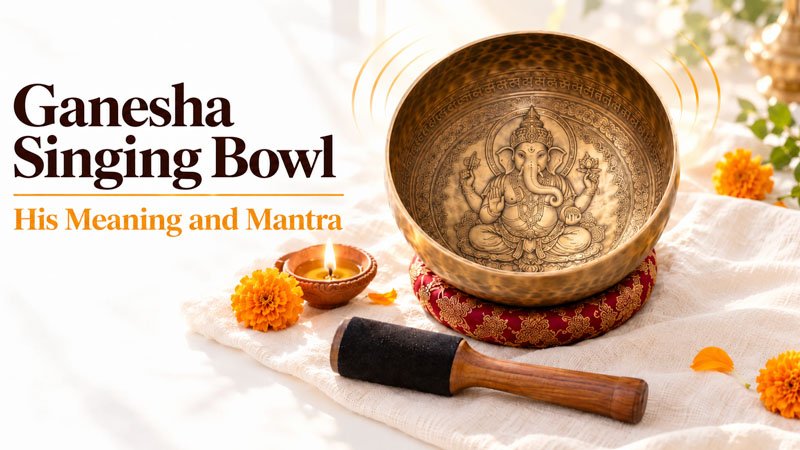
A Ganesha singing bowl has Ganesha, the elephant-headed remover of obstacles, etched at the centre, with his mantra in Devanagari around the bowl, usually Shree Ganeshaya Namah or Om Ganeshaya Namah. Ganesha is honoured first at the start of anything new, so the bowl is played to open a practice, a project or a new home. The sound comes from the bowl itself.
Key takeaways
- Who he is: Ganesha, son of Shiva and Parvati, remover of obstacles.
- His mantra: Om Gam Ganapataye Namah, ॐ गं गणपतये नमः.
- On a bowl: Ganesha inside, his name in Devanagari around the outside.
- To use it: strike once at the start of something, and chant as the sound fades.
Who is Ganesha?
Ganesha, also called Ganapati or Ganesh, is the son of Shiva and Parvati. In the best-known story, Parvati shaped him to guard her door, Shiva struck off his head when the boy blocked his way, and then gave him the head of an elephant.
He is the remover of obstacles and the patron of learning, writing and the arts. Hindus honour him first, before any other god, at the start of a ceremony, a journey or a new venture.
In the Kathmandu Valley he has four especially loved temples, among them Surya Binayak in Bhaktapur and Jal Binayak at Chobhar. Tibetan Buddhism honours him too, as Tsokdak, the Lord of Hosts.
How do you recognise Ganesha on a bowl?
| Look for | What it is often said to mean |
|---|---|
| Elephant head | Wisdom; big ears to listen |
| One broken tusk | Giving something up for knowledge |
| Round belly | All worlds held within him |
| Axe and noose | Cutting attachments, drawing you close |
| Bowl of modak sweets | The sweetness of devotion |
| The mouse | Desire, kept in check |
These are traditional readings, and teachers explain them in different ways. On an etched bowl, look first for the elephant head and trunk; the four arms and the mouse confirm it.
What does the Ganesha mantra mean?
| Word | Devanagari | Meaning |
|---|---|---|
| Om | ॐ | The sacred sound |
| Gam | गं | Ganesha's seed syllable |
| Ganapataye | गणपतये | To Ganapati, lord of the hosts |
| Shree | श्री | Revered, auspicious |
| Ganeshaya | गणेशाय | To Ganesha |
| Namah | नमः | I bow, salutations |
Say his seed mantra as Om Gum Ga-na-pa-ta-yay Na-ma-ha. Shree Ganeshaya Namah, "salutations to revered Ganesha", is the greeting you will find on many Ganesha bowls.
Where do Ganesha and his mantra appear on a bowl?
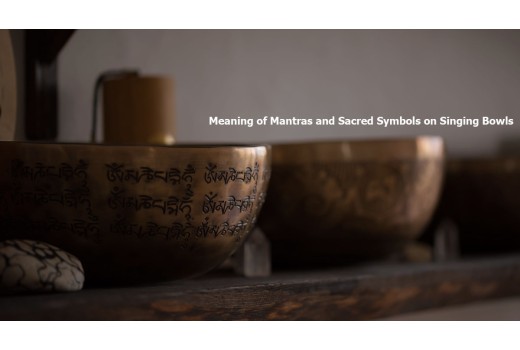
On most of our Ganesha bowls, Ganesha is etched at the centre inside and his mantra runs in Devanagari around the rim or the outside wall. Some carry a symbol on the base, such as a shatkona, the six-pointed star of Shiva and Shakti, his father and mother.
One of our Ganesha bowls carries Om Mani Padme Hum in Tibetan around him instead: a Nepali mix of Hindu and Buddhist traditions on one bowl.
Looking for a Ganesha bowl?
Our Ganesha engraved bowl has Ganesha at the centre and Om Ganeshaya Namah in Devanagari along the rim, hand-hammered, in 8 to 12 inches.
Which Ganesha bowl should you choose?
| If you want | Look at |
|---|---|
| His mantra in Devanagari | Ganesha engraved bowl: Om Ganeshaya Namah along the rim, 8 to 12 inches |
| Shree Ganeshaya Namah and the shatkona | Ganesha shatkona bowl: mantra around the outside, shatkona on the base, 8 to 12 inches |
| Hindu and Buddhist together | Ganesha Buddha-eyes mandala bowl: Om Mani Padme Hum around him, Buddha eyes on the base, 8 to 12 inches |
| Ganesha alone, plain outside | Lord Ganesha etched bowl, 8 to 12 inches |
| A first bowl or a gift | Ganesha etched hand-cast bowl, 8 inches |
Hand-hammered bowls give a richer, layered sound; a hand-cast bowl is a good gift or first bowl, as in our beginner and gift singing bowls. Every figure bowl is in carved and etched singing bowls.
How do you use a Ganesha bowl?
- Begin with him: play the bowl at the start of a meditation, a working day or a new project.
- Strike once and listen until the sound fades.
- Chant Om Gam Ganapataye Namah softly on each out-breath, or 108 times on a mala from our prayer beads.
- Bless a new home: play it once in each room as you move in, as in cleansing a room with a singing bowl.
- Finish with a moment of silence.
Practice like this supports relaxation and focus, and does not treat any condition.
Why is Ganesha on a Tibetan singing bowl?
Singing bowls are made in Nepal, where Hindu and Buddhist traditions live side by side. Ganesha is honoured in both, so a Nepali bowl may carry him with a Hindu mantra in Devanagari or a Buddhist one in Tibetan.
Every figure you may meet on a bowl, Buddhist and Hindu, is explained in deities on singing bowls, and other symbols in singing bowl symbols and mantras.
Can you have Ganesha on your own bowl?
Yes. On our custom singing bowl page we can engrave Ganesha at the centre of the bowl, with Om Gam Ganapataye Namah or Shree Ganeshaya Namah around him. You can add a name or a date on the outside or the base.
Frequently asked questions
What does a Ganesha singing bowl mean?
It carries Ganesha, the elephant-headed remover of obstacles, who is honoured first at the start of anything new. The bowl is a reminder to begin with a clear path, and the sound itself comes from the bowl.
What is the Ganesha mantra on a singing bowl?
Most Ganesha bowls carry Shree Ganeshaya Namah, श्री गणेशाय नमः, or Om Ganeshaya Namah, written in Devanagari. His seed mantra is Om Gam Ganapataye Namah, ॐ गं गणपतये नमः.
What does Om Gam Ganapataye Namah mean?
Om is the sacred sound, Gam is Ganesha's seed syllable, Ganapataye means to Ganapati, the lord of the hosts, and Namah means I bow. Together: Om, Gam, I bow to Ganesha.
How do you pronounce Om Gam Ganapataye Namah?
Om Gum Ga-na-pa-ta-yay Na-ma-ha. Gam rhymes with hum.
Why does Ganesha have a broken tusk?
Stories differ. The best known says he broke off his tusk to use as a pen when he wrote down the Mahabharata as the sage Vyasa recited it.
When should I use a Ganesha bowl?
At the start of something: a meditation, a working day, a new project or a move into a new home. Strike it once and chant his mantra as the sound fades.
Can I have Ganesha engraved on my own bowl?
Yes. We can engrave Ganesha at the centre of a custom singing bowl with his mantra around him, and engraving is free.
Want Ganesha at the centre of your bowl?
Choose the size and finish, and ask for Ganesha with his mantra around him. Engraving is free, and Sunita chooses your bowl after your order arrives.