




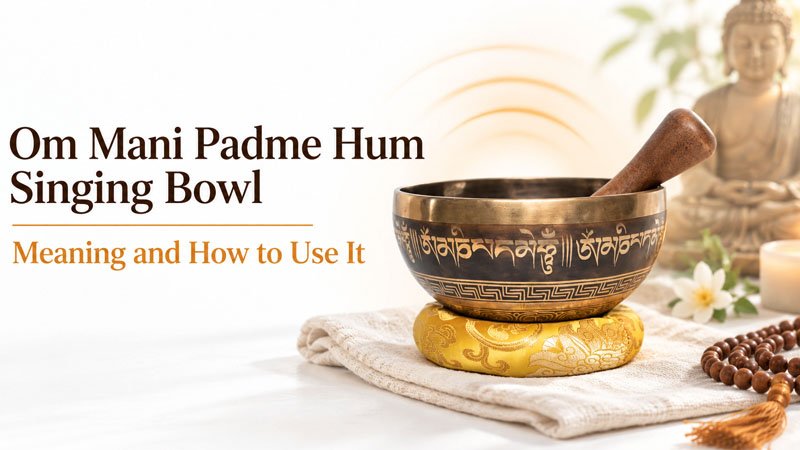
Om Mani Padme Hum Singing Bowl - What the Mantra Means and How to Use the Bowl
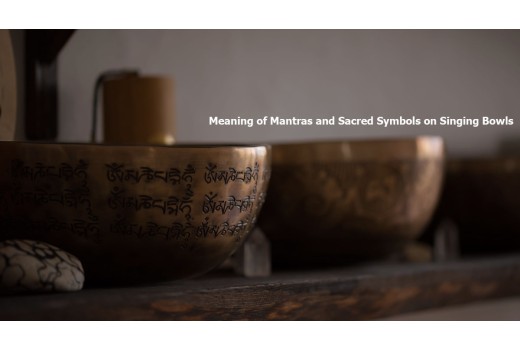
The Tibetan writing on most carved singing bowls is Om Mani Padme Hum, the six-syllable mantra of Avalokiteshvara, the bodhisattva of compassion. In Tibetan script it reads ཨོཾ་མ་ཎི་པདྨེ་ཧཱུྂ, often repeated all the way round the bowl. To use the bowl, strike it and chant the mantra softly as the sound fades, one recitation on each out-breath.
Key takeaways
- Six syllables: Om Ma Ni Pad Me Hum, each linked with a quality of mind.
- The meaning: usually translated "the jewel in the lotus", a call to compassion and wisdom.
- In Tibetan script: ཨོཾ་མ་ཎི་པདྨེ་ཧཱུྂ, starting with Om and ending with Hum.
- To use it: strike once, then one mantra on each out-breath as the sound fades.
What is the Tibetan writing on my singing bowl?
If your bowl carries a line of Tibetan letters, it is most often Om Mani Padme Hum. Many customers ask us this, because the mantra is carved in Tibetan script, not English letters.
| Tibetan | Say it | What to look for |
|---|---|---|
| ཨོཾ | Om | A curled letter with a crescent and a dot on top: the start |
| མ | Ma | A short, open letter |
| ཎི | Ni | A hook above the letter, which gives the "i" sound |
| པདྨེ | Pad-me | Two syllables written as one block, with letters stacked |
| ཧཱུྂ | Hum | A tall stacked letter with a crescent and a dot: the end |
- Find Om first: on a bowl the mantra often repeats all the way round, so Om shows where each round begins.
- Read left to right: the small dots between syllables are word dividers, called tsheg.
- Something else? Some bowls carry other mantras, such as Green Tara's or the chakra seed syllables. Send us a photo and we will tell you what yours says.
What does Om Mani Padme Hum mean?
It is one of the most widely recited mantras in Tibetan Buddhism, carved on mani stones and prayer wheels across the Himalaya. Word by word, it reads:
| Word | Meaning |
|---|---|
| Om | The sacred opening sound, also explained in what Om on a singing bowl means |
| Mani | Jewel |
| Padme | Lotus, or in the lotus |
| Hum | A closing seed syllable |
The popular translation is "the jewel in the lotus", though scholars read the words in more than one way, some as a name of Avalokiteshvara himself. Many teachers explain the jewel as compassion and the lotus as wisdom.
In Sanskrit it is written ॐ मणि पद्मे हूँ. Say it as Om Mah-nee Pad-may Hoom; Tibetan speakers often say it closer to Om Mani Peme Hung.
What do the six syllables stand for?
| Syllable | Colour | Quality |
|---|---|---|
| Om | White | Generosity |
| Ma | Green | Ethics |
| Ni | Yellow | Patience |
| Pad | Blue | Effort |
| Me | Red | Concentration |
| Hum | Black | Wisdom |
These are the six perfections as many Tibetan teachers link them to the mantra. On a bowl, Pad and Me are written together as one block, པདྨེ. Teachers differ on some details, so treat the table as one well-known reading, not the only one.
Where is the mantra carved on a bowl?
| Bowl | Where the mantra sits |
|---|---|
| Om Mani Padme Hum Potala Gate bowl | Inside a Potala Gate frame, with Om at the centre |
| Tibetan full mantra etched bowl | Outside wall, inside and on the base |
| Koprebati full mantra bowl | Around the outside wall, with a double dorje inside |
| 4 inch full mantra bowl | Around the outside of a small hand-cast bowl |
Looking for a mantra bowl?
See every bowl carved with Om, Om Mani Padme Hum and other mantras. Sunita chooses yours after your order arrives.
How do you use an Om Mani Padme Hum bowl?
- Sit comfortably with the bowl in front of you, with ཨོཾ (Om) facing you if you can find it.
- Strike once and simply listen for a breath.
- Chant softly: one Om Mani Padme Hum on each out-breath while the sound fades.
- Strike again when the sound is gone, or rim the bowl gently for a steady tone.
- Count with a mala if you like: 108 recitations, as in how to use a mala.
- Finish in silence, then one last strike to close.
Malas for counting are in our prayer beads category. Practice like this supports relaxation and focus, and does not treat any condition.
Can you have the mantra put on your own bowl?
Yes. Choose a bowl on our custom singing bowl page and ask for Om Mani Padme Hum, in Tibetan script like the traditional bowls or in English letters; engraving is free. Ideas for size and placement are in what to engrave on a singing bowl.
The mantra is there for its meaning; the note still comes from the bowl itself, as does etching change the sound explains.
Where else do you see this mantra?
- Prayer wheels: rolls of the mantra turn inside, as in what mantra is written on a prayer wheel; see our prayer wheels.
- Mani stones: rocks carved with the mantra along Himalayan paths.
- Prayer flags: printed so the wind carries it.
Other symbols and mantras you will meet on bowls are explained in singing bowl symbols and mantras.
Frequently asked questions
What is the Tibetan writing on my singing bowl?
On most carved bowls it is Om Mani Padme Hum, written ཨོཾ་མ་ཎི་པདྨེ་ཧཱུྂ in Tibetan script and often repeated all the way round. Look for ཨོཾ (Om) at the start and ཧཱུྂ (Hum) at the end.
How do I read Om Mani Padme Hum in Tibetan?
Read from left to right: ཨོཾ Om, མ Ma, ཎི Ni, པདྨེ Pad-me and ཧཱུྂ Hum. The small dots between them are word dividers.
What does Om Mani Padme Hum mean?
It is usually translated as "the jewel in the lotus". Om and Hum are sacred seed syllables, mani means jewel and padme means lotus, and many teachers explain the jewel as compassion and the lotus as wisdom.
Whose mantra is Om Mani Padme Hum?
It is the mantra of Avalokiteshvara, known in Tibet as Chenrezig, the bodhisattva of compassion.
What do the six syllables stand for?
In one widely taught explanation, Om, Ma, Ni, Pad, Me and Hum stand for generosity, ethics, patience, effort, concentration and wisdom.
How do I use a singing bowl with Om Mani Padme Hum?
Strike the bowl once, then chant the mantra softly on each out-breath while the sound fades. Strike again when it is gone, or count 108 recitations on a mala.
Can I have Om Mani Padme Hum engraved on my bowl?
Yes. Engraving is free. Ask for it in Tibetan script like the traditional bowls, or in English letters if you prefer.
Does the mantra change the sound of the bowl?
No. The note comes from the size, shape and wall of the bowl; the mantra is there for its meaning.
Want the mantra on your own bowl?
Choose the size and finish, and ask for Om Mani Padme Hum. Engraving is free, and a mallet and cushion come with every bowl.