




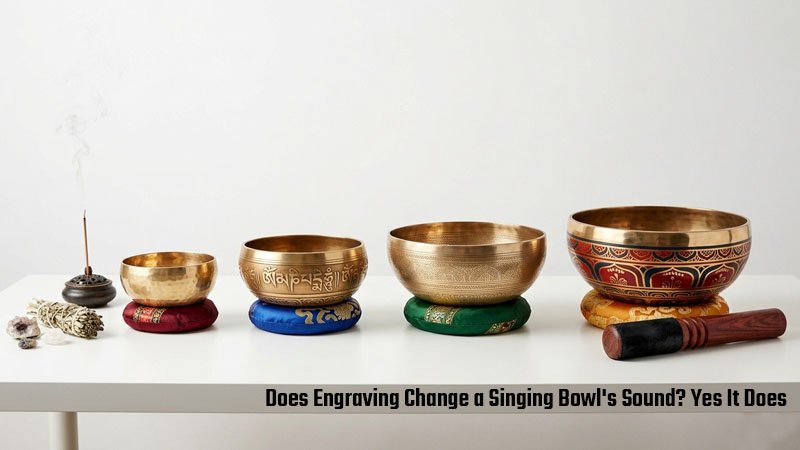
Does Etching, Engraving or Painting Change a Singing Bowl's Sound?
Short answer: yes, it does. Every seller will tell you it makes no difference. That is not true, and the physics is not complicated — anything that changes the mass or the stiffness of a vibrating wall changes how that wall sounds.
Ranked by how much they actually affect the tone, and the order surprises people:
- Paint changes it most. It adds a soft layer to a surface whose entire job is to vibrate freely, and soft mass absorbs energy.
- Hand chisel carving is next. It removes real metal from the wall.
- Acid etching is close to negligible. It bites a few microns.
- Laser is negligible for mass, though it introduces localised heat.
And here is the part that actually matters to you as a buyer: we do not test a bowl's sound until the decoration is finished. The note we tell you is the note of the completed object, not a promise made about it beforehand.
Why does any of this change the sound?
A singing bowl works by letting its wall flex. Strike it or rim it and the metal bends in and out thousands of times a second. The pitch depends on how stiff that wall is and how much it weighs. Change either and you change the note and how long it rings.
That is the whole principle, and it applies to everything done to the surface:
- Remove metal and the wall gets lighter and slightly less stiff where the metal is gone.
- Add material and the wall gets heavier — and if what you added is soft rather than rigid, it also absorbs vibration rather than passing it along.
- Heat the metal locally and the grain structure in that spot changes, which changes stiffness.
So the honest question is never whether decoration affects the sound. It is how much, and in which direction.
Hand chisel engraving: removes the most metal
The method everyone treats as the most authentic is physically the most invasive. A chisel driven by a hammer displaces and removes real material, and a deep mantra band or a full yantra takes a measurable amount of metal out of the wall.
What that does: the wall becomes marginally lighter and slightly less stiff along the cut lines. On a thick bowl this is a rounding error. On a thin wall it is not, and it is why fine deep carving belongs on bowls with enough metal to carry it.
There is a second consideration that matters more than tone. A deep cut is a stress line. Metal under repeated vibration concentrates stress where the section changes, which is why the depth of the cut relative to the thickness of the wall is something a carver has to judge, not just a matter of how the design looks.
How to recognise it: depth varies as the chisel travels. Hold the bowl under a raking light and you can see where the tool started and stopped, and the line is not uniform along its length.
Acid etching: a few microns, and almost nothing
Acid etching removes so little metal that the effect on tone is effectively nil. The design is masked, the exposed metal is chemically bitten to a depth measured in microns, and the mask is removed. Compared with a chisel, nothing has happened to the wall.
Which makes it the right tool for certain jobs, and this is worth saying plainly because the trade treats acid etching as the cheap option. It is not cheaper in every sense — it is the only practical way to put fine, intricate detail on a curved surface. Detailed geometry inside a bowl, where a chisel cannot travel cleanly and where the curve works against you, is a genuine case for etching rather than a compromise.
The real questions with acid work are not acoustic. They are whether the residue has been properly neutralised and washed, and whether the surface has been finished afterwards. Badly rinsed acid work continues to react slowly.
How to recognise it: uniform line depth and a flat, even floor to every cut. The line looks the same at its start and its end, which a hand-driven chisel never quite manages.
Laser: no mass, but heat
Laser marking removes almost nothing and the mass effect is negligible. What it introduces instead is heat, applied in a tightly focused spot.
Bell bronze is a high-tin alloy, and localised heating changes the grain structure of metal in the heat-affected zone. Whether that is audible depends entirely on power, dwell time and how deep the marking goes — a light surface mark is unlikely to do anything you could hear, while deep laser engraving on a thin wall is a different proposition.
We would be cautious about anyone claiming it has zero effect, in the same way we are cautious about anyone claiming a chisel has zero effect. The honest position is that it is probably inaudible in most cases and nobody has published measurements either way.
How to recognise it: extremely consistent line width, perfectly repeated elements, and often a slight discolouration at the edge of the mark where the metal was heated.
Paint: the one that actually damps
This is the answer people get wrong, and it is the most common decoration of all. Paint is not neutral. It is a soft, lossy layer bonded to a surface that needs to move freely, and it absorbs vibrational energy rather than transmitting it.
The effect is on sustain more than pitch. A painted bowl tends to ring for less time than the same bowl unpainted, because some of the energy that would have kept the wall moving is being converted to heat inside the paint layer. How much depends on two things: how much of the surface is covered, and how thick the coat is.
This is not an argument against painted bowls. A hand-painted chakra bowl is a beautiful object, it is often the right choice for teaching where the colour carries the mapping visually, and for a bowl that will mostly be struck rather than rim-played the shortened sustain barely registers. It is simply worth knowing that the method everybody assumes is purely cosmetic is the one with the largest real acoustic effect.
How to recognise it: obvious. What is less obvious is how much of the outer wall is covered, and that is the number that matters.
| Method | What it does to the wall | Effect on tone | Best for |
|---|---|---|---|
| Hand chisel carving | Removes real metal | Small pitch shift; needs wall thickness to carry it | Bold symbols, mantra bands, exterior work |
| Acid etching | Bites a few microns | Effectively none | Fine detail, interiors, curved surfaces |
| Laser marking | Almost no mass; adds localised heat | Probably inaudible; unmeasured | Repeatable fine work, text |
| Paint | Adds a soft layer | Shortens sustain, in proportion to coverage | Colour, teaching, visual chakra mapping |
The part that matters more than the method
Here is where our answer differs from the one you will get everywhere else.
The standard line in this trade is that a bowl is tuned first and decorated afterwards, so the decoration cannot possibly affect the tone. It is a tidy answer and it is how we used to describe it ourselves. It is also not what happens in our workshop.
We do not test a bowl's sound until the decoration is finished. The bowl is hammered, it is carved or etched or painted, and only then is it played and judged. Whatever the decoration did to the sound — and it did something — is already in the instrument by the time anyone listens to it.
Which means the note we give you is the note of the finished object. You are never told a bowl is F♯ and then handed something that was etched afterwards.
The note is discovered, not made
This is the piece of the picture most people have backwards, and it explains everything above.
You cannot hammer a raw disc toward a note you have chosen in advance. A smith working by hand over a fire produces a bowl, and the bowl turns out to have a pitch. The pitch is a consequence of diameter, wall thickness, profile, alloy and thousands of hammer strikes — and no one is controlling all of those precisely enough to hit a target. Pitch can be nudged afterwards by removing metal, but that is a small adjustment to something that already exists, not manufacture to a specification.
So a bowl's note is found rather than set. The process is: make the bowl, finish the bowl, then find out what it is.
One distinction worth being clear about, because the word "tuned" gets used for two different things. An individual bowl's note is discovered. A chakra set is genuinely tuned — but it is tuned by selection, by finding bowls whose discovered notes sit correctly against one another. The tuning happens across the set, not inside any one bowl.
Which is also why a sound healer chooses each bowl rather than a machine printing a label. If the note is something you find, somebody has to do the finding.
Two identical bowls, decorated differently, are two different instruments
Follow the logic and you arrive somewhere unexpected.
Take two bowls off the same bench, hammered by the same smith to the same size, as close to identical as hand work gets. Carve one with a deep mantra band. Paint the other. Play them both.
They are now different instruments, and not only because they look different. The carved one has lost a little metal. The painted one has gained a damping layer and will ring for less time. Neither is worse — they are simply not the same bowl any more.
The decoration is not something applied to a finished instrument. It is part of how the instrument became what it is. Our post on why every singing bowl sounds different covers the hammering side of the same idea.
Hear the finished bowl before you buy it
Because the decoration is part of the instrument, the only honest way to judge one is to hear the actual piece. Tell us which bowl you are considering and we will record it, struck and rim-played, before it ships.
Which method should you choose?
- You want the longest sustain → plain, or light chisel work on a thick wall. Avoid heavy paint coverage.
- You want bold symbols visible across a room → chisel carving, on a bowl with enough wall to take it. See Om singing bowls.
- You want fine, intricate geometry → etching. A chisel cannot travel cleanly through detailed work on a compound curve. See sacred geometry on singing bowls.
- You want colour, or you are teaching → painted. Accept the shorter sustain as the trade, and consider a bowl you will mostly strike.
- The bowl is a gift and the look matters most → any of them. The differences discussed here are real but modest, and a gift bowl is chosen with the eyes first.
Size matters more than method in every one of those cases. A thick-walled bowl absorbs any of this without complaint; a thin one does not. Our guide to choosing a singing bowl covers diameter and wall weight.
Commissioning a decorated bowl
If you want a specific design, a custom singing bowl lets you set the pattern, the placement, the diameter, the finish and the note, with personal engraving included free. Two things worth knowing when you specify one:
- Tell us how you will play it. A bowl for rim-playing and a bowl for striking suit different amounts of decoration, and we would rather advise you before the work is done than after.
- Heavy decoration wants diameter. Detailed work on a small thin bowl is the one combination where the effects in this article stop being modest.
Building a set? The custom set builder lets you specify the same design across several bowls, with the notes selected to sit together.
Design a decorated bowl
Choose the pattern, the method, the diameter and the finish — and tell us how you intend to play it, so the decoration suits the job. Engraving alongside it is free.
Frequently asked questions
Does engraving change the sound of a singing bowl?
Yes, though usually only slightly. Hand chisel carving removes real metal from the wall, which makes it marginally lighter and less stiff along the cut lines. On a thick bowl the effect is very small. On a thin wall it is not, which is why deep carving belongs on bowls with enough metal to carry it.
Does acid etching affect a singing bowl's tone?
Effectively not at all. Acid bites a depth measured in microns, so almost no mass is removed. It is also the only practical way to put fine intricate detail on a curved surface, which is why it is the right method for interior geometry rather than a compromise.
Does painting a singing bowl affect the sound?
More than most people expect, and more than either carving or etching. Paint adds a soft layer to a surface that needs to vibrate freely, and soft mass absorbs energy. The effect is mainly on sustain rather than pitch: a painted bowl rings for less time than the same bowl unpainted, in proportion to how much of the surface is covered and how thick the coat is.
Does laser engraving damage a singing bowl?
It removes almost no mass, but it applies localised heat, and heating changes the grain structure of metal in the heat-affected zone. A light surface mark is unlikely to be audible. Deep laser work on a thin wall is a different proposition. Nobody has published measurements either way.
Are singing bowls tuned to a specific note?
Individual hand-hammered bowls are not. The pitch is a consequence of diameter, wall thickness, profile, alloy and thousands of hammer strikes, and no smith controls all of those precisely enough to hit a chosen target. The note is discovered after the bowl is finished rather than made to order. A chakra set is genuinely tuned, but by selecting bowls whose discovered notes sit correctly against each other.
Is a bowl tested before or after it is decorated?
At Dharma Tool, after. The bowl is hammered, decorated, and only then played and judged, so whatever the decoration did to the sound is already in the instrument when it is assessed. The note you are given is the note of the finished object.
How can I tell chisel carving from acid etching?
Look under a raking light. Chisel lines vary in depth as the tool travels, and you can see where it started and stopped. Acid lines are uniform in depth with a flat even floor, and look the same at both ends. Laser lines are extremely consistent in width and often show slight discolouration at the edges.
Does decoration make a singing bowl more likely to crack?
A deep cut is a stress line, and metal under repeated vibration concentrates stress where the section changes. This is a matter of cut depth relative to wall thickness rather than of decoration in general. Etching, laser and paint do not create the same concern because none of them meaningfully reduce the section.