



Sacred Geometry on Singing Bowls: Every Pattern and What It Means
Short answer: sacred geometry on a singing bowl is a pattern built from repeated geometric rules rather than from script or figures. The designs fall into four families:
- Circle-based — Seed of Life, Flower of Life, Vesica Piscis. One circle repeated at its own radius.
- Triangle-based — Shree Yantra, Merkaba, Metatron's Cube. Interlocking forms meeting at a centre.
- Concentric — mandalas, labyrinths. A journey inward through rings.
- Symbolic form — Tree of Life, Yin Yang, lotus, Unalome. Geometry carrying a figurative meaning.
A bowl is an unusually fitting object for these patterns, and not for decorative reasons. A vibrating surface physically arranges itself into symmetrical geometric figures — which is what the section below is about.
Why does geometry belong on a singing bowl?
Because a vibrating bowl produces geometry whether anyone carves it or not. This is the part most articles on the subject miss, and it is the only genuinely interesting thing anyone can say about why these two things go together.
When a surface vibrates at a particular frequency, it does not move uniformly. Parts of it move a great deal and parts of it barely move at all. Scatter fine sand across it and the sand migrates away from the moving zones and settles along the still ones, forming a visible figure. These are called Chladni figures, after Ernst Chladni, who demonstrated them in the 18th century with a violin bow and a metal plate. The study of them is now usually called cymatics.
The figures are not random. Every frequency produces its own, and they are strikingly symmetrical — rings, radial divisions, star forms. Raise the pitch and the pattern divides further.
So a bowl carrying a Flower of Life is carrying, on its outside, a static version of the kind of pattern it generates acoustically on the inside. That correspondence is real, and it is the honest version of a claim usually made far more loosely.
What we would not claim: that carving a pattern changes the frequency, amplifies the healing, or alters the bowl's effect. It does not. The bowl is hammered and tuned first and carved afterwards, so the tone is set before any line is cut. The geometry is meaningful to look at and to hold your attention on. It is not doing anything to the physics.
The circle patterns: Seed of Life and Flower of Life
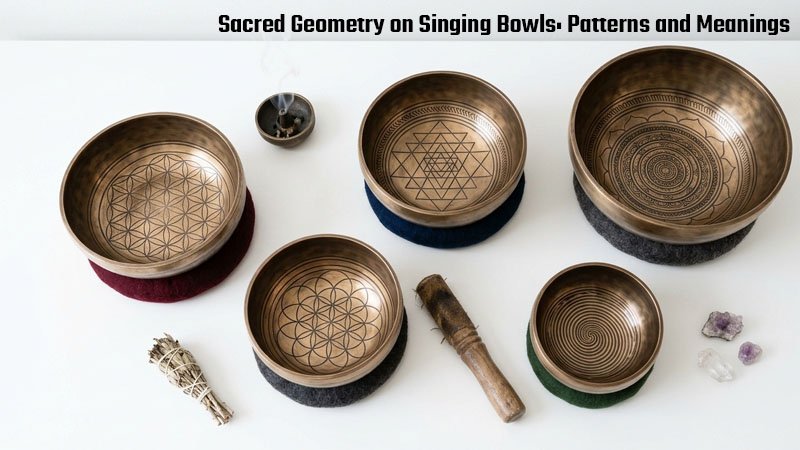
The Flower of Life is nineteen overlapping circles of identical size, arranged in six-fold symmetry. The Seed of Life is the first seven of them. Both are built by one rule repeated: draw a circle, then draw another of the same radius centred on its edge, and keep going.
What it means. The pattern appears across cultures and eras — carved into the Osirion temple at Abydos in Egypt, in Assyrian palace decoration, in Chinese and Japanese ornament, in medieval European manuscripts. What people generally take from it is the idea that complexity emerges from one simple rule applied repeatedly, which is a reasonable thing to contemplate and does not require anyone to make a claim about ancient astronauts.
The Seed of Life is read as the seven days of creation in some traditions, and simply as beginnings in most modern practice. It is the most common geometry request we get from people who want something meaningful without a specific religious attachment.
The Vesica Piscis — the almond shape formed where two circles overlap — is the simplest unit of the whole family, and it is the form from which everything else here can be constructed. We cut it rarely, and it makes a beautifully restrained bowl.
The Shree Yantra: nine triangles and a point
The Shree Yantra is the most revered diagram in Hindu tantra, and the most technically demanding thing our artists carve. Nine interlocking triangles — four pointing up, five pointing down — overlap to produce forty-three smaller triangles around a single central point.
What it means. The four upward triangles represent Shiva, the masculine principle; the five downward ones Shakti, the feminine. Their interpenetration is the union from which the manifest world arises. At the centre sits the bindu, the single undifferentiated point — the source everything radiates from and returns to. Around the triangles sit rings of sixteen and then eight lotus petals, and outside those a square enclosure with four gates.
It is used as a focus for meditation on manifestation and abundance, and traditionally the practitioner works inward from the outer square toward the bindu. On a bowl this works particularly well, because the eye travels the same way the sound does: outward from a single strike, then back to stillness.
We cut it on carved bowls, on Lingam bowls where the raised centre sits at the heart of the yantra, and on large standing bowls where there is room to make the structure legible.
Mandalas: the journey inward
A mandala is a concentric diagram representing the universe and the path to its centre. In Tibetan Buddhism it is a map of a sacred palace and its deities, read from the outer edge inward.
Unlike the Flower of Life, a mandala is not built from a single repeated rule — it is composed, which is why no two of ours are identical and why a full mandala bowl can occupy an artist for the better part of a week. The Seed of Life mandala designs we cut on large bowls sit between the two families, using circle geometry within a mandala structure.
What it means. Impermanence, most directly — the sand mandalas of Tibetan practice are destroyed on completion. On a bowl the meaning shifts slightly and becomes rather apt: the sound you make is also gone as soon as it is made.
Tree of Life, Yin Yang and the symbolic forms
These carry figurative meaning rather than being generated by a rule, and they are the designs most often chosen by people who want something spiritual without a specific tradition attached.
- Tree of Life — roots and branches mirroring each other, found in Norse, Celtic, Kabbalistic, Buddhist and countless other traditions. Read as connection between what is below and what is above, and as growth. We often cut it with a Yin Yang at the centre.
- Yin Yang — Chinese in origin, representing complementary rather than opposing forces, each containing a seed of the other. Geometrically it is two circles within a circle, which makes it one of the simplest true geometry forms we carve.
- Lotus — growing from mud into clear water and opening. The most common supporting element in Himalayan carving, and it appears around the base of most of our yantra and mantra work.
- Chakra symbols — each of the seven centres has its own traditional form, with a specific number of petals. These work best across a set, one per bowl, which is what our chakra sets do.
How is geometry carved onto a curved surface?
This is harder than it sounds and it is where most machine-etched bowls fail visibly.
A geometric figure is designed flat. A bowl is a compound curve. Laid out naively, a Flower of Life stretches at the rim and compresses toward the base, and a Shree Yantra's triangles stop meeting where they should. Our artists compensate as they cut, adjusting spacing by eye as the surface falls away — which is exactly the kind of judgement a template cannot make.
It is worth examining on any geometric bowl you are considering. Look at whether the circles stay circular near the rim, and whether the triangle intersections actually meet at points. On acid-etched work, where a flat design is masked onto a curved object, they frequently do not. Our post on Om singing bowls covers the hand-carved versus acid-etched distinction in more detail.
What geometry is nobody carving yet?
An honest observation from inside the trade: the range of geometry on singing bowls is much narrower than the range of geometry people actually care about. Several patterns central to modern yoga and wellness practice appear on jewellery, wall art, tattoos and crystal grids, and almost never on a metal bowl.
We can cut any of these to order, and several have already been commissioned:
- Metatron's Cube — thirteen circles with every centre joined to every other, containing all five Platonic solids. Widely used in sacred geometry practice, and to our knowledge not offered on hand-hammered bowls by anyone.
- Merkaba — two interlocking tetrahedra forming a star. Available as a crystal shape; we have not seen it carved on metal.
- Vesica Piscis — the two-circle overlap. Restrained and unusual.
- Fibonacci spiral and the golden ratio — the proportion, the spiral, or the phi symbol itself.
- Enso — the Zen circle drawn in one brushstroke, deliberately imperfect. Suits anyone who finds mandala work too busy.
- Unalome — the winding path straightening toward a point, from Thai and Burmese Buddhist tradition. Enormously popular in yoga culture and absent from this market entirely.
- Hamsa — the protective hand, often with a Flower of Life or Om in the palm.
- Triple moon — waxing, full and waning, for practitioners working with lunar cycles. Pairs naturally with a full moon bowl.
- Labyrinth — the Chartres form, walked as meditation. A single path inward, which translates well onto a bowl.
- Bija mantras — LAM, VAM, RAM, YAM, HAM, OM, one seed syllable per bowl across a chakra set.
- Platonic solids — one per bowl across a five-element set.
The one we would most like to make: your bowl's own pattern
Here is an idea we have been turning over, and we would rather put it in public than keep it quiet.
Every bowl has a cymatic figure that belongs to it alone. Its fundamental frequency produces a specific nodal pattern — that bowl's own geometry, generated by its own voice. It can be measured, and it can be drawn.
So it can be carved onto the bowl that produced it. Not a symbol chosen from a catalogue, but the physical signature of that particular instrument, cut into its own surface. As far as we can establish, nobody has done this.
It would need the bowl's frequency measured accurately first, the figure derived, and then cut by hand onto a curved surface — which is demanding, and honestly we are still working out how precisely it can be done. If it appeals to you, tell us. We would like to make the first one.
In the meantime, a simpler version already works: the note and frequency engraved on the bowl itself. Practitioners label their bowls with tape; a hand-cut "F♯ · 369 Hz" on the base is better in every way. Measure any bowl you own with our live singing bowl tuner.
Have your own geometry carved
Any pattern above, or one of your own. You choose the design, the diameter, the finish and the musical note, and personal engraving alongside it is free. Tell us what you have in mind and we will come back with what is possible and how long it takes.
How do you commission a geometry bowl?
Geometry is the most commissioned category we make, and for a straightforward reason: people who care about a specific pattern usually care about a specific pattern, not an approximation of it. A custom singing bowl lets you set six things:
- The pattern — from our range, from the list above, or a drawing of your own. Send us an image and we will tell you honestly whether it can be cut cleanly at the size you want.
- Where it sits — filling the outer wall, as a band, inside the bowl, or on the base.
- Diameter — and this matters more with geometry than with anything else. Fine patterns need room. A Metatron's Cube at four inches becomes a smudge; at eight it is legible.
- Musical note — mapped to the chakras from C at the Root to B at the Crown. See chakra and note information.
- Finish — a golden interior throws carved lines into relief, which suits geometry better than any other finish we do.
- Your own engraving alongside it, free of charge, in English or Tibetan script.
Three cases where commissioning is genuinely the better route rather than an upsell. When the pattern is not in stock at all — most of the list above falls here. When you need a specific pattern at a specific size, because fine geometry and small bowls do not go together. And when you are building a themed set — one Platonic solid per bowl, one bija mantra per note, or the same geometry repeated across seven.
For a full set, the custom set builder lets you specify the notes across several bowls with the same design cut on each, which is what practitioners want and what an assembled set almost never provides.
Every commissioned bowl is hammered, carved, then tuned and played by a sound healer before it ships, the same as everything else we make.
Building a set rather than one bowl?
Specify the notes across several bowls with the same geometry on each — seven chakra symbols, five Platonic solids, or one pattern repeated. Tuned as a set, not assembled from stock.
Which geometry should you choose?
- Hindu or tantric practice → Shree Yantra, or the chakra forms across a set.
- Buddhist practice → mandala, or geometry with lotus and mantra work around it. See also Om singing bowls.
- No specific tradition → Flower of Life or Seed of Life. The most requested, and they carry meaning without belonging to anyone.
- Minimal taste → Vesica Piscis or Enso. Quiet, and unlike anything else on the market.
- Sound healing practice → the note and frequency engraved, or a chakra symbol per bowl across a set.
- A gift → Tree of Life, with a name and date engraved. Free, and it makes the object specific to one person.
Then size and note, which are separate decisions — how to choose a singing bowl covers both, and types of singing bowls covers the forms. Ready-carved bowls are in Om and mantra carved, large standing and hand-casted, and the vocabulary is in our terminology guide.
Frequently asked questions
What is sacred geometry on a singing bowl?
A pattern built from repeated geometric rules rather than from script or figures. The main families are circle-based designs such as the Flower of Life, triangle-based designs such as the Shree Yantra, concentric designs such as mandalas, and symbolic forms such as the Tree of Life.
Why is sacred geometry carved on singing bowls?
Because a vibrating surface produces geometry by itself. Scatter sand on a vibrating plate and it settles along the still lines, forming a symmetrical Chladni figure specific to that frequency. A bowl carrying a geometric pattern displays, on its surface, the kind of pattern it generates acoustically.
Does carved geometry change the sound?
No. The bowl is hammered and tuned first and carved afterwards, so the tone is established before any line is cut. The surface texture changes, which many players find helps with rim-playing, but the frequency does not.
What does the Flower of Life mean?
Nineteen overlapping circles of equal size in six-fold symmetry, built by repeating one rule. It appears across many cultures and eras, and is generally read as complexity emerging from a single simple principle. The Seed of Life is the first seven circles of the same pattern.
What does the Shree Yantra represent?
Nine interlocking triangles — four upward for Shiva, five downward for Shakti — forming forty-three smaller triangles around a central point, the bindu. It represents the union from which the manifest world arises, and is used as a focus for meditation on manifestation.
Can you carve a pattern that is not in your range?
Yes. Metatron's Cube, Merkaba, Vesica Piscis, Fibonacci spirals, Enso, Unalome, Hamsa, triple moon, labyrinths, bija mantras and Platonic solids can all be commissioned, along with a design of your own. Send an image and we will say honestly whether it can be cut cleanly at the size you want.
What size bowl does fine geometry need?
Larger than most people expect. Detailed patterns such as Metatron's Cube or a full Shree Yantra need room to stay legible — around eight inches and up. At four inches fine geometry becomes a smudge.
How can you tell hand-carved geometry from machine etching?
Look at the rim. A flat design masked onto a curved bowl distorts as the surface falls away, so circles stop being circular and triangle intersections stop meeting at points. A hand carver adjusts spacing by eye as they cut.