



Eight Auspicious Symbols - The Ashtamangala on Bowls, Gongs and Tingsha
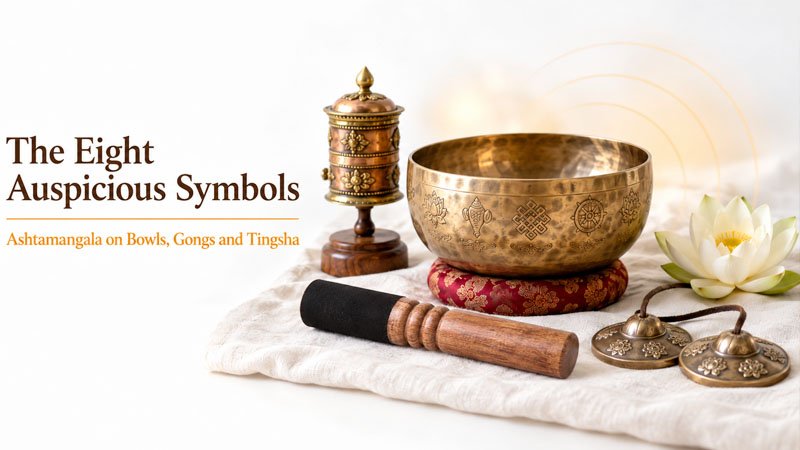
The eight auspicious symbols, the Ashtamangala, are the parasol, the golden fish, the treasure vase, the lotus, the white conch, the endless knot, the victory banner and the Dharma wheel. Tradition says the gods offered them to the Buddha after his awakening, and each stands for a quality of his teaching. On our instruments they ring a singing bowl, circle its centre, or are embossed on tingsha, gongs and prayer wheels.
Key takeaways
- What they are: eight offerings made to the Buddha; in Tibetan, tashi tagye.
- What they mean: protection, freedom, plenty, purity, the sound of the teaching, wisdom, victory and the teaching itself.
- Their order: from the parasol to the Dharma wheel, spaced evenly around a design.
- Where you find them: on singing bowls, tingsha, gongs and prayer wheels.
What are the eight auspicious symbols?
The Sanskrit name, Ashtamangala, joins ashta, "eight", and mangala, "auspicious". In Tibetan they are the tashi tagye, the eight auspicious signs.
Sets of eight lucky signs were used in ancient India at the crowning of a king. In Buddhism they became the offerings the gods made to the Buddha just after his awakening: Tibetan texts say Indra offered the white conch, asking him to teach, and Brahma a golden wheel with a thousand spokes.
Hindu and Jain traditions keep their own sets of eight, with different objects, and some Buddhist lists put a fly-whisk in place of the wheel. The set on our bowls is the Tibetan Buddhist one.
What does each of the eight symbols mean?
| Symbol | What it stands for | Part of the Buddha |
|---|---|---|
| 1. Parasol | Protection from harm, illness and the heat of suffering | Head |
| 2. Golden fish | Freedom: moving through life without fear of drowning; also happiness and plenty | Eyes |
| 3. Treasure vase | Riches that never run out: long life, wealth and endless teaching | Throat |
| 4. Lotus | Purity: it rises from the mud without being stained | Tongue |
| 5. White conch | The sound of the teaching spreading in every direction, waking us from ignorance | Voice |
| 6. Endless knot | Everything connected; wisdom and compassion joined | Mind |
| 7. Victory banner | Victory over obstacles: pride, desire, disturbing emotions and the fear of death | Body |
| 8. Dharma wheel | The Buddha's teaching, set turning at his first sermon | Feet |
Tibetan teachers say the eight together make up the body of the Buddha, which is why the last column runs from his head to his feet.
- The fish always come as a pair. They are said to have stood first for India's two sacred rivers, the Ganga and the Yamuna.
- The conch spirals to the right. Right-turning shells are rare in nature, which is why they are prized.
- The endless knot has no beginning and no end, so it also stands for the Buddha's endless wisdom.
- The wheel has eight spokes, often read as the Noble Eightfold Path.
For the other designs you will meet on a bowl, see singing bowl symbols explained.
In what order are the eight shown?
Tibetan art usually follows the order in the drawing above: the parasol first and the Dharma wheel last. Orders vary between traditions; Chinese art, for example, begins with the wheel.
On a bowl, a gong or a prayer wheel the eight are spaced evenly around the main design, so you meet them one by one as you turn it.
Where do the eight appear on a singing bowl?
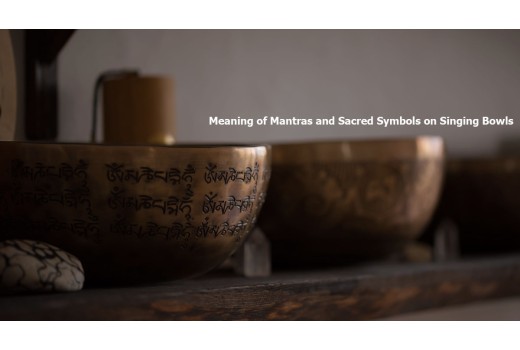
On most of our Ashtamangala bowls the eight are hand-etched around the outside wall, with another design at the centre inside: a lotus and star, a Flower of Life, the Home Yogi or Jungle Yogi, a lingam, or a mandala with Om.
On others they form a ring inside, around the main figure: around the Buddha on our large Buddha bowl, or around a Tibetan Om on our chakra Om bowl. Two small bowls are hand-cast rather than hammered: one with the eight embossed at the centre, and one with them painted around the outside.
Looking for an Ashtamangala bowl?
Our Eight Auspicious Symbols bowl has all eight hand-etched around the outer wall, a lotus and star at the centre and a dorje on the back, hand-hammered, in 7 to 12 inches.
Where else do you find the eight symbols?
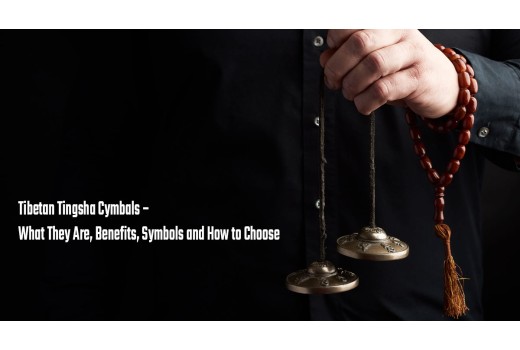
On tingsha, the eight are embossed on the small cymbals; ours are in Tibetan tingsha.
On a gong, they ring the main carving: on our Chakra Yogi gong they surround the seated yogi and his chakras. More gongs are in Tibetan gongs.
On a prayer wheel, they run around the drum with Om Mani Padme Hum; turning the wheel is said to be like reciting the mantra rolled up inside it. Table-top, wall-hanging and hand-held wheels are in Tibetan prayer wheels.
Which Ashtamangala piece should you choose?
| If you want | Look at |
|---|---|
| All eight around the outside | Eight Auspicious Symbols bowl: lotus and star inside, dorje on the back, 7 to 12 inches |
| The eight in a ring around the Buddha | Large Buddha bowl: double dorje underneath, 11 to 13 inches |
| A small cast bowl, the eight embossed | Embossed Ashtamangala bowl: Buddha eyes on the back, 6 inches |
| A small painted bowl | Painted Ashtamangala bowl: double dorje at the centre, 4 to 6 inches |
| Tingsha | Ashtamangala embossed tingsha, 2.5 inches |
| A gong | Chakra Yogi gong: the yogi and his chakras at the centre, 16 to 22 inches |
| A hand-held prayer wheel | Eight Auspicious Symbol prayer wheel: carved wooden handle, 12 inches long |
| A table-top prayer wheel | Stone inlay prayer wheel: turquoise, coral and lapis, 10 inches tall |
Every symbol bowl is in carved and etched singing bowls.
How do you use the eight symbols in practice?
- Choose one quality: before you play, pick the symbol you need today, such as the parasol for protection or the lotus for a fresh start.
- Turn it towards you: strike once with that symbol facing you, and hold its meaning in mind as the sound fades.
- Go round the eight: on a bowl or a gong, play eight slow strikes, one for each symbol, from the parasol to the wheel.
- Turn the wheel clockwise: on a prayer wheel, always turn it clockwise, the traditional direction.
Practice like this supports relaxation and focus, and does not treat any condition.
Can you have the eight symbols on your own bowl or gong?
Yes. Ask for all eight around the wall, a ring of them inside, or just the one that speaks to you, on a custom singing bowl; engraving is free.
The eight can also frame any god or figure you choose for the centre. For a gong, use our custom gong page.
Frequently asked questions
What are the eight auspicious symbols?
They are the parasol, the golden fish, the treasure vase, the lotus, the white conch, the endless knot, the victory banner and the Dharma wheel: eight offerings said to have been made to the Buddha after his awakening.
What does Ashtamangala mean?
It is Sanskrit: ashta means eight and mangala means auspicious. In Tibetan the set is called tashi tagye, the eight auspicious signs.
Are they the same as the eight lucky symbols?
Yes. They are often called the eight lucky symbols, because Tibetan families and temples paint and carve them as blessings for good fortune and protection.
Which of the eight comes first?
In the usual Tibetan order the parasol comes first and the Dharma wheel last. Other traditions start elsewhere: Chinese art, for example, begins with the wheel.
What do the two golden fish mean?
Freedom and fearlessness: moving through life like fish in water, without fear of drowning. They also stand for happiness and plenty.
Why does the conch turn to the right?
A conch that spirals to the right is rare in nature, so it is especially prized. It stands for the sound of the teaching spreading in every direction.
Are the eight symbols Buddhist or Hindu?
The set on our bowls is the Tibetan Buddhist one. Hindu and Jain traditions keep their own sets of eight auspicious objects, which are not the same.
Can I have the eight symbols on my own bowl or gong?
Yes. Ask for all eight, a ring of them, or just one on our custom singing bowl page, or on our custom gong page for a gong. Engraving on a bowl is free.
Want the eight symbols on your bowl?
Choose the size and finish, and tell us which symbols you want and where: around the wall, inside or underneath. Engraving is free, and Sunita chooses your bowl after your order arrives.