



5 Powerful Ways to Set Up a Singing Bowl Set for a Sound Bath
Short answer: how do you set up singing bowls for a sound bath?
There are five common singing bowl setups for a sound bath. Use a chakra line along the body for full-body sessions, a circle around the group for group sound baths, a semi-circle around yourself for home practice, an altar or mandala pattern for ritual use, and a feet-to-head line for one-to-one therapy. Beginners should start with the semi-circle, with 3 to 5 bowls within easy reach, and place deeper-toned bowls low and higher-toned bowls high.
A well-arranged singing bowl set is not just about aesthetics—it directly affects how sound flows, how people experience vibration, and how deeply the mind relaxes. Whether you are creating a personal meditation space at home or preparing for a professional sound bath session, the way you position your singing bowls can transform the entire experience.
In this guide, we explore five powerful and practical singing bowl setups used in sound healing, meditation, and wellness practices.
| Setup | Best for | Bowls needed |
|---|---|---|
| 1. Chakra alignment | Full-body sound healing | 7, one per chakra |
| 2. Circle | Group sound baths, retreats | 5 to 12 |
| 3. Practitioner-centered semi-circle | Beginners, home practice | 3 to 7 |
| 4. Sacred geometry or altar | Ritual and personal meditation | 3 to 9 |
| 5. Linear flow | One-to-one sound therapy | 5 to 7 |
1. Chakra Alignment Setup (Full Body Sound Healing)
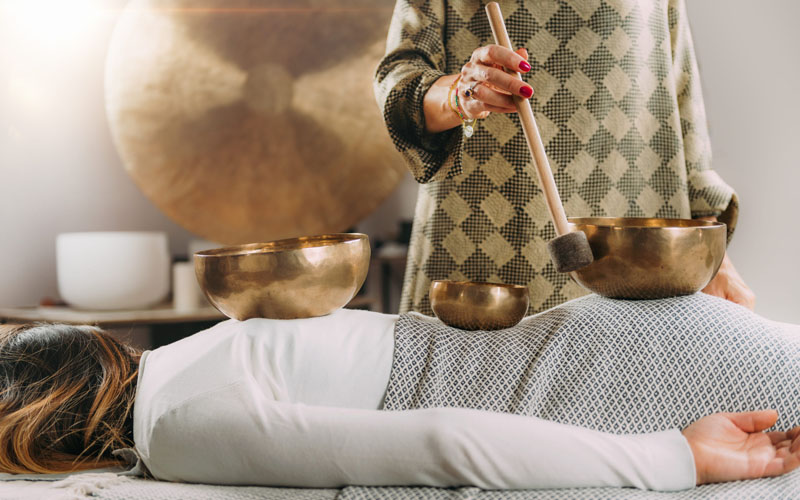
This is the most widely used setup in sound healing. Each singing bowl is aligned with the body's energy centers, known as chakras.
Place your bowls in a straight line or arc, from the Root chakra bowl to the Crown chakra bowl. Go by the note of each bowl, not its size: in a graduated set the bowls get smaller as the notes rise, but in an equal-size set every bowl has the same diameter. If working with a person, position the bowls along their body or just beside them.
The order you play them in depends on the tradition you follow, so if you were taught a Tibetan or a Vedic sequence, keep to it. For a five-bowl version of this layout, see our guide to the 5 element singing bowl set.
This setup supports deep relaxation and is commonly used in yoga studios and professional healing sessions. The progression of tones helps guide the body into a calm, meditative state.
2. Circle Setup (Immersive Group Sound Bath)

For group sessions, arranging singing bowls in a circular layout creates a powerful surround sound experience. Participants sit or lie down inside the circle, while the practitioner plays from the center or moves around.
This method distributes sound evenly from all directions, creating a sense of immersion. It is highly effective for workshops, retreats, and group meditation experiences.
3. Practitioner-Centered Setup (Best for Control and Flow)
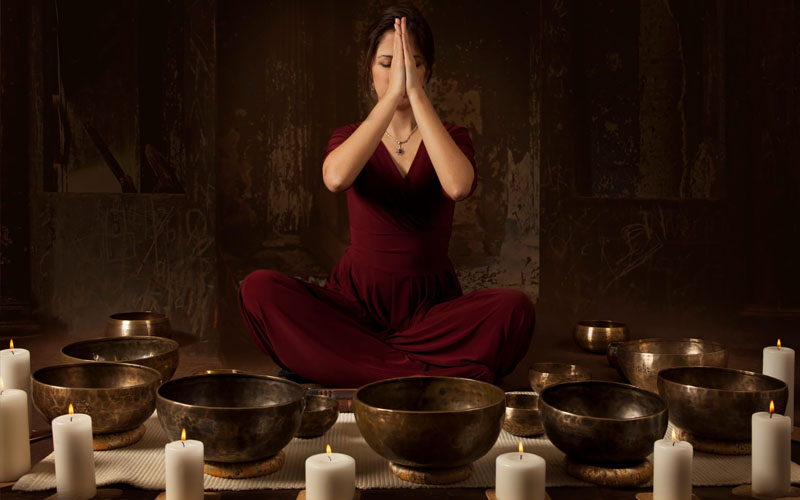
This setup is ideal for beginners and solo practitioners. Arrange your singing bowls in a semi-circle around you so that each bowl is within easy reach.
This allows smooth transitions between tones and helps maintain rhythm during the session. You can also add bells, gongs, or tingsha cymbals behind you to layer the sound.
This is one of the most practical setups for home use and daily practice.
4. Sacred Geometry or Altar Setup (Spiritual & Ritual Use)
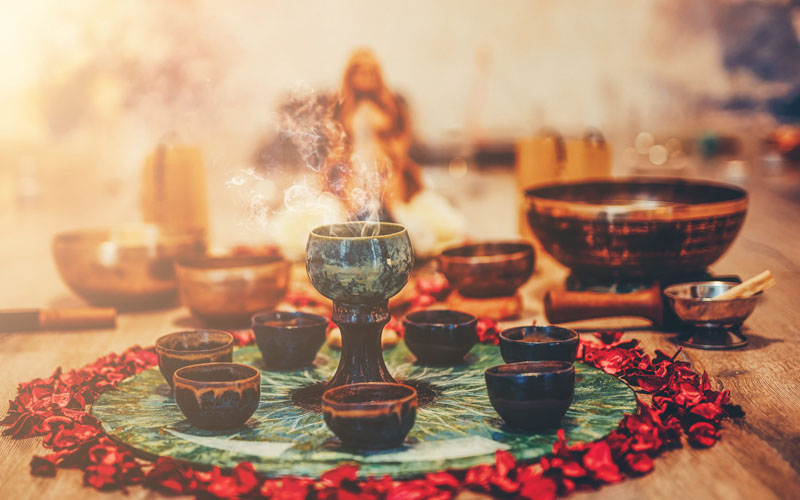
For deeper spiritual practice, singing bowls can be arranged in symbolic patterns such as a mandala, triangle, or Flower of Life formation.
This setup is often combined with candles, incense, or crystals to create a sacred space. It enhances intention, focus, and emotional connection during meditation or sound healing rituals.
While less about efficiency, this setup is powerful for personal transformation and ceremonial use.
5. Linear Flow Setup (Therapeutic Sound Journey)

This method is commonly used in one-on-one sound therapy sessions. Singing bowls are placed along the length of the body—from feet to head.
Deeper-toned bowls are positioned near the feet for grounding, and large standing bowls work well here. Higher-toned bowls are placed near the head. The practitioner plays in sequence, creating a guided sound journey.
This setup helps move the listener through a progressive state of relaxation and awareness.
Pro Tips for Better Sound Bath Experience
- Start with deeper tones to help the body settle
- Gradually introduce higher tones for mental clarity
- Maintain a slow and consistent rhythm
- Use soft lighting and a quiet environment
- Allow silence between sounds for integration
To learn how to structure a full session, our free singing bowl healing course covers sequencing and body placement step by step.
Explore Singing Bowl Sets for Sound Healing
Hand-hammered singing bowl sets of 3, 5, 7, 9 and 12 bowls for meditation, sound baths and healing practice. Each set is tuned by selection for your order by our healer, from her experience.
Create Your Custom Singing Bowl Set
Choose the notes, size range, finish and free engraving, and our healer selects the combination that suits your personal or professional practice.
Frequently Asked Questions
How many singing bowls do I need for a sound bath?
You can start with 3 to 5 bowls. A full chakra setup uses 7, and sets also come in 9 and 12 bowls for larger sessions.
Do singing bowl setups really affect the experience?
Yes. The placement changes how sound travels and how vibrations are perceived, which directly impacts relaxation and immersion.
Which setup is best for beginners?
The practitioner-centered setup is the easiest and most practical for beginners.
Can I create a sound bath at home?
Yes. With a few bowls, a quiet space, and proper arrangement, you can create an effective home sound healing experience.