




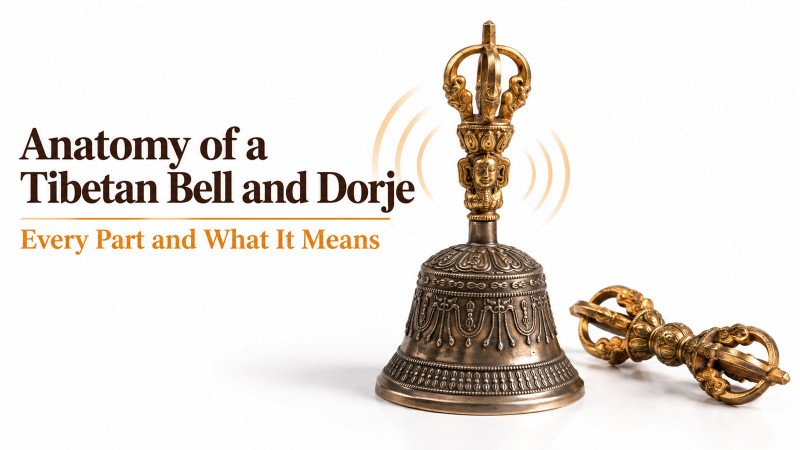
Anatomy of a Tibetan Bell and Dorje - Every Part and What It Means
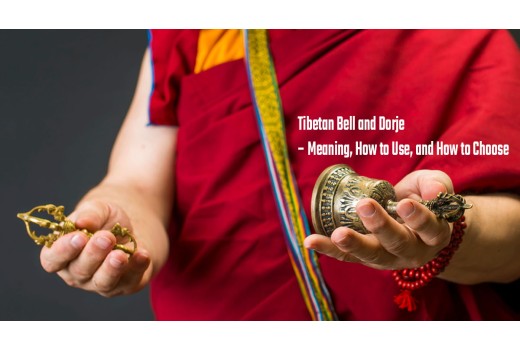
A Tibetan bell and dorje are made so that every part has a meaning. The bell, or ghanta, stands for wisdom: a vajra on top, the face of Prajnaparamita on the handle, lotus petals and seed syllables on the shoulder, and a hollow and clapper for emptiness and its sound. The dorje, or vajra, stands for method: a central sphere, a lotus and makara heads on each side, and prongs that meet at the tip.
Key takeaways
- The bell: wisdom, held in the left hand.
- The dorje: method and compassion, held in the right hand.
- The face on the handle: Prajnaparamita, the Perfection of Wisdom.
- The prongs: five for the five wisdoms, or nine in the Nyingma tradition.
- A matched pair: the bell and dorje should have the same number of prongs.
What are the Tibetan bell and dorje?
The bell, ghanta in Sanskrit and drilbu in Tibetan, and the dorje, vajra in Sanskrit, are the two ritual tools of Tibetan Buddhism. They are always used together: the bell for wisdom and the dorje for method, the compassion that puts wisdom into action.
How to use them, and how to choose a set, is in our Tibetan bell and dorje guide. This post looks at every part, one by one.
What are the parts of a Tibetan bell?
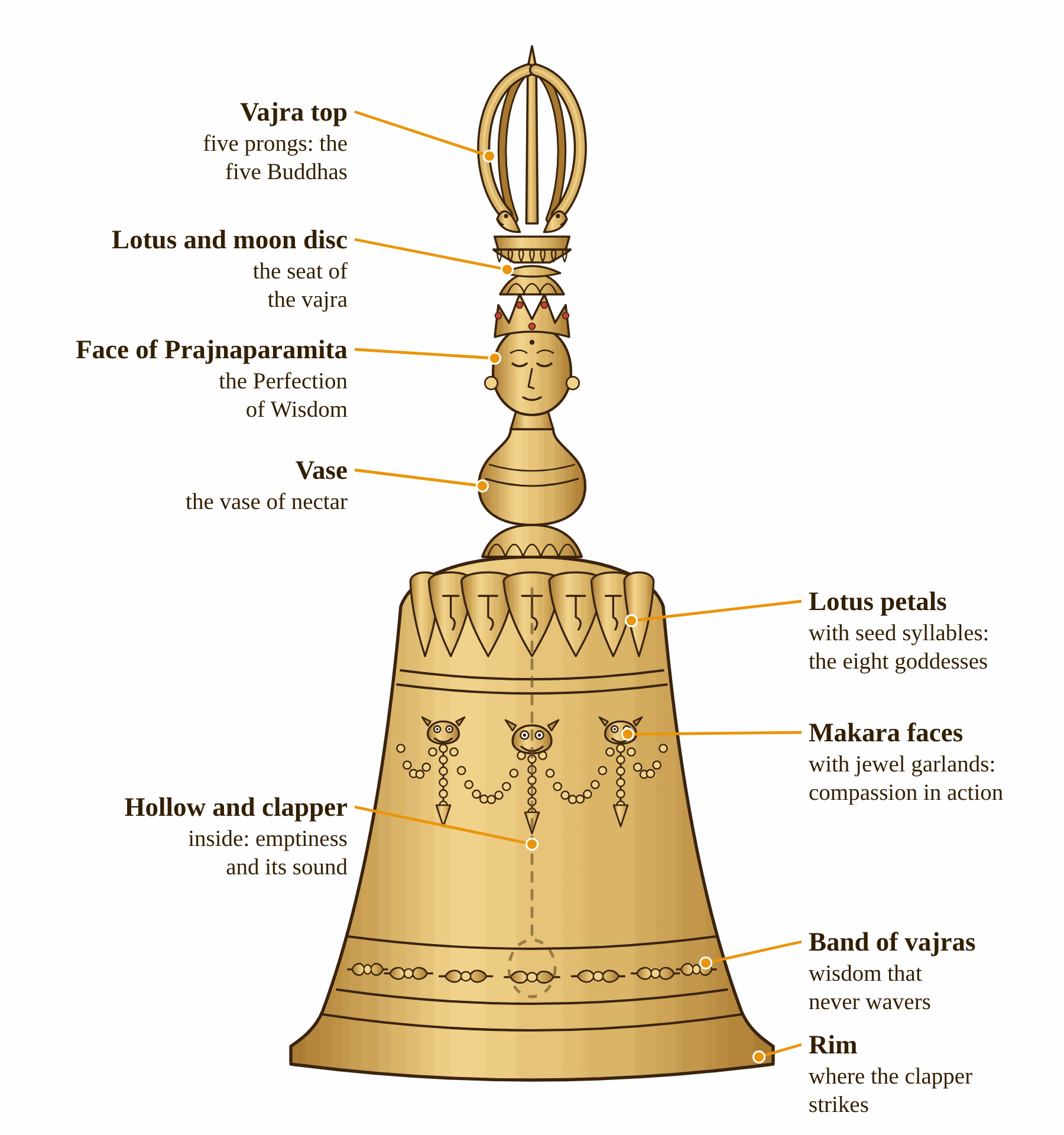
Read the bell from the top down. The handle carries a vajra, a lotus and moon disc, a face and a vase; the bell carries lotus petals, garlands and a band of vajras; and inside hang the clapper and the hollow.
| Part | Where it is | What it means |
|---|---|---|
| Vajra top | The tip of the handle | Five prongs, linked with the five Buddhas |
| Lotus and moon disc | Under the vajra | The seat of the vajra |
| Face of Prajnaparamita | The middle of the handle | The Perfection of Wisdom |
| Vase | Between the face and the bell | The vase of nectar: every quality complete |
| Lotus petals and seed syllables | The shoulder of the bell | The eight bodhisattvas and eight goddesses |
| Makara faces and jewel garlands | The body of the bell | Great compassion, and activity that never stops |
| Band of vajras | Near the rim | A mind that never leaves wisdom |
| Hollow | Inside the bell | Emptiness |
| Clapper | Hanging inside | The sound of emptiness |
What do the parts of the handle mean?
The vajra top is half a dorje, usually with five prongs, linked with the five Buddhas. It sits on a lotus and moon disc, the seat that holds it.
The face below is Prajnaparamita, the Perfection of Wisdom, often called the mother of all Buddhas; some teachings name her Dhatvishvari, the queen of space (Himalayan Art Resources). She is the bell's own meaning made visible: wisdom.
The vase under the face holds the nectar of accomplishment. In one teaching, it shows that every quality of the path is already complete within wisdom.
What do the parts of the bell itself mean?
On the shoulder, a ring of lotus petals carries seed syllables, the sacred letters of the deities. Together they stand for the eight bodhisattvas and the eight goddesses.
Around the body, makara faces hold jewel garlands in their mouths. The makara stand for great compassion, and the endless strings of jewels for enlightened activity that never stops (Dodrupchen Rinpoche).
Near the rim, a band of vajras runs all the way round, for a mind that never leaves wisdom. In all, one teaching counts 23 deities carried by a single bell.
What does the inside of the bell mean?
The hollow of the bell is emptiness, the wisdom that sees the true nature of things. The clapper hanging inside strikes the rim, and its ring is called the sound of emptiness.
What are the parts of a dorje?
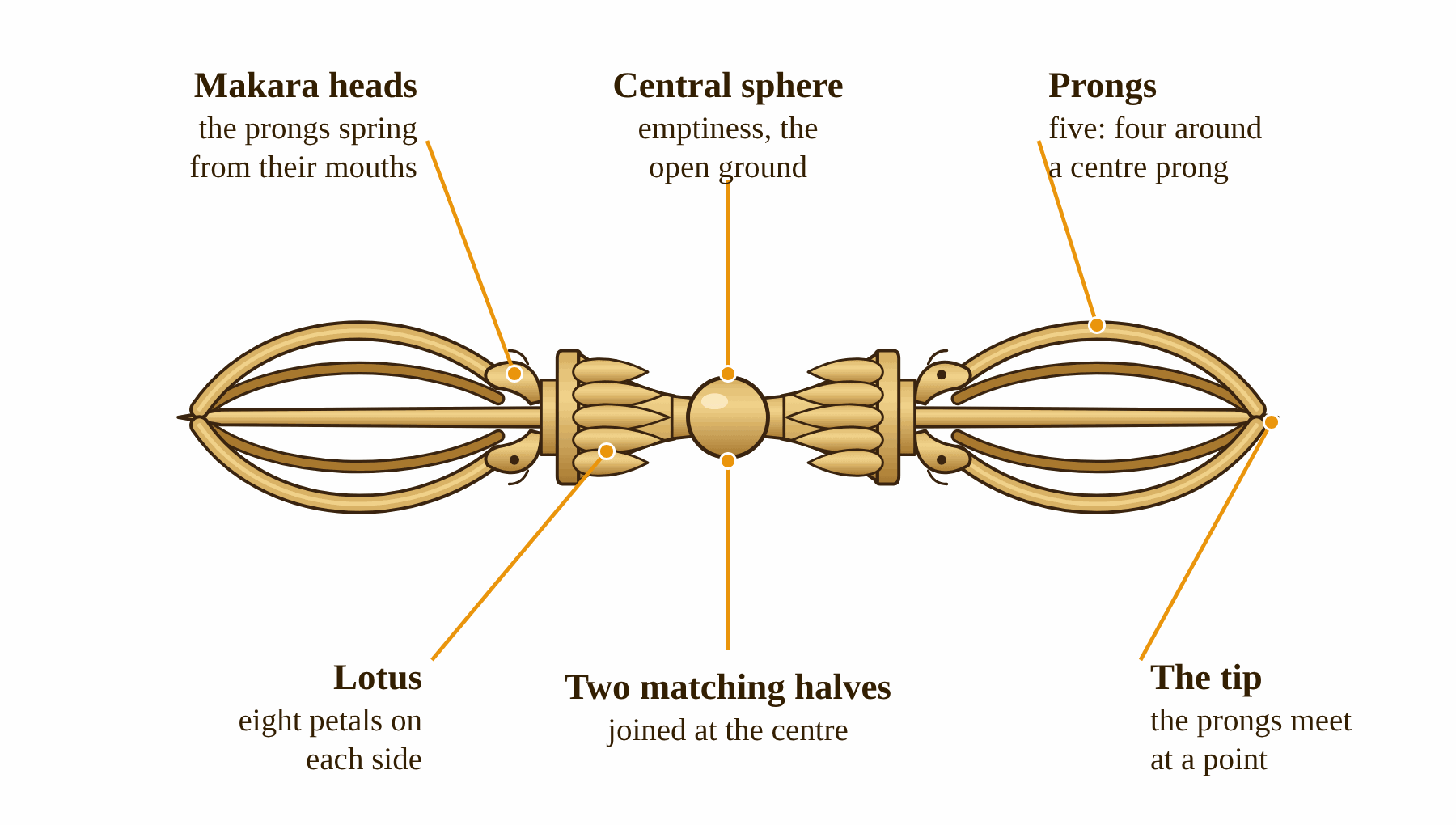
A dorje is two matching halves joined at a central sphere. On each side comes a lotus, then small makara heads, and from their mouths spring the outer prongs, which curve out and meet the central prong at the tip.
| Part | What it means |
|---|---|
| Central sphere | Emptiness, the open ground from which everything arises |
| Lotus | A lotus on each side, the seat from which the prongs rise |
| Makara heads | Great compassion: the prongs spring from their mouths |
| Five prongs | The five wisdoms, and with them the five Buddhas |
| The tip | The prongs meet at a point |
| Two halves | Two matching halves joined at the centre |
The five prongs on each side stand for the five wisdoms. More on the dorje, and the crossed double dorje, is in our post on the meaning of the dorje.
Five prongs or nine prongs?
Most bells and dorjes have five prongs, the form used across the Tibetan schools. The nine-pronged form, with eight outer prongs around the centre, is used mainly in the Nyingma tradition.
Whichever you choose, the bell and dorje must match: a five-pronged dorje goes with a five-pronged bell, because the two are one set.
Why are the bell and dorje held in different hands?
The dorje is held in the right hand, for method and compassion, and the bell in the left hand, for wisdom. Used together, they show that wisdom and compassion work as one; how to hold and ring them is in our bell and dorje guide.
What should you check on the parts before you buy?
- The face: clear features, not a blur.
- The syllables and petals: crisp and evenly spaced.
- The prongs: even, meeting neatly at the tip, the same number on bell and dorje.
- The handle: firmly fixed to the bell, with no wobble.
- The clapper: hanging freely and firmly fixed inside.
- The sound: a clear ring that lasts.
The size of a bell is its height, from the rim to the tip of the vajra. Traditional texts measure it in finger-widths, from eight to twenty-two (Buddhist eLibrary).
Which bell and dorje sets do we make?
Our bell and dorje sets are handmade in Nepal, from 5 to 9 inches, in brass, plain bronze, gold-plated and antique finishes, including a set with the five Buddhas embossed on the bell. Sunita checks the sound of every bell before it ships.
Looking for a first set?
Our 7 inch bronze bell and dorje set is a good size for home practice and an altar, handmade in Nepal and checked for sound before it ships.
| If you want | Look at |
|---|---|
| A small brass set | 5 Inch Brass Bell and Dorje Set |
| Plain bronze | 5.5 Inch Bronze Bell and Dorje Set |
| An antique finish | 6 Inch Antique Finish Bronze Bell and Dorje Set |
| The five Buddhas on the bell | 5 Buddha Embossed Bell and Dorje Set |
| A 7 inch bronze set | 7 Inch Bronze Bell and Dorje Set |
| A gold-plated set | 7 Inch Gold-Plated Bell and Dorje Set |
| A large ritual bell | 9 Inch Large Bell and Dorje Set |
Every set is in Tibetan bell and dorje. Practice with a bell and dorje supports relaxation and focus, and does not treat any condition.
Frequently asked questions
What are the parts of a Tibetan bell?
From the top: a vajra with five or nine prongs, a lotus and moon disc, the face of Prajnaparamita, a vase, and the bell itself. The bell carries lotus petals with seed syllables on its shoulder, makara faces with jewel garlands, a band of vajras near the rim, and a clapper inside.
Whose face is on a Tibetan bell?
The face on the handle is usually Prajnaparamita, the Perfection of Wisdom, often called the mother of all Buddhas. Some teachings name her Dhatvishvari, the queen of space.
What does the Tibetan bell symbolise?
The bell stands for wisdom, the understanding of emptiness. Its hollow is emptiness itself, and the ring of the clapper is called the sound of emptiness.
What are the parts of a dorje?
A dorje has two matching halves around a central sphere. Each half has a lotus, a moon disc, small makara heads and prongs that curve out from their mouths and meet at the tip.
What do the five prongs of a dorje mean?
The five prongs stand for the five wisdoms, and with them the five Buddhas. The four outer prongs curve around the central one and meet it at the tip.
What is the difference between a five-prong and a nine-prong dorje?
Five prongs are the most common, used across the Tibetan schools. Nine-pronged dorjes and bells are used mainly in the Nyingma tradition, with eight outer prongs around the centre.
Why must the bell and dorje match?
They are one set, wisdom and method together, so a five-pronged dorje goes with a five-pronged bell and a nine-pronged dorje with a nine-pronged bell.
Which hand holds the bell and which holds the dorje?
The dorje is held in the right hand, for method and compassion, and the bell in the left hand, for wisdom.
How is the size of a Tibetan bell measured?
By the height of the bell, from the rim to the tip of the vajra on the handle. Traditional texts measure it in finger-widths, from eight to twenty-two.
Ready to choose your bell and dorje?
Every set is handmade in Nepal, with a matching bell and dorje.