




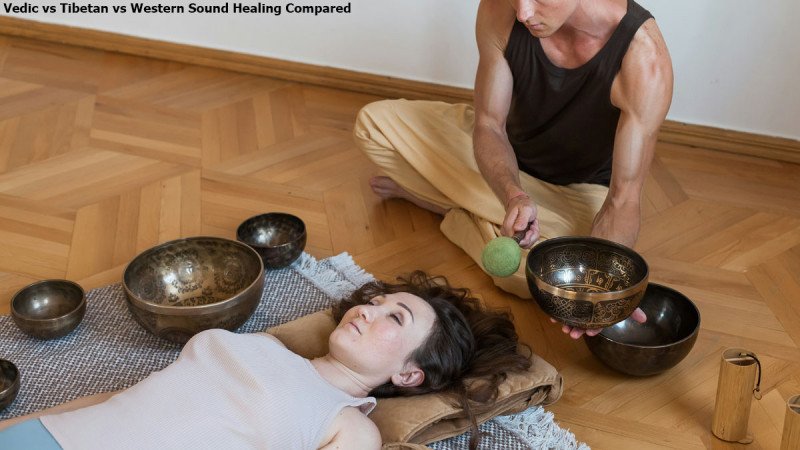
Three systems, and only two of them are old
If you have been to a sound bath in London or Los Angeles and then read about sound healing in Nepal, you will have noticed they do not describe the same thing. Different instruments, different structure, different claims — and yet all three go by the same name.
Two of them are codified traditions with fixed sequences. The third is a recent synthesis that borrowed the instruments and left the method behind. This is an honest comparison of all three, including where each one actually comes from.
What are the three systems?
| Vedic | Tibetan | Western | |
|---|---|---|---|
| Origin | Indian and Himalayan, taught by lineage | Himalayan Buddhist, taught by lineage | United States and Europe, from the 1970s |
| Root note | C | F | No fixed system |
| Instruments | Bronze bowls, tingsha | Bronze bowls, tingsha, gongs | Crystal bowls, gongs, bronze bowls, chimes |
| Format | One to one | One to one | Usually a group |
| Structure | Fixed sequence, direction matters | Fixed sequence, direction matters | Largely improvised |
| Session length | 30–60 minutes | 30–60 minutes | 45–60 minutes |
What is Vedic sound healing?
The Vedic system maps the seven chakras onto the seven notes in ascending order: C at the root, D sacral, E solar plexus, F heart, G throat, A third eye, B crown.
It is the more intuitive of the two, because the notes climb as the body does. A Vedic healing session runs downward, from crown to root, discharging into the ground — which is why the direction matters as much as the notes. Root to crown is therapy; crown to root is healing.
The full method is in Lesson 3.3 of our free course.
What is Tibetan sound healing?
The Tibetan system uses the same seven notes for the same seven chakras — in a completely different order.
Root F, sacral C, solar plexus G, heart D, throat A, third eye E, crown B. Only the crown agrees with the Vedic map.
Look at that sequence as intervals and something appears: F, C, G, D, A, E, B is a chain of fifths. Where the Vedic system climbs a scale, the Tibetan system moves in the interval that Western music theory also treats as the most consonant relationship between two notes. Two traditions, arriving at the same structure by different routes.
A Tibetan session gives more attention to the throat, third eye and crown, and ends at the crown rather than the root. The comparison is set out in full in Lesson 3.1, which is the only place we have found both note maps written down side by side in English.
So which of the two is correct?
Both, and they are not mixed.
Sunita Poudel's notebook is emphatic on this point: you choose a system before the session and you stay in it. A session that starts Vedic and drifts Tibetan is not a fusion, it is a mistake.
In practice the tradition uses Tibetan work for stress and anxiety, and Vedic work for general wellbeing and grounding. Neither is the advanced version of the other.
Where does Western sound healing come from?
Here is where the honest answer surprises people, and it is much better documented than the Eastern ones.
Chögyam Trungpa began using singing bowls in the Shambhala meditation centres he founded in 1971, having learned the practice from Suzuki Roshi — the bowls were not part of traditional Vajrayana practice. In 1974, Dorje Lama opened The Tibet Shop in San Francisco, the first retail store to sell singing bowls in America, and Karma Moffett became one of the first people to record them.
So the Western sound healing movement is roughly fifty years old. Not ancient, not a lineage, and not a secret — a documented sequence of events involving identifiable people in California.
And crystal bowls?
Newer still, and their origin is remarkable.
Crystal singing bowls emerged in the 1980s as a by-product of the semiconductor industry. Fused quartz crucibles, used to grow the ultra-pure silicon crystals that become computer chips, turned out to sing with a clear pure tone when tapped. Crucibles rejected by industry for insufficient purity found a second life once musicians noticed the sound, and makers then began producing quartz bowls specifically for meditation.
The instrument most associated with ancient sound healing began life as industrial equipment in Silicon Valley, about forty years ago.
That does not make crystal bowls bad. They have a purity and sustain that bronze cannot match, plenty of people prefer them, and an instrument's origin does not determine its worth. But it does mean that anyone selling you one on the basis of an ancient lineage is telling you something untrue.
How does a Western sound bath actually differ?
Four differences, and they follow from each other.
It is a group experience. Twenty people on mats in a hall, rather than one person receiving a sequence. That changes everything downstream.
It is improvised. Because you cannot run a chakra sequence on twenty different bodies at once, the practitioner plays for the room. Skilled improvisation, but not a fixed method.
It is immersive rather than positional. No bowl placement, no counted rounds, no working up or down a body. Sound fills a space and people lie in it.
It rarely uses a note system. Where a system is claimed it is often the Solfeggio frequencies, which come from 1970s numerology rather than from either Eastern tradition — and which do not correspond to the chakra notes at all.
Is one of them better?
They answer different questions, and we would rather say that than pretend otherwise.
A sound bath is very good at what it does: giving a room full of people an hour of deep rest, at a price that makes it accessible, in a format that does not require anyone to book a personal appointment. That is a real service and there is no reason to sneer at it.
What it does not offer is a method — a sequence you can learn, repeat, teach and evaluate. That is what the Vedic and Tibetan systems have, and it is why a tradition can be passed down through a notebook for generations.
If you want to be moved for an hour, go to a sound bath. If you want to learn to do something, learn one of the two systems.
Which should you learn?
Start with either Vedic or Tibetan, learn it properly, and only then look at the other.
Both are taught in full in our free course, transcribed from the training notebook of Nepali healer Sunita Poudel. Course Three covers both systems, client intake, sound massage, warm water therapy and the eighteen-day treatment programme.
The reason to learn a system rather than improvising is simple: when a session does not go well, a system tells you what to change. Improvisation only tells you to try again.
Learn both systems properly. Thirty-six free lessons from a Nepali healer's notebook — no account, no email, nothing locked.
Which bowls do you need for each?
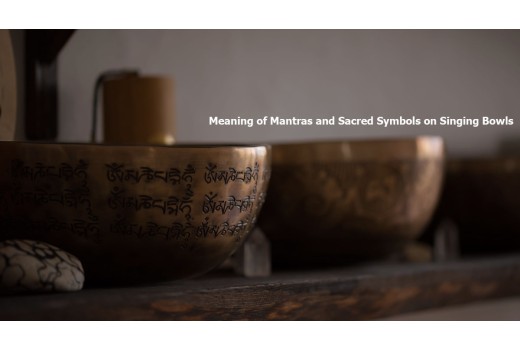
Both Eastern systems assume hand-hammered bronze, and for a practical reason as much as a traditional one. An irregular hand-beaten bowl produces a fundamental plus several overtones that beat gently against each other, which is what gives it the living, wavering quality that a machine-made bowl and a crystal bowl both lack.
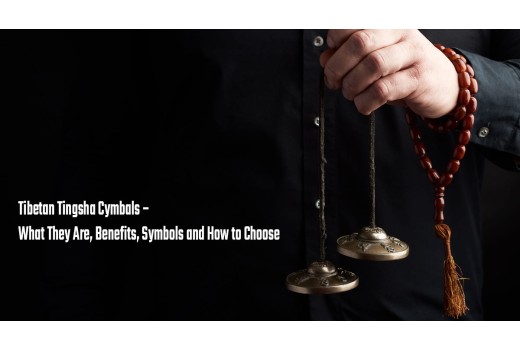
For a single bowl, an A or B is the most forgiving — those are the universal bowls, playable for any chakra. For the full sequences you need a graded seven-bowl chakra set, and the root bowl wants real mass, which is why it comes from the large standing bowls. Both traditions open and close with tingsha.
If you are choosing a first bowl, our guide to choosing a singing bowl covers size and note together, and the frequency analyser will tell you what you already own.
The honest summary
Vedic and Tibetan sound healing are old, structured, one-to-one, and taught by lineage. Western sound healing is about fifty years old, group-based, improvised, and largely invented in California — which is not a criticism, only a fact that its own marketing tends to obscure.
You can practise any of them. Just know which one you are practising, and do not let anyone sell you the third while describing the first.