




What Is Voo Breathing, and Why Pair It With a Singing Bowl?
Voo breathing is a somatic technique developed by Peter Levine: you inhale through the nose and exhale on a long, low "voooo" sound, deep enough to vibrate the chest and belly. It stimulates the vagus nerve through the vocal apparatus. A singing bowl makes it considerably easier, because the bowl gives you a pitch to match — which turns a vague instruction into a specific one, and puts external and internal vibration at the same frequency.
Most people who try Voo breathing for the first time do it wrong in the same way. They make a sound that is too high, too quiet and too short, feel nothing much, and conclude it is not for them.
The instruction is the problem. "Make a low foghorn sound from deep in your gut" is accurate and almost impossible to act on without a reference. There is nothing to aim at.
A singing bowl solves this in about four seconds. Strike it, and you have a target — a low sustained tone sitting right in the range Voo is meant to occupy. Match your voice to it and the technique stops being vague.
What Voo Breathing Actually Is
Voo comes from Somatic Experiencing, the trauma therapy approach developed by Peter A. Levine. He describes it in Healing Trauma and In an Unspoken Voice, and it has become one of the most widely taught nervous system regulation techniques in somatic work.
The instruction is simple. Breathe in through the nose. On the out breath, make a long, low voooooo — the sound of a foghorn, or the lowest note a cello or tuba can manage. Let it come from the belly rather than the throat. Then allow two ordinary breaths before the next one.
What you are looking for is not volume. It is vibration — a physical buzzing you can feel in the chest, the belly, sometimes the back. If you cannot feel it, the sound is too high or too thin.
Levine tells a story about teaching this to a nurse working through the early pandemic. She came back to him and said she was teaching it to the rest of her ward. Her words were: the work is still hard, but it is not so heavy anymore.
Why the Voice Reaches the Vagus Nerve Directly
The vagus nerve begins at the brainstem and runs down through the throat, lungs, heart, spleen, liver, stomach, pancreas, kidneys and intestines. It is the main pathway of the parasympathetic nervous system — the state opposite to fight, flight and freeze.
Crucially, it passes directly through the larynx and pharynx. That means vocalising is not an indirect route to the vagus. It is mechanical contact. When your vocal folds vibrate at low frequency, structures the vagus nerve innervates are physically vibrating.
This is why humming, chanting and singing all produce the same family of effects, and why they show up in contemplative traditions worldwide without anyone having needed the anatomy to explain it. Research also indicates that humming increases nitric oxide production, which supports blood flow.
Voo simply optimises the variables. Low frequency, long exhale, sustained tone, sound produced from the abdomen. Everything about it is arranged to maximise vagal stimulation.
The Problem With Voo — and How a Bowl Solves It
Here is the practical difficulty nobody addresses.
Voo is an unpitched instruction. "Low" and "like a foghorn" describe a quality, not a note. Without a reference, most people default to somewhere in their comfortable speaking range, which is considerably higher than the technique wants — and the vibration they were told to look for never arrives.
A singing bowl removes the guesswork entirely.
Strike the bowl. Match your voice to what you hear. Sustain together.
That single change does three things at once.
It gives you a target. A large bowl's fundamental typically sits between roughly 80 and 160 Hz — squarely in the range Voo is aiming for. You are no longer guessing at "low." You are matching a note that is audibly present in the room.
It gives you immediate feedback. When your voice locks onto the bowl's pitch, you hear it — the two tones stop sitting alongside each other and start reinforcing. Miss the pitch and you hear a wobble. That feedback loop teaches the technique faster than any verbal instruction.
It puts external and internal vibration at the same frequency. The bowl vibrates the air and, at close range, your body. Your vocal folds vibrate your throat, chest and abdomen from the inside. Both at the same pitch. That is a fundamentally different sensory experience from either alone, and it is the reason people who try this often describe it as considerably stronger than Voo on its own.
If you want to know exactly what note your bowl is producing so you can find it more easily, our live singing bowl tuner will tell you.
This practice needs a bowl with a genuinely low fundamental
A small bright bowl sits far above the range a voice can comfortably meet. Explore Calm Mind bowls chosen for depth and long sustain, or large standing bowls where the fundamental sits lowest of all.
How to Practise Voo With a Singing Bowl
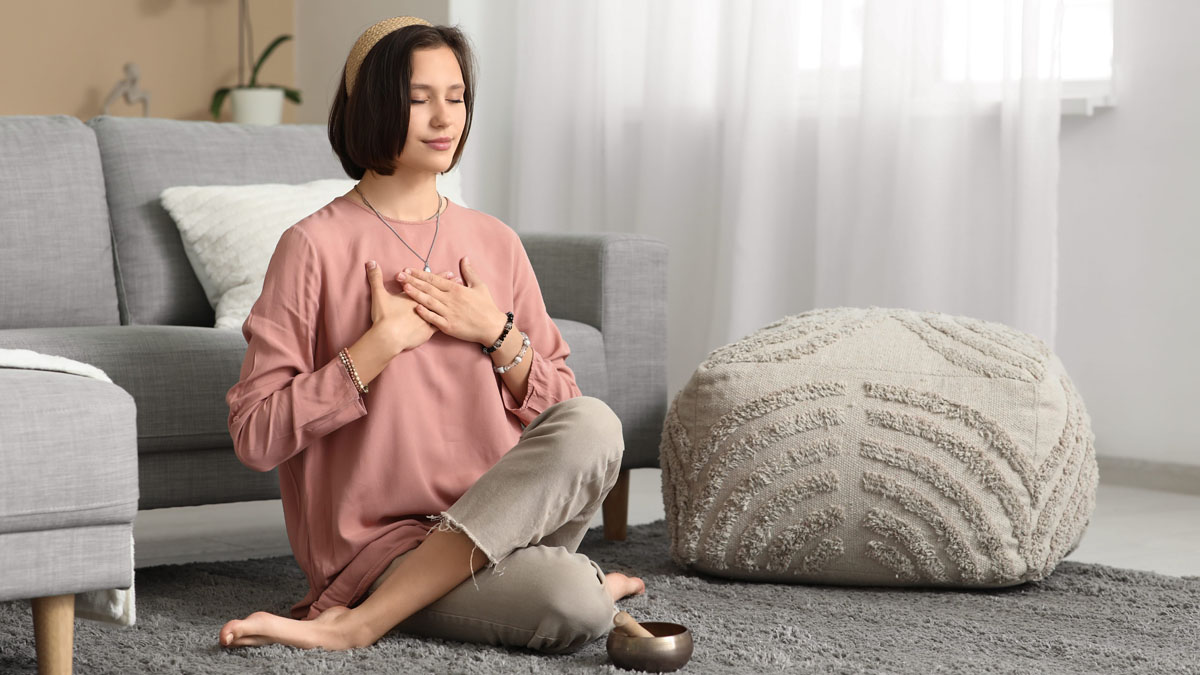
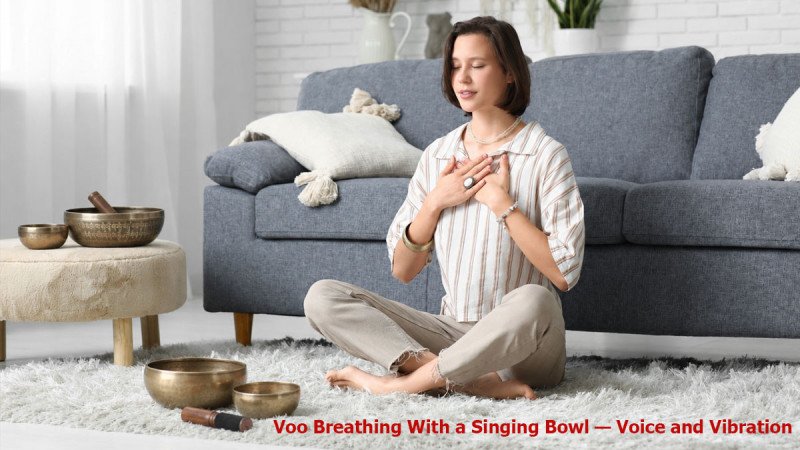
- Sit somewhere firm, feet on the floor. Hard surface if possible. One hand on the centre of your chest, the other on your belly — this is standard Voo practice and it helps you notice where the vibration reaches.
- Relax the jaw. A little space between upper and lower teeth, tongue resting on the floor of the mouth. A clenched jaw kills the vibration before it starts.
- Strike the bowl once and listen. Let the tone establish. Do not sing yet — just take in the pitch for a couple of seconds.
- Breathe in through the nose, letting the belly expand rather than the chest lifting.
- Exhale on voooooo, matching the bowl. Aim your voice at the tone you just heard. If it feels too low to reach, drop to the octave you can hold — matching an octave still resonates.
- Look for the buzz, not the volume. You want to feel it in the chest and belly. Quiet and vibrating beats loud and thin every time.
- Let the sound run out with your breath, then take two ordinary breaths before the next one. Do not rush back in.
- Repeat five times, striking the bowl again whenever its tone has faded. Five rounds is a complete practice and takes a few minutes.
- Sit still afterwards. Thirty seconds of doing nothing. Notice what is different — most people report the chest and belly feeling looser, and the room feeling slightly further away.
If your bowl will not sustain long enough to sing along with, that is usually technique rather than the instrument — the playing guide covers getting a full tone.
A Variation Worth Trying
Rim the bowl into a continuous tone rather than striking it, and Voo over the top of a sound that does not fade. This removes the need to re-strike and lets you run several breath cycles against one continuous pitch. It takes two hands and a bit of coordination, and it is the version most practitioners settle on.
None of This Is New
Worth saying plainly: pairing a low sustained vocal tone with a resonant metal instrument is not a technique anyone invented recently.
Chanting alongside a singing bowl is standard practice across the Himalayan world and always has been. Reciting Om Mani Padme Hum while a bowl sounds, matching voice to metal, is exactly the same mechanism Voo uses. Tibetan overtone chanting works on the same principle at a considerably higher level of skill. Gregorian chant does too, in an entirely separate tradition that arrived at the same place.
What Levine did was isolate the active ingredient and describe it in terms a clinician can use. He gave a mechanism to something several traditions had already found by other means.
That convergence is worth noticing. When a modern somatic technique and a centuries-old contemplative practice arrive at the same physical act — low sustained vocalisation with a resonating instrument — it suggests both were tracking something real about how bodies work.
If you want the traditional version, chanting Om over a bowl's tone is the same practice in older clothes. Our article on the male and female tones of a singing bowl covers how the instrument's own voice shifts depending on technique.
Which Bowl Suits Voo Practice
The requirement here is unusually specific: the bowl has to be low enough for a human voice to meet.
Large is close to essential. A bowl of 25cm or more typically produces a fundamental around 80 to 160 Hz. That is comfortable matching territory for most voices, at pitch or an octave up. A 10cm bowl sitting at 700 Hz is not something you can sing with.
Long sustain matters more than usual. You want the tone still present when you begin your exhale, and ideally still there when you finish it. Short-decay bowls force constant re-striking, which breaks the practice.
Thick walls help. Heavier bowls sit lower and carry more felt vibration, which means you get the external component through your hands and the floor as well as through your ears.
A clean fundamental is better than a complex one. Pitch-matching against a bowl with competing overtones is harder. This is one of the few cases where a slightly simpler bowl is the better instrument.
If You Want to Choose the Note
Some practitioners want a bowl pitched deliberately for their own vocal range rather than whatever a stock bowl happens to produce. Through the custom singing bowl service you can specify the note, size and wall thickness, hand-forged by artisans in Kathmandu — which for a practice built entirely on matching pitch is a genuinely practical reason to commission rather than browse.
A bowl you can actually sing with — specified rather than hoped for
If the practice depends on matching pitch, the note is worth choosing. Through Dharma Tool's custom singing bowl service you set the size, note, wall thickness and engraving, hand-forged in Kathmandu. Optional monk blessing on every commission.
When to Go Gently
Voo is a somatic technique from a trauma therapy tradition, and it is capable of bringing things to the surface. That is often the point and occasionally more than expected.
Start with two or three rounds, not five. See how it lands before extending.
Stop if activation rises. Racing heart, shallow breathing, a sense of drifting away from your body, or emotion arriving faster than you can hold it — stop, put both feet flat on the floor, and name three things you can see in the room.
Voo can affect the gut noticeably. The vagus reaches the digestive tract, and audible gurgling during practice is common and normal. Practise on a reasonably empty stomach if that is more comfortable.
If you are working with trauma, do this with support. Somatic techniques are most useful inside a therapeutic relationship rather than alone off the internet. A qualified trauma-informed practitioner is worth more than any bowl.
A note on health: Voo breathing and singing bowl practice support relaxation and nervous system regulation. Neither is a treatment for trauma, anxiety or any other condition. If you are living with persistent symptoms, work with a qualified clinician — these practices belong alongside that care, not instead of it.
Sources and Further Reading
- The Voo Breathing Method — Insight Timer. A clear step-by-step guide to the technique, including the five-round structure.
- Peter A. Levine, Healing Trauma and In an Unspoken Voice — the primary sources for Voo and for Somatic Experiencing more broadly.
- Somatic Experiencing — background on the approach Voo comes from.
Frequently Asked Questions
What is Voo breathing?
A somatic technique developed by Peter Levine, founder of Somatic Experiencing. You inhale through the nose and exhale on a long, low "voooooo" sound — like a foghorn — produced from the belly rather than the throat, then take two ordinary breaths before repeating. The aim is not volume but vibration you can physically feel in the chest and abdomen. Five rounds is a standard practice.
How does a singing bowl help with Voo breathing?
It gives you a pitch to match. "Make a low foghorn sound" is almost impossible to act on without a reference, which is why most beginners pitch too high and never feel the vibration. Striking a large bowl provides a target tone in the right range, immediate feedback on whether your voice is locking onto it, and external vibration at the same frequency as the vibration your own vocal folds are producing.
Why does making a low sound calm the nervous system?
The vagus nerve runs from the brainstem through the throat, lungs, heart and digestive tract, and it passes directly through the larynx and pharynx. Vocalising at low frequency physically vibrates structures the vagus innervates, which is mechanical contact rather than an indirect effect. This is why humming, chanting and singing all produce similar calming responses.
What kind of singing bowl works for Voo practice?
A large bowl of 25cm or more, with a long sustain and a clean fundamental. Large bowls typically produce fundamentals around 80 to 160 Hz, which most voices can match at pitch or an octave up. A small bright bowl sitting at 700 Hz is not something anyone can sing with. Long sustain matters more than usual here, since you want the tone still present through your whole exhale.
Is combining voice and singing bowl a traditional practice?
Yes, though not under this name. Chanting alongside a resonant bowl is standard across the Himalayan world — reciting Om Mani Padme Hum while a bowl sounds uses the same mechanism Voo does. Tibetan overtone chanting and Gregorian chant arrived at the same physical act independently. What Levine contributed was isolating the mechanism and describing it in clinical terms.
Can Voo breathing bring up difficult emotions?
Yes. It comes from a trauma therapy tradition and is capable of surfacing things. Start with two or three rounds rather than five. If your heart rate rises, breathing becomes shallow, or emotion arrives faster than you can hold it, stop, place both feet flat on the floor and name three things you can see. If you are working with trauma, do this with a qualified practitioner rather than alone.