




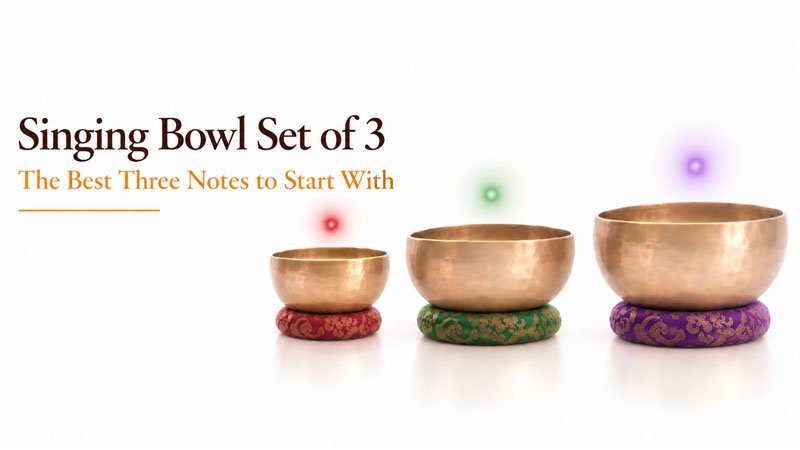
Singing Bowl Set of 3 - The Best Three Notes to Start With
The best three bowls to start with are the Root, Heart and Crown bowls: the base, the centre and the top of the chakra line. In the Vedic mapping those are the notes C, F and B, and three bowls are enough to open, work and close a session.
Key takeaways
- Root, Heart, Crown is the set of 3 we suggest for a first set.
- The notes are C, F and B in the Vedic mapping, and they change in the Tibetan mapping.
- The three are chosen to sit together, because a hand-hammered bowl's note is discovered, not made.
- You can grow from 3 to 5, 7, 9 or 12 bowls later.
Which three bowls should you buy first?
Buy the Root, the Heart and the Crown. One bowl sits at the bottom of the line, one in the middle and one at the top.
With these three you can open, work and close a session without carrying a full case of bowls. You will find sets of every size in our chakra singing bowl sets.
| Bowl | Place on the body | Job in a session | Note in the Vedic mapping |
|---|---|---|---|
| Root | Base of the spine | The low bowl that the session starts from or returns to | C |
| Heart | Centre of the chest | The middle bowl, where most of the playing happens | F |
| Crown | Top of the head | The high bowl that opens or closes the session | B |
Do the three notes change with the tradition?
Yes. The Vedic and Tibetan traditions use the same seven notes for the seven chakras, in different orders.
| Chakra | Vedic note | Tibetan note |
|---|---|---|
| Root | C | F |
| Heart | F | D |
| Crown | B | B |
So a Vedic set of 3 is C, F and B, and a Tibetan set of 3 is F, D and B. Our course lesson on Vedic and Tibetan sound traditions explains the two maps.
Tell us which tradition you follow when you order. If you are not sure, start with the Vedic mapping, which is the one our own guides use.
Why not three bowls of any notes?
Because three notes that sit close together give you three versions of the same sound. Root, Heart and Crown are spread across the whole line, so each bowl has a clear job.
There is one more reason. My training notebook calls A and B the universal bowls, bowls that can be played for anyone, and the Crown bowl in this set is a B. Our course lesson on the universal bowls explains the idea.
Ready for your first three?
See the handmade singing bowl set of 3. Size and finish are selectable, and Sunita chooses your three bowls after the order arrives.
Which bowls go together in a set?
Bowls that were chosen as a set. A hand-hammered bowl's note is discovered, not made, so three bowls picked up one at a time rarely belong together.
After your order arrives, Sunita plays the bowls in your size range and chooses three from her experience in practice. The set is then dispatched from Kathmandu in 3-4 business days by DHL Express.
What sizes does a set of 3 come in?
| Size range | What it is like |
|---|---|
| Equal 5 inch | All three bowls the same size, compact and easy to carry |
| 4 to 8 inch | A light graded set for home and travel |
| 5 to 10 inch | A full graded set, and Sunita's favourite range |
| 8 to 12 inch | Large, heavy bowls for studios and body work |
The Root bowl is not always the largest. In an equal 5 inch set all three bowls are the same size, and that is a normal set.
Which sets of 3 should you look at?
- Handmade set of 3: the handmade singing bowl set of 3 is the plain, hand-hammered starting set.
- Set of 3 chosen by note: this singing bowl set of 3 is matched by selection for its three notes.
- Your own three notes: use the set builder, choose three bowls and your tradition, and it ticks the notes for you.
- One bowl to complete a set: design it on the custom singing bowl page, where you ask for the note and add free engraving.
How do you play a set of 3?
- Lay them out in note order, lowest to highest.
- Choose a direction: Root, Heart, Crown to work upward, or Crown, Heart, Root to work downward.
- Strike once and let each sound fade fully before the next bowl.
- Finish on the last bowl of your direction, and sit in silence for a minute.
Which direction to choose is explained in root to crown or crown to root. Playing order depends on the tradition, so follow the one you were taught.
Should you start with 3 or go straight to 7?
| Set of 3 | Set of 7 | |
|---|---|---|
| What it covers | Root, Heart and Crown | All seven chakras |
| Best for | A first set, daily practice, travel | Full chakra sessions and client work |
| To carry | Light | A full case |
| Next step | Add bowls to reach 5 or 7 | Add bowls to reach 9 or 12 |
If you already know you want the full line, look at the 7 chakra hand-beaten set. If you are still deciding, read how many singing bowls you need.
What are the common mistakes with a set of 3?
- Three loose bowls: buying three single bowls that were never chosen to sit together.
- Notes too close: choosing three neighbours, such as C, D and E, and getting little contrast.
- Wrong map: ordering Vedic notes when your teacher uses the Tibetan mapping.
- Judging by size: thinking an equal size set is a fault.
- Not checking: never reading the three notes once the set arrives.
What should you do when the set arrives?
Play each bowl into our free live singing bowl tuner and write down the three notes. A hand-hammered bowl rarely lands exactly on a piano note, so a small gap is normal.
Then learn to use them in the free singing bowl healing course. A mallet and a cushion come with every bowl, and engraving is free.
Frequently asked questions
Which three singing bowls should I buy first?
Root, Heart and Crown. They mark the base, the centre and the top of the chakra line, which is enough to open, work and close a session.
What notes are in a singing bowl set of 3?
In the Vedic mapping the three are C for the Root, F for the Heart and B for the Crown. In the Tibetan mapping the same three chakras use F, D and B.
Is a set of 3 singing bowls enough?
Yes, for a first set and for daily practice. A full chakra session with one note for each chakra needs a set of 7.
Which singing bowls go together?
Bowls that were chosen as a set. Each hand-hammered bowl's note is discovered, so Sunita plays the bowls after your order arrives and chooses three that sit together.
Is the Root bowl always the largest in a set of 3?
No. In a graded set the deepest bowl is usually the largest, but in an equal 5 inch set all three bowls are the same size.
In what order do I play a set of 3?
Play Root, Heart, Crown to work upward, or Crown, Heart, Root to work downward. Playing order depends on the tradition, so follow the one you were taught.
Can I add bowls to a set of 3 later?
Yes. Tell us the notes of the three you own, and the new bowls are chosen to sit with them, up to a set of 5, 7, 9 or 12.
Want to compare set sizes?
See our chakra sets of 3, 5 and 7 bowls, with 9 and 12 made to order. Each set is put together by selection after your order arrives.