




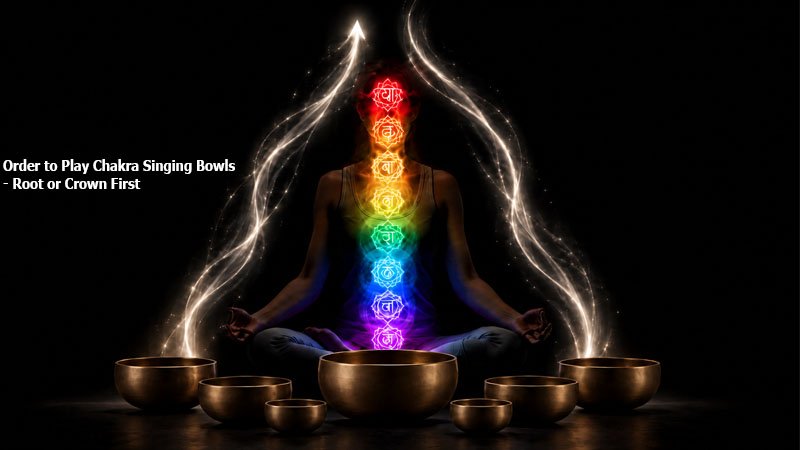
Root to Crown or Crown to Root - Which Order to Play Chakra Bowls
Both orders are correct, and the right one depends on what the session is for. In the tradition I was taught, root to crown is the direction for the body, and crown to root is the direction for settling the mind.
Key takeaways
- Root to crown works upward and is used when the body feels tired, stiff or heavy.
- Crown to root works downward and is used when the mind is busy and needs to settle.
- The bowls and the technique are the same in both, and only the order changes.
- Decide first: choose the direction before the first strike and do not change it.
In what order should you play chakra bowls?
My training notebook gives the rule in two short lines: "From the root to the crown is therapy. From the crown to the root is healing."
Most guides teach only one order, root to crown. The notebook teaches two directions with two purposes, and that choice shapes the whole session.
Our free singing bowl healing course teaches it in the lesson called The Two Directions.
What is the difference between the two directions?
| Root to crown | Crown to root | |
|---|---|---|
| Name in the notebook | Therapy | Healing |
| Direction | Upward, from the ground | Downward, from above |
| Note order in the Vedic mapping | C, D, E, F, G, A, B | B, A, G, F, E, D, C |
| First bowl | Root bowl | Crown bowl |
| Used when | The body feels tired, stiff or heavy | The mind is busy or scattered |
| The idea | You begin at the ground and lift | You begin above and settle |
When do you play root to crown?
Play upward when the session is for the body. This is the direction used with sound massage, for a body that feels tired, stiff or heavy.
You start with the Root bowl, the C note, and rise one chakra at a time to the Crown. The feeling people describe is of being lifted.
When do you play crown to root?
Play downward when the session is for a busy mind. The tradition describes energy as entering at the crown and moving down through the body.
You start with the Crown bowl, the B note, and come down one chakra at a time to the Root. This is the direction people choose for a calm mind and before sleep.
A bowl supports relaxation and a calm bedtime routine. See a doctor if stress or poor sleep is affecting your health.
How do you choose the direction for a session?
Use this simple check: if the tiredness is in the body, go up, and if the busyness is in the head, go down.
- Heavy legs after a long day: upward, starting at the Root.
- Racing thoughts at night: downward, starting at the Crown.
- Not sure: downward is the gentler choice for a first session.
Need a set to play in order?
See our chakra sets of 3, 5 and 7 bowls. Each set is put together by selection after your order arrives.
How do you play each direction, step by step?
- Lay the bowls out in note order, lowest to highest, so the position tells you the note.
- Say the direction to yourself before the first strike.
- Strike once and let the sound fade fully before the next bowl.
- Move one chakra with each strike, seven strikes for seven bowls.
- Sit in silence for a minute at the last bowl.
The full session, bowl by bowl, is in our guide on how to use a 7 chakra singing bowl set.
Is the order the same in the Tibetan and Vedic traditions?
No. The note for each chakra and the playing order both depend on the tradition. The orders above use the Vedic mapping, C at the Root to B at the Crown.
So never take one order as the only one. Our course lesson on Vedic and Tibetan sound traditions compares the two, and whichever you follow, stay with it for the whole session.
What do you need to play in order?
- A set of 7: the 7 chakra hand-beaten set or the 7 chakra colour set gives one bowl for each step.
- A shorter set: the handmade singing bowl set of 3 follows the same order with three stops.
- A set of 9: adds a bowl below the Root and one above the Crown, as shown in which nine bowls are in a 9 chakra set.
- Your own set: use the set builder to choose the tradition, the number of bowls and the notes.
- One missing bowl: design it on the custom singing bowl page, where you ask for the note and add free engraving.
A hand-hammered bowl's note is discovered, not made, so every set is matched by selection. The Root bowl is not always the largest bowl.
What are the common mistakes with playing order?
- Drifting: choosing the direction half way through, or switching between the two.
- Rushing: striking again before the last sound has fully faded.
- One order for all: always playing root to crown because it is the only one you were shown.
- Wrong layout: placing bowls by size or by looks and then losing the note order.
- Gripping the bowl: curling fingers around the rim, which stops the sound.
What should you do next?
Try it over two days. Play downward on the first day and upward on the second, and write one line after each about how you felt.
Then learn the full sessions in the free singing bowl healing course.
Frequently asked questions
In what order should I play my chakra singing bowls?
It depends on what the session is for. In the tradition Sunita was taught, root to crown is the direction for the body and crown to root is the direction for settling the mind.
Should I play chakra bowls from root to crown or crown to root?
Play root to crown when the body feels tired, stiff or heavy and needs lifting. Play crown to root when the mind is busy and you want to settle down.
What is the note order from root to crown?
In the Vedic mapping it is C, D, E, F, G, A, B. That is Root, Sacral, Solar Plexus, Heart, Throat, Third Eye and Crown.
What is the note order from crown to root?
In the Vedic mapping it is B, A, G, F, E, D, C. That is Crown, Third Eye, Throat, Heart, Solar Plexus, Sacral and Root.
Is the playing order the same in the Tibetan and Vedic traditions?
No. Chakra note mapping and playing order depend on the tradition, so follow the one you were taught and stay with it for the whole session.
Can I change direction in the middle of a session?
It is better not to. Decide the direction before the first strike and keep to it, because drifting between the two is the most common mistake.
How long should I wait between bowls?
Let each sound fade fully before you strike the next bowl. The silence between strikes is part of the practice.
Want a set matched to your tradition?
Tell us Vedic or Tibetan, the number of bowls and the notes. The request is free, and Sunita reads every one herself.