




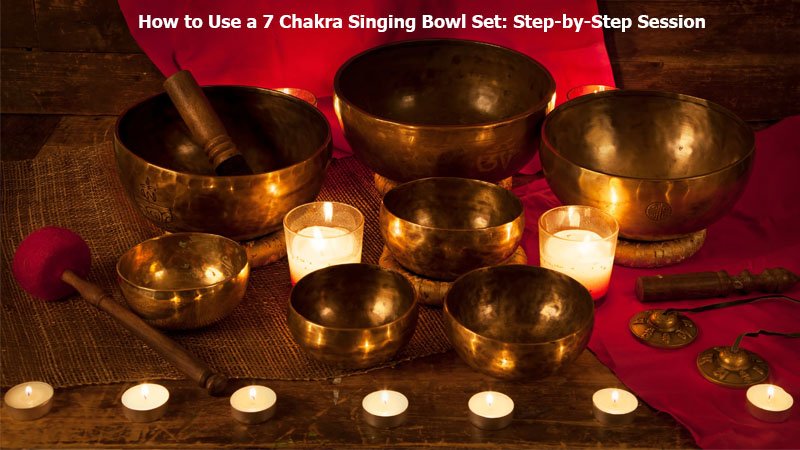
How to Use a 7 Chakra Singing Bowl Set: A Step-by-Step Balancing Session
Short answer: the playing order depends on the tradition you follow. In the Vedic seven-chakra system, which most chakra sets are built around, you play from Root (C) up to Crown (B), then ground back down. Tibetan practice works differently — it centres on five chakras and often begins at the crown or the heart. This guide gives the full Vedic sequence step by step, the Tibetan approach alongside it, and how to adapt the order for sets of 3, 5, 9 and 12 bowls.
The Vedic session in one line each:
- Order: C, D, E, F, G, A, B — from the Root up.
- Stroke: strike to open each bowl, rim to hold it.
- Pace: never play the next bowl until the last one has gone silent.
- Finish: silence, then a descending pass back to the Root.
- Other set sizes: the same principle applies to sets of 3, 5, 9 and 12 — play from the lowest bowl to the highest, one at a time.
A full balancing session takes 20 to 45 minutes. Whichever tradition you follow, keep to its order — a beginner who follows a sequence consistently will get more from a set than an experienced player who skips around it.
Which order? It depends on your tradition
A chakra set is built as one instrument, and it is meant to be played in a sequence. Most people who buy a set play each bowl a few times, enjoy the sound, and then never quite know how to turn seven bowls into a session. The sequence is what does that — but there is more than one sequence, because the traditions behind singing bowl healing do not describe the body in the same way.
| Tradition | Chakra model | Usual direction | Bowls used |
|---|---|---|---|
| Vedic (Hindu yogic) | Seven chakras, Root to Crown | Rises from the Root to the Crown, then grounds back down | All seven, C to B |
| Tibetan (Himalayan Buddhist) | Five main chakras along the central channel: crown, throat, heart, navel and the secret place at the base | Often begins at the crown or the heart and works downward, drawing energy down into the body | Five, or a seven-bowl set played in five centres |
| Modern Western sound healing | The Vedic seven, mapped to the notes C to B | Usually follows the Vedic ascending order | All seven |
Two things are worth knowing. The note-to-chakra mapping (C for the Root through to B for the Crown) is a modern development, not an ancient Tibetan rule — traditional bowls were never made to a chakra note. And neither direction is wrong: rising builds from a grounded base, while descending brings awareness down into the body. Our guide to Vedic, Tibetan and Western sound healing covers the differences in depth.
Most chakra sets, ours included, are built around the seven-note Vedic model, so the step-by-step session below follows the Vedic order. The Tibetan approach comes after it.
This is also why a set has to be tuned as a set. A hand-hammered bowl's note is discovered once it is finished, not hammered to order, so a set is tuned by selection — finding seven bowls whose notes sit correctly against one another. Play a poorly matched set in sequence and the problem shows up immediately: one bowl too sharp, one dying away too fast, one fighting its neighbour.
What you need before you begin
- A 7 chakra set — seven bowls running C, D, E, F, G, A, B, from Root to Crown. If you are still choosing one, our 7 chakra singing bowl set guide covers the options.
- Mallets — ideally one per bowl, or at least a soft one for striking and a wooden one for rimming. The mallet guide explains which does what.
- Cushions or rings — so every bowl sits level and rings freely without touching the floor.
- A quiet room and a mat — you will be still for half an hour or more.
- A gentle timer, if you like — useful while you learn the pacing, so you are not watching a clock.
Not sure which bowl is which? Each bowl's note is its fundamental, and you can check it in seconds with our live singing bowl tuner. Label the bowls the first time; it saves guessing in the middle of a session.
How to arrange the seven bowls
For self-practice: an arc in front of you
Sit cross-legged or on a low stool and place the bowls in a gentle arc within arm's reach. Put the Root on your left and run up the scale to the Crown on your right, so you move left to right as you rise. Leave a hand's width between bowls so they do not touch when they vibrate.
For a client: along the body
With the client lying on their back, place the bowls on the floor beside them, level with each energy centre: Root near the base of the spine, Sacral below the navel, Solar Plexus above it, Heart at the centre of the chest, Throat at the neck, Third Eye at the brow and Crown just beyond the top of the head. Sit where you can reach all seven without leaning across the body. Our sound bath setup guide covers larger room layouts.
The two strokes you need
- Strike — tap the outer rim once with a soft mallet, about a third of the way down. A gentle strike gives a clear tone full of overtones; a hard one gives a harsh clang.
- Rim — press a wooden mallet against the outer rim and circle it slowly with steady, even pressure. After a few rotations the bowl begins to sing. Keep the speed constant; speeding up makes it rattle.
In a session you strike to open each chakra and rim to hold it. If either stroke is new, practise on one bowl first with our how to play a singing bowl guide.
The Vedic balancing session, step by step
Starting at the Root gives the session a foundation. The low C is the largest, deepest bowl, and the body settles into it; each bowl after it is smaller and brighter, so the session rises from heavy to light.
Step 1 Settle and breathe — 2 to 3 minutes
Sit or lie still with your eyes closed. Breathe slowly, making the exhale longer than the inhale. A low hum on the out-breath, as in our voo breathing practice, helps the body settle before the first bowl sounds. Set a simple intention — calm, focus, release — and keep it in mind.
Step 2 Open with the Root bowl — 3 to 5 minutes
Strike the Root bowl (C) once and listen until the sound has completely faded. Strike again. Then rim it slowly and let it sing for a minute or two. The Root is the foundation, so give it the most time; a rushed start leaves the rest of the sequence unanchored. Our Root chakra C note guide explains why this bowl carries the set.
Step 3 Rise through Sacral, Solar Plexus and Heart — 2 to 4 minutes each
Play each bowl the same way: strike, listen to the full decay, strike again, then rim. Move on only when the previous bowl is silent, so two notes never compete. Bring your attention to the area of the body each chakra relates to as you play it.
Pause at the Heart (F). It sits at the centre of the seven, the turning point between the lower grounding bowls and the upper ones, and it is worth holding a little longer. More on this note in our Heart chakra F note guide.
Step 4 Continue through Throat, Third Eye and Crown — 2 to 4 minutes each
The upper bowls are smaller and brighter, so play them more softly — they need less force to speak. Finish with the Crown (B) and let its last ring fade completely.
Step 5 Rest in silence — 2 to 5 minutes
Play nothing. The silence after the Crown is part of the session, not a gap in it. Stay still and notice how you feel.
Step 6 Ground back down — 2 to 3 minutes
Play one gentle strike on each bowl from Crown back down to Root, letting each ring for only a few seconds, and finish with a longer strike on the Root. This descending pass brings your attention back into the body. It is the step people skip most often — and then wonder why they feel light-headed afterwards.
Step 7 Close
Open your eyes slowly, stretch, and drink a glass of water. If you are working with a client, give them a minute before they sit up.
A set that plays as one instrument
Every chakra set at Dharma Tool is tuned as a set by selection — seven handmade bowls chosen because their notes sit correctly together, then played through before they ship. Choose a ready set, or build your own note by note with the set builder.
The Tibetan approach
Tibetan practice does not divide the body into seven. It works with the central channel and five main chakras — the crown, throat, heart, navel and the secret place at the base of the trunk — and many Tibetan-style sessions move from the top down rather than the bottom up, bringing awareness and energy down into the body. The heart is treated as the centre that everything returns to.
With a seven-bowl set, a common way to work in this style is:
- Use five bowls for the five centres — Crown (B), Throat (G), Heart (F), Solar Plexus or navel (E) and Root (C) — and set the Sacral and Third Eye bowls aside, or use them softly as transitions.
- Begin at the crown or the heart. Strike, listen to the full decay, then rim, exactly as in the Vedic session.
- Move downward through the centres to the base, holding each for two to four minutes.
- Return to the heart and close there with a long rim and a few minutes of silence.
Traditions within the Himalaya vary from lineage to lineage, so if you have trained with a teacher, follow the order you were taught. The important thing is the same in both systems: a deliberate sequence, played slowly, with silence at the end.
Using a set of 3, 5, 9 or 12 singing bowls
Seven is the most common set because it matches the seven Vedic chakras, but singing bowl sets also come as sets of 3, 5, 9 and 12, and each follows its own system. The method stays the same — strike to open, rim to hold, never play the next bowl until the last has gone silent, and finish with silence and grounding. What changes is which centres the bowls represent and how many you move through.
| Set | System it usually follows | What the bowls represent | How to play it |
|---|---|---|---|
| Set of 3 | Simplified chakra set | Root, Heart and Crown — the base, the centre and the top | Root to Crown, then ground back to the Root. The usual first set. |
| Set of 5 | Five elements, or the five Tibetan chakras | Earth, Water, Fire, Air and Space — or crown, throat, heart, navel and base | Earth to Space in the elemental order, or top-down to the heart in the Tibetan way |
| Set of 7 | The seven Vedic chakras | Root (C) to Crown (B) | The full session above |
| Set of 9 | The nine-chakra system | The seven chakras plus the Earth Star below the feet and the Soul Star above the head | Earth Star, then Root to Crown, then Soul Star; ground back down through the Root to the Earth Star |
| Set of 12 | The twelve-chakra system, or a full chromatic octave | The nine plus higher transpersonal centres — or all twelve semitones from C to B | Lowest bowl to highest, slowly. Mostly used by experienced practitioners and in long sound baths. |
Sets of 3 and 5
A set of three is the simplest way into chakra work: Root for grounding, Heart for the centre, Crown for the top. Play them in rising order and ground back to the Root exactly as you would a full set. A set of five usually follows one of two systems. The five-element set — Earth, Water, Fire, Air and Space — is played in elemental order, and our 5 element singing bowl set guide explains it in full. A five-bowl set can also be played in the five Tibetan centres described above.
Sets of 9 and 12
A nine-bowl set adds two centres outside the body: the Earth Star below the feet, which grounds the whole session, and the Soul Star above the head. Begin at the Earth Star, rise through the seven chakras, finish at the Soul Star, then ground back down through the Root to the Earth Star. The nine-chakra system guide covers what each extra centre represents.
A twelve-bowl set is used in two ways. Some practitioners work with the twelve-chakra system, which extends the nine further into higher transpersonal centres. Others use twelve bowls as a full chromatic octave — every semitone from C to B — which gives a sound healer the freedom to build any sequence. Either way, it is a large instrument: give each bowl less time than in a seven-bowl session, and allow 60 minutes or more for the whole set.
Larger sets put even more weight on how the bowls are chosen, because every extra bowl is another note that has to sit with all the others. Any set size can be specified with the custom set builder, where you choose how many bowls, which notes, the sizes and the finish.
Chakra-by-chakra reference (Vedic seven)
Keep this beside you while you learn the sequence.
| Order | Chakra | Note | Body area | Focus while playing | Time |
|---|---|---|---|---|---|
| 1 | Root — Muladhara | C | Base of the spine | Grounding, safety | 3–5 min |
| 2 | Sacral — Svadhisthana | D | Below the navel | Emotion, creativity | 2–4 min |
| 3 | Solar Plexus — Manipura | E | Above the navel | Confidence, will | 2–4 min |
| 4 | Heart — Anahata | F | Centre of the chest | Compassion, acceptance | 3–5 min |
| 5 | Throat — Vishuddha | G | Throat | Expression, truth | 2–4 min |
| 6 | Third Eye — Ajna | A | Brow | Intuition, clarity | 2–4 min |
| 7 | Crown — Sahasrara | B | Top of the head | Awareness, stillness | 2–4 min |
How long should a chakra session be?
- 15 minutes — daily practice. About 90 seconds per bowl, a short silence and a quick grounding pass. Enough to reset in the morning or evening.
- 30 minutes — self-healing. The full sequence with generous time on the Root and the Heart.
- 45 to 60 minutes — a client session or sound bath. Longer holds, repeated rimming and a fuller silence. For group classes, see singing bowls during savasana.
Placing bowls on the body
Some practitioners place a bowl directly on the body — usually the chest, the belly or the soles of the feet — so the vibration is felt as well as heard. Use only thicker, heavier bowls for this, set them on a thin cloth, strike very gently, and never place a bowl on someone's head or throat unless you are trained to do so.
On-body work is not suitable for everyone. Read our sound healing contraindications first, and check with a doctor if you are pregnant or have a medical implant or condition.
Variations once you know the sequence
- Single-chakra focus. Play the full sequence once, then return to one bowl and stay with it for five to ten minutes. Not sure where to focus? The chakra quiz suggests a starting point.
- Grow your set over time. Start with three or five bowls and add notes later — to seven, nine or twelve. With the custom set builder, new bowls are selected to sit with the ones you already own. See using sets of 3, 5, 9 or 12 for the order each size follows.
- One bowl for your focus chakra. If you keep returning to the same chakra, a custom singing bowl lets you choose the note, diameter, finish and design for that single bowl, with personal engraving included free.
- Two bowls together. Once you are confident, strike two neighbouring bowls in turn and let them overlap. In a set tuned as a set the overtones blend; in a poorly matched one, this is where the clash becomes obvious.
Common mistakes to avoid
- Striking too hard. Louder is not stronger. A gentle strike carries more of the bowl's overtones.
- Rushing to the next bowl. Let each note fade completely first.
- Mixing two traditions in one session. Rising in the Vedic order and then switching to a Tibetan descent halfway through leaves the session without a shape. Choose one order and keep to it.
- Skipping the silence and the grounding. Together they take five minutes, and they are the difference between feeling settled and feeling spaced out.
- Playing all seven at once. It sounds impressive for a moment and then turns into noise.
Between sessions, keep the bowls clean and dry and store them on their cushions. Our singing bowl care guide covers cleaning and storage.
Learn the full method, free
Our free singing bowl healing course goes much deeper: how to structure a session, where to place bowls around a body, sequencing across the seven notes, and how the chakra mapping works in practice. It is open to everyone at no cost, drawn from the working notes of a practising Himalayan sound healer.
Frequently asked questions
In what order do you play chakra singing bowls?
It depends on the tradition. In the Vedic seven-chakra system, which most chakra sets follow, you play from Root to Crown — C, D, E, F, G, A, B — then briefly back down to ground yourself. Tibetan practice works with five chakras and often begins at the crown or heart and moves downward.
What is the difference between Tibetan and Vedic chakra sessions?
The Vedic system has seven chakras and usually rises from the Root to the Crown. The Tibetan system works with five main chakras along the central channel — crown, throat, heart, navel and the base — and sessions often move from the top down, returning to the heart. The C-to-B note mapping is a modern addition used with the Vedic seven.
How long should I play each bowl?
Two to five minutes each in a full session, with the most time on the Root and the Heart. In a short daily practice, around 90 seconds per bowl is enough.
Do I need all seven bowls for a chakra session?
No. A set of three — Root, Heart and Crown — follows the same ascending order, and you can add the remaining notes over time.
How do I use a set of 9 or 12 singing bowls?
A set of nine adds the Earth Star below the feet and the Soul Star above the head: play from the Earth Star up through the seven chakras to the Soul Star, then ground back down. A set of twelve follows either the twelve-chakra system or a full chromatic octave; play from the lowest bowl to the highest, slowly, and allow an hour or more.
Which singing bowl set size should I choose?
A set of 3 or 5 for a first set or daily practice, a set of 7 for full chakra work, and a set of 9 or 12 for experienced practitioners and long sound baths. Many people start small and add bowls later.
Should I strike or rim the bowls?
Both. Strike to open each chakra and rim to hold the tone. Beginners usually find striking easier; rimming comes with practice.
Can I do a chakra session every day?
Yes. A 15-minute daily session is a common practice. Shorten it if you feel tired or overstimulated afterwards.
Why do I feel light-headed after a session?
Usually because the grounding step was skipped. End every session with a descending pass back to the Root bowl, sit for a minute, and drink some water.
Why does one bowl sound wrong when I play the set in order?
Usually because the bowls were not chosen to work together. A hand-hammered bowl's note is discovered once it is finished, so a set has to be tuned by selection. If one bowl is noticeably sharp, flat or short-sustaining against the others, the set was assembled rather than tuned.