




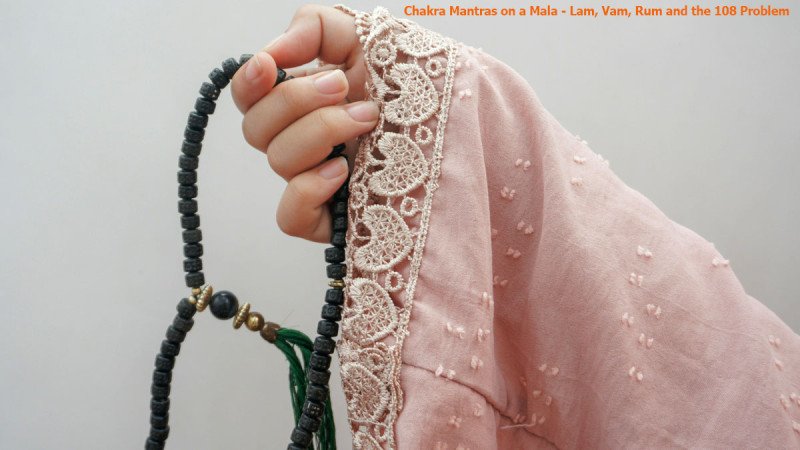
Reciting the Chakra Mantras on a Mala
A mala counts so that you do not have to. That is its entire function, and it matters more than it sounds — because the moment you start keeping a number in your head, the mantra stops being the thing you are doing and becomes something you are getting through. This is how to run a chakra mantra practice on 108 beads, including the arithmetic problem nobody mentions and what to do at the chakra that has no mantra at all.
Most guides to mala practice tell you to pick a mantra you like and repeat it 108 times. That is fine, and it is also the least interesting thing you can do with a mala.
The Himalayan chakra tradition has seven specific mantras, one for each centre of the body, and they are not interchangeable. Working through them on a mala turns a counting exercise into something with a shape — you begin at the ground and finish at the crown, or you stay at one centre for a week and get to know it properly.
The Seven Chakra Mantras
These come from the training notebook of Nepali healer Sunita Poudel, and they belong to the Vedic system — the one that runs C at the root up to B at the crown.
| Chakra | Mantra |
|---|---|
| Root | Lam |
| Sacral | Vam |
| Solar Plexus | Rum |
| Heart | Yum |
| Throat | Hum |
| Third Eye | Aum |
| Crown | Aung |
Look at the structure rather than memorising the list. The five lower mantras all end the same way and differ only in how they begin — Lam, Vam, Rum, Yum, Hum. Five variations on one sound. Then the two head chakras leave that family entirely and use the Om sounds instead.
That is not decoration. The body below the throat is worked with one family of sounds; the head is worked with another. Once you have heard it you cannot unhear it, and it makes the whole set far easier to remember.
The full pronunciation guide, and how to pitch each one against a singing bowl, is in Lesson 2.10 of our free course.
The Arithmetic Problem Nobody Mentions
A mala has 108 beads. There are seven chakras. 108 does not divide by seven.
Every guide that tells you to work through the chakras on a mala quietly skips this, and then you sit down with the beads in your hand and discover it in the first thirty seconds.
There are three honest ways to handle it, and the tradition does not prescribe between them.
One chakra per sitting — the cleanest. A full 108 on the root today, 108 on the sacral tomorrow, and so on. Seven days for a complete cycle. This is the version we would suggest to anyone starting, because a full round of one mantra does something that fifteen repetitions cannot.
Fifteen per chakra — the practical compromise. Fifteen beads for each of the seven takes you to 105, leaving three. Use those three at the guru bead as a close, or simply stop at 105 and accept that the number is a tool rather than a rule.
Twelve per chakra — the tidy one. Twelve sevens make 84. You will not use the whole mala, but every chakra gets the same count and there is no remainder to explain away.
What we would avoid is fudging it — thirteen here, seventeen there — because then you are counting again, and counting is precisely what the mala was supposed to take off your hands.
The Chakra With No Mantra
Here is the detail that makes this practice unusual, and it comes straight from the notebook.
Sunita records a second set of mantras alongside the first, and in that second set the root has no mantra and neither does the crown. Only the five centres in between are chanted. The syllables it uses — Om, Aa and Hung — are the Tibetan triad of body, speech and mind, which suggests the second list belongs to the Tibetan system rather than the Vedic one.
So in one system every chakra has a sound. In the other, the bottom and the top of the body are worked without the voice.
That raises a question no mala guide answers: what do you do with the beads when there is nothing to say?
The honest answer is that the notebook does not say, so what follows is our suggestion rather than her instruction. Breathe on each bead instead. One slow breath, one bead, no sound. It keeps the hand moving and the count intact, and it gives the silent centres the same weight as the chanted ones rather than skipping them.
People who try it usually report that the silent rounds are the harder ones, which is worth knowing before you assume the chanting is the difficult part.
How to Hold and Move the Mala
The mechanics are simple and worth getting right, because a bad grip makes a long practice uncomfortable.
- Drape the mala over the middle finger of your right hand. The beads hang down; the hand stays relaxed rather than clenched.
- Use your thumb to pull each bead toward you. One bead, one repetition. The index finger stays out of it in most traditions.
- Begin at the bead beside the guru bead, not on the guru bead itself.
- When you reach the guru bead, do not cross it. Turn the mala around and go back the way you came. Crossing over is traditionally avoided, and the turn also gives you a natural pause to change chakra.
- Let the pace settle. A round of 108 usually takes six to ten minutes once you stop hurrying.
That turning point at the guru bead is genuinely useful for this practice. If you are moving through the chakras it gives you a moment to change mantra without losing your place.
Chanting at the Pitch of the Bowl
If you own a singing bowl, this is where the two practices meet, and it is the part most people never try.
Strike the bowl for the chakra you are working on, and match your voice to its pitch before you begin the round. Not approximately — actually listen and adjust until your voice and the bowl are the same note.
Two things happen. The mantra becomes easier to sustain, because you are no longer choosing a pitch each time. And you can feel where the sound sits: Lam should be felt low in the body, Hum in the throat and face, Aum behind the eyes. If a mantra is buzzing in the wrong place, drop your pitch until it moves.
You do not need seven bowls for this. A single bowl gives you one chakra to work with properly, and if you do not know what note yours is, the frequency analyser will tell you in seconds.
One mala and one bowl is a complete practice
A 108-bead mala for the counting, and a single bowl in the chakra you are working with for the pitch. If you are building toward all seven, a graded chakra set covers the full cycle, and incense is how the tradition opens a sitting.
Which Chakra Should You Start With
Not the crown, and not whichever one sounds most appealing.
Start at the root. Lam, 108 beads, for a week before you move up. The tradition builds from the ground for the same reason a house does, and the root chakra is the one that asks whether you are safe — which turns out to be the question underneath most of the others.
If you would rather work on something specific, our chakra quiz takes two minutes and points you at one to begin with. But the honest advice is that almost everyone benefits from a week at the root first, including people who are certain their problem is elsewhere.
Common Mistakes
Rushing to finish the round. The mala is not a task with an end. If you find yourself checking how many beads are left, slow the pace until the question stops occurring to you.
Chanting too high. Most beginners pitch these mantras above their comfortable speaking range, which puts the sound in the head where it does not belong. Drop lower than feels natural.
Changing mantra mid-round. Finish the count you started. Switching because one feels better is how a practice becomes browsing.
Crossing the guru bead. Turn back instead. It takes one second and it keeps the practice intact.
Doing all seven every day. Seven fifteen-bead rounds is a survey, not a practice. One chakra properly beats all seven briefly, particularly in the first month.
Wearing it and never using it. A mala worn as jewellery is fine and there is nothing wrong with it. But if you bought one for practice, ten minutes a day will do more than a year of wearing it.
Looking After a Mala
Keep it off the floor, keep it somewhere consistent rather than in a drawer with everything else, and expect the cord to need restringing eventually — a mala that gets used will break at some point, and in most traditions that is treated as unremarkable rather than ominous.
Wooden and seed malas darken with handling. That is not damage; it is the record of the practice, and an old mala looks the way it does because someone used it.
Frequently Asked Questions
What are the seven chakra mantras?
In the Vedic system taught in this tradition: Lam for the root, Vam for the sacral, Rum for the solar plexus, Yum for the heart, Hum for the throat, Aum for the third eye and Aung for the crown. The five lower mantras all end the same way and differ only in how they begin, while the two head chakras leave that family and use the Om sounds instead.
How do you divide 108 beads between seven chakras?
You cannot divide it evenly, because 108 does not divide by seven. Three practical options: a full round of 108 on one chakra per sitting, which takes seven days for a complete cycle; fifteen beads per chakra, which reaches 105 with three left for the close; or twelve per chakra, which makes 84 with no remainder. The first is the best for anyone starting, because a full round of one mantra does something fifteen repetitions cannot.
Is there a chakra with no mantra?
In the second mantra set recorded in the notebook — the one that appears to belong to the Tibetan rather than the Vedic system — the root and the crown are both silent, and only the five centres between them are chanted. The notebook does not say what to do with the beads during the silent centres. Our own suggestion is to take one slow breath per bead, which keeps the count intact and gives the silent centres the same weight as the chanted ones.
Should you chant at the pitch of your singing bowl?
It helps considerably. Strike the bowl for the chakra you are working on and match your voice to it before starting the round. The mantra becomes easier to sustain, and you can feel where the sound sits — Lam low in the body, Hum in the throat and face, Aum behind the eyes. If a mantra is buzzing in the wrong place, drop your pitch until it moves.
Which chakra should you start with?
The root. Lam, a full round of 108, for a week before moving up. The tradition builds from the ground, and the root chakra is the one that asks whether you are safe — which is usually the question underneath the others. Almost everyone benefits from a week at the root first, including people who are certain their problem is elsewhere.
Why should you not cross the guru bead?
In most traditions the guru bead marks the beginning and end of a round and is not counted or passed over. When you reach it, turn the mala around and count back the way you came. For chakra work this turn is practically useful as well, since it gives you a natural pause to change mantra without losing your place.