




Embossed Singing Bowls - How Raised Designs Are Made and What They Do to the Sound
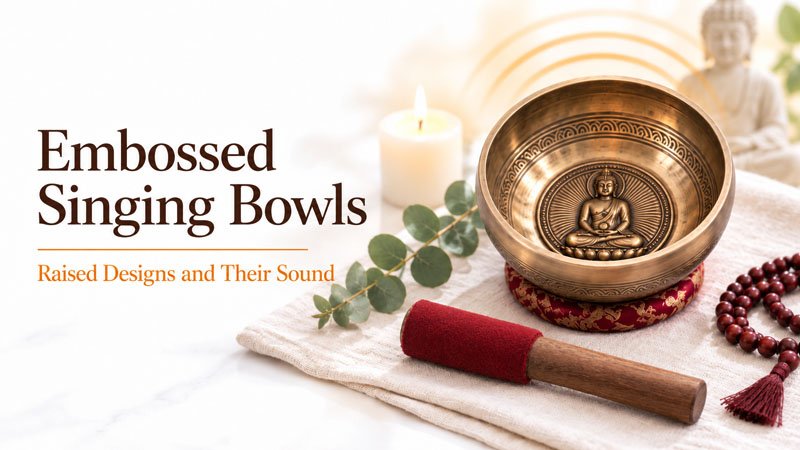
An embossed singing bowl has its design raised above the metal instead of cut into it, usually one sacred symbol standing up at the centre of the bowl. The raised design is formed with the bowl, cast in the mould or pushed up by hand, and it is there for its meaning: the note still comes from the bowl's size, shape and wall.
Key takeaways
- Raised, not cut: the design stands up from the surface.
- At the centre: one symbol on the floor, with mantras etched around the outside.
- Two ways to make it: cast in relief, or pushed up by hand from behind.
- Sound: set by the bowl itself; cast bowls bright and clear, hand-beaten bowls warmer.
What is an embossed singing bowl?
Look into the bowl and you see a symbol standing up from the floor, such as Om, the Buddha or the eight auspicious symbols. Around the outside and on the back, our embossed bowls usually carry hand-etched mantras as well.
Embossing gives a bold, three-dimensional design that catches the light, so the symbol is the first thing you see when the bowl sits on a table or altar.
How is a raised design made?
- Cast in relief: the symbol is cut into the mould as a hollow. When molten bronze fills the mould, the symbol comes out raised, and the detail is finished by hand.
- Pushed up by hand: the metal is hammered from behind so the design rises on the front, then refined from the front with small tools.
Most of our embossed bowls are hand-cast, which gives smooth, clean detail. Our small embossed bowl also comes hand-beaten, with hammer marks around the raised symbol. More cast bowls are in our beginner and gift singing bowls.
Embossed, carved or etched: what is the difference?
| Embossed | Carved | Etched | |
|---|---|---|---|
| How | Raised above the surface | Cut in with a chisel | Bitten lightly into the surface |
| Feel | Stands up under your finger | A groove you can feel | Almost smooth |
| Look | Bold relief that catches the light | Deep, hand-cut lines | Fine, crisp lines |
| Where | Usually one symbol at the centre | Around the wall | Around the wall and base |
How carving and etching affect a bowl is explained in does etching change the sound of a singing bowl.
Does embossing change the sound?
The note comes from the bowl: its size, shape, wall and metal. The raised symbol sits at the centre of the floor, where the bowl moves least as it sings, so it is there for its meaning rather than its sound.
What you hear depends more on how the bowl was made. Our hand-cast embossed bowls sound bright and clear, and the hand-beaten version gives a warmer, deeper tone.
Sunita chooses each bowl after your order arrives, and the note you get is the note of the finished bowl. Check it yourself with our free live singing bowl tuner.
Looking for an embossed bowl?
Choose your symbol on our pure bronze embossed bowl in 4 or 5 inches. A mallet and silk cushion come with it.
Which embossed bowl should you choose?
| If you want | Look at |
|---|---|
| A small bowl, your choice of symbol | Pure bronze embossed bowl, 4 or 5 inches |
| Cast or hand-beaten | Embossed small singing bowl, 4 or 5 inches |
| Om | Hindu Om embossed bowl, 6 inches |
| The Buddha | Buddha embossed bowl or Buddha mandala bowl |
| Auspicious symbols | Ashtamangala embossed bowl, 6 inches |
| The Five Buddhas | Five Buddha embossed bowl, 6 inches |
| Green Tara | Green Tara embossed bowl, 6 inches |
All our carved, etched and embossed bowls are in Om and mantra carved bowls.
Who are embossed bowls for?
- Gifts: the raised symbol carries its meaning at a glance.
- Altars and display: the centre symbol faces up when the bowl sits out.
- Meditation: rest your eyes on the symbol while the sound fades.
- Beginners: small cast bowls are bright, clear and easy to play.
A singing bowl supports relaxation and does not treat any condition.
Can you have your own design?
For a symbol or design of your own, use our custom singing bowl page and tell us what you would like. Engraving is free, and we will tell you whether your design can be raised on the bowl you choose.
How do you care for an embossed bowl?
- Wipe with a soft, dry cloth after playing.
- Brush around the raised edges with a soft brush to lift dust.
- Avoid rough polish, which wears down the high points of the design.
More tips are in how to care for your singing bowl.
Frequently asked questions
What is an embossed singing bowl?
It is a singing bowl with a design raised above the metal rather than cut into it, usually one sacred symbol standing up at the centre of the bowl.
How is the raised design made?
In one of two traditional ways: cast in relief, with the symbol cut into the mould so it comes out raised, or pushed up by hand from behind and refined from the front.
What is the difference between embossed and etched?
Embossed designs stand up above the surface. Etched designs are cut lightly into it, and carved designs are cut deeper with a chisel.
Does embossing change the sound of a singing bowl?
The note comes from the size, shape, wall and metal of the bowl. A raised symbol sits at the centre of the floor, where the bowl moves least as it sings, and is there for its meaning.
Do embossed bowls sound different from hammered bowls?
Our hand-cast embossed bowls sound bright and clear. The hand-beaten version of our small embossed bowl gives a warmer, deeper tone.
Which symbols come embossed?
Our embossed bowls carry Om, the Buddha, a Buddha mandala, the eight auspicious symbols, the Five Buddhas, Green Tara, the dorje or a mantra mandala.
How do I clean an embossed singing bowl?
Wipe it with a soft, dry cloth and use a soft brush around the raised edges. Avoid rough polish, which wears down the high points of the design.
Want a design made for you?
Choose the size and finish, and tell us the symbol or words you want. Engraving is free, and Sunita chooses your bowl after your order arrives.