




Jhumka vs Classic Full Moon Singing Bowl - Which One Is Right for You
A Jhumka singing bowl is an antique type of singing bowl with a thicker wall, and that thicker wall gives it a longer lasting sound. Choose a Jhumka if you are a healer or a collector, and a classic full moon bowl if you want a lighter bowl for everyday practice.
Key takeaways
- Jhumka is the name of a form, the antique type with a thicker wall.
- Thicker wall means a heavier bowl at the same diameter and a longer lasting sound.
- Healers and collectors are the people a Jhumka suits best.
- The note of either bowl is discovered after hammering, so check it on the tuner instead of guessing from the wall.
What is a Jhumka singing bowl?
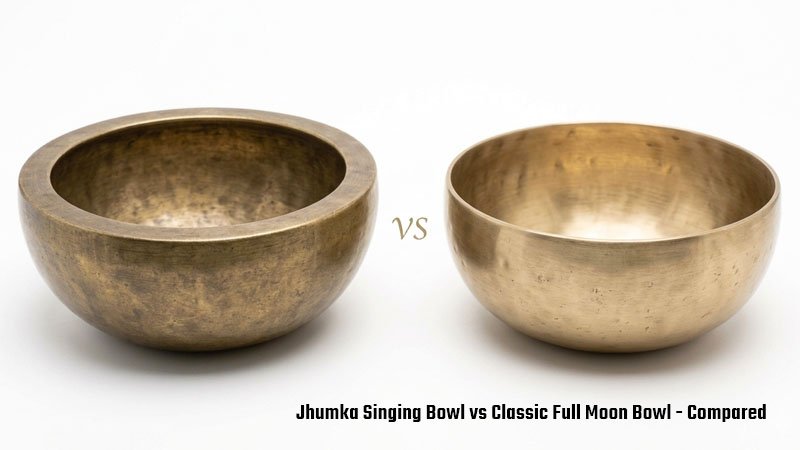
Jhumka refers to an antique type of singing bowl with a thicker wall. It is a name for the form of the bowl, not for its age.
A Jhumka full moon singing bowl is a full moon bowl hand-hammered in that thick-walled form. You will find both kinds side by side in our full moon singing bowls.
If words like wall, rim and base are new to you, our guide to the anatomy of a singing bowl shows each part.
Jhumka vs classic full moon bowl - what is the difference?
The difference is the wall. Everything else you notice, the weight and the length of the sound, follows from it.
| Jhumka full moon bowl | Classic full moon bowl | |
|---|---|---|
| Wall | Thicker | Standard |
| Form | The antique thick-walled type | The familiar full moon bowl shape |
| Weight at the same diameter | Heavier, because there is more metal | Lighter |
| Sound | Longer lasting | Clear, and fades sooner |
| In the hand | Sits best on its cushion in larger sizes | Easier to hold on the palm |
| Best for | Healers and collectors | Home practice, a first full moon bowl, a gift |
Both are hand-hammered, and both come with a mallet and a cushion. Neither is the better bowl; they are built for different people.
Why does a thicker wall give a longer lasting sound?
A thicker wall puts more metal into a bowl of the same diameter. In our bowls, that extra metal is what makes the Jhumka sound last longer after a single strike.
Wall thickness is a real part of bowl acoustics. An MIT study of Tibetan singing bowls measured the wall thickness and rim size of four bowls and explained their sound with the same physics as bells and wine glasses.
That study did not test Jhumka bowls or compare how long thick and thin bowls ring. So the longer sound is what we find in our own bowls, not a laboratory figure.
Does the thicker wall change the note?
It can. The wall is one of several things that set a bowl's pitch, along with diameter, shape and the metal itself, as we explain in why every singing bowl sounds different.
You cannot read the note from the wall, though. A hand-hammered bowl's note is discovered, not made, and two Jhumka bowls of the same size can land on different notes.
The simple way to know is to play the bowl into our free live singing bowl tuner. It shows the note and frequency of the bowl in front of you.
Want to see a Jhumka?
The 8 inch thick-walled Jhumka is a good place to start. Size and finish are selectable, and Sunita chooses your bowl after the order arrives.
Who should choose a Jhumka singing bowl?
- Healers choose a Jhumka because the long lasting sound carries through a session between strikes.
- Collectors choose it for the form, since Jhumka is one of the antique types of singing bowl.
- Experienced players who already own a classic bowl often add a Jhumka as a second, heavier voice.
We list Jhumka full moon bowls from small to large, including a 5 inch Jhumka and a 10 inch Jhumka. Collectors who want older bowls listed by form can look at our antique and collected singing bowls.
Who should choose a classic full moon bowl?
- Home practice suits the classic bowl, because a lighter bowl is easy to lift and hold every day.
- First-time buyers get the full moon bowl most people picture when they hear the name.
- Gift givers often pick a classic bowl and add a full moon date engraving to make it personal.
A good middle size is the 10 inch classic full moon bowl. If you are unsure about diameter, the singing bowl size guide compares small, medium and large bowls.
What do you need to decide before you order?
- Form first: decide between Jhumka and classic before you think about size.
- Size second: remember a Jhumka weighs more than a classic bowl of the same diameter.
- Note: ask for one if it matters to you, and it is met by selection after your order arrives.
- Finish and engraving: both can be chosen on most bowls, and engraving is free.
After the order arrives, Sunita plays the bowls in your size and chooses one from her experience in practice. The bowl leaves Kathmandu in 3-4 business days by DHL Express.
What are the common mistakes when choosing between them?
- Comparing by diameter alone hides the real difference, which is the wall and the weight.
- Reading Jhumka as age is wrong, because the word names a form and says nothing about when a bowl was made.
- Expecting a set note from a thick wall does not work, since every hand-hammered bowl's note is discovered.
- Assuming thicker is better ignores that a lighter classic bowl is the easier one to live with daily.
What should you do next?
If the long sound and the antique form are what you want, start with a Jhumka. If you want one bowl for daily use, start with the classic.
If neither listing is quite right, the custom singing bowl page lets you set the size, finish and engraving yourself.
Frequently asked questions
What is a Jhumka singing bowl?
Jhumka is the name for an antique type of singing bowl with a thicker wall. A Jhumka full moon singing bowl is a full moon bowl hand-hammered in that thick-walled form.
What is the difference between a Jhumka and a classic full moon singing bowl?
The wall. A Jhumka has a thicker wall, so it is heavier at the same diameter and its sound lasts longer, while a classic full moon bowl is lighter in the hand.
Does a thicker wall make a singing bowl sound longer?
In our bowls, yes: the thicker Jhumka wall gives a longer lasting sound. How long any one bowl rings still depends on that bowl, which is why each one is played before it is chosen.
Is a Jhumka singing bowl an antique?
Not by name alone. Jhumka describes the form, and our Jhumka full moon bowls are hand-hammered in that form.
Who should buy a Jhumka singing bowl?
Healers and collectors. Healers choose it for the long lasting sound, and collectors choose it for the antique form.
Can I choose the note of a Jhumka singing bowl?
You can ask for a note on most bowls, and it is met by selection. A hand-hammered bowl's note is discovered after the bowl is finished, so Sunita chooses a bowl whose note matches your order.
What comes with a Jhumka full moon singing bowl?
A mallet and a cushion come with every bowl, and engraving is free. Orders are dispatched from Kathmandu in 3-4 business days by DHL Express.
Still deciding between Jhumka and classic?
Tell us how you will use the bowl and design it your way. Engraving is free, and a mallet and cushion come with every bowl.