




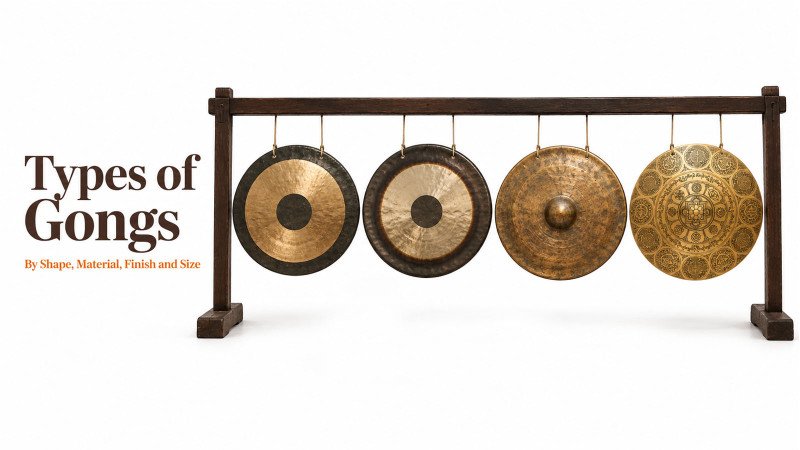
Types of Gongs - By Shape, Material, Finish and Size
Gongs are grouped in four ways: by shape, where the main types are the wind, chau, nipple, opera, symphonic and Tibetan gongs, the Burmese kyeezee and the gong chime. By material, most are bronze, brass or nickel silver; by finish, they run from raw and black to lathed, polished, hammered, carved and painted; and by size, from handheld to giant. Shape and metal matter most to the sound.
Key takeaways
- Shape: flat, rimmed, bossed or domed, the biggest difference in sound.
- Material: bronze is warm and layered, brass brighter, nickel silver clear and even.
- Finish: mostly about looks, with a small effect on the tone.
- Size: bigger usually means deeper, longer and louder.
- Choose by sound: listen to a gong, or a recording, before you decide.
What are the types of gongs by shape?
Shape is the biggest difference between one gong and another. Look at three things: whether the face is flat or domed, whether the edge is turned back into a rim, and whether there is a raised boss at the centre.
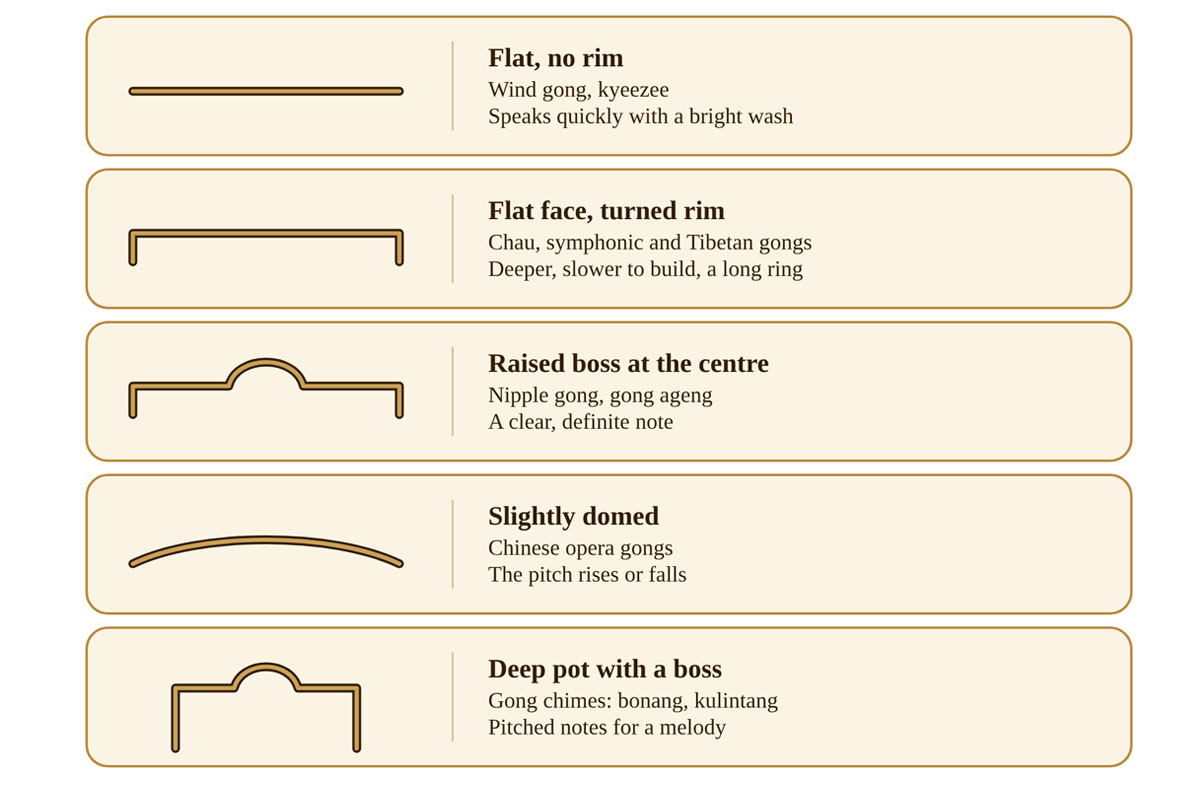
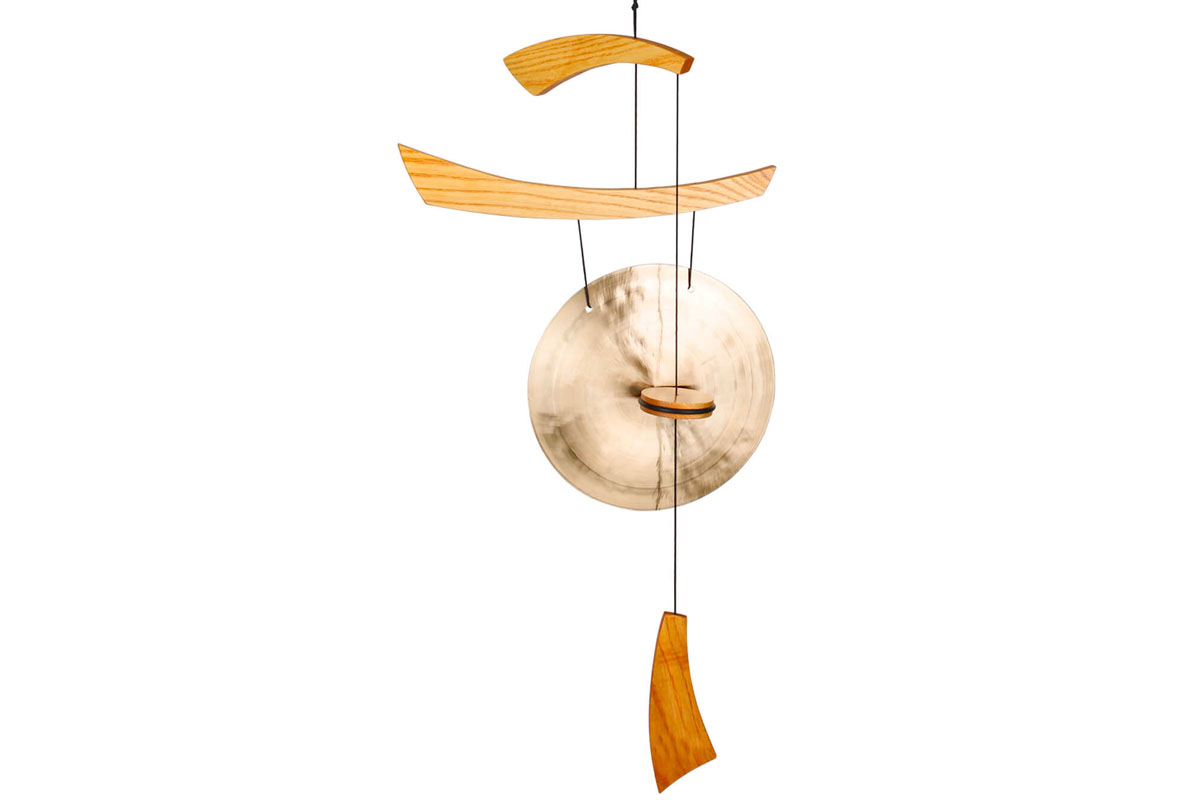
Wind gong: Also called a feng gong, it is a flat disc with no turned rim, usually lathed on both sides. Struck, it blooms quickly into a bright, airy wash, which is why many sound bath players like it.
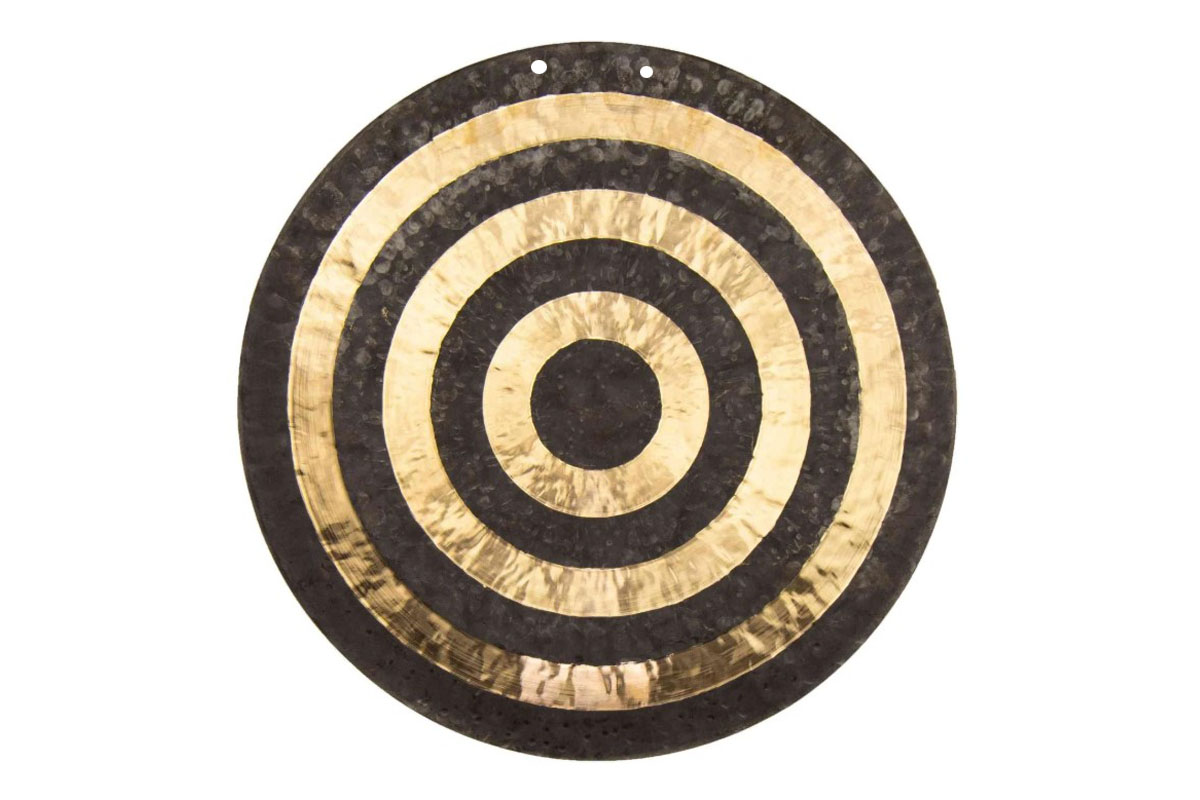
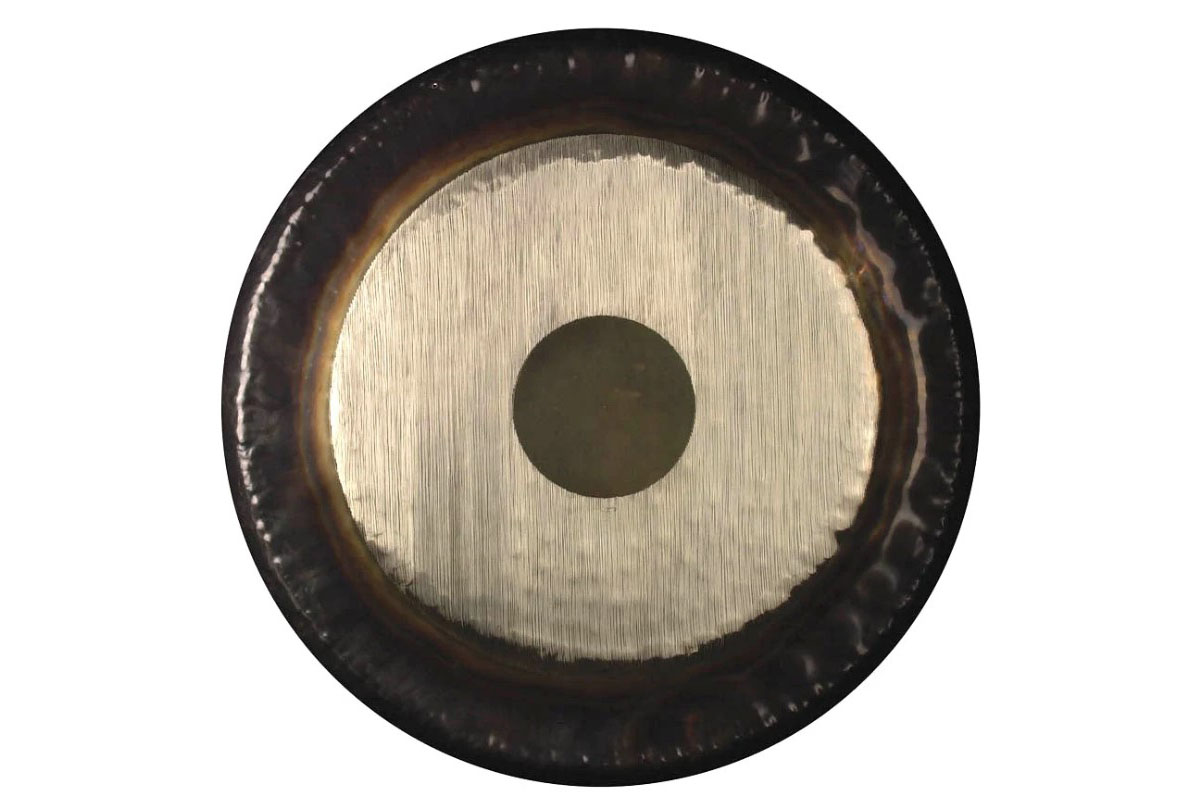
Chau gong: A flat face with a rim turned back at the edge, and the classic gong of China; in an orchestra it is called the tam-tam. The centre and rim are usually left dark, with a polished band between. Its sound is deep, slow to build and long.
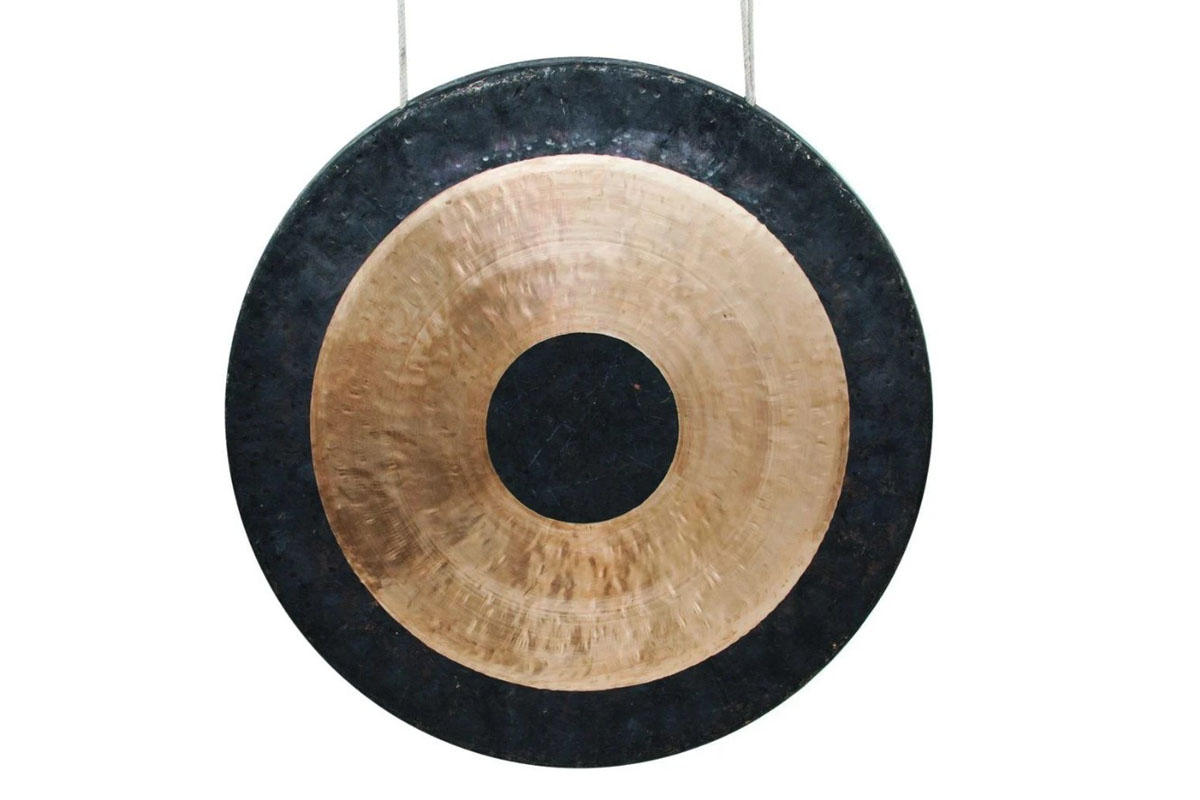
Nipple gong: Also called a bossed gong, it has a raised boss, or nipple, at the centre. Struck on the boss, it gives a clear, definite note; struck beside it, more shimmer. Bossed gongs are used in temples across Asia and lead the gamelan orchestras of Java, where the great gong ageng is often about 80 cm across.
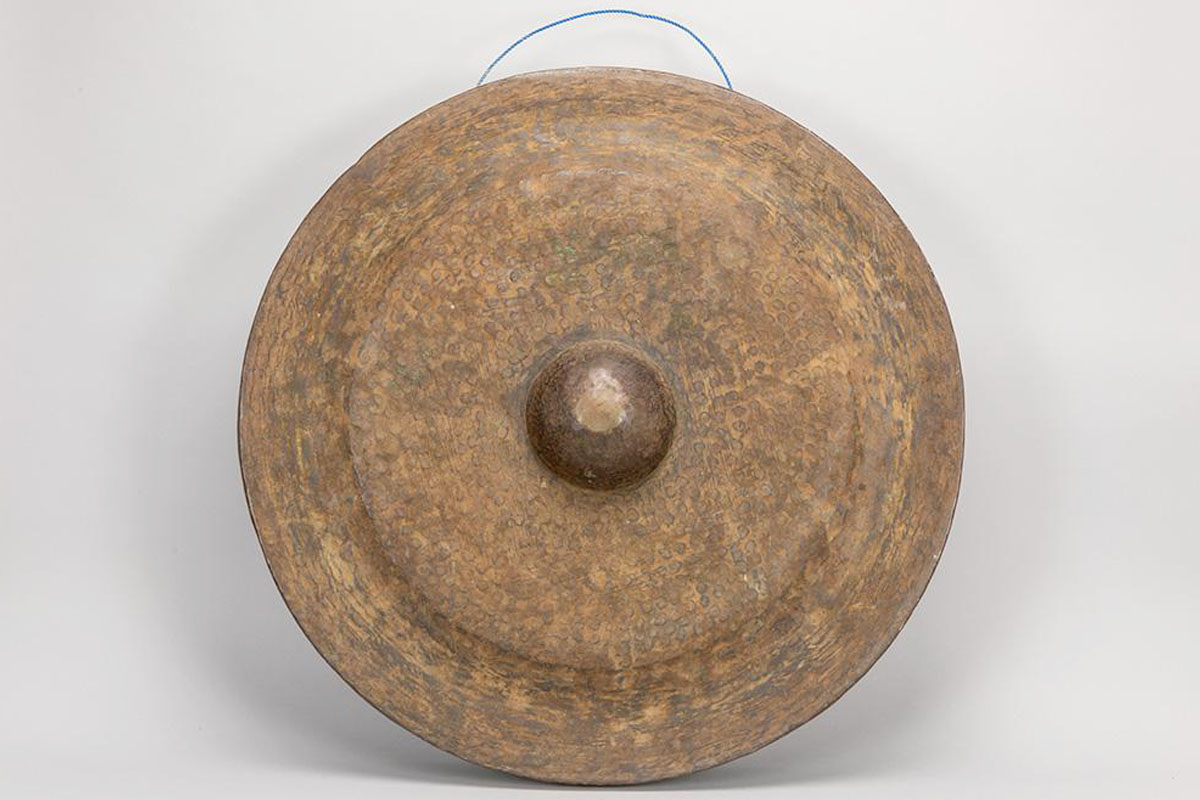
Opera gong: Small Chinese gongs, about 18 to 30 cm, with a slightly domed face. Their pitch bends after the strike, rising on some and falling on others, and that sliding sound is part of Chinese opera. The larger tiger gong falls in pitch with a long, swooping tone.
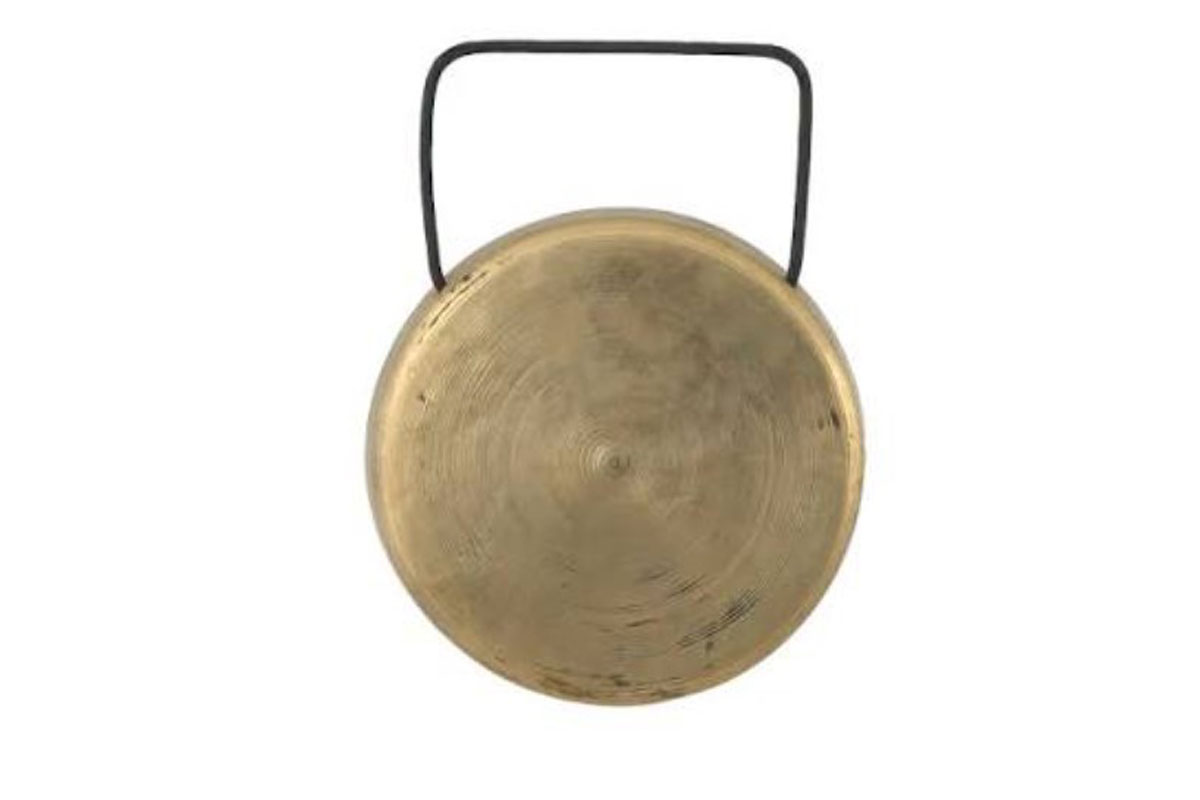
Symphonic gong: European concert gongs, often made of nickel silver, in sizes up to about 2 m (80 inches). They have a rich, even sound and are used in orchestras and by many sound bath players. Planet gongs are a kind of symphonic gong, each made to sound at a frequency calculated from the orbit of a planet.
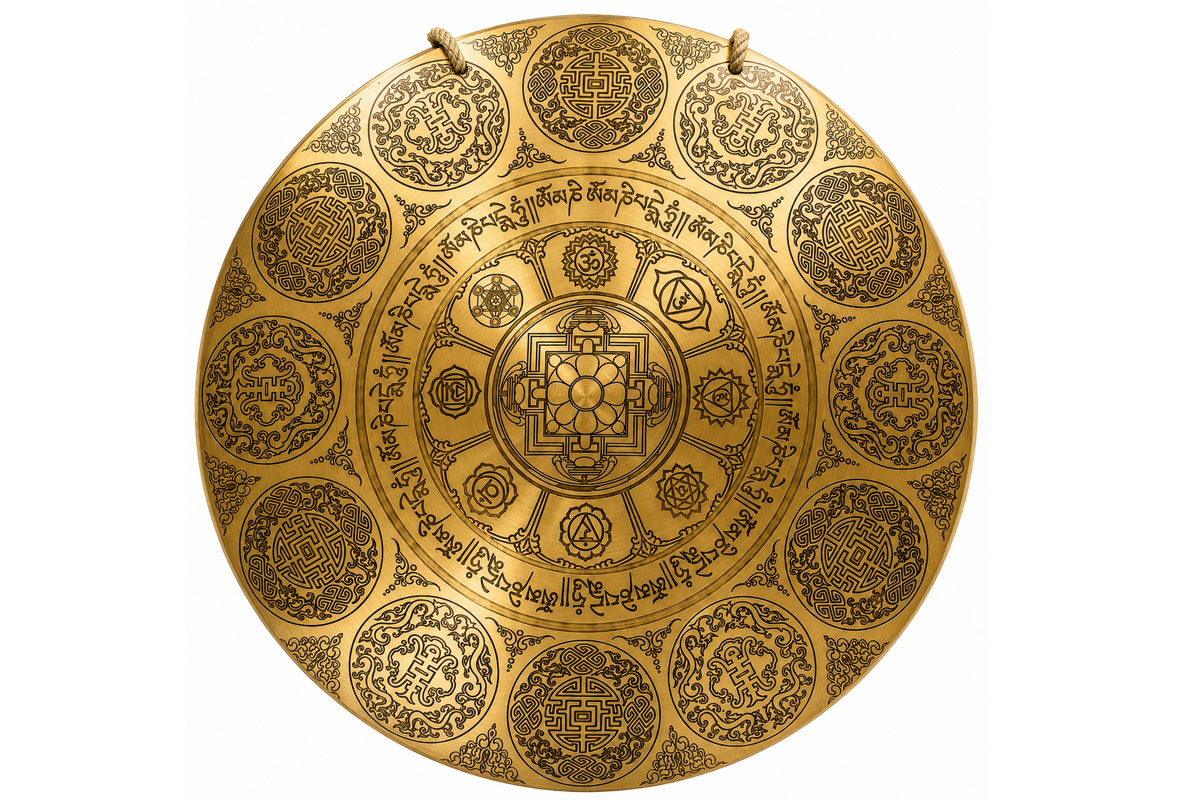
Tibetan or Nepali gong: Hand-forged gongs, usually with a turned rim and the marks of the hammer on the face. Many are carved or etched with mantras, deities and symbols, and because each is hammered by hand, each has its own voice. What the carvings mean is in our guide to Tibetan gong carvings.
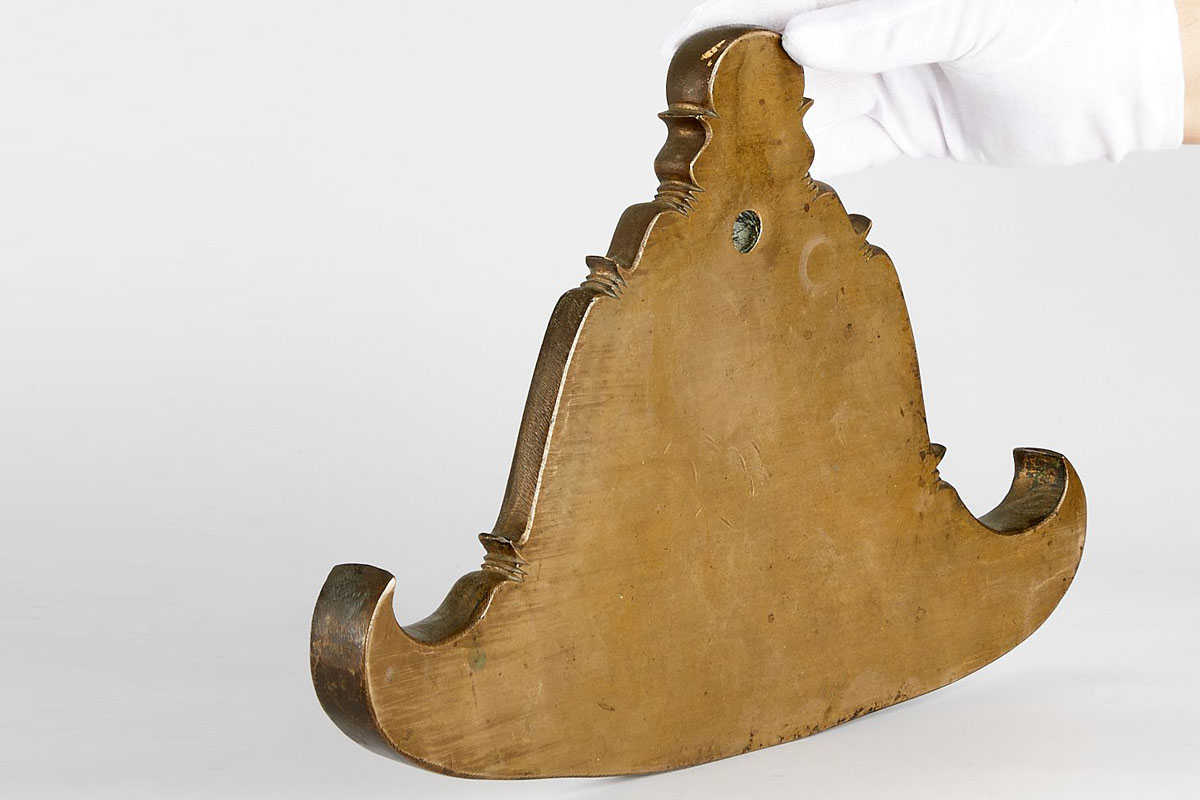
Kyeezee: The Burmese spin gong is a flat bronze plate with a curved, flared outline, hung from a cord. It is struck near the lower edge with a wooden mallet and then set spinning, so the tone wavers as it turns. In Burmese temples it is struck when an offering is made.
Gong chime: Small bossed pot gongs set boss-up in a row on a frame and played as a melody. Examples are the bonang of Java, the kulintang of the southern Philippines and the khong wong of Thailand (Wikipedia).
| Type | Shape | Sound | Used for |
|---|---|---|---|
| Wind gong | Flat, no turned rim | Bright, fast wash | Sound baths, orchestras |
| Chau gong | Flat face, turned rim | Deep, slow to build, long | Sound baths, temples, orchestras |
| Nipple gong | Raised boss at the centre | A clear, definite note | Temples, gamelan |
| Opera gong | Small, slightly domed | The pitch rises or falls | Chinese opera |
| Symphonic gong | Flat, slight rim, often nickel silver | Rich and even | Orchestras, sound baths |
| Tibetan or Nepali gong | Hand-forged, turned rim, often carved | Warm, each with its own voice | Home practice, altars, temples |
| Kyeezee | A flat, flared plate on a cord | A tone that wavers as it spins | Burmese temples, meditation |
| Gong chime | Small pot gongs in a row | A melody of notes | Gamelan, kulintang |
Where do the different types of gong come from?
Gongs began in Asia and spread from there (Wikipedia). China gave the world the rimmed chau gong, the flat wind gong and the opera gongs. Southeast Asia developed bossed gongs and gong chimes, and Japan has its own temple gong, the dora.
In Tibet and Nepal, gongs are hand-forged and often carved, and large gongs hang in monasteries and temples. Europe came later, adding concert gongs for the orchestra, planet gongs and gongs in newer metals.
What are gongs made of?
The metal decides much of a gong's colour. Here are the main metals and how they usually sound.
| Metal | Made of | Sound | Found in |
|---|---|---|---|
| Bronze | Copper and tin, about four parts to one in bell bronze | Warm, layered, a slow bloom and a long ring | Most traditional gongs |
| Brass | Copper and zinc | Brighter and a little thinner | Lower-cost gongs |
| Nickel silver | Mostly copper with nickel; no silver | Clear and even, can be made to sound a set pitch | Concert and planet gongs |
| Stainless steel | Iron with chromium and nickel | Deep and physical | Newer gongs |
| Titanium | A light, strong metal | Light for its size; costly | A few specialist makers |
| Seven metal | A Nepali bronze alloy said to hold seven metals | Warm and complex | Hand-forged Nepali gongs |
Bronze is copper with tin; bell bronze is about four parts copper to one part tin. It gives a warm, layered sound with a slow bloom, and a large bronze chau gong can ring for over a minute. Brass, copper with zinc, costs less to make and sounds brighter and a little thinner.
Nickel silver contains no silver at all; it is mostly copper with some nickel (Wikipedia). It gives a clear, even tone and can be made to sound a set pitch, which is why many concert and planet gongs use it.
Stainless steel and titanium gongs are newer. Steel gives a deep, physical sound, and titanium is light for its size but costly.
In Nepal, makers often call their gong metal seven metal, a bronze alloy said to hold seven metals. The exact mix is rarely published, so judge a seven metal gong by its sound rather than the label.
How a gong is made matters too. Some are hand-forged, hammered out from a cast blank; some are cast whole; and some are pressed and spun by machine. Hand-forging gives each gong its own voice, while machine making gives more even results from one gong to the next.
What are the types of gong finish?
The finish is the surface of the gong: how it was left, cut, polished or decorated after forging. These are the finishes you will meet most often.
- Raw or black: the dark surface left by forging and heating, often kept on the back or at the centre.
- Two-tone: a dark centre and rim with a polished band between, the classic chau gong look.
- Lathed: fine rings cut in on a lathe, bright and even, typical of wind gongs.
- Mirror-polished: polished by hand to a mirror shine, as on some concert gongs.
- Hammered: the marks of the hammer left on the face.
- Antique: darkened with a patina for an old look.
- Carved or etched: carved designs are cut into the metal by hand, while etched designs are finer, shallower lines; both are common on Tibetan and Nepali gongs.
- Painted: colour added to the face, sometimes over a carved design.
Does the finish change the sound? A little. Lathing and hammering change the surface of the metal and so the tone slightly, while polishing, carving and painting change the look more than the sound.
What are the types of gong by size?
Gongs run from handheld gongs of 6 to 12 inches to temple gongs of about 40 to 60 inches and giant gongs of 60 inches and more. For most homes, 16 to 22 inches is plenty; for studios and sound baths, 28 to 32 inches and up. Every size band, with weights and stands, is in our gong size guide.
Which type of gong should you choose?
| If you want | Look at |
|---|---|
| A bright, fast wash of sound | A wind gong |
| A deep, steady base for a sound bath | A chau gong |
| A clear note you can return to | A nipple gong |
| A gong carved with mantras for home or an altar | A Tibetan or Nepali carved gong |
| An orchestral sound | A symphonic gong |
| A small gong to hold, strike and spin | A Burmese kyeezee |
| A melody rather than a wash | A gong chime |
Start with the sound you want, then the room it has to fill. For a first gong at home, a chau or Tibetan gong of 16 to 22 inches is easy to play and fits most rooms. Once it arrives, our guide on how to play a gong covers striking, warming up and building a swell.
If you are still choosing between a gong and a bowl, read singing bowls vs gongs.
Which types of gong do we make?
Our gongs are hand-forged in Nepal. Most are Tibetan gongs, carved or etched with Om, mantras, the Buddha and other designs, alongside a chau gong and our Extra Large Temple Gong of 20 to 39 inches. Each comes with a soft felt striker, and most with a wall-hanging setup.
From Myanmar, our Burma Bell kyeezee comes in 5.5, 6.5 and 8 inches with a wooden striker and a spinner.
Looking for a first gong?
Our Tibetan OM Carved Gong is hand-forged in Nepal and comes in 13 to 22 inches, with a soft felt striker and a wall-hanging setup.
| If you want | Look at |
|---|---|
| A gong with Om at the centre | Tibetan OM Carved Gong, carved, 13 to 22 inches |
| A gong covered in mantras | Mantra Carved Tibetan Gong, carved, 13 to 22 inches |
| The Buddha at the centre | Buddha Carved Tibetan Gong, carved, 16 to 22 inches |
| An etched design | Dragon Etched Tibetan Gong, etched, 16 to 22 inches |
| A chau gong | Chau Gong with Flower of Life mandala, 16 to 26 inches |
| A large gong for a studio or hall | Extra Large Temple Gong, 20 to 39 inches |
| A Burmese spin gong | Burma Bell kyeezee, 5.5, 6.5 or 8 inches |
Every gong is in Tibetan gongs.
Can you have a gong made to order?
Yes. On our custom gong page you choose a wind or chau gong, the diameter and the design, from a mantra or symbol to a deity at the centre, and you can add a mallet, a stand and a carry bag.
Practice with a gong supports relaxation and focus, and does not treat any condition.
Frequently asked questions
What are the main types of gongs?
By shape, the main types are the wind gong, chau gong, nipple gong, opera gong, symphonic gong, Tibetan or Nepali gong, the Burmese kyeezee and the gong chime. Gongs are also grouped by material, finish and size.
What is the difference between a wind gong and a chau gong?
A wind gong is flat with no turned rim and blooms quickly into a bright wash. A chau gong has a flat face with a rim turned back at the edge, usually a dark centre and rim, and a deeper, slower, longer sound.
What is a nipple gong?
A gong with a raised boss, or nipple, at the centre. Struck on the boss it gives a clear, definite note, and struck beside the boss it gives more shimmer. Bossed gongs are used in temples and in gamelan.
What is the difference between a gong and a tam-tam?
In an orchestra, tam-tam is the name for a large flat gong without a clear pitch, like the chau gong. Gong is the wider name, and some musicians keep it for gongs with a boss and a definite note.
What are gongs made of?
Most gongs are bronze, which is copper and tin, or brass, which is copper and zinc. Many concert gongs are nickel silver, and some newer gongs are stainless steel or titanium.
What is a seven metal gong?
Seven metal is the name many Nepali makers give their gong metal, a bronze alloy said to hold seven metals. The exact mix is rarely published, so judge the gong by its sound rather than the label.
Does the finish change the sound of a gong?
A little. Lathing and hammering change the surface of the metal and so the tone slightly, while polishing, carving and painting change the look more than the sound. Shape and metal matter far more.
Which type of gong is best for a sound bath?
Many players use a chau gong for a deep, steady base and a wind or symphonic gong for a brighter wash, often 28 inches and up. A hand-forged Tibetan gong works well too, especially in smaller rooms.
Which type of gong is best for a beginner?
A flat gong with a turned rim, such as a chau or a Tibetan gong of 16 to 22 inches, is easy to play and fits most homes. It speaks gently and does not crash as quickly as a large wind gong.
What is a Burmese spin gong?
A kyeezee, a flat bronze plate from Myanmar hung from a cord. You strike it near the lower edge with a wooden mallet and then set it spinning, so the tone wavers as it turns.
Want a gong in the type, size and design you choose?
Tell us what you have in mind, and we will hand-forge it for you in Nepal.