




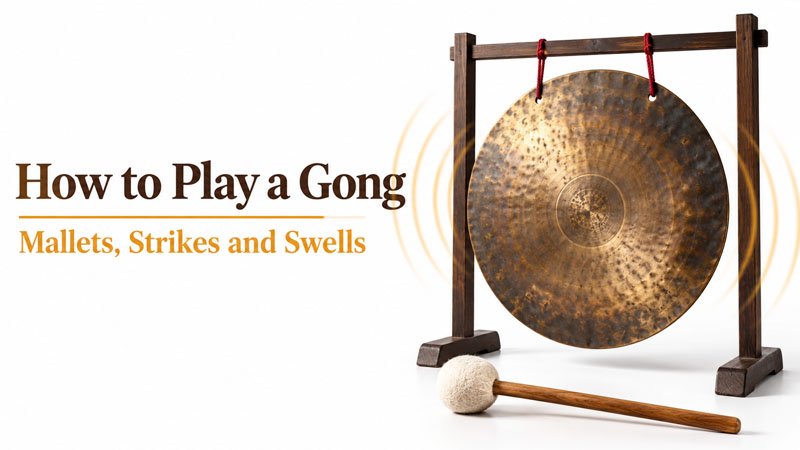
How to Play a Gong - A Beginner Guide to Mallets, Strikes and Swells
To play a gong, hang it so it swings freely, stand to one side and strike just off centre with a soft mallet, letting the mallet fall straight away again. Start with soft taps to wake the gong, then build slowly: a gong's big sound comes from patience, not force. The centre gives deep tones, the edge bright ones, and a swell is simply a run of even strikes, each a little harder than the last.
Key takeaways
- Hang it free: a gong only sings when nothing touches it.
- Start soft: a few quiet taps wake the gong before a fuller strike.
- Strike just off centre with a soft mallet, and let it fall away.
- Build slowly: a swell is many even strikes, not one hard one.
- Stop with your palm: a flat hand on the face quiets it.
- Master techniques: two-mallet rolls, two friction mallets, letting the gong swing or spin, and rubbing a nipple gong by hand.
How should you hang a gong before you play?
A gong only rings when it can move. Hang it by its cord from a stand or a strong hook, with space all round, so it does not touch a wall or the frame. Hang it so the centre sits around the height of your chest, wherever you will sit or stand to play: you should be able to reach the whole face without stretching.
Most of our gongs come with a wall-hanging setup, so a smaller gong can go straight onto a strong hook. A larger gong needs a stand and room around it: tell us when you order, or add a stand on our custom gong page.
Where should you strike a gong?
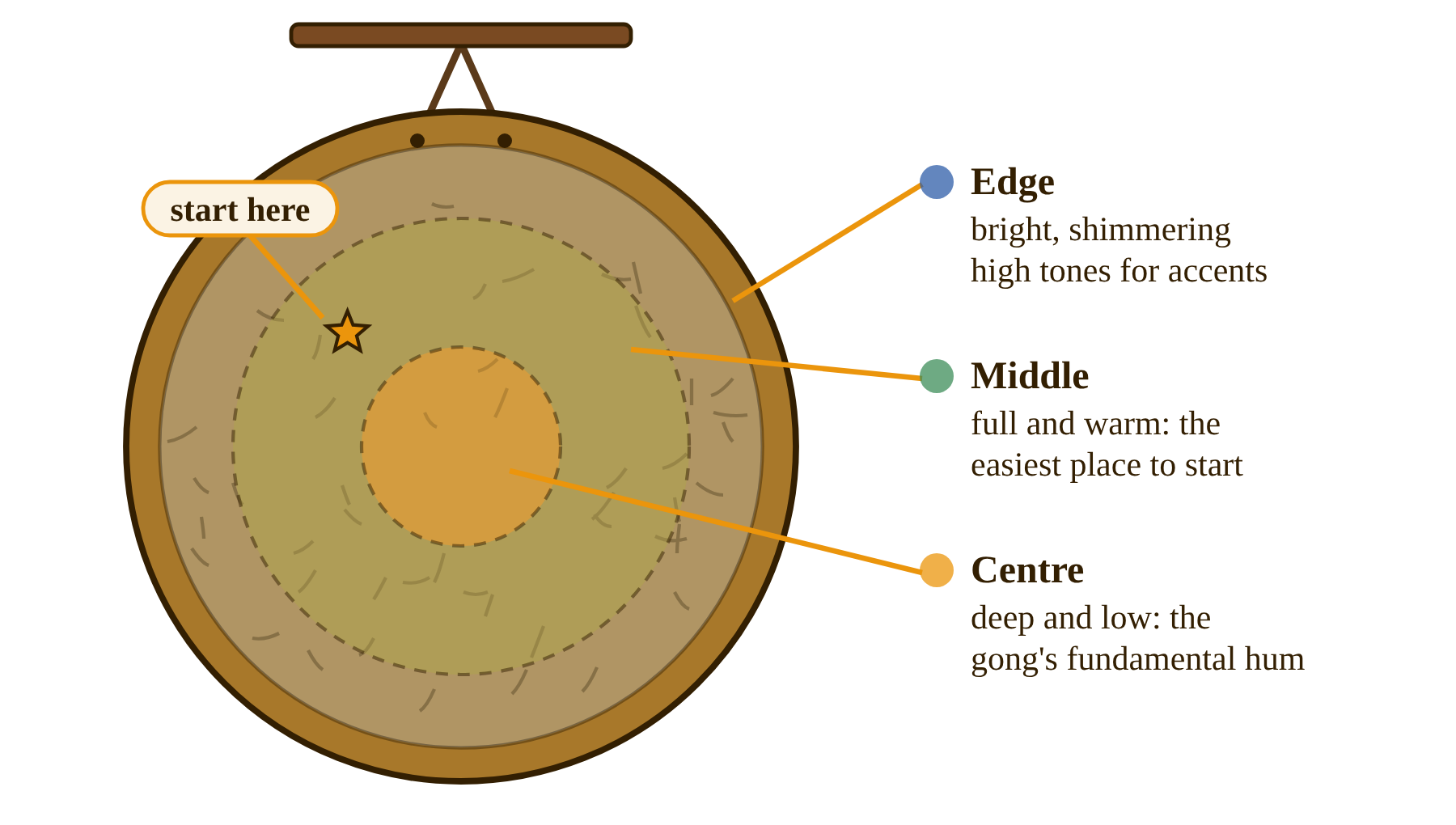
The face of a gong has three playing zones. The centre gives the deep, low hum, the gong's fundamental.
The middle ring gives a full, warm tone. The edge gives bright, shimmering high tones, good for accents.
Begin in the middle ring, just off centre. It is the most forgiving place to strike, and from there you can move in for depth or out for shimmer. Once you know your gong, strikes nearer the centre give its deepest note, which is where many players place the main strike in a full session.
Every gong is a little different, so spend your first sessions finding where yours sounds sweetest.
Which mallet should you use?
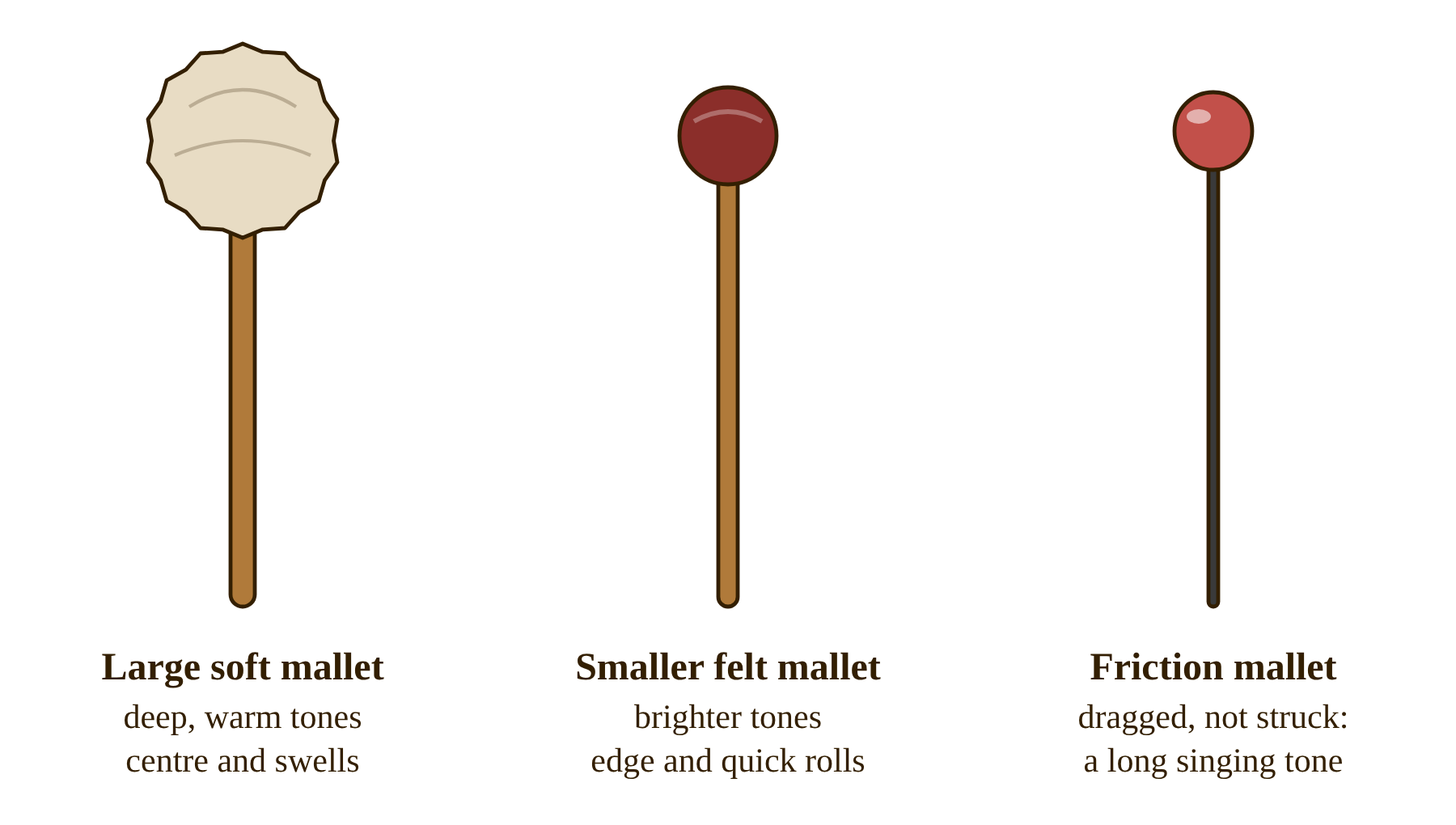
The mallet shapes the sound as much as where you strike. A larger, softer mallet stays on the metal a moment longer and brings out the deep, warm tones.
A smaller, firmer mallet leaves the high overtones ringing, so the sound is brighter. As a rule, the bigger the gong, the bigger the mallet.
A friction mallet, a rubber ball on a thin rod, is not struck at all. You drag it slowly across the face to draw out a long, singing tone. It works best on larger gongs; on small gongs it has much less to work with.
Every gong we sell comes with a soft felt striker, and that is all you need to begin. For a deeper voice from a larger gong, add a bigger felt striker: the large size, with a head of about 8 cm, suits small to medium gongs, and the extra large, about 11 cm, suits large gongs.
How do you hold the mallet and strike?
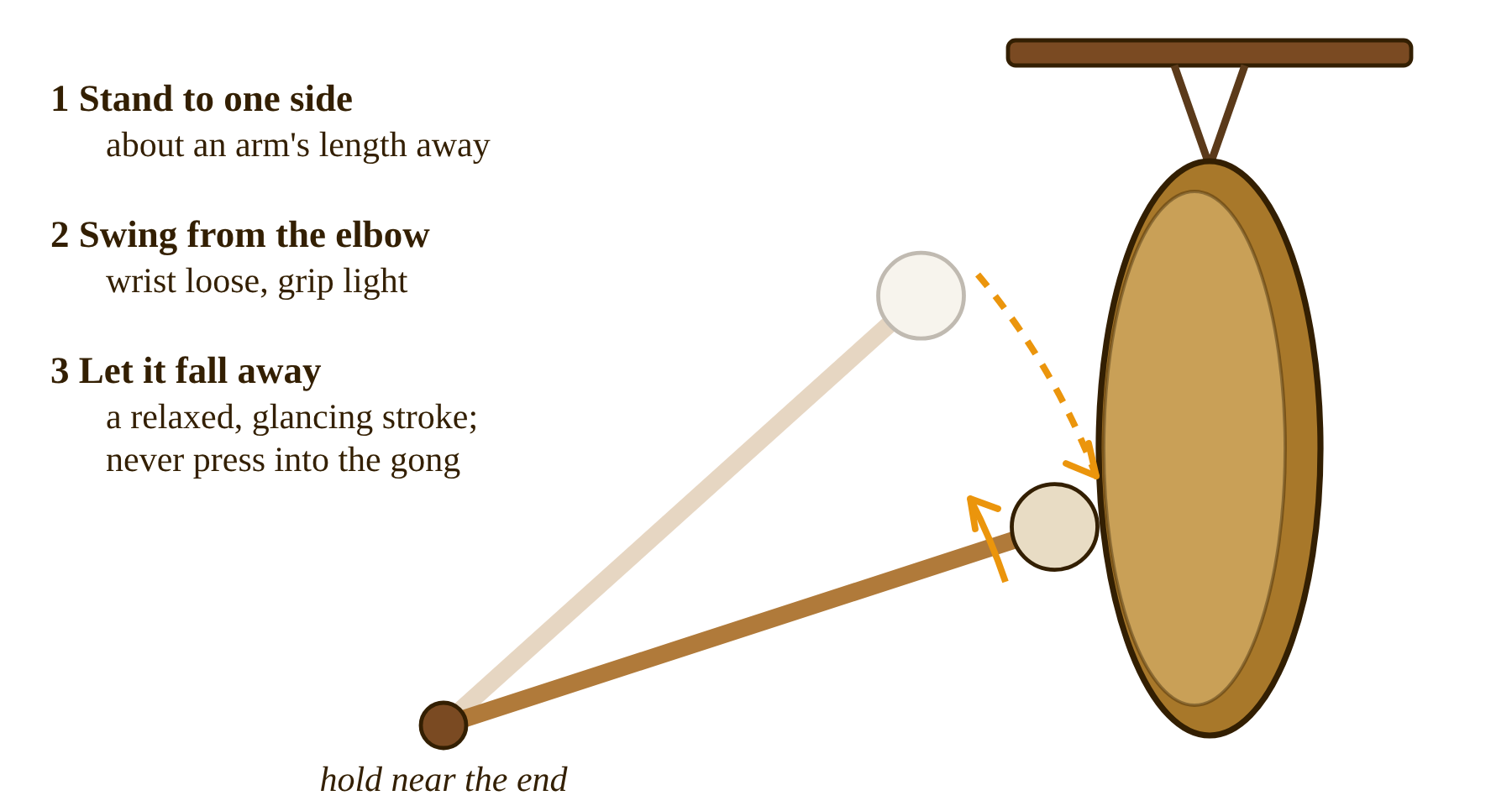
- Stand to one side, about an arm's length away, so the sound travels past you rather than straight into you.
- Hold the mallet near the end of its handle, with a light grip, as if holding a small bird.
- Swing from the elbow, with a loose wrist, in a relaxed, glancing stroke.
- Let the mallet fall away. If you press it into the gong, you stop the very sound you are making.
What does warming up, or priming, a gong mean?
A gong at rest takes a moment to wake. If you strike it hard from silence, the sound can come out harsh and clipped.
Priming means playing a few very soft taps first, so quiet you can barely hear them. They set the metal moving, and the strike that follows blooms into a fuller, rounder sound.
Make priming a habit: a few soft taps at the start of every session, and before any strike that is louder than the ones before it.
Which strokes should you learn first?
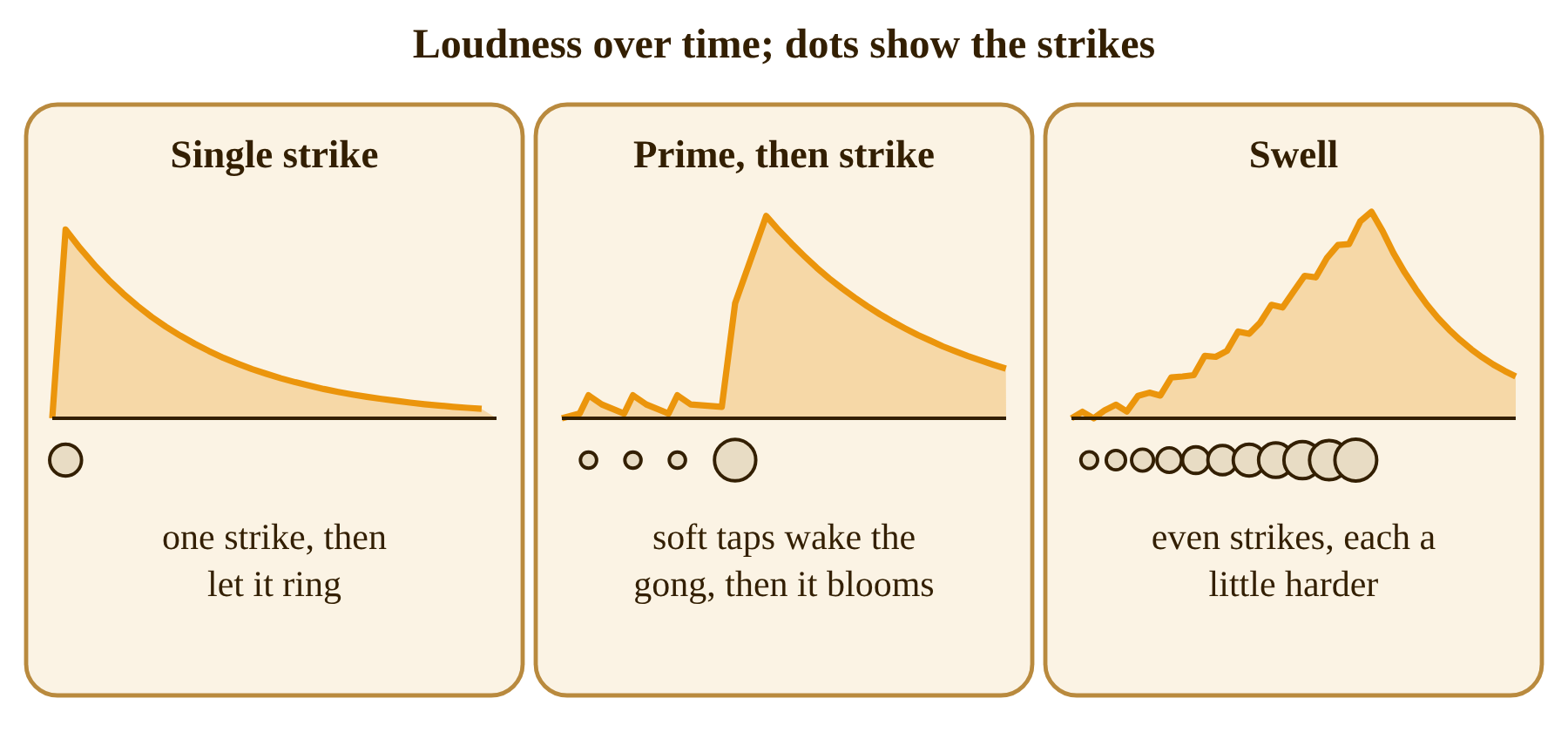
- Single strike: one stroke, then let it ring until it has almost gone. This teaches you to listen.
- Prime, then strike: three or four soft taps, then one fuller stroke in the same spot.
- Swell: a run of even, steady strikes, each a little harder than the last, so the sound rises like a wave. Keep the rhythm even and let the gong, not your arm, do the work.
How do you stop a gong ringing?
To stop the sound, lay your palm flat on the face, or rest the mallet head against it. Press gently to fade the sound, or firmly to stop it at once. Most of the time, though, the best ending is no ending at all: let the last strike fade on its own, and listen until the room is quiet.
What is a good first pattern?
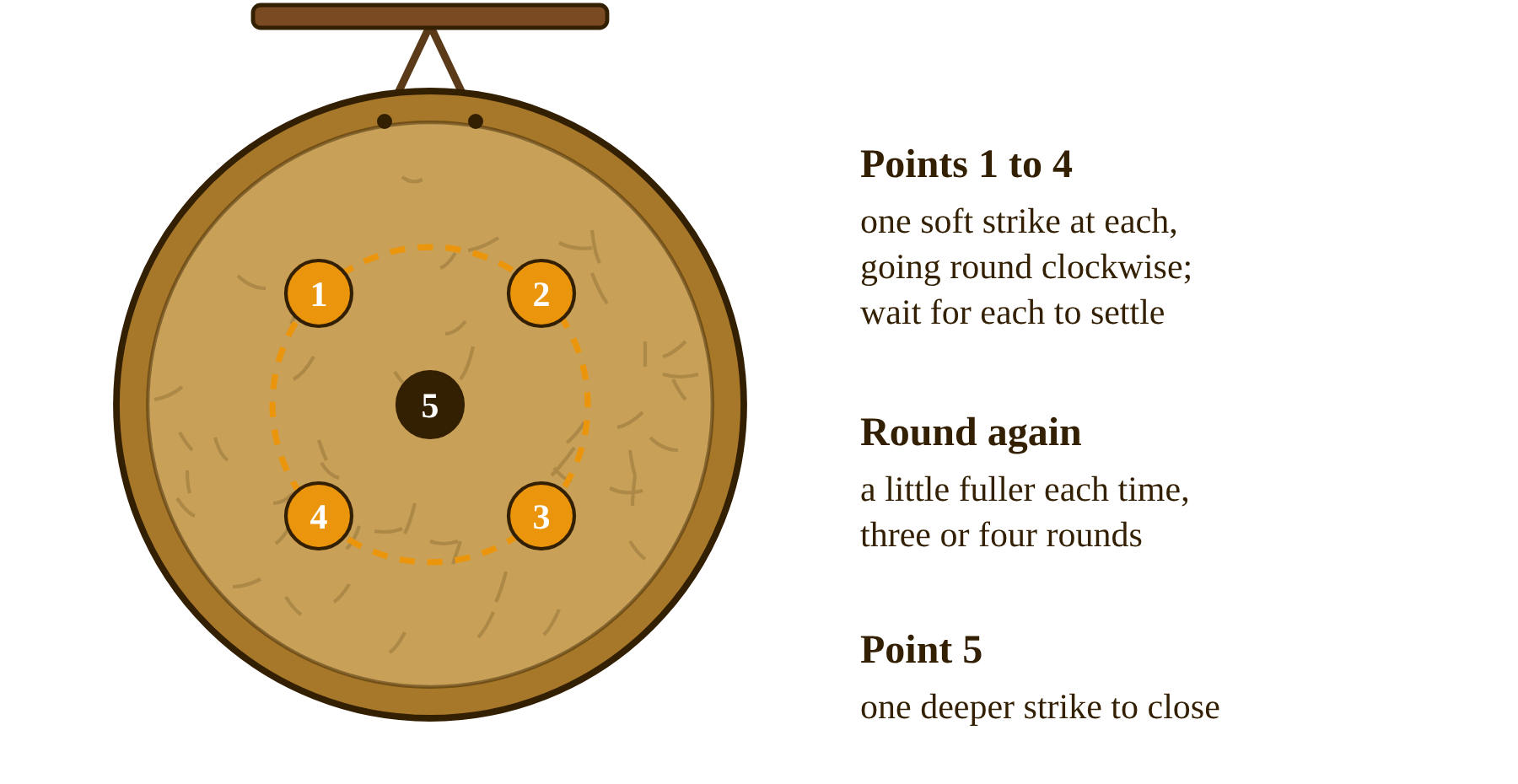
This simple pattern keeps your strikes even and moves the sound around the face. Strike once at each of the four points in the middle ring, going round clockwise, and wait for each sound to settle before the next. Go round three or four times, a little fuller each round, then close with one deeper strike near the centre.
How do you play your first ten-minute session?
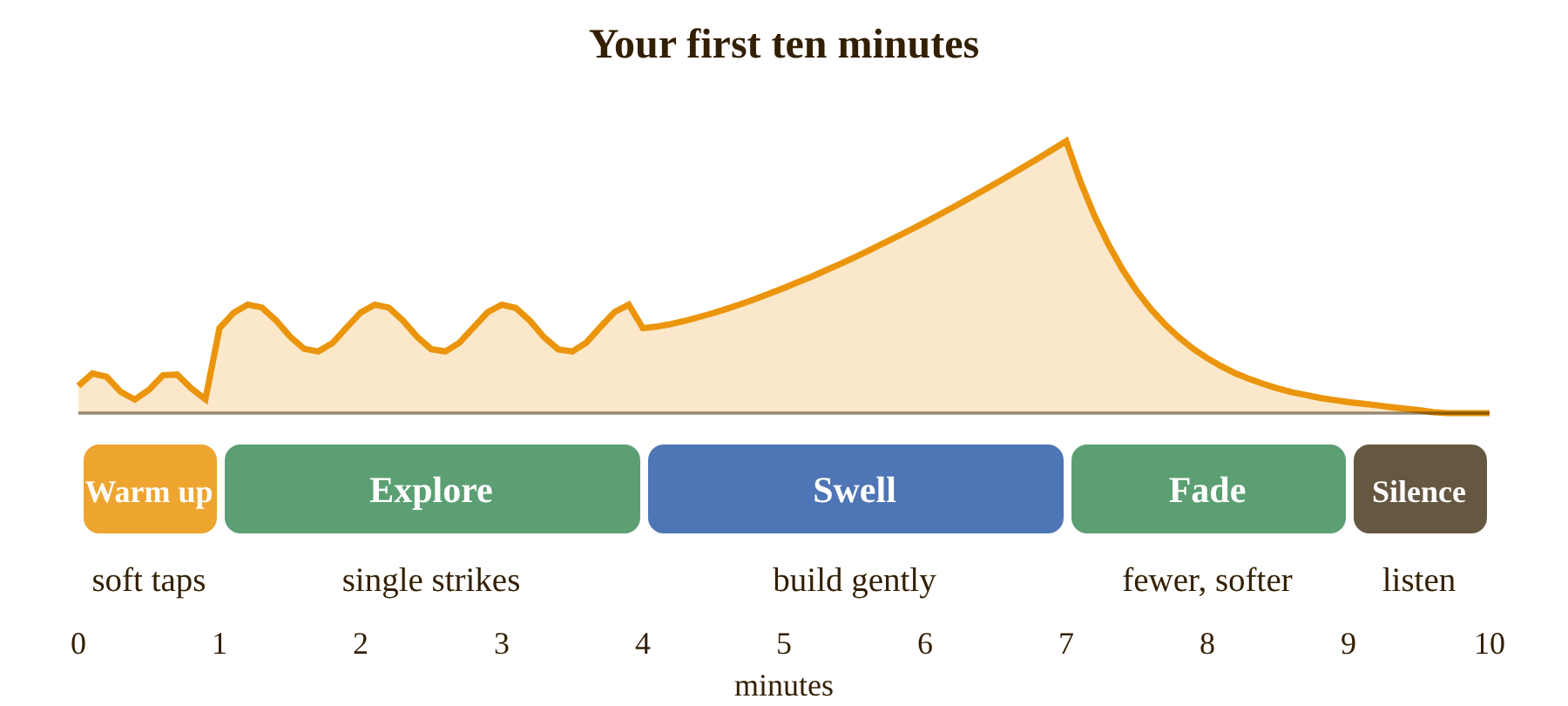
- Warm up, 1 minute: soft priming taps, barely audible.
- Explore, 3 minutes: single strikes around the pattern; wait for each sound to open before the next.
- Swell, 3 minutes: build gently, keeping the rhythm even; stop before it feels loud.
- Fade, 2 minutes: fewer and softer strikes.
- Silence, 1 minute: no strikes at all; listen to the last sound die away.
Practice like this supports relaxation and focus, and does not treat any condition. When you are ready to add singing bowls, our guide to combining a gong and singing bowls in one session shows how.
Which master techniques can you learn next?
Once single strikes, priming and swells feel natural, these techniques open up the rest of a gong's voice. Learn them one at a time.
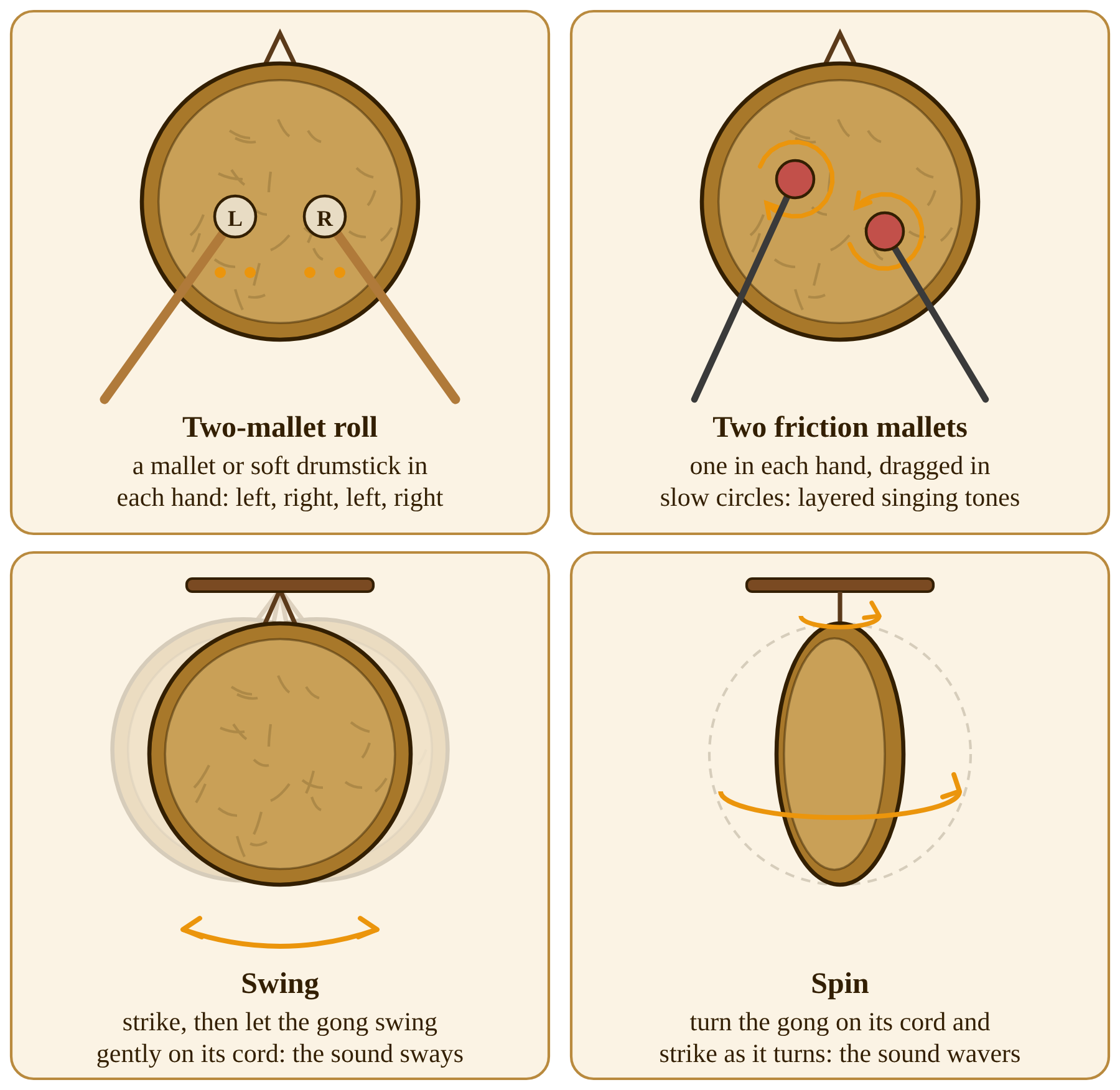
- Two-mallet roll: hold a mallet, or a soft-headed drumstick, in each hand and strike in turn: left, right, left, right, quickly and softly, side by side in the middle ring. The strokes blend into one rolling sound, and striking a little harder each round gives the smoothest swell of all.
- Drumstick accents: with plain wooden sticks, tap lightly near the edge for bright, crisp sparkles over a deeper sound. Go gently, as hard sticks can mark the surface.
- Two friction mallets: one in each hand, dragged slowly across the face in circles, in opposite directions or at different speeds. The two tones weave into a long, layered singing sound. This works best on larger gongs.
- Swing: strike once, then give the gong a gentle push so it swings on its cord. As the face turns towards and away from you, the sound sways and rises and falls in slow waves.
- Spin: turn the gong a little on its cord and let it go, then strike it as it turns. The sound warps and wavers as the face spins; the bigger the gong, the stronger the effect.
Only swing or spin a gong that hangs securely, with clear space all round it, and keep the swing small.
How do you make a nipple gong sing by hand?
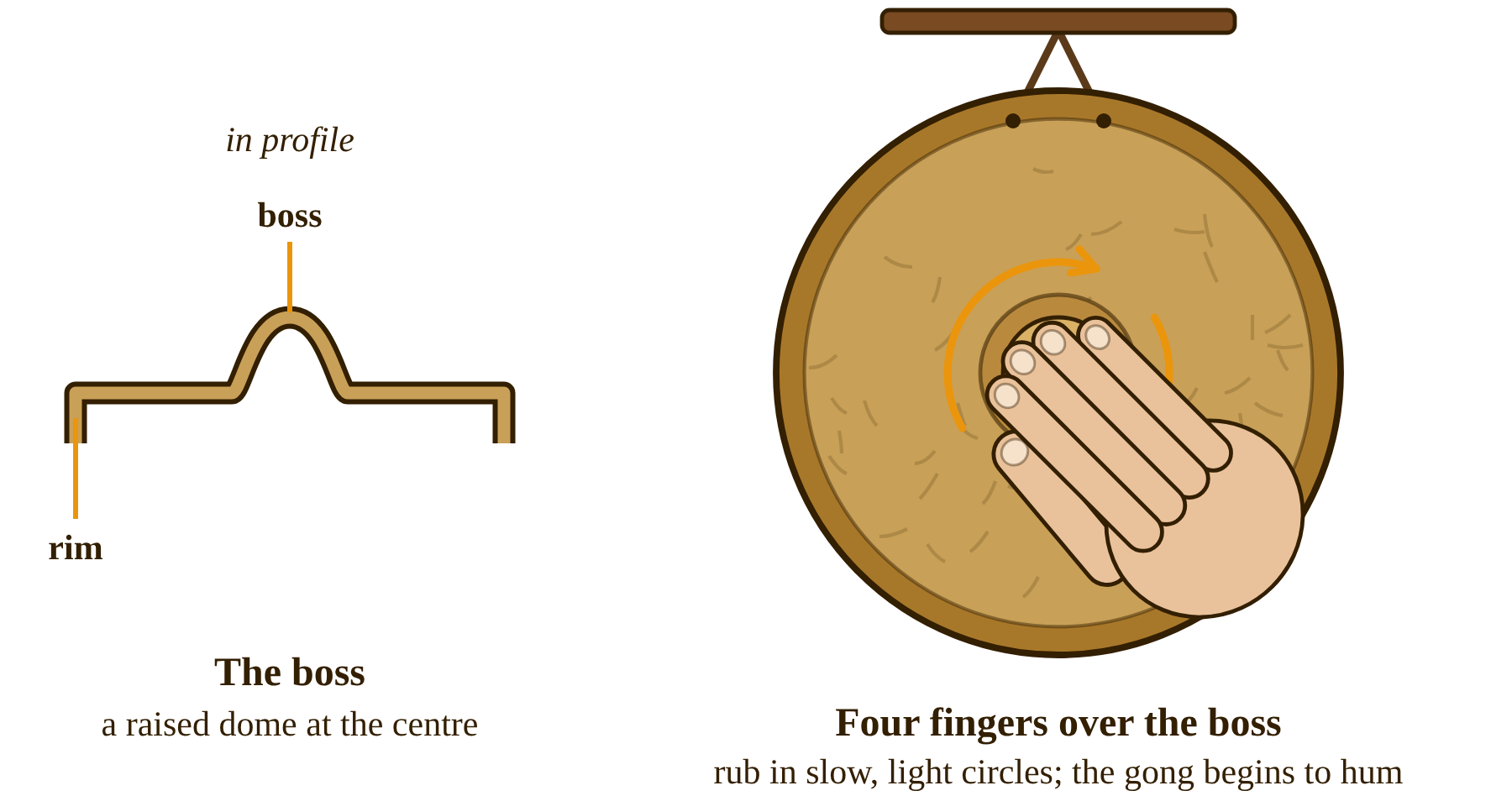
A nipple gong has a raised dome, the boss, at its centre. Struck on the boss, it gives a clear, definite note with less shimmer than a flat gong.
It also has a master technique of its own: rubbing the boss softly by hand. Wake the gong with one gentle tap on the boss, then lay four fingers together, flat, over the boss and rub over it in slow, even circles. The gong begins to hum, and the note swells into a long, singing tone, much like rubbing the rim of a singing bowl.
- Keep the pressure light: press too hard and you damp the hum you are making.
- Keep the circles slow and steady: the longer and more evenly you rub, the stronger the tone grows.
- Keep all four fingers together, so the whole boss is covered as you circle; if they skip or squeak, slow down and lighten your touch.
- To finish, lift your hand away and let the hum fade on its own.
It takes practice. Learn to strike first, and add the hand rub once you know your gong.
How loud should you play?
Softer than you think. A gong can grow very loud, very fast, and the most moving sounds are often the quiet ones.
Play gently near other people, never strike close to someone's head, and keep your first sessions short. If a sound feels uncomfortable to you or your listeners, it is too loud.
Which gong should a beginner start with?
Choose a gong you can hang at home and play without effort. A smaller gong, 13 to 16 inches, has a higher voice and a shorter ring and is easy to hang. A larger gong, 18 inches and up, has a deeper voice and a longer ring that fills the room, but needs a stand and space around it.
Shape matters too. A chau gong has a turned rim and a flat face; its deep, steady tone builds slowly, so it is easy to control. A wind gong is flat with no rim and opens quickly into a brighter wash of sound.
The carving does not change how you play; what each design means is in our guide to Tibetan gong carvings. If you are still choosing between the two instruments, read singing bowls vs gongs.
Looking for a first gong?
Our Tibetan OM Carved Gong is hand-forged in Nepal, with Om at the centre and mantras around it. It comes with a soft felt striker and a wall-hanging setup, in 13 to 22 inches.
| If you want | Look at |
|---|---|
| A first gong for home | Tibetan OM Carved Gong, 13 to 22 inches |
| Mantras all over the face | Mantra Carved Tibetan Gong, 13 to 22 inches |
| A symbol at the centre | Endless Knot Tibetan Gong, 13 to 22 inches |
| A chau gong | Chau Gong with Flower of Life mandala: turned rim, flat face, 16 to 26 inches |
| The Buddha at the centre | Buddha Carved Tibetan Gong, 16 to 22 inches |
| Green Tara at the centre | Green Tara Carved Tibetan Gong, 16 to 22 inches |
| A large gong for a studio or hall | Extra Large Temple Gong, 20 to 39 inches |
| A second, larger mallet | Felt striker, up to extra large, about 11 cm head |
Every gong is in Tibetan gongs.
Can you design your own gong?
Yes. On our custom gong page you choose a wind or chau gong, its size and its design: a mantra, a symbol, your own artwork, or any god at the centre. You can add a mallet, a stand and a carry bag.
For a bowl to play alongside it, use our custom singing bowl page; engraving on a bowl is free.
Frequently asked questions
Where do you hit a gong?
To start, just off centre, in the middle ring of the face. The centre gives the deepest tone and the edge the brightest, so move in or out once you know your gong.
What mallet do you use for a gong?
A soft felt mallet. Every gong we sell comes with a felt striker; a larger, softer mallet brings out deeper tones, a smaller one brighter tones.
What does priming a gong mean?
Priming means a few very soft taps before the first full strike. They set the metal moving, so the next strike blooms instead of clanging.
How hard should you hit a gong?
Gently. A gong builds its big sound from many soft strikes, not from one hard one. If it sounds harsh, strike more softly and let it ring longer.
How do you stop a gong from ringing?
Rest your palm, or the mallet head, flat on the face. A light touch fades the sound; a firmer one stops it at once.
Can you play a gong by rubbing it with your hand?
Yes, on a nipple gong. Lay four fingers together flat over the raised boss and rub over it in slow, light circles; the gong begins to hum and swells into a long, singing note.
How do you play a gong with two mallets?
Hold a mallet or soft-headed drumstick in each hand and strike in turn, left and right, quickly and softly side by side. The strokes blend into one rolling sound, ideal for a smooth swell.
What does swinging or spinning a gong do?
As the gong swings or turns on its cord, its face moves towards and away from you, so the sound sways and wavers. Only do it when the gong hangs securely with space around it.
Do you need a stand for a gong?
A smaller gong can hang from a strong hook on its wall-hanging cord. A larger gong needs a stand and space around it; tell us when you order, or add one on our custom gong page.
What size gong is best for a beginner?
One you can hang at home and play without effort. A 13 to 16 inch gong is easy to hang and has a higher voice; 18 inches and up is deeper but needs a stand and more room.
Can you play a gong at home?
Yes, if it can hang freely and you play softly. Start with ten minutes, as in the session above, and keep the sound gentle near anyone lying close by.
Can you play a gong with singing bowls?
Yes. The two work well together; our guide to combining a gong and singing bowls shows how to shape a session with both.
Ready to play your own gong?
Choose a wind or chau gong, its size and its carving, and add a mallet, stand or carry bag. We hand-forge it for you in Nepal.