




How to Tell an Authentic Singing Bowl From a Factory One
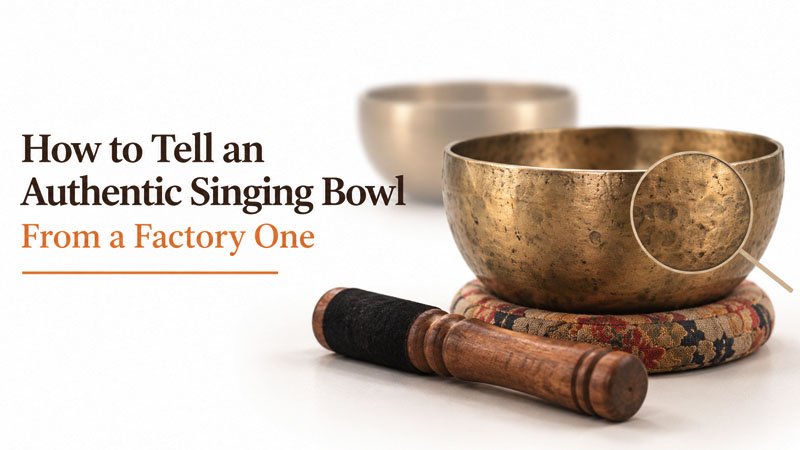
An authentic hand-hammered singing bowl shows uneven hammer marks, a rim that is not a perfect circle, and a sound with several tones that rings for a long time. A bowl called machine made or factory made is really a hand-cast bowl, with a smooth, even wall and a clear, simple tone.
Key takeaways
- No machine makes singing bowls. "Machine made" means hand-cast.
- Look: uneven hammer marks and a slightly uneven rim show hand hammering.
- Strike: several tones and a long ring, not one thin tone.
- Question big claims about age, sacred metals and chakra stickers.
Is there such a thing as a machine made singing bowl?
No machine makes a singing bowl. When a seller or a buyer says "machine made" or "factory bowl", they mean a hand-cast bowl.
So there are two kinds of singing bowl, and you can usually tell them apart by looking at the wall.
| Kind | How it is made | What you see | What you hear |
|---|---|---|---|
| Hand-hammered | Hot bronze beaten into shape by hand | Uneven, overlapping hammer marks | Several tones, long ring |
| Hand-cast, often called machine made | Metal poured into a mould | Smooth, even wall and an even rim | Usually a clear, simple tone |
Our guide to hand-hammered and hand-cast singing bowls compares them in more detail.
What is the five point check?
- 1. Hammer marks: small, overlapping dents that never repeat in a perfect pattern.
- 2. The rim: seen from above, it is rarely a perfect circle.
- 3. The wall: run a finger and thumb around it and feel small changes in thickness.
- 4. The sound: strike it softly and notice more than one tone, with a long ring.
- 5. The seller: they can say who made it, how it was made and where.
No single sign is proof. Use all five together, because marks can be added to a cast bowl, but the sound cannot be copied.
Looking for a hand-hammered bowl?
See our hand-hammered singing bowls from Nepal. A mallet and cushion come with every bowl.
Why does a hand-hammered bowl sound different?
Hand hammering leaves the wall slightly uneven. An uneven wall produces several tones at once and a long ring.
That is also why a hand-hammered bowl's note is discovered, not made. Nobody can know the note until the bowl is finished and played.
You can read the note of any bowl with our free live singing bowl tuner.
Which seller claims should you question?
- "It is antique": truly old bowls are uncommon, and artificial ageing is easy. Read how to spot a fake antique singing bowl.
- "Seven sacred metals": the tradition is real, but tested bowls are mostly bronze. See the seven metals in a singing bowl.
- Chakra colour stickers: a sticker is not a measured note.
- "Made in Tibet": most bowls sold today are made in Nepal and India.
- "Hand-hammered" on a smooth bowl: a perfectly even wall and rim point to a cast bowl.
- A mirror shine: shine is a finish, not a sign of quality.
Is a hand-cast bowl a fake?
No. A hand-cast bowl is an honest bowl when it is sold as cast. It suits a first bowl or a gift, and it costs less.
We keep ours in their own group, hand-cast singing bowls, so you always know which kind you are buying.
How do we choose bowls at Dharma Tool?
- Made in Nepal: our main bowls are hand-hammered by smiths in Nepal.
- Chosen per order: after your order arrives, Sunita plays the bowls and chooses one from her experience in practice.
- Plainly described: hand-hammered, hand-cast and old collected bowls are sold under their own names.
- Made your way: on the custom singing bowl page you choose size and finish and add free engraving.
For bowls that are old, see our antique and collected singing bowls. We never put a date on them.
What are the common mistakes?
- Buying by shine: choosing the brightest bowl on the shelf.
- Buying by story: paying for a claim about age or metals.
- Trusting one sign: hammer marks alone are not proof.
- Fearing "machine made": it only means hand-cast, which is fine when sold honestly.
- Not asking: a good seller is happy to say how the bowl was made.
More are covered in mistakes when buying a singing bowl.
What should you do next?
- See how bowls are made: read how Tibetan singing bowls are made.
- Take the first lesson: what is a Himalayan singing bowl, from our free course.
- Follow the whole course: the free singing bowl healing course.
Frequently asked questions
How do I know a singing bowl is authentic?
Look for uneven hammer marks, a rim that is not a perfect circle and a wall that changes a little in thickness. Then strike it: a hand-hammered bowl gives several tones and rings for a long time.
What is a machine made singing bowl?
There is no machine that makes a singing bowl. When people say machine made or factory bowl, they mean a hand-cast bowl, where metal is poured into a mould.
What is the difference between a hand-hammered and a hand-cast singing bowl?
A hand-hammered bowl is beaten into shape from hot bronze, so its wall is slightly uneven and its sound has several tones. A hand-cast bowl is poured into a mould, so its wall is even and its tone is usually clear and simple.
Are hand-cast singing bowls fake?
No. A hand-cast bowl is an honest bowl when it is sold as cast. It becomes a problem only when it is sold as hand-hammered or antique.
Are authentic Tibetan singing bowls made in Tibet?
Most bowls sold as Tibetan singing bowls today are made in Nepal and India. Ours are made in Nepal, and Tibetan is the name the world knows them by.
Do real singing bowls contain seven metals?
The seven metals are a real and old tradition. When bowls are tested, most are bronze, which is copper and tin, with small traces of other metals.
Can I check a bowl I already own?
Yes. Run the five point check in this guide, then read its note with our free live singing bowl tuner and compare it with what the seller told you.
Want a bowl chosen for you?
Choose the size and finish, and add free engraving. Sunita chooses your bowl after the order arrives.