




What Are the Benefits of Singing Bowl Vibration?
The felt vibration of a singing bowl works on the body rather than the ears. Low-frequency mechanical vibration stimulates skin and tissue mechanoreceptors, which can dampen pain signalling through the gate control mechanism, release muscle guarding, raise heart rate variability, and pull attention out of thought and into physical sensation. Large bowls produce fundamentals of roughly 80 to 160 Hz — inside the range clinical vibroacoustic therapy uses.
Most writing about singing bowl benefits is really about sound — the tone, the overtones, the calming effect of listening. This is about the other half: the part you feel in your hands, your chest and the floor beneath you.
It behaves differently from sound, it reaches the body through a different sensory system, and the benefits it produces are physical rather than auditory.The two qualities of a singing bowl covers the mechanism in full. This one covers what that felt vibration actually does — and, honestly, where the evidence runs out.
How Does Vibration Act on the Body?
Mechanical vibration entering the body through contact stimulates mechanoreceptors — specialised nerve endings in skin, tissue and near bone that respond to physical oscillation rather than to sound. The main ones, the Pacinian corpuscles, respond across roughly 50 to 1,000 Hz and peak in sensitivity near 250 Hz.
That stimulation does several things at once, and the effects are physiological rather than metaphorical.
It occupies the nervous system's signalling pathways. It changes muscle tone. It shifts autonomic balance toward the parasympathetic. And it gives conscious attention something physical to rest on. Each of those produces a different benefit.
Pain Modulation and the Gate Control Mechanism
This is the best-established of the effects, and it is the reason everyone instinctively rubs a knee they have just banged.
Under the gate control theory of pain, the spinal cord has limited capacity to carry sensory traffic upward. Signals from fast mechanoreceptors and signals from slower pain fibres compete for the same pathway. Flood the pathway with mechanical sensation and less pain signal gets through. The pain has not gone — the message is simply arriving reduced.
Vibration is a particularly efficient way to occupy that pathway, because mechanoreceptors respond to it strongly and continuously. This is the principle underpinning clinical vibroacoustic therapy, where low-frequency vibration is delivered through mats, chairs and beds for chronic low back pain, fibromyalgia and post-surgical discomfort.
One further detail from the research is worth knowing: low-frequency vibration is consistently rated as pleasant, while high-frequency vibration tends toward unpleasant — and pleasant stimuli applied during muscle pain produced overall pain relief, while unpleasant ones intensified it. The frequency band matters, and it is the low end that helps.
Muscle Tension and Guarding
Muscle guarding is protective. The body tightens around an area it considers vulnerable and holds it there, often long after the original reason has passed. Told to relax, a guarded muscle typically does not, because the instruction is going to a system that is not listening to language.
Sustained low-frequency vibration reaches that system directly. In a 2022 randomised controlled trial of 54 university students, low-frequency sound vibration produced measurable reductions in subjective muscle tension alongside the physiological changes. Practitioners working with vibration report the same thing consistently — a shoulder that would not release to instruction releases to sustained mechanical input.
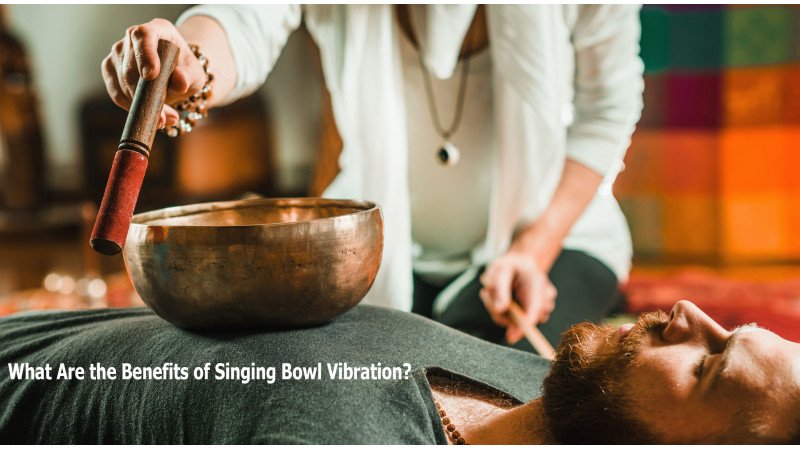
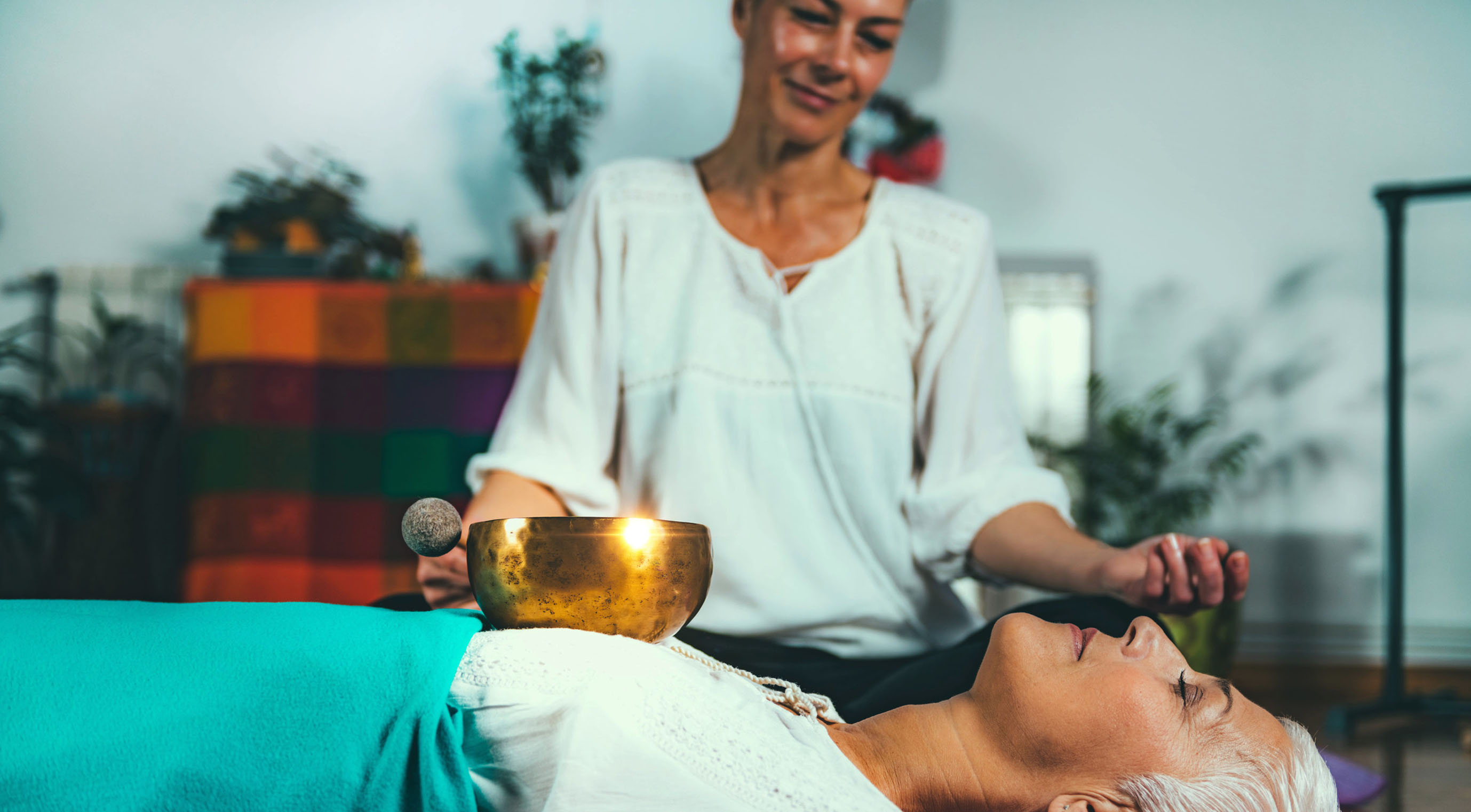
This is why singing bowl massage work places bowls directly on or beside the body. Contact delivers the mechanical stream at full strength, without a floor or a cushion absorbing most of it first.
Heart Rate Variability and Autonomic Balance
Heart rate variability measures the natural variation in interval between heartbeats. Higher variability indicates a nervous system able to move flexibly between activation and rest; chronic stress and trauma both reduce it.
That same 2022 trial, double-blinded and randomised, found the strongest and only statistically significant between-group result in HRV — the vibration group showed genuine improvement in autonomic markers over the control group. Subjective stress and muscle tension improved in both groups; the physiological measure separated them.
That is a useful result to hold onto, because it is measurable rather than reported. Something in the body changed that the participant could not have produced by expecting it to. The vagus nerve pathway is the most likely route.
Vibration is a question of size — small bowls cannot produce it
The felt component depends on a low fundamental, and a low fundamental depends on a large, thick-walled bowl. Explore large standing bowls for room-filling physical resonance, hand-casted bowls whose heavier walls sit lower, or handmade bowls in the balanced mid-range.
Body Awareness and Getting Out of Your Head
Vibration arrives with no content. There is nothing in it to interpret, follow, remember or think about — which makes it unusually good at interrupting the loop of thought.
Sound can be attended to or ignored, and the mind can quite happily think about something else while music plays. Felt vibration is harder to sit alongside. Attention goes to the sensation because the sensation is physically present, and while attention is there it is not somewhere else.
For anyone whose relationship with their own body has become distant — through stress, through dissociation, through simply living in their head — this is a gentle route back. No instruction to feel anything, no requirement to describe it. The vibration arrives and the body notices.
Sleep and Downregulation
The pattern that precedes sleep is not mysterious: breathing slows and lengthens, muscle tone drops, and the autonomic system shifts toward parasympathetic dominance. Anything producing those changes moves the body toward sleep.
Low-frequency vibration produces all three. Breathing slows without instruction — people synchronise with sustained low tones automatically. Muscle tension drops. Autonomic balance shifts. Studies of vibroacoustic therapy in chronic pain populations consistently report improved sleep quality alongside pain outcomes, and improved sleep is often the change participants value most.
What the Research Actually Shows — and What It Does Not
Here is where most articles on this subject become unreliable, so this section is deliberate.
The evidence base is real but preliminary. A 2022 scoping review screened over 430 records and examined 20 studies, most concerning chronic pain — fibromyalgia, musculoskeletal conditions, low back pain. A 2018 pilot study applied vibration at 16-160 Hz through the hands and feet to 23 people with chronic back or shoulder pain, three sessions weekly for twelve weeks, and found significant pain reduction and improved function. A 2022 randomised controlled trial of 54 students found significant HRV improvement.
The evidence is also mixed. A multicentre trial applying abdominal vibration at 20-100 Hz alongside music found it well tolerated but produced no clinically meaningful pain reduction over high-frequency controls. That result deserves stating as plainly as the positive ones.
And there is a gap that matters. This research is conducted with calibrated devices — transducer mats, vibroacoustic chairs, multi-motor units delivering precise frequencies at controlled amplitudes. A singing bowl is not a calibrated device. It produces a fundamental within the same range, delivered through contact rather than through a mat, at whatever amplitude the person playing it happens to produce.
The mechanism is the same. The delivery is not. Anyone claiming clinical trial results for singing bowls specifically is overstating what has been shown.
| Reasonably supported | Not supported |
|---|---|
| Low-frequency vibration can dampen pain signalling via gate control | Singing bowls treat or cure any condition |
| Measurable increases in heart rate variability | Vibration works at a cellular or molecular level |
| Reduced subjective muscle tension | Specific frequencies target specific organs |
| Improved sleep quality in chronic pain groups | Bowls can replace pain medication or physiotherapy |
| Parasympathetic activation and slower breathing | Clinical trial results apply directly to bowls |
| Increased body awareness and reduced rumination | Effects are guaranteed or consistent between people |
The honest position is that vibration does something real, the mechanism is understood, the clinical evidence is promising and incomplete, and a singing bowl is a good non-clinical way to access it. That is a genuinely worthwhile claim. It does not need inflating.
How to Actually Get the Vibration, Not Just the Sound
Most people never experience the felt component, because the setup prevents it. Vibration weakens sharply with distance and is absorbed by every soft surface between the bowl and the body.

- Use a large bowl. Fundamental frequency is decided by size. A small bowl's fundamental sits above the range the body registers, so no amount of technique will make it felt.
- Hold it in open palms. The hands are dense with mechanoreceptors and the contact is direct. This is the quickest way to feel a bowl properly and the best test of whether yours can produce it at all.
- Sit on a hard floor, barefoot. The feet are more sensitive to low-frequency vibration than the fingertips, because a larger contact area recruits more receptors. Carpet, shoes and upholstery all absorb before it arrives.
- Stay within a metre. Sound carries across a room. Vibration does not.
- Build the tone fully. A partially built tone is audible long before it is palpable. The playing guide covers getting a bowl to full volume.
- Let the fade run out. The felt component is often clearest as the sound drops away and the ear stops dominating attention.
Who Should Be Cautious
Vibration is physical input, and a few situations call for care. This is rarely covered and it should be.
Pacemakers and implanted devices. Do not place a bowl directly on the body near an implanted electronic device. Playing a bowl in the room is a different matter and is not a concern.
Pregnancy. Avoid direct placement on the abdomen or lower back. Listening at a normal distance is widely considered fine, but body placement should wait.
Recent surgery, fractures, or acute injury. Do not apply vibration over a healing site. Wait until cleared.
Thrombosis or clotting disorders. Avoid direct body placement entirely and speak to a doctor first.
Epilepsy. Rare, but sustained rhythmic stimulation can be a trigger for some people. Worth knowing before a long session.
Anyone in acute distress. Vibration can surface emotion, which is often useful and occasionally overwhelming. Shorter sessions and the freedom to stop at any point matter more than duration.
None of this makes singing bowls dangerous. They are among the gentlest physical interventions available. But body-placement work is bodywork, and bodywork has contraindications.
Which Bowls Deliver Vibration
The felt component depends almost entirely on fundamental frequency, and fundamental frequency depends on size and wall thickness.
Large standing bowls of 25cm and above produce fundamentals around 80 to 160 Hz — squarely inside the range clinical vibroacoustic work uses. These fill a room with physical presence, not only sound. Our guide on choosing a large singing bowl covers sizing.
Thick walls lower the fundamental further. Heavier bowls carry more physical weight in the tone. Hand-casted bowls tend to be thicker and heavier than forged ones of the same diameter, which makes them well suited to body-contact work.
Bronze rather than brass. Bronze carries and sustains vibration efficiently. Machine-pressed brass bowls are softer, thinner and damp quickly — they produce a thin sound and almost no felt component at all.
Commissioning for Vibration
A stock bowl arrives with whatever fundamental its dimensions happened to produce. For practitioners who need a specific low note, or a bowl heavy enough to be felt through a treatment table, those characteristics are set at the forge.
The custom singing bowl service lets you specify size, wall thickness, musical note, metal composition and engraving, hand-forged by artisans in Kathmandu. For vibration work in particular, requesting a low fundamental and a heavy wall changes what the instrument is physically capable of delivering.
For body work, the note and the wall thickness decide everything
A bowl that will be felt through a treatment table needs a low fundamental and a heavy wall — neither of which you can pick from a shelf. Through Dharma Tool's custom singing bowl service you specify size, note, thickness, engraving and intention, and the bowl is hand-forged in Kathmandu. Optional monk blessing on every commission.
What Vibration Is Good For
The felt component is not a bonus feature on top of the sound. It is a separate channel doing separate work.
Sound is for the mind — directional, detailed, easy to attend to and equally easy to think about. Vibration is for the body. It arrives without content, occupies the sensory pathways pain uses, releases muscle the way instruction cannot, and moves attention out of thought and into sensation.
For meditation, transitions and attention training, sound does the work. For pain, tension, embodiment and downregulation, vibration does. A bowl large enough to give you both is worth considerably more than two bowls that only give you one.
A note on health: Singing bowls support relaxation, body awareness and nervous system regulation. They are not medical devices and are not a treatment for pain or any other condition. If you are living with chronic pain, work with a qualified clinician — vibration is a useful complement to that care, not a substitute for it.
Frequently Asked Questions
What are the benefits of singing bowl vibration?
Felt vibration can dampen pain signalling through the gate control mechanism, release muscle guarding that does not respond to instruction, raise heart rate variability, support sleep, and pull attention out of thought into physical sensation. These are physical effects delivered through mechanoreceptors in skin and tissue, and they are distinct from the effects of hearing the bowl.
How does vibration reduce pain?
Through the gate control mechanism. The spinal cord has limited capacity to carry sensory signals upward, and input from fast mechanoreceptors competes with slower pain fibres for the same pathway. Flooding that pathway with mechanical sensation means less pain signal reaches the brain. It is the same reason rubbing a knocked knee helps, and it is the principle behind clinical vibroacoustic therapy.
Is there scientific evidence for singing bowl vibration?
There is real evidence for low-frequency vibration, and it is preliminary. A 2022 scoping review examined 20 studies, mostly on chronic pain. A 2018 pilot study found significant pain reduction over twelve weeks. A 2022 randomised controlled trial found significant heart rate variability improvement. One multicentre trial found no meaningful benefit. Importantly, this research uses calibrated devices rather than singing bowls — the mechanism is shared, but the delivery differs, and claiming clinical results for bowls specifically overstates what has been shown.
Which singing bowl gives the most vibration?
A large bowl with thick bronze walls. Fundamental frequency decides the felt component, and fundamental frequency is set by size and wall thickness. Large standing bowls of 25cm and above produce fundamentals around 80 to 160 Hz, inside the range used in clinical vibroacoustic work. Small bowls sit above the range the body registers and cannot produce it regardless of technique.
Why can I hear my singing bowl but not feel it?
Usually the bowl is too small, you are too far away, or something soft is absorbing the energy. Vibration weakens sharply with distance while sound carries across a room, and carpet, shoes and upholstered furniture all absorb mechanical energy. Test it by holding a struck bowl in both open palms — the hands are dense with receptors and the contact is direct.
Is singing bowl vibration safe for everyone?
Playing a bowl in a room is safe for essentially everyone. Placing one directly on the body is bodywork and has contraindications: avoid direct placement near implanted electronic devices, over the abdomen or lower back in pregnancy, over recent surgery or fractures, and entirely in cases of thrombosis or clotting disorders. Anyone with epilepsy should be aware that sustained rhythmic stimulation can occasionally be a trigger.