



Eyes of Buddha Singing Bowl - What the Wisdom Eyes Mean
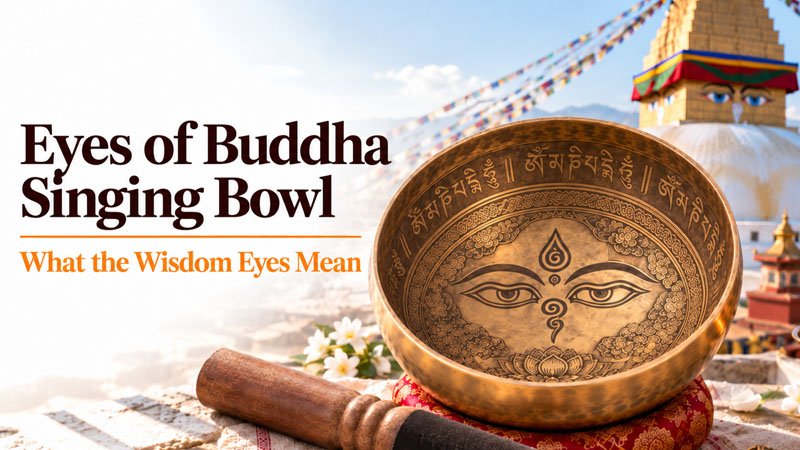
The eyes on a singing bowl are the Eyes of Buddha, also called wisdom eyes: the same eyes that look out from the great stupas of Kathmandu. Half closed in meditation, they stand for the Buddha's wisdom seeing in every direction. The curl above them is the third eye, and the mark below, where a nose would be, is the Nepali number one, १, for unity.
Key takeaways
- What they are: the Eyes of Buddha, or wisdom eyes.
- Where they come from: the stupas of Boudhanath and Swayambhunath.
- Three parts: half-closed eyes, the third eye, and the Nepali number one.
- On a bowl: usually at the centre inside, sometimes on the base.
What are the Eyes of Buddha?
The Eyes of Buddha, also called wisdom eyes, show the Buddha's wisdom, which sees in every direction. On Nepali stupas they are painted on all four sides of the square tower above the dome, so they look out over the whole valley.
You can see them at Boudhanath, the great white stupa at the heart of Kathmandu's Tibetan community, and at Swayambhunath on its hill above the city. Both are UNESCO World Heritage Sites, and the eyes have become a symbol of Nepal itself.
How do you read the Buddha eyes?
| Part | What it shows |
|---|---|
| Half-closed eyes | The calm gaze of meditation |
| The curl above | The urna, or third eye, one of the marks of a Buddha |
| The "nose" | The Nepali number one, १: unity, and the one path |
| Four sides | On a stupa: wisdom that sees in every direction |
The question-mark shape is not a nose at all. It is the number one written in Devanagari, the script of Nepali, so the eyes carry a word of Nepal's own language.
Where do the eyes appear on a bowl?
On most of our eyes bowls, the Eyes of Buddha are etched at the centre inside, with mantra around the outside and a symbol such as the endless knot or the Dharma wheel on the base. On a few, the eyes look out from the base instead, with Om, a Dharma wheel or a double dorje at the centre.
Our Om Eyes of Buddha bowl is one of these: a Tibetan Om at the centre, Om Mani Padme Hum around the outside and the eyes beneath. Om is explained in Om singing bowl meaning, and the mantra in Om Mani Padme Hum singing bowl.
Looking for an Eyes of Buddha bowl?
Our Om Eyes of Buddha bowl has a Tibetan Om at the centre, Om Mani Padme Hum around the outside and the Eyes of Buddha on the base, hand-hammered, in 7 to 12 inches.
Which Eyes of Buddha bowl should you choose?
| If you want | Look at |
|---|---|
| Om inside, eyes below | Om Eyes of Buddha bowl, 7 to 12 inches |
| Eyes inside, Om Mani Padme Hum around | Eyes of Buddha mantra bowl: endless knot on the base, 7 to 12 inches |
| Eyes with the Dharma wheel below | Eyes of Buddha Dharma chakra bowl, 8 to 12 inches |
| Mantra inside and out | Buddha eyes full mantra bowl: endless knot underneath, 7 to 12 inches |
| A mantra wheel below | Buddha eyes mantra chakra bowl, 7 to 12 inches |
| A thick-walled Jhumka bowl | Jhumka Buddha eyes bowl, 7 to 10 inches |
| The Dharma wheel inside, eyes below | Dharma chakra Buddha eyes bowl, 6 to 12 inches |
| A double dorje inside, eyes below | Double dorje focus bowl, 7 to 12 inches |
| A small bowl for the palm | Hand-beaten Buddha eyes bowl: raised eyes at the centre, 4 to 6 inches |
Every symbol bowl is in carved and etched singing bowls, and other symbols are explained in singing bowl symbols and mantras.
How do you use an Eyes of Buddha bowl?
- Soften your eyes: let them half close, like the eyes on the bowl, resting on its centre.
- Strike once and follow the sound as it spreads out in every direction.
- Widen your attention: notice sounds near and far, without fixing on any one.
- Return to the eyes on the bowl when your mind wanders, and strike again.
Practice like this supports relaxation and focus, and does not treat any condition.
Can you have the Buddha eyes on your own bowl or gong?
Yes. Ask for the Eyes of Buddha at the centre or on the base of a custom singing bowl, with the mantra of your choice around the outside; engraving is free. For a gong, use our custom gong page.
Frequently asked questions
What do the eyes on a singing bowl mean?
They are the Eyes of Buddha, also called wisdom eyes: the Buddha's wisdom, which sees in every direction. They are the same eyes painted on the great stupas of Kathmandu.
What is the symbol between the Buddha's eyes?
The small curl or dot above is the urna, or third eye, one of the marks of a Buddha. The question-mark shape below, where a nose would be, is the Nepali number one, १, a symbol of unity.
Why are the Buddha's eyes half closed?
They show the calm gaze of meditation: neither shut away from the world nor caught up in it.
Where can I see the Buddha eyes in Nepal?
On the stupas of Boudhanath and Swayambhunath in Kathmandu, both World Heritage Sites, and on many smaller stupas and chaityas across the valley.
Are the eyes inside or under the bowl?
On most of our eyes bowls they are etched at the centre inside. On a few, such as our Om bowl, they are engraved on the base, with Om or a Dharma wheel at the centre.
Can I have the Buddha eyes engraved on my own bowl or gong?
Yes. Ask for them on our custom singing bowl page, or on our custom gong page for a gong. Engraving on a bowl is free.
Want the Eyes of Buddha on your bowl?
Choose the size and finish, and ask for the eyes at the centre or on the base, with your mantra around them. Engraving is free, and Sunita chooses your bowl after your order arrives.