




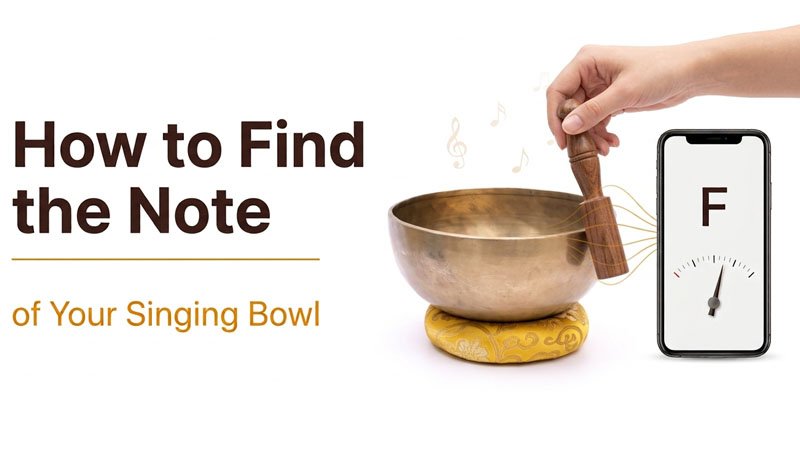
How to Find the Note of Your Singing Bowl
To find the note of your singing bowl, strike it softly and play it into a tuner: the lowest steady pitch it shows is your bowl's note. Our free live singing bowl tuner does this in your browser and shows the note and the frequency in a few seconds.
Key takeaways
- A tuner is the quickest way, and it takes about two minutes.
- Strike softly in a quiet room and read the lowest steady pitch.
- Two notes from one bowl is normal, one when struck and one when rubbed on the rim.
- Between two notes is normal too, because a hand-hammered bowl's note is discovered, not made.
What do you need to find the note?
- Your bowl, resting on its cushion so it rings freely.
- A soft mallet, because a padded or felt end gives the cleanest low tone.
- A phone or laptop with a working microphone.
- A quiet room, with fans, music and the television off.
Then open our free live singing bowl tuner. It runs in the browser, so there is nothing to install.
How do you find the note, step by step?
- Place the bowl on its cushion about a hand's length from the microphone.
- Open the tuner and allow it to use the microphone when your browser asks.
- Strike once, softly, on the outside wall just below the rim.
- Wait a moment for the first clang to pass and the reading to settle.
- Write down the note, the frequency in Hz and the cents.
- Repeat three times and keep the reading that comes up most often.
Do not hold the bowl by its wall while you test it. Fingers on the metal shorten the sound and can change the reading.
Have your bowl beside you?
Open the free tuner, strike once and read the note. It runs in your browser, with nothing to install.
Why does one bowl show two different notes?
A hand-hammered bowl sounds several pitches at once. That mix is what gives it a rich voice, and it is also why a tuner can show more than one note.
| How you play | What you usually hear | What to write down |
|---|---|---|
| Soft strike with a padded mallet | The lowest tone of the bowl | The struck note |
| Rubbing the rim with a wooden mallet | Often a higher tone | The rim note |
| Hard strike with bare wood | A bright mix of high tones | Nothing, strike softer and try again |
Write down both the struck note and the rim note. Most people name a bowl by its struck note, and our post on singing bowl octaves explains why the two can be far apart.
What if the reading is between two notes?
That is normal. A hand-hammered bowl's note is discovered, not made, so it rarely lands exactly on a piano note.
The tuner shows the gap in cents. There are 100 cents between one note and the next, so a reading of F plus 20 cents is still an F, sitting slightly high.
A reading near 50 cents means the bowl sits half way between two notes. The pitch standard matters as well, as we explain in 432 Hz and 440 Hz singing bowls.
What does the note tell you?
It tells you where the bowl sits in a set and which chakra it is paired with. Our guide to singing bowl notes, frequencies and chakras gives the pairs.
Remember that the pairing depends on the tradition, Tibetan or Vedic. The pairs we use are on our chakra note information page and in the course lesson on notes and frequencies.
How do you find the note without a tuner?
- Piano or keyboard app: strike the bowl, then play keys one at a time until one blends with the bowl's lowest tone.
- Guitar tuner app: it works, but it may jump between pitches because a bowl sounds several at once.
- A musician friend: someone with a trained sense of pitch can name the note in a moment.
All three are slower than a tuner made for bowls, and none of them gives you the cents.
What should you do once you know the note?
- Write it in a notebook, with the date, so you can compare later.
- Want a note you do not have: on most of our hand-hammered singing bowls you select the note when you order.
- Want a bowl with the note chosen up front: see the note select singing bowl or the chakra symbol note selected bowl.
- Want one bowl made your way: ask for the note on the custom singing bowl page, and add free engraving.
- Building a set: send the notes you own through the set builder, and the new bowls are chosen to sit with them.
When you ask for a note, it is met by selection. After your order arrives, Sunita plays the bowls in your size and chooses one from her experience in practice.
What are the common mistakes when finding a note?
- Striking too hard: a hard hit brings out high tones and hides the low one.
- A noisy room: a fan or a fridge can give the tuner a false reading.
- Holding the wall: fingers on the metal stop the bowl ringing.
- One reading only: trusting a single strike when three give a surer answer.
- Calling it out of tune: judging a hand-hammered bowl against a piano, when a small gap is normal.
What should you learn next?
Once you know the note, learn what to do with it. The free singing bowl healing course starts with notes and playing, and builds up to full sessions.
Frequently asked questions
What note is my singing bowl?
Strike the bowl softly and play it into a tuner. The lowest steady pitch the tuner shows is the note of your bowl.
How do I find the note of a singing bowl without a tuner?
Match it against a piano or a keyboard app. Strike the bowl, then play keys one at a time until one blends with the bowl's lowest tone.
Why does my singing bowl show two different notes?
A hand-hammered bowl sounds several pitches at once. Striking usually brings out the lowest one, and rubbing the rim often brings out a higher one, so one bowl can give two readings.
Which is the real note of a singing bowl, struck or rimmed?
Write down both. Most people name a bowl by the low note it gives when struck softly, and the rim note is useful to know when you play the bowl by rubbing.
Is my singing bowl out of tune if it is between two notes?
No. A hand-hammered bowl's note is discovered, not made, so it rarely lands exactly on a piano note. A reading a little above or below a note is normal.
Can I use a guitar tuner for a singing bowl?
You can, but it may jump between pitches, because a bowl sounds several at once. A tuner made for singing bowls is steadier and easier to read.
How do I match my singing bowl's note to a chakra?
Use a chakra note chart for the tradition you follow. The note for each chakra depends on the tradition, Tibetan or Vedic, so there is more than one chart.
Looking for a bowl in a note you do not have?
See our hand-hammered singing bowls, where size, finish and note are selectable on most bowls. A mallet and cushion come with every bowl.