



Gong Bath at Home - A First Session With One Gong
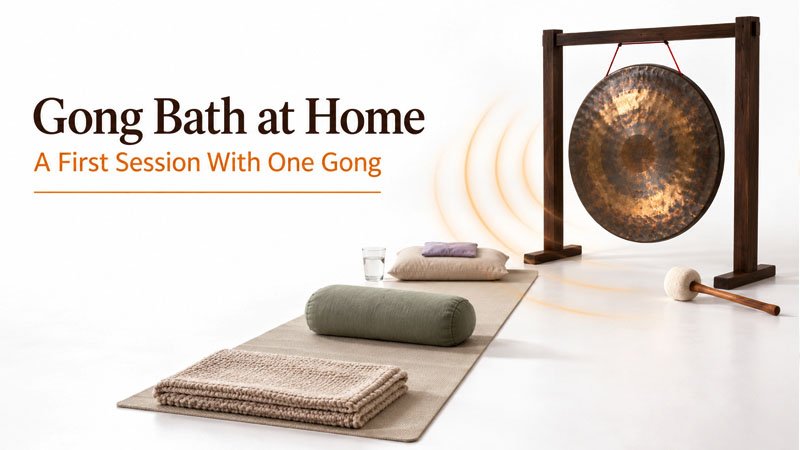
To do a gong bath at home, hang one gong at the listener's feet, 1 to 2 metres away, in a warm, quiet, dim room, and let them lie on a mat under a blanket. Play softly for 20 to 30 minutes: wake the gong, build slowly to a gentle swell, ease down and finish with five minutes of silence. Keep it soft enough to talk over, and check with a doctor first if you are pregnant, have epilepsy or have an implant.
Key takeaways
- Set-up: gong at the feet, 1 to 2 metres away, head furthest from the sound.
- Prepare: loose, warm clothes, a light meal and phones on silent.
- Length: 20 to 30 minutes for a first session, including silence.
- Volume: soft enough to talk over; never loud near the head.
- Who plays: a partner, yourself, or a recording of your own gong.
- Safety: check with a doctor first if you are pregnant, have epilepsy or an implant.
What is a gong bath?
A gong bath, also called gong meditation or a gong sound bath, is a session in which you lie still while a gong is played and let the sound wash over you. There is no water: the "bath" is the sound, which surrounds you as you rest.
Most gong baths are held in yoga studios and halls, with a practitioner and a room full of people. A gong sound bath at home, or gong meditation at home, is simpler: with one Tibetan gong and a little care, beginners can give a gentle session to themselves or their family.
Is a gong bath the same as a sound bath?
A gong bath is one kind of sound bath. A sound bath is any session where you rest in sound, from singing bowls, crystal bowls, chimes or tuning forks, while a gong bath, or gong sound bath, is led by the gong.
A gong gives a full, rolling wash that seems to fill the whole room. A singing bowl gives a clearer, quieter single tone that suits small rooms and short sessions, and many home sessions use a bowl to begin and end, with the gong in the middle.
What does the research say?
The research is still early. In one study of 62 adults, an hour of sound meditation with gongs, singing bowls and other instruments was followed by lower tension, anger, fatigue and low mood, and people new to it showed the biggest drop in tension (Goldsby and colleagues). The authors note it had no control group, so the results are a starting point, not proof.
Most people simply find a gong bath deeply restful. A gong bath supports relaxation and focus, and does not treat any condition.
What do you need for a gong bath at home?
| What you need | Why |
|---|---|
| One gong, ideally 20 to 28 inches | A full, warm sound that fills an ordinary room; a smaller gong works too |
| A large, soft felt mallet | Draws out the deep tones without harsh edges; our felt strikers come in large and extra large |
| A stand or a strong hook | The gong must hang freely to ring |
| A mat or thick blanket | Somewhere comfortable to lie for half an hour |
| A cushion and a pillow | One under the knees to ease the lower back, one under the head |
| A warm blanket | The body cools as it rests |
| An eye pillow or scarf | Darkness helps the mind settle |
| A glass of water | For afterwards |
The size of the gong matters less than how gently you play it. Which size suits your room is in our gong size guide.
How do you set up a room for a gong bath at home?
Choose a room where you will not be disturbed, turn phones to silent, close the curtains and make it warm, because the body cools as it rests. Clear away anything that might rattle, such as glasses or loose ornaments.
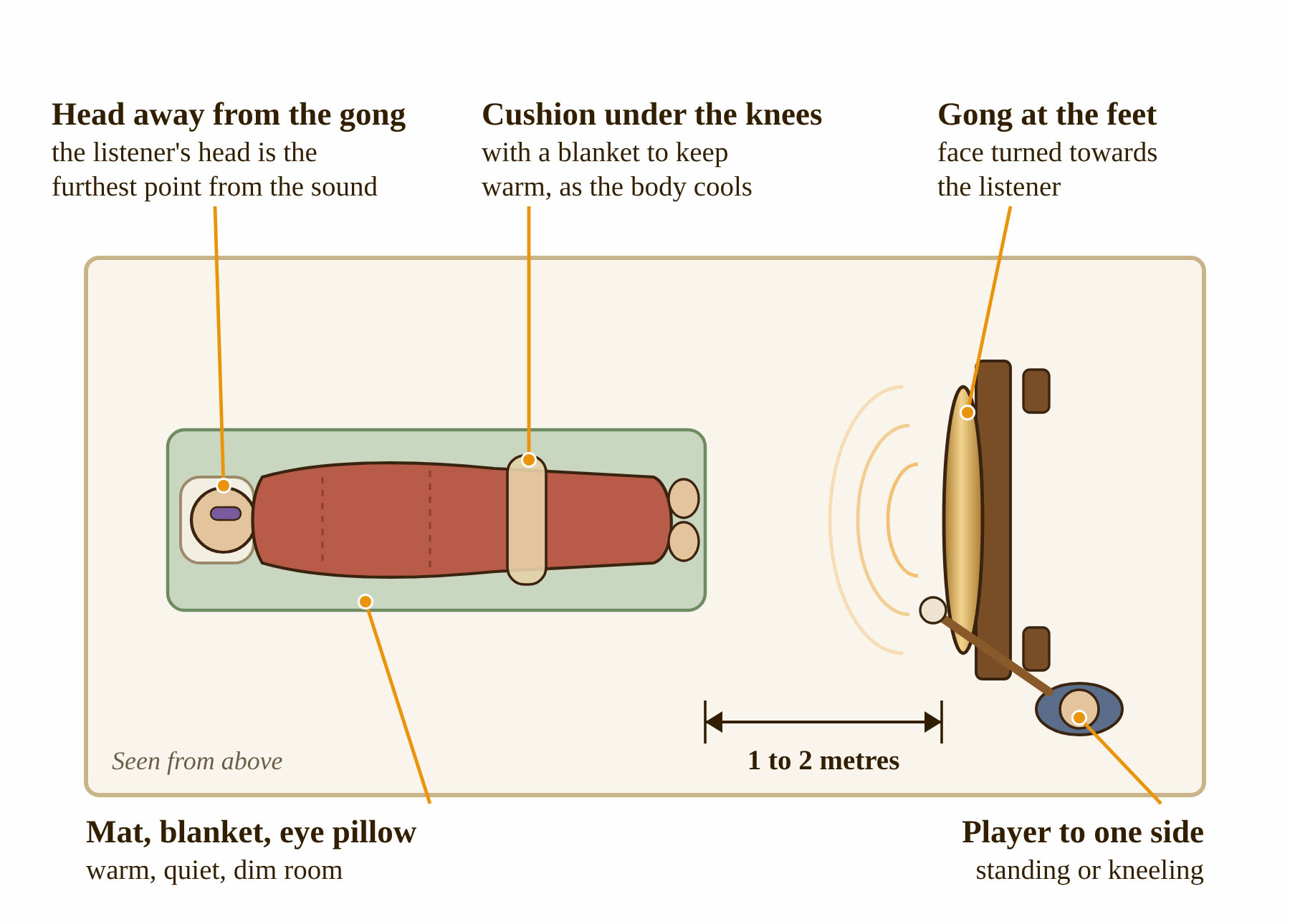
Lay the mat so the listener's feet point towards the gong, and hang the gong 1 to 2 metres from the feet with its face turned towards them. That keeps the head the furthest point from the sound. The player stands or kneels to one side of the gong.
How should you prepare for a gong bath at home?
- Wear loose, warm clothes and socks, and take off belts, glasses and heavy jewellery.
- Eat lightly, and leave an hour or two after a big meal.
- Skip alcohol beforehand, and use the toilet before you lie down.
- Arrive calm: if you feel restless, take a short walk or a few slow breaths first.
- Set a simple intention, such as "rest" or "let go of the day", then let it go.
Who plays the gong?
The easiest way is for someone else to play while you rest, then swap. If you are on your own, play for yourself: sit or kneel beside the gong, play softly with your eyes half closed, then lie down for the silence.
You can also record your own gong and play it back through good speakers, not a phone speaker, at a moderate volume. That way you can rest fully while your own gong plays.
How do you do a gong bath at home, step by step?
This 30-minute plan suits beginners and a first gong bath at home.
| Time | Step | What to do |
|---|---|---|
| 0 to 5 min | Settle | Lie down, cover up, close your eyes and take a few slow breaths |
| 5 to 7 min | Wake the gong | A few priming taps near the centre, barely audible |
| 7 to 15 min | Soft start | Single soft strikes just off centre, letting each one fade most of the way |
| 15 to 22 min | Gentle swell | A run of even strikes, each a little stronger, held at a soft, steady wash |
| 22 to 25 min | Ease down | Fewer, softer strikes, then let the gong fade on its own |
| 25 to 30 min | Silence | Rest in the quiet; this is part of the gong bath |
| After | Return | Wiggle fingers and toes, roll onto your right side, then sit up slowly |
The secret is patience. A gong's deep wash comes from many soft, even strikes, not from hitting hard, so let each sound bloom and fade before the next.
Priming, single strikes and the swell are explained step by step in our guide on how to play a gong.
How loud should a gong bath be at home?
Softer than you think. A gong played hard can be very loud up close, and hearing experts see 85 decibels as the point where sound starts to harm hearing over time; above that, every 3 decibels halves the safe exposure time (NIOSH).
| Sound level | Safe time (NIOSH) |
|---|---|
| 85 dB | 8 hours |
| 91 dB | 2 hours |
| 94 dB | 1 hour |
| 97 dB | 30 minutes |
| 100 dB | 15 minutes |
At home, keep the gong at a level you could still talk over, avoid big crashes in a small room, and never play loud near anyone's head. A free sound-meter app on your phone helps: aim to stay under about 70 decibels where the listener lies.
Think of the people and animals around you too. Pets hear more sharply than we do, sound travels through walls, and anyone in the room should be free to stop the session at any time.
Who should check with a doctor first?
Gong baths are gentle for most people, but some should speak to a doctor first (Healthline):
- Pregnancy, especially in the early months.
- Epilepsy or a history of seizures.
- A pacemaker or other implanted device, or recent surgery.
- A serious heart condition.
- Hearing aids, tinnitus or sensitivity to sound.
- Migraines triggered by sound or vibration.
- Severe trauma triggered by sound, a history of psychosis, or a mental health crisis.
If anyone feels uncomfortable, dizzy or anxious during the session, stop, open the eyes and sit up slowly.
What might you feel during a gong bath?
Most people feel deeply relaxed, and many drift between waking and sleep. Tingling, warmth, a cooler body, a sense of time passing quickly, or emotions coming to the surface are all common.
There is nothing you need to do. Breathe, rest and let the sound come and go.
What should you do after a gong bath?
Stay lying down for a moment, then wiggle your fingers and toes, roll onto your right side and sit up slowly. Sit for a minute before standing, drink some water and take the next half hour gently.
An evening gong bath before bed suits many people. To start, once or twice a week is a good rhythm.
What are the most common beginner mistakes?
- Playing too hard. Loud crashes startle the body instead of settling it.
- Playing too close to the head. Keep the gong at the feet, 1 to 2 metres away.
- Rushing the strikes. Let each sound bloom and fade before the next.
- Skipping the silence. The quiet at the end is part of the gong bath.
- Going too long too soon. Start with 20 to 30 minutes and build up.
- Using a phone speaker for recordings, which loses the deep tones.
- Trying hard to feel something. Just rest; whatever comes is fine.
Which gong is best for a gong bath at home?
A chau gong or a hand-forged Tibetan gong of 20 to 28 inches suits most homes: deep, warm and steady when played softly. A wind gong gives a brighter wash but becomes loud and crashy more quickly, so it needs a lighter hand. The differences are in our guide to types of gongs.
Gongs and bowls are compared in our guide to singing bowls vs gongs. If you would rather start with a bowl, see our guide to choosing your first singing bowl.
Our gongs are hand-forged in Nepal and come with a soft felt striker, and most with a wall-hanging setup.
Choosing a gong for home?
Our Chau Gong with Flower of Life mandala comes in 16 to 26 inches, a deep, steady gong for gentle home gong baths, hand-forged in Nepal.
| If you want | Look at |
|---|---|
| A deep, steady gong | Chau Gong with Flower of Life mandala, 16 to 26 inches |
| A hand-forged Tibetan gong | Tibetan OM Carved Gong, 13 to 22 inches |
| A gong covered in mantras | Mantra Carved Tibetan Gong, 13 to 22 inches |
| A larger gong for a bigger room | Extra Large Temple Gong, 20 to 39 inches |
| A soft mallet for deep tones | Felt striker, large and extra large |
Every gong is in Tibetan gongs, and you can have one made in your size and design on our custom gong page. If you play for groups, our practitioner guide to gong and singing bowl sessions takes the next step.
Frequently asked questions
Can you do a gong bath at home?
Yes. With one gong on a stand or hook, a mat, a blanket and a quiet room, you can give a gentle gong bath at home. Keep it soft and short at first, around 20 to 30 minutes.
Is a gong bath at home good for beginners?
Yes. You need no experience to lie and listen, and playing softly is easy to learn. Start with a short session of 20 to 30 minutes and our step-by-step plan.
Is a gong bath the same as a sound bath?
A gong bath is one kind of sound bath. A sound bath can use singing bowls, crystal bowls, chimes or tuning forks, while a gong bath, or gong sound bath, is led by the gong.
How long should a gong bath at home be?
Start with 20 to 30 minutes, including five minutes of silence at the end. Once you are used to it, sessions of 45 to 60 minutes are common.
How often should I do a gong bath at home?
Once or twice a week is a good start, and many people like an evening session before bed. Short, regular sessions suit beginners better than long, rare ones.
Can I give myself a gong bath?
Yes, in three ways. You can sit or kneel beside the gong and play softly with your eyes half closed, then lie down for the silence; you can record your own gong and play it back through good speakers; or someone at home can play for you.
What should I wear for a gong bath at home?
Loose, warm, comfortable clothes and socks, because the body cools as you lie still. Take off belts, glasses and heavy jewellery, and keep a blanket over you.
How far should the gong be from me?
About 1 to 2 metres from your feet, with its face turned towards you. Keep your head the furthest point from the gong, and never play a gong close to someone's head.
What size gong do I need for a gong bath at home?
A gong of 20 to 28 inches gives a full, warm sound in most rooms. A smaller gong of 16 to 20 inches also works, especially in a small room or for a gentler session.
How loud should a gong bath at home be?
Soft enough that you could still talk over it. If you want to check, a free sound-meter app on your phone helps: aim to stay under about 70 decibels where the listener lies.
Is it normal to fall asleep during a gong bath?
Yes, it is very common. Many people drift between waking and sleep, and some feel tingling, warmth, a cooler body or emotions coming up. All of these are normal.
Can a gong bath have side effects?
Most people simply feel relaxed. Some feel light-headed, emotional or tired afterwards, and a gong played too loud or too close can be uncomfortable for the ears. Keep it soft, sit up slowly, drink water and stop if anything feels wrong.
Who should not do a gong bath?
Check with a doctor first if you are pregnant, have epilepsy or seizures, have a pacemaker or other implant, have had recent surgery, have a serious heart condition, or have tinnitus, hearing aids or sound sensitivity. The same applies if loud sound triggers migraines, trauma or a mental health crisis.
Can I use a gong bath recording instead?
Yes. Use good speakers rather than a phone speaker, keep the volume moderate, and if you use headphones keep them low. A recording of your own gong works well when no one can play for you.
Ready for your first gong bath at home?
Every gong is hand-forged in Nepal and comes with a soft felt striker.