




How to Choose Tingsha - What to Know Before You Buy
To choose tingsha, start with how many people will hear them: a 2.5 inch pair for yourself or one client, 3 inches and up for classes, groups and sound baths. Then check the metal and the making, because a heavy, hand-cast bronze pair rings longer and cleaner than a thin, machine-made one. Finally, listen to the pair itself: one light strike should give a clear ring, a soft shimmer and a slow fade, with no buzz.
Key takeaways
- Size: the more people, the bigger the pair: 2.5 inch for one, 3 inch and up for groups.
- Weight: a good pair feels heavy for its size.
- Metal: cast bronze rings longer and cleaner than thin brass.
- Sound: a clear ring, a soft shimmer, a slow fade and no buzz.
- Design: changes the look more than the sound.
What are tingsha?
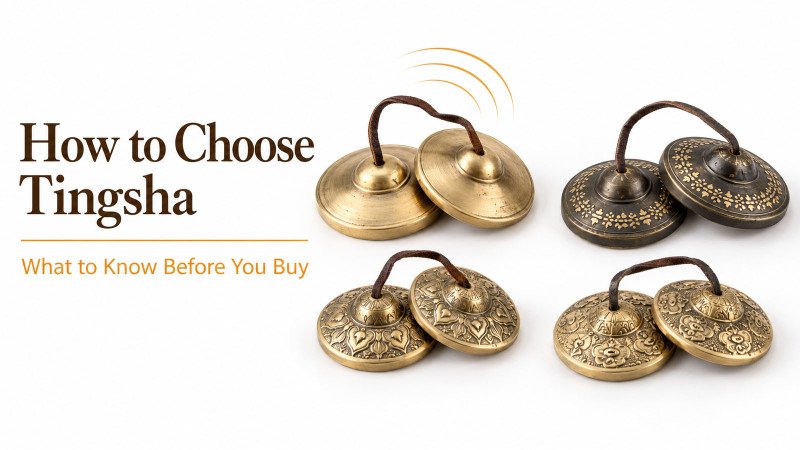
Tingsha are a pair of small, thick cymbals joined by a leather cord, used in Tibetan Buddhist practice (Wikipedia). Touched edge to edge, they give a bright, high ring that is used to open and close meditation, prayer and sound sessions.
Our Tibetan tingsha guide covers their history and meaning. This post is about buying a good pair.
What size tingsha do you need for your group?
Choose the size by how many people need to hear them. The more people and the bigger the room, the bigger and heavier the tingsha you need, because a larger pair gives a fuller ring that reaches the back of the room and lasts longer.
| How many people | Typical space | Size | Why |
|---|---|---|---|
| Just you, or one client | A bedroom, a small practice room | 2.5 inch | Gentle and bright; plenty for one or two people close by |
| A small group, up to about 10 | A living room, a small studio | 2.75 to 3 inch | A fuller ring that reaches everyone without being sharp |
| A class or sound bath, about 10 to 30 | A yoga studio | A heavy 3 inch pair | Enough volume and a long ring for the back of the room |
| A large group, 30 or more | A hall | 3.5 to 4 inch, or the heaviest pair you can find | The most volume and the longest ring; walk among people as you ring |
Small tingsha are not weak. Their high, bright ring cuts through talk, so even a 2.5 inch pair can call a busy room to attention. In a quiet sound bath, though, you want a ring that fills the space and fades slowly for everyone, and that needs a bigger, heavier pair.
For a very large group, size alone is not enough. Ring the tingsha as you walk slowly among people, or let a gong or singing bowls carry the main sound and use the tingsha to open and close.
Does the weight matter?
Yes. Weight tells you how thick the metal is, and thick tingsha ring longer and more cleanly than thin ones. A good pair feels heavy for its size when you hold it by the cord.
When buying online, look for the weight in the listing. If a seller does not give it, ask.
What metal are good tingsha made of?
Good tingsha are made of bronze, a mix of copper and tin, which gives a clear, long ring with a warm shimmer. In Nepal, makers often call their bronze seven metal.
Cheaper tingsha are often brass, a mix of copper and zinc. Brass looks similar when new, but it usually sounds harsher and fades sooner.
Hand-cast or machine-made: how can you tell?
Traditional tingsha are cast by hand in a mould, then shaped and finished. Each pair is a little different, with a thick edge, a solid weight and small marks from the making.
Machine-pressed tingsha are stamped from thin sheet metal. They look very even and shiny, feel light, and give a short, tinny ring. The table below sums up what to look for.
| A good pair | A pair to avoid | |
|---|---|---|
| Weight | Feels heavy for its size | Feels light, almost like tin |
| Edge | Thick and smooth | Thin, sharp or uneven |
| Ring | Clear and long, fading slowly | Short, harsh or clanging |
| Pair | Two close notes that shimmer | One cymbal much duller than the other |
| Buzz | None | A buzz or rattle, often a sign of a crack |
| Cord | Soft leather, knotted firmly through the centre | Thin string, glue or a loose knot |
How do you test the sound of tingsha?
If you can hold the pair, or watch a sound video of it, test it like this.
- Hold the cord in the middle and let both cymbals hang freely.
- Touch the edges together lightly, once. Tingsha are not meant to be clashed.
- Listen to the ring. It should be clear and should last well after the strike.
- Listen for the shimmer. Because the two cymbals are close in pitch but not the same, the sound gently pulses as it fades.
- Listen for a buzz. A buzz or rattle often means a crack, so choose another pair.
How to ring tingsha well, and when to use them, is in our guide on how to use tingsha.
Does the musical note matter?
Tingsha ring very high, in the top octaves of a piano, and the two cymbals of a pair sound two slightly different notes. Some sellers label a pair with a note, such as E or G sharp, and a few match pairs to the seven chakras.
Matching notes to chakras is a modern Western idea rather than part of Tibetan tradition, and there is no evidence that a note acts on a chakra. If it is part of your practice, ask the seller for the note measured on the pair you will get, and check it yourself with our free frequency analyzer.
For most people, the note matters less than the quality of the ring. Choose a pair whose sound you like, and if you play tingsha with singing bowls, a note that sits well with your bowls is a nice extra.
Should you choose plain or decorated tingsha?
Plain tingsha are chosen for sound alone. Decorated tingsha carry a raised design on the face, such as Om Mani Padme Hum, a dragon, the eight auspicious symbols, the zodiac animals or Om Namah Shivaya.
A design changes the look more than the sound, so choose one that means something to you. What the eight symbols mean is in our post on the eight auspicious symbols.
Which finish should you choose?
Most tingsha are polished bronze, bright and golden. Black bronze has a dark finish that hides fingerprints, and antique finishes are darkened to look old. The finish is about looks; the metal and the making decide the sound.
What should you check on the cord?
The cord should be soft leather, threaded through the centre hole and knotted firmly on the inside of each cymbal. Avoid thin string or glued cords, which wear through, and check that the cord is long enough to hold comfortably with both cymbals hanging free.
A pair or a single tingsha?
Most tingsha are sold as a joined pair, and the pair is what gives the shimmer. A single tingsha sits on a small stand and is struck with a wooden mallet, giving one clear note; it suits an altar or a desk.
What should you check when buying tingsha online?
- Size in inches or centimetres.
- Weight of the pair.
- Metal: bronze, and how it was made.
- A sound sample of the pair you will get, or at least of the same model.
- The cord: leather, and included.
- A clear return policy in case a pair arrives damaged.
Be careful with very cheap pairs, listings with no size or weight, and claims you cannot check.
Which tingsha suits which use?
| If you will use them for | Look at |
|---|---|
| Your own meditation at home | A 2.5 inch pair, plain or with a design you love |
| A yoga class or group of up to 30 | A heavy 3 inch pair |
| Opening and closing a sound bath | A 3 inch prime quality pair, or larger for a big room |
| Travel | A 2.5 inch pair in a soft pouch |
| An altar or a gift | An embossed pair: mantra, dragon, the eight auspicious symbols or zodiac animals |
| One clear note, struck with a mallet | A single tingsha on a stand |
Which tingsha do we make?
Our tingsha are cast in bronze by hand in Nepal and joined by a leather cord. They come in 2.5 inch pairs, mostly with raised designs, and 3 inch pairs, plain, black bronze or with zodiac animals, plus a 2.75 inch prime quality mantra pair. Before a pair ships, Sunita checks its sound.
Not sure which pair to choose?
Our plain Bronze Tibetan Tingsha is a 3 inch pair, cast by hand in Nepal and chosen for its sound, a good first pair for practice or a class.
| If you want | Look at |
|---|---|
| A plain pair, chosen for sound | Bronze Tibetan Tingsha, 3 inch |
| Our top grade, for depth of tone | Prime Quality Bronze Tingsha, 3 inch |
| A dark finish | Black Bronze Tibetan Chimes, 3 inch |
| The mantra in a middle size | Prime Quality Mantra Embossed Chimes, 2.75 inch |
| A mantra design | Mantra Embossed Tingsha, 2.5 inch |
| A dragon design | Dragon Embossed Tingsha, 2.5 inch |
| The eight auspicious symbols | Eight Auspicious Symbols Tingsha, 2.5 inch |
| Zodiac animals | Tibetan Zodiac Animal Tingsha, 3 inch |
Every pair is in Tibetan tingsha, and more about our tingsha is on our tingsha information page. To see where your pair's main tone sits, try our free frequency analyzer.
How do you look after tingsha?
Keep tingsha dry and wipe them with a soft cloth after use. Store them in a pouch so the two cymbals do not knock together, and never drop them on a hard floor, because bronze can crack.
Practice with tingsha supports relaxation and focus, and does not treat any condition.
Frequently asked questions
What size tingsha should I buy?
Choose by the number of people who need to hear them. A 2.5 inch pair is enough for yourself or one client, 2.75 to 3 inches suits a small group, and for a class or sound bath of 10 or more, choose a heavy 3 inch pair or larger.
Do bigger tingsha sound louder?
Yes, usually. A bigger, heavier pair gives a fuller ring that reaches the back of a larger room and lasts longer, while a small pair sounds brighter and softer. That is why larger groups need larger tingsha.
What are the best tingsha made of?
Good tingsha are cast from bronze, a mix of copper and tin, which gives a clear, long ring. Cheaper tingsha are often thin brass, which sounds harsher and fades sooner.
How can I tell good tingsha from cheap ones?
Good tingsha feel heavy for their size, have a thick edge, ring clearly for a long time after one light strike, and never buzz or rattle. Thin, light pairs with a short, harsh ring are usually machine-made.
Why do the two cymbals sound slightly different?
Each cymbal is made by hand, so the two are close in pitch but not the same. That small difference makes the gentle shimmer you hear as the sound fades.
Do tingsha come in different musical notes or chakra notes?
Each pair rings at its own high notes, and some sellers label pairs by note or by chakra. Matching notes to chakras is a modern idea with no evidence behind it, so choose by the quality of the ring, and ask for the measured note if it matters to you.
Do the designs change the sound?
Only a little. Raised designs change the look more than the sound, but if a pure, clean ring matters most to you, a plain pair is the safest choice.
Can I buy a single tingsha?
Yes. A single tingsha can sit on a small stand and be struck with a wooden mallet. It gives one clear note without the shimmer of a pair.
How do I look after tingsha?
Keep them dry, wipe them with a soft cloth, and store them in a pouch so they do not knock together. Never drop them on a hard floor, as bronze can crack, and a cracked tingsha buzzes.
Can I choose tingsha online?
Yes, if the seller gives the size, the weight, the metal and a sound sample of the actual pair. At Dharma Tool, Sunita checks the sound of each pair before it ships.
Ready to choose your tingsha?
See every pair, from 2.5 inch embossed designs to 3 inch plain bronze, each one checked for sound before it ships.