




Hand-Held, Table-Top or Wall-Hanging - Which Prayer Wheel to Choose
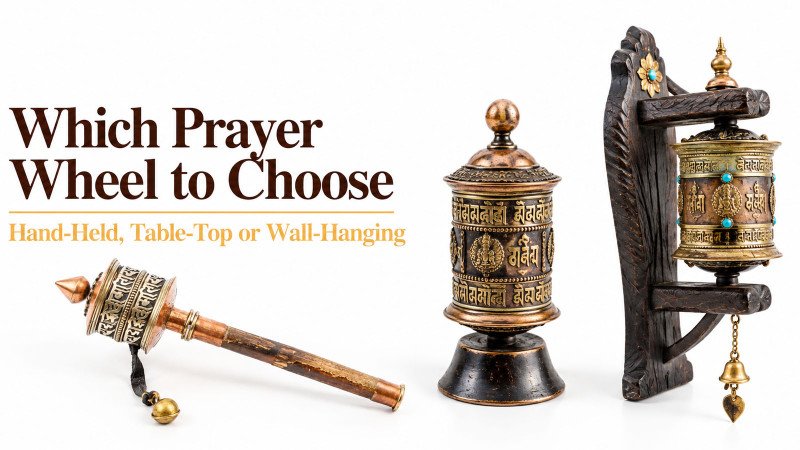
Choose a prayer wheel by where you will turn it. A hand-held wheel goes with you and suits daily practice, chanting and walking; a table-top wheel sits on a shrine, desk or shelf; and a wall-hanging wheel stays by a door or in a hallway, so you turn it as you pass. Then choose the size, the metal and the design.
Key takeaways
- Hand-held: for practice on the move; a small weight on a chain keeps it turning.
- Table-top: for a shrine or quiet corner; no technique needed.
- Wall-hanging: for a doorway or hallway, turned as you pass.
- Size: match it to the space, from 5 inch desk wheels to 14 inch shrine wheels.
- Quality: a good wheel turns smoothly, without wobble or noise.
What are the main types of prayer wheel?
A prayer wheel is a drum, usually of copper or brass, that holds a rolled scroll of mantras and turns on a central axis. For the home, it comes in three main types: hand-held, table-top and wall-hanging.
Temples and monasteries also have human-sized standing wheels and long rows of fixed wheels that pilgrims turn as they walk around, and some wheels are turned by water, wind or the heat of a lamp (Wikipedia). Electric and solar wheels turn on their own; we compare them in automatic vs handmade prayer wheels.
How do the three types compare?
| Hand-held | Table-top | Wall-hanging | |
|---|---|---|---|
| How you turn it | A small circle of the wrist | A light touch of the hand | With your hand as you pass |
| Where it lives | In your hand, then in a bag or on a stand | On a shrine, desk or shelf | On a wall, in a bracket or wooden frame |
| Our sizes | 8 to 15 inches long | About 5 to 14 inches tall | About 5 to 9 inches |
| Best for | Daily practice, chanting, walking, travel | A home shrine or a quiet corner | A doorway, hallway or entrance |
| Good to know | Has a small weight on a chain | Needs a flat, steady surface | Needs a solid wall at hand height |
What is a hand-held prayer wheel?

A hand-held prayer wheel, called mani lag-khor in Tibetan, is a drum on a short spindle set into a wooden or metal handle. A small weight on a chain hangs from the side of the drum. As you move your wrist in a small, steady circle, the weight swings out and keeps the drum turning clockwise with very little effort.
It is the wheel for practice on the move. Many people turn it while chanting Om Mani Padme Hum, while walking, or for a few minutes each morning, and it packs easily for travel.
When choosing one, hold it if you can: it should feel balanced, the drum should spin freely, and the handle should sit comfortably in your hand. A small stand lets you keep it upright on your shrine between uses.
What is a table-top prayer wheel?
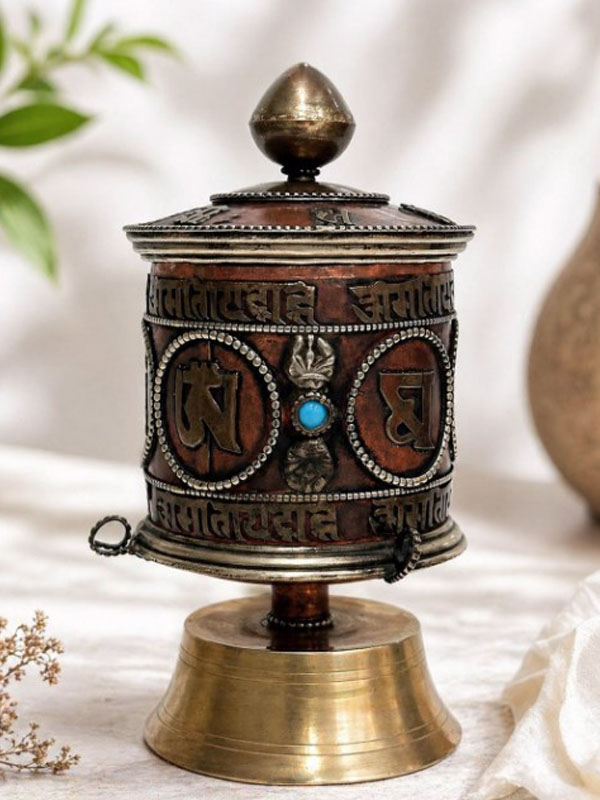
A table-top prayer wheel stands upright on its own base, so it sits on a shrine, desk, shelf or bedside table. You turn it with a light touch of the hand, and it keeps spinning for a moment on its own.
It needs no technique, which makes it a good first prayer wheel and a good gift. Small wheels of 5 to 7 inches suit a desk or a small shrine, while wheels of 8 to 14 inches become the centre of a shrine room.
Table-top wheels carry the widest range of designs: Om Mani Padme Hum in two, three or four lines, the eight auspicious symbols, turquoise and coral stones, and frames shaped like the Potala Palace gate. What the lines and stones mean is in what mantra is written on a prayer wheel.
What is a wall-hanging prayer wheel?
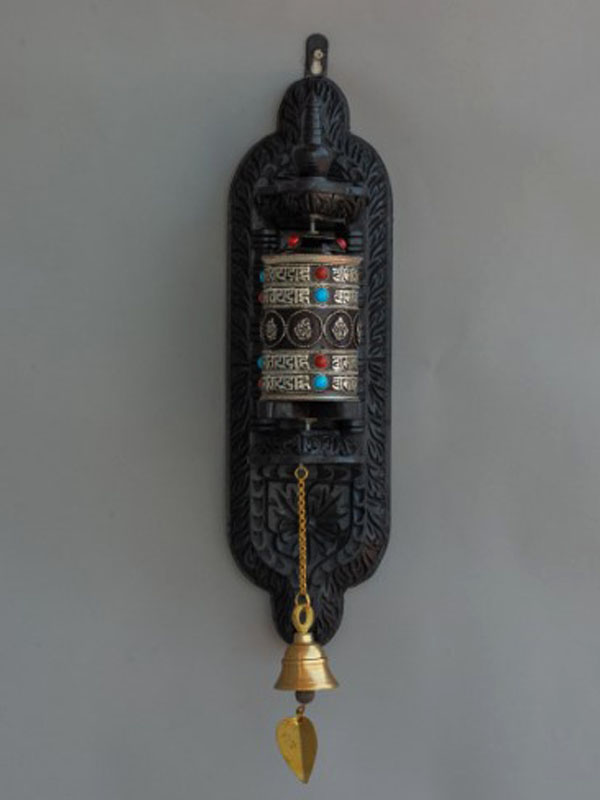
A wall-hanging prayer wheel sits in a bracket or a carved wooden frame that is fixed to the wall. It is made for a doorway, a hallway or the wall beside a shrine, so you can turn it each time you pass, the way pilgrims turn wheels as they walk around a temple.
Hang it at hand height on a solid wall, with enough space around the drum for your fingers. Check whether screws or a hook come with it; if not, use fixings that suit your wall. Some framed sets of three or five wheels can either hang on the wall or stand on a table.
Which prayer wheel should you choose?
| If you want | Choose |
|---|---|
| To turn the wheel while you chant or walk | A hand-held wheel |
| A wheel for your shrine or meditation corner | A table-top wheel |
| To turn the wheel each time you pass a door | A wall-hanging wheel |
| Something small for a desk or bedside | A 5 to 7 inch table-top wheel |
| A strong focal point for a shrine room | An 8 to 14 inch table-top wheel |
| Several wheels at once | A 3-in-1 or 5-in-1 wheel set |
| A gift that is easy to post | A small table-top or hand-held wheel |
If you are still unsure, think about when you will turn it. If it will be part of a daily practice, a hand-held wheel; if it will be part of your shrine, a table-top wheel; if you want to turn it many times a day without thinking, a wall-hanging wheel by the door.
What size prayer wheel do you need?
| Type | Size | Suits |
|---|---|---|
| Hand-held | 8 to 10 inches long | Travel and smaller hands; light to carry |
| Hand-held | 11 to 12 inches long | Everyday practice; the most common choice |
| Hand-held | 14 to 15 inches long | A fuller wheel with more presence |
| Table-top | 5 to 7 inches | A desk, shelf, bedside or small shrine |
| Table-top | 8 to 14 inches | A shrine room, studio or main altar |
| Wall-hanging | 5 to 9 inches | A doorway, hallway or beside a shrine |
Bigger wheels can hold a longer scroll with more mantras, and they make a stronger focal point. Smaller wheels are lighter, easier to fit into a busy room and easier to post as a gift.
What should you look for in metal and design?
Most prayer wheels have a copper drum with brass lettering and trim, which gives the familiar red-gold look. Some have a silver-tone finish, and some are set with turquoise, coral or lapis stones.
For the design, choose between the mantra, usually Om Mani Padme Hum in one or more lines, and symbols such as the eight auspicious symbols. Both are traditional; it is a matter of meaning and taste.
What is inside a prayer wheel?
Inside the drum is a tightly rolled paper scroll printed with mantras, most often Om Mani Padme Hum, wound around a central axis. Turning the wheel clockwise is traditionally held to be like reciting every mantra on the scroll, which is why larger scrolls are valued.
A good prayer wheel is sealed, so the scroll stays clean and dry. The full story of what is written inside, and how the scroll is wound, is in what mantra is written on a prayer wheel.
How can you tell a well-made prayer wheel?
- Smooth turning: the drum spins freely and quietly, without catching.
- No wobble: the drum sits straight on its axis.
- Clean lettering: the mantra is crisp and evenly spaced.
- Firm joins: the handle, base or frame does not rock.
- A scroll inside: ask the seller if it is not stated.
How do you turn and place a prayer wheel?
Always turn a prayer wheel clockwise, gently and steadily; why the direction matters is in prayer wheel direction. Keep it off the floor, on a shrine, a shelf or a wall, and where to put one at home is covered in the benefits of prayer wheels.
To care for it, dust it with a soft, dry cloth and keep it away from water, which can damage the scroll. Practice with a prayer wheel supports relaxation and focus, and does not treat any condition.
Which prayer wheels do we make?
Our prayer wheels are handmade in Nepal, mostly in copper and brass. We make hand-held prayer wheels from 8 to 15 inches, and table-top and wall-hanging prayer wheels from about 5 to 14 inches, including multi-wheel sets that can stand or hang. Hand-held wheels can come with an optional stand.
Not sure where to start?
Our 11-inch hand-held prayer wheel has a copper drum engraved with Om Mani Padme Hum, a wooden handle and a mantra scroll inside, a good first wheel for daily practice.
| If you want | Look at |
|---|---|
| A light hand-held wheel | 8-Inch Handheld Tibetan Mantra Prayer Wheel, hand-held |
| An everyday hand-held wheel | 11-Inch Handheld Prayer Wheel with Wooden Handle, hand-held |
| A larger hand-held wheel | 15-Inch Handheld Brass Engraved Prayer Wheel, hand-held |
| A small wheel for a desk or shelf | 6 Inch Table Top Prayer Wheel, 4-Line Om Mani, table-top |
| A large wheel for a shrine room | 14 Inch Tabletop Prayer Wheel, Eight Auspicious Symbols, table-top |
| A wheel for a doorway | 8-Inch Wall Hanging Prayer Wheel, Om Mani Padme Hum, wall-hanging |
| Five wheels in one frame | 5-in-1 Tibetan Prayer Wheel, stands or hangs |
Every wheel is in Tibetan prayer wheels. To learn how a prayer wheel works, read prayer wheel meaning.
Frequently asked questions
What are the types of prayer wheels?
For the home, there are three main types: the hand-held prayer wheel, the table-top prayer wheel and the wall-hanging prayer wheel. Temples and monasteries also have large standing wheels and long rows of fixed wheels, and some wheels are turned by water, wind, heat or a small motor.
Which prayer wheel is best for home?
It depends on where you will turn it. A table-top wheel suits a shrine, desk or shelf, a wall-hanging wheel suits a doorway or hallway, and a hand-held wheel suits daily practice and walking.
Is a hand-held or table-top prayer wheel better for beginners?
Both are easy to use. A table-top wheel needs no technique at all, while a hand-held wheel takes a minute to learn: a small, steady circle of the wrist keeps it turning.
How do you use a hand-held prayer wheel?
Hold the handle upright and move your wrist in a small, gentle circle. The little weight on the chain swings out and keeps the drum turning clockwise without much effort.
Can a table-top prayer wheel hang on a wall?
Most table-top wheels sit on their own base and are made to stand. Some framed and multi-wheel sets can either stand or hang, so check the listing before you buy.
What size prayer wheel should I buy?
For a desk, shelf or small shrine, 5 to 7 inches is enough. For a shrine room or studio, choose 8 to 14 inches, and for a hand-held wheel, 10 to 12 inches suits most people.
What is inside a prayer wheel?
A tightly rolled paper scroll printed with mantras, most often Om Mani Padme Hum, wound around a central axis. Larger wheels can hold a longer scroll with more mantras.
Which way should a prayer wheel turn?
Clockwise, so the mantras pass in the order they are written. It is the same direction pilgrims walk around a stupa or temple.
Are electric prayer wheels the same as hand-turned ones?
They hold the same kind of mantra scroll, but they are turned by a small motor instead of by hand. Many people prefer a hand-turned wheel because turning it is part of the practice.
Ready to choose your prayer wheel?
Hand-held, table-top or wall-hanging, every wheel is handmade in Nepal with a mantra scroll inside.