



Sound Healing Instruments - What a Sound Healer Needs for One-to-One, Group and Online Sessions
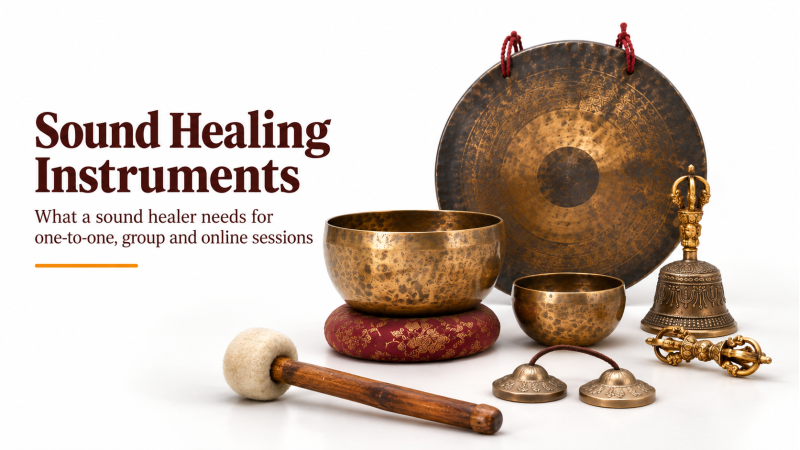
The core sound healing instruments are singing bowls, gongs, tingsha and a bell, with chimes, drums, tuning forks and the voice adding colour. What you need depends on the session: one bowl is enough at home, three to five bowls and a tingsha suit one-to-one work, and a group sound bath usually adds a gong. Sound healing supports relaxation and focus, and does not treat any condition.
Key takeaways
- Singing bowls are the heart of almost every kit, from home practice to retreats.
- Gongs and tingsha come next: a gong for groups and bigger rooms, tingsha and bells to open and close.
- Build slowly: one good bowl first, then add instruments as your sessions grow.
- Online sessions need a microphone and the right app setting more than a bigger kit.
What instruments are used in sound healing?
Most sound healing sessions are built on a small group of instruments: singing bowls, gongs, tingsha, bells, chimes, tuning forks and crystal bowls, often with the healer's own voice (Cleveland Clinic). You don't need all of them. Each one has a job, and the right kit depends on how and where you work.
| Instrument | Its job in a session | Best for |
|---|---|---|
| Singing bowls | Carry the session with long, layered tones you can also feel as vibration | Every kind of session |
| Gong | Fills the room with a wide wash of sound that deepens rest | Groups and bigger rooms |
| Tingsha | A bright, clear ring that marks the start, the changes and the end | Opening and closing |
| Bell and dorje | A ritual pair for setting an intention; the bell can also be circled to sing | Opening and closing |
| Chimes, drums and rattles | Movement and texture between longer tones | Groups and sound journeys |
| Tuning forks | One exact pitch, held near the ears or placed on the body | One-to-one work |
| Crystal bowls | A pure, strong, single tone | Groups and studios |
| Voice | Humming, toning and mantra, alone or with a bowl | Every kind of session |
In Sunita's own sessions, singing bowls do most of the work and the other instruments come in for a moment each. That is a good rule for building a kit too: buy for the job, not for the collection.
Singing bowls: the heart of most kits
A singing bowl can be struck for a long, fading tone or circled with a mallet so it sings continuously. Larger bowls can also be placed on or near the clothed body, so the person feels the vibration as well as hears it. That range is why Tibetan singing bowls sit at the centre of most sound healing kits.
There are two kinds of bowl. Hand-hammered singing bowls are shaped by hammer blows and usually give a more layered sound with a longer fade, while hand-cast bowls are poured into a mould and give a clearer, simpler tone that makes a good first or gift bowl.

Size changes the sound and the use:
- Small bowls, under about 5 inches, are bright and quick, and good for opening a session or working near the head.
- Medium bowls, about 5 to 8 inches, are the everyday working range for most healers.
- Large bowls, 9 inches and up, give a deep tone and strong vibration for the body and for groups.
- Standing bowls, 15 inches and larger, are big enough to stand in, and suit studios and retreats. See our large standing singing bowls.
Healers who work with chakras or play for groups often use a set. Our chakra singing bowl sets come in sets of 3, 5, 7, 9 and 12, and you can request your own combination with the singing bowl set builder.
Gongs: for groups and bigger rooms
Of all the sound bath instruments, a gong is the one that fills a room with a wide wash of sound no bowl can match. In a group sound bath it is often used in the middle of the session, when people have settled and are ready to rest more deeply.
Our Tibetan gongs are made in Nepal from a seven-metal alloy by traditional forging, as plain chau gongs or carved and etched temple gongs. Each comes with a mallet, the size is chosen on the listing, and Sunita checks the sound before it is sent. You can also design your own with the custom gong builder, and our gong size guide helps you match a gong to your room.

A gong is loud close up. Start softly, keep it well away from people's heads, and build the sound slowly.
Tingsha and bell and dorje: opening and closing
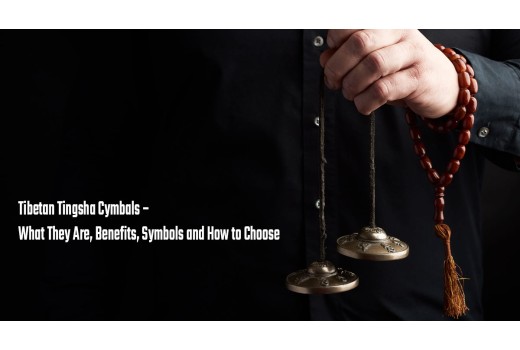
Tibetan tingsha are a pair of small cymbals joined by a leather strap. Their bright, clear ring cuts through a room, so healers use them to open a session, mark a change and bring people gently back at the end.

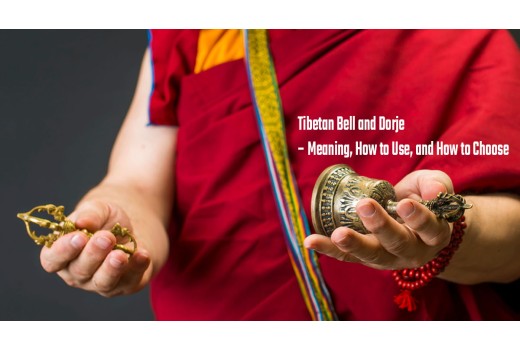
A Tibetan bell and dorje is a ritual pair from Himalayan Buddhist practice. The bell can be rung, or circled around the rim with a wooden stick so it sings like a bowl, and many healers use it to set an intention at the start.

Chimes, drums and other texture instruments
Chimes, an ocean drum, a frame drum, rattles and a rainstick add movement between longer bowl and gong sections. They are most common in group sound baths and sound journeys, where a change of texture helps people stay with the sound. Some healers also use a shruti box, a monochord or a handpan for a steady drone or a soft melody.
Use them sparingly, because a few well-placed sounds work better than a constant stream. Our hanging singing bowl chime is a gentle middle ground: three hand-hammered bowls on one cord that ring one after another, and it can hang in the room between sessions.
Tuning forks and crystal bowls
Tuning forks give one exact pitch. Weighted forks are placed on the body so the vibration is felt, while unweighted forks are held near the ears, which makes them useful in quiet one-to-one work.
Crystal bowls are made from quartz and give a pure, strong, single tone, but they are fragile and less suited to being placed on the body. Metal bowls give many layered tones at once, and we compare the two in metal vs crystal singing bowls.
Many healers use both alongside metal bowls. We make and select metal instruments from Nepal, so our kit advice starts there.
The voice: the instrument everyone has
Humming, toning and chanting a mantra with a bowl are some of the simplest and most personal sounds in a session. Many healers hum softly along with a bowl's tone, which can encourage the person on the mat to slow their breathing too.
You don't need a trained voice. Our Singing Bowl Healing Course includes a lesson on using mantra and voice with a bowl.
Sound healing instruments and kits by session type
The right kit depends on who you play for and where. This is how we would build one for each kind of session:
| Session | Start with | Add when ready |
|---|---|---|
| Home practice | One hand-hammered bowl of about 5 to 7 inches, a mallet and a ring cushion | A tingsha |
| One-to-one session | Three to five bowls, including one large bowl, plus a tingsha or a bell and dorje | A small gong |
| Group sound bath | A chakra set or five to seven bowls, one gong and a tingsha | Chimes or an ocean drum |
| Retreat or studio | One or two large standing bowls, a bowl set and one or two gongs | A hanging bowl chime for the room |
| Online session | One to three bowls, a tingsha and an external microphone | A small gong, played softly |
For one-to-one work, choose one large bowl that can rest on the body. For groups, place the louder instruments further from people's heads and keep the bowls close to the centre of the room.
Sound healing instruments for online sessions
Video calls are built for speech, so their noise suppression often mistakes a long bowl tone for background noise and cuts it short. In Zoom, turn on "Original sound for musicians" in the audio settings (University of Michigan guide), and check whether your platform has a similar music mode.
An external microphone placed about an arm's length from the bowls picks up far more of the tone than a laptop microphone. Play more softly than you would in a room, because hard strikes and large gongs can distort.
Bowls and tingsha usually carry best online. Ask people to use headphones or good speakers at a comfortable volume.
Mallets, cushions and bags
Mallets and cushions are easy to forget on a list of sound healing equipment, but they change the sound more than most people expect. A felt mallet gives a soft strike, a wooden or suede-wrapped mallet helps a bowl sing when circled, and a gong needs its own soft beater.
A ring cushion lets a bowl ring freely instead of being muffled by the floor, and a padded bag protects bowls and gongs when you travel to clients. You will find these in our singing bowl accessories.

How do healers choose an instrument?
When you choose instruments for sound healing, play each one the way you will use it, struck and circled. Notice how easily it sings, how long the tone lasts and how it sits next to the bowls you already own.
The note of a hand-hammered bowl is found, not made, because a smith cannot hammer towards an exact note. A set is put together by choosing bowls whose notes sit well together.
If you buy online, choose a seller who plays each piece before it is sent. Sunita plays and selects every bowl, gong, tingsha and bell for each order before it leaves Kathmandu, usually within 3 to 4 business days.
What to buy first, and what to skip
- One good bowl: a hand-hammered bowl of about 5 to 7 inches, with a mallet and a ring cushion.
- A tingsha: to open and close your sessions.
- Two more bowls: a small and a large bowl, so you have a working set of three.
- A gong: once you start leading groups or working in a bigger room.
- Texture instruments: chimes or a drum last, when you know where they fit.
Skip buying every sound healing tool at once, before you know how you like to work. Our beginner sound healer guide covers what else to know in your first year.
Build your sound healing kit
Every Dharma Tool singing bowl, gong, tingsha and bell is made in Nepal, and played and checked by a sound healer before it leaves Kathmandu.
| If you want | Look at |
|---|---|
| Bowls for sound healing | Tibetan singing bowls |
| Hand-hammered bowls | Hand-hammered singing bowls |
| A matched set of bowls | Chakra singing bowl sets |
| A gong for group sessions | Tibetan gongs |
| Opening and closing sounds | Tibetan tingsha |
| Mallets, cushions and bags | Singing bowl accessories |
Frequently asked questions
What instruments are used in sound healing?
The most common are singing bowls, gongs, tingsha, bells, chimes, tuning forks, crystal bowls and the voice. Most healers build their work on singing bowls and add the others for particular jobs, such as a gong for groups or a tingsha to open and close.
What is the best sound healing instrument for a beginner?
One good hand-hammered singing bowl of about 5 to 7 inches, with a mallet and a ring cushion. It is easy to play, works in any room and teaches you most of what you need before you add more.
Do I need a gong for sound healing?
Not to start. A gong is most useful once you lead groups or work in a large room, because it fills the space in a way a bowl cannot.
How many singing bowls does a sound healer need?
One bowl is enough for home practice. Three to five bowls cover most one-to-one sessions, and five to seven bowls or a chakra set suit group sound baths.
Are crystal bowls or metal singing bowls better for sound healing?
Neither is better for everyone. Crystal bowls give a pure, strong single tone, while metal bowls give many layered tones at once and can be placed on or near the body.
What do tingsha do in a sound healing session?
Tingsha are a pair of small cymbals joined by a strap. Their bright ring is used to open a session, mark a change and bring people gently back at the end.
Which instruments work best for an online sound bath?
Singing bowls and tingsha carry well online, while large gongs can distort through a microphone. Use an external microphone and turn on your video app's music setting so the long tones are not cut off.
What is in a sound healing kit?
A starter kit is one bowl, a mallet and a cushion. A working kit for clients adds more bowls, a tingsha or bell, and later a gong and a few texture instruments such as chimes.
Does sound healing really work?
Many people find it deeply relaxing, and early studies on singing bowls are encouraging but small. Sound healing supports relaxation and focus, and does not treat any condition.
Learn to use your instruments with Sunita
Learn how to play singing bowls, use your voice and lead a simple session, at your own pace.