




Thadobati Singing Bowl - Shape, Sound and What It Is Used For
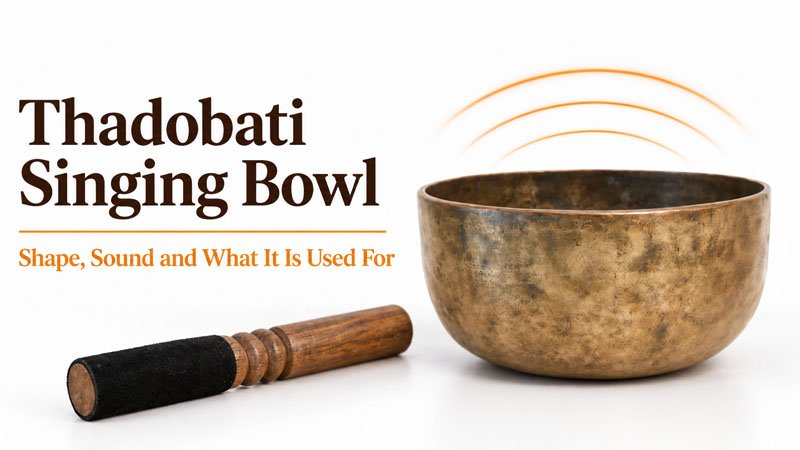
A Thadobati is the antique singing bowl with straight, upright walls and a flat base almost as wide as its rim. It gives a clear, bright, focused tone and sits steady on its own, which makes it a favourite for daily meditation, hand-held playing and chakra sets.
Key takeaways
- Know it by its walls: straight and upright, with little or no curve.
- Flat base: almost as wide as the rim, so it does not rock.
- Clear and bright: a focused tone, with higher notes in small sizes.
- Used for: daily meditation, hand-held playing and chakra sets.
What is a Thadobati singing bowl?
Thadobati is one of the traditional antique forms, grouped by shape like the Jambati and the Lingam. In Nepali, thado means upright, a name that describes its straight walls.
We do not put a date on any bowl. Age cannot be proved from patina or wear, as our guide on how to spot a fake antique singing bowl explains.
How do you recognise a Thadobati?
| Feature | What to look for |
|---|---|
| Walls | Straight and upright, with little or no curve |
| Base | Flat, almost as wide as the rim |
| Corner | A short, rounded turn from the wall to the base |
| Lip | Plain and cut straight; heavier bowls can have a thicker lip |
| Collar | On many, a ring of small punched marks below the rim |
| Size | Usually small to medium; ours run from 3 to 6.5 inches |
Set it on a table. If the walls rise straight up from a wide flat base and the bowl does not rock, you are looking at a Thadobati.
How does a Thadobati sound?
- Clear: a clean, focused note.
- Bright: small bowls give higher notes, larger ones a warmer tone.
- Easy to play: the straight wall answers well to the mallet and rims steadily.
Every Thadobati has its own note, set by its size and wall. Find the note of yours with our free live singing bowl tuner.
How is a Thadobati different from a Jambati?
| Feature | Thadobati | Jambati |
|---|---|---|
| Walls | Straight and upright | Deep and full, rounding to the base |
| Base | Flat, almost as wide as the rim | Small, flat or rounded |
| Lip | Plain, cut straight | Thick, sloping inward |
| Size | Usually small to medium | Usually 8 inches and over |
| Sound | Clear, bright and focused | Deep, with a long sustain |
Read more in our Jambati singing bowl guide, and see the raised centre of another form in what a Lingam singing bowl is.
Looking for a Thadobati?
Choose an old collected Thadobati, or the small Thadobati cup in 3 to 5 inches. Sunita chooses yours from the collection after your order arrives.
What is a Thadobati used for?
- Daily meditation: a clear note that is easy to start and stop.
- Hand-held playing: a small one sits steady on a flat palm.
- Chakra sets: see our antique Thadobati 7 chakra set, matched by selection.
- Opening and closing a session: one bright strike for yoga or Reiki.
A Thadobati supports relaxation and does not treat any condition.
How do you play a Thadobati?
- Rest it flat on a palm, your fingertips or a cushion, without touching the walls.
- Strike the upper wall with a wooden or padded mallet.
- Rim with steady pressure: the straight wall keeps the mallet on track.
- Match the mallet: a small bowl needs a small, light mallet.
For the basics of striking and rimming, read how to play a singing bowl in our free course.
Old or new: which Thadobati?
- Old collected: chosen from our collection, each with its own tone and patina.
- New hand-cast: the same shape made new, as our 4 inch Thadobati, in several finishes.
Compare the two in new handmade vs antique singing bowls. For small bowls of every kind, see our palm size singing bowl guide.
How is your Thadobati chosen?
Our antique bowls are listed by form, not as one numbered piece. We keep a collection of old Thadobati bowls, and after your order arrives Sunita chooses one from her experience in practice.
Each one is unique in tone, patina and marks, so yours will differ a little from the photos. Dispatch is from Kathmandu in 3–4 business days by DHL Express.
Want a set in your own tradition? Build it in our set builder, or see all chakra singing bowl sets.
Frequently asked questions
What is a Thadobati singing bowl?
It is an antique singing bowl form with straight, upright walls and a flat base almost as wide as its rim.
What does Thadobati mean?
Thado means upright in Nepali, which describes the straight walls that give the bowl its name.
What is the difference between a Thadobati and a Jambati?
A Thadobati has straight walls and a wide flat base, and is usually small to medium. A Jambati is deep and wide open, with a thick lip that slopes inward and walls that round down to a small base.
What does a Thadobati sound like?
Clear, bright and focused. Small Thadobati bowls give higher notes, and the straight wall keeps the mallet steady when rimming.
Is a Thadobati good for beginners?
Yes. Its flat base sits steady and its straight wall is easy to rim, so it is one of the easiest antique forms to play.
Can I hold a Thadobati in my hand?
Yes. A small one sits well on a flat palm or on your fingertips. Keep your fingers off the walls so the bowl can ring.
How old is a Thadobati singing bowl?
We do not put a date on any bowl, because age cannot be proved from patina or wear. Thadobati is a traditional form, and we choose each bowl for its sound.
See all our antique forms
Thadobati, Jambati, Manipuri, Lingam and more, each chosen by Sunita for its sound.