



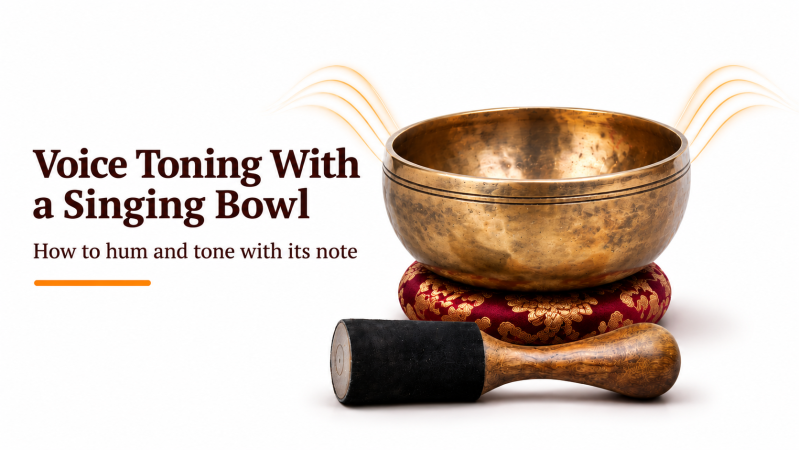
Voice Toning With a Singing Bowl - How to Hum and Tone With Its Note
Voice toning means making a long, steady sound with your voice, usually a hum or an open vowel such as "ah" or "oo", without words or a tune. With a singing bowl, you strike the bowl, let its tone settle, then hum or tone softly along with it so your voice and the bowl ring together. It supports relaxation and focus, and does not treat any condition.
Key takeaways
- Toning is a long, steady hum or vowel, with no words and no melody.
- Humming first: it is the simplest way to start and the easiest to keep soft.
- With a bowl: strike, let the tone settle, then tone along; an octave lower is fine.
- Keep it gentle: a soft voice for a few minutes works better than a loud one for longer.
What is voice toning?
Voice toning is making a long, steady sound with your voice, a hum or a vowel, held for a full breath out. There are no words, no tune and no right or wrong voice.
The word became popular through Laurel Elizabeth Keyes, whose 1973 book Toning described using the voice in this way (Wikipedia). Today toning is used in meditation, yoga and sound healing, often together with a singing bowl.
Toning is not the same as chanting a mantra, and it is not the same as Voo breathing. This table shows how the voice practices on our blog differ:
| Practice | The sound you make | Words or syllables? | Where to read more |
|---|---|---|---|
| Humming | A soft "mmm" with the lips closed | No | This guide |
| Vowel toning | Open sounds such as "ah", "oo", "oh" and "ee" | No | This guide |
| Voo breathing | One low "voo" sound on a long breath out | No | Voo breathing with a singing bowl |
| Bija mantras | Seed syllables such as LAM, VAM and RAM | Yes | Bija mantras with a singing bowl |
Why start with humming?
Humming is the gentlest toning sound: lips closed, jaw soft, and the sound felt in the face and chest. It is easy to keep quiet, so you can practise at home without disturbing anyone.
In a small study of 10 healthy men, humming raised nitric oxide in the nose about 15 times compared with breathing out quietly (Weitzberg and Lundberg, 2002). The researchers said what this means for health still needs testing.
Yoga has its own humming breath, bhramari or "bee breath", where you hum on a long breath out. A small 2023 study found humming gave the lowest stress score of the activities it measured (Cureus, 2023), but a review of earlier bhramari studies rated their quality as very low (Kuppusamy and colleagues, 2017).
Much of what is called hum healing rests on small studies like these. It is best seen as a calming practice, not as medicine.
How do you tone with a singing bowl?
- Settle: sit comfortably with the bowl on a cushion in front of you and let your shoulders drop.
- Strike: strike the bowl gently once and wait until the first bright ring softens.
- Hum: breathe in through your nose, then hum softly on the breath out, under the bowl's tone.
- Open the sound: when the hum feels easy, let it open into a vowel, from "mmm" to "ah" or "oo".
- Pause: let the breath run out, rest, and strike again only when the bowl has faded.
- Finish: after 5 to 10 minutes, sit in silence for a minute before you get up.
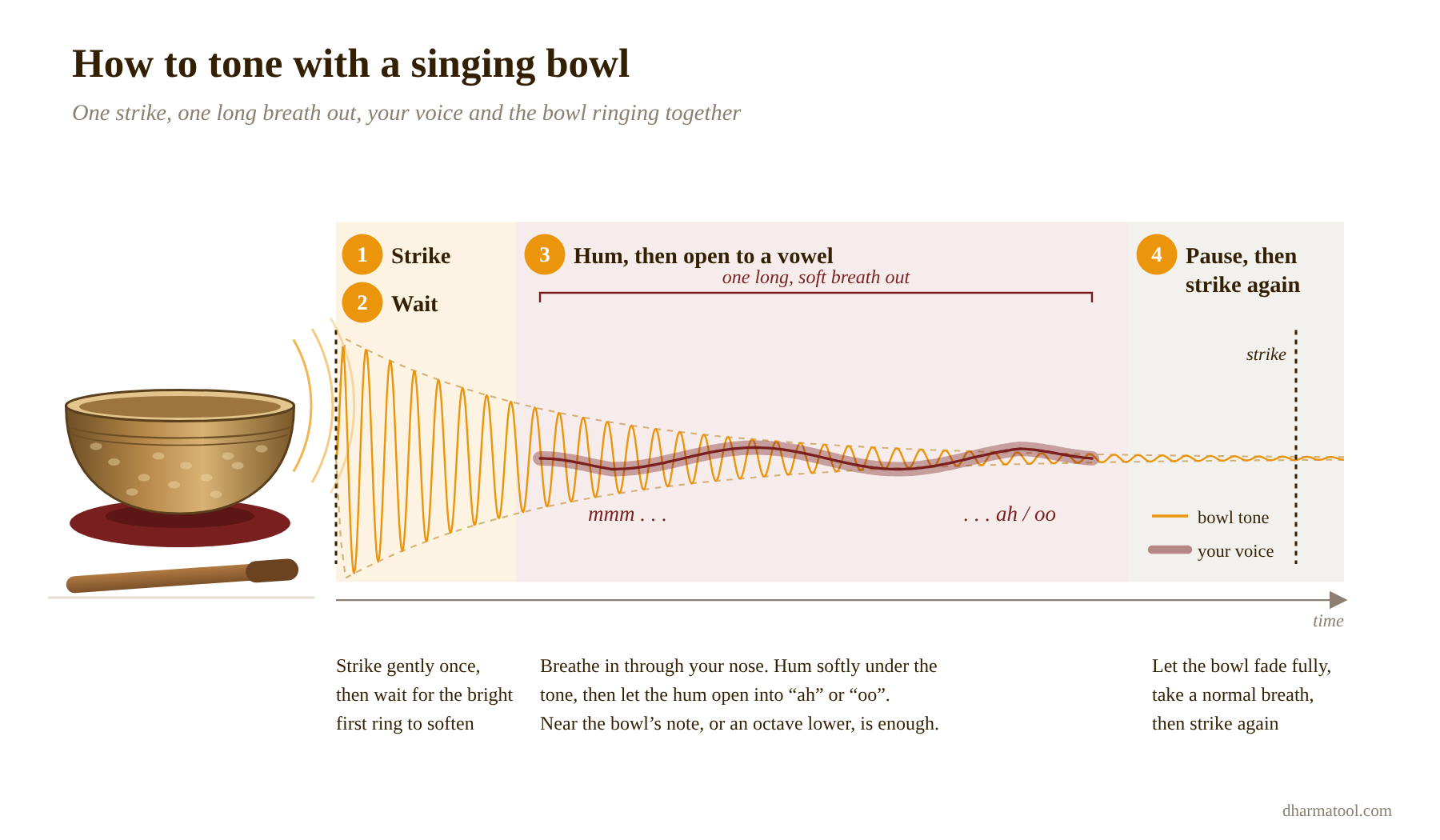
You don't need to match the bowl's note exactly. Humming near it, or an octave lower, still blends well, and our bija mantras guide shows how to find the bowl's pitch with your voice if you want to.
Our free singing bowl tuner shows which note your bowl plays. You can also use our meditation with a singing bowl guide to make toning part of a longer sitting.
Which vowels should you use?
Each vowel feels different in the body. Many people feel a deep "oo" or "oh" lower in the chest, "ah" around the heart and a bright "ee" higher in the head.
Try each vowel on one breath and notice where you feel it. Then stay with the one that feels easiest for most of your practice.
Some modern teachers link a vowel to each chakra, from a deep "uh" at the root to a high "ee" at the crown, though the systems differ between teachers. If you work with the chakras, our chakra singing bowl sets let you tone with a different bowl for each.
Which singing bowl is easiest to tone with?
A bowl with a lower note and a long fade is easiest to tone with. A high, bright bowl is harder to hum along with, and a short fade does not leave time for a full breath.
Medium and large hand-hammered singing bowls usually give that deeper, longer sound. For a bowl chosen for calm, see our Calm Mind singing bowls, and for daily sitting, our singing bowls for meditation.
Sunita plays and selects each bowl for each order before it leaves Kathmandu. If you mention in the order note that you want a bowl for toning, she can choose one with a longer fade.
What are the common mistakes?
- Pushing for volume: a soft hum blends with a bowl far better than a loud one.
- Chasing the exact note: near the note, or an octave lower, is enough.
- Striking again too soon: let the bowl fade fully before the next strike.
- Holding the breath out too long: take a normal breath or two between tones.
- A tight jaw or raised shoulders: relax first, then tone.
A few minutes of soft humming with a bowl can also be a gentle way to wind down at night. Our guide to singing bowl sound before sleeping shows how to build it into an evening routine.
When should you keep it gentle?
Toning should never strain your throat, so keep your voice soft and never push for volume. If you feel light-headed, stop and breathe normally for a few breaths.
If you have a voice or throat problem, a breathing condition or are recovering from illness, check with your doctor before long toning sessions. Our guide to sound healing contraindications covers who else should take care.
Our Singing Bowl Healing Course includes a lesson on mantra and voice with a bowl, if you want to go further.
Find a bowl to tone with
Every Dharma Tool singing bowl is made in Nepal, and played and checked by a sound healer before it leaves Kathmandu.
| If you want | Look at |
|---|---|
| A bowl to tone with | Hand-hammered singing bowls |
| A bowl for calm | Calm Mind singing bowls |
| A bowl for meditation | Singing bowls for meditation |
| A bowl for each chakra | Chakra singing bowl sets |
| To find your bowl's note | Free singing bowl tuner |
Frequently asked questions
What is voice toning?
Voice toning is making a long, steady sound with your voice, usually a hum or an open vowel, held for a full breath out. There are no words or tune, and there is no right or wrong voice.
Is humming the same as toning?
Humming is one kind of toning, with the lips closed. Vowel toning opens the same sound into "ah", "oo" or "ee".
Do I need to sing in tune to tone with a singing bowl?
No. You can hum near the bowl's note or an octave lower, and the sound will still blend. If you want to match it closely, a tuner shows the bowl's note.
What sound should I make when toning?
Start with a soft hum. When it feels easy, open it into a vowel such as "ah" or "oo", and notice where you feel the sound in your body.
How long should I tone for?
Five to ten minutes is plenty for a home practice. Keep your voice soft and stop if your throat feels tired or you feel light-headed.
What is the difference between toning and chanting a mantra?
Toning uses open sound with no words or syllables. A mantra uses set syllables with meaning, such as the seed sounds of the chakras.
Which singing bowl is best for toning?
A bowl with a lower note and a long fade is easiest, because it gives you time for a full breath. Medium and large hand-hammered bowls usually suit toning well.
Does voice toning really work?
Many people find humming and toning calming, and small studies on humming are encouraging but early. Toning with a singing bowl supports relaxation and focus, and does not treat any condition.
Learn mantra and voice with Sunita
Learn to play a singing bowl, use your voice with it and build a simple daily practice, at your own pace.